

The cheapest managed IT contract you sign today might actually be the most expensive mistake your business makes this year. It’s a frustrating reality for many executives who find themselves trapped in a cycle of hidden fees and “nickel-and-diming” while still worrying about silent cybersecurity gaps. Understanding the true cost of managed it services isn’t just about comparing line items on a spreadsheet; it’s about identifying where your investment builds resilience and where it merely patches holes. You’ve likely felt the anxiety of paying for support only to realize your team is still struggling with downtime or compliance hurdles.
We agree that your technology budget should be a predictable driver of growth, not a source of monthly anxiety. While research shows most mid-sized enterprises spend between 3% and 6% of their revenue on IT, the real value lies in how those dollars are strategically allocated. This guide unlocks a transparent breakdown of modern pricing models and the strategic ROI of enterprise-grade management. We’ll preview the critical cost drivers you need to watch for, how to compare service tiers without the headache, and why integrated cybersecurity is now the mandatory standard for businesses aiming for total peace of mind.
Key Takeaways
- Understand why the per-user pricing model is the gold standard for creating a predictable, scalable budget for your remote or hybrid team.
- Identify the critical variables that influence the cost of managed it services, from basic support to 24/7 SOC monitoring.
- Recognize the “Reactive Trap” where cheap, break-fix support leads to expensive downtime and unmitigated security risks.
- Learn how to leverage vCIO services and cloud optimization to reduce waste and maximize the ROI of your technology stack.
- Transition from unpredictable capital expenditures to a stable operating model that prioritizes compliance and long-term business resilience.
Understanding Managed IT Service Pricing Models
Choosing a pricing model is the first step in stabilizing your technology budget. It defines the relationship between your business and your provider. Unlike the old “break-fix” model where providers profit when you suffer downtime, managed IT services create a partnership focused on uptime. To understand how these structures work, it’s helpful to look at Wikipedia’s definition of Managed Services, which emphasizes the proactive outsourcing of management responsibilities to improve operations. This shift from reactive to proactive is the foundation of modern business resilience.
To better understand the logic behind these different structures, watch this helpful video:
Per-User vs. Per-Device: Which Fits Your Business?
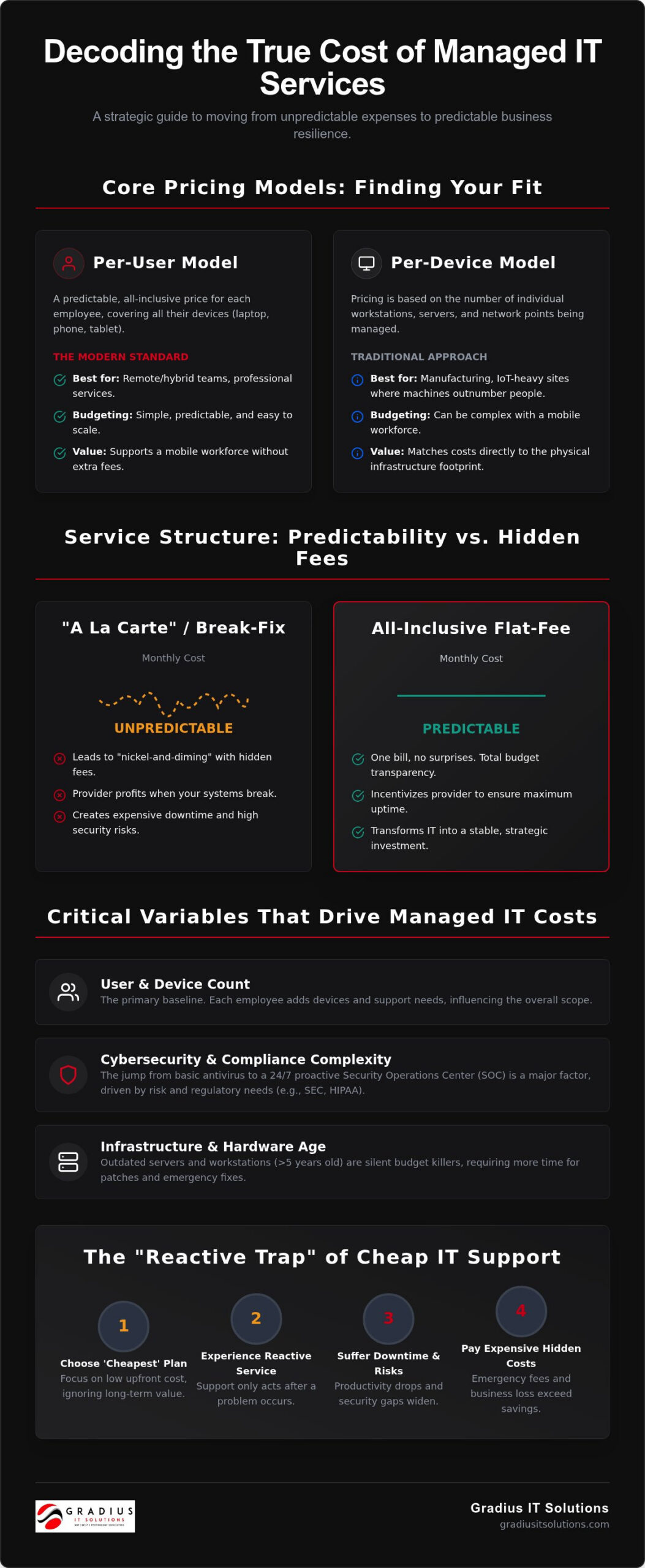
The per-user model is the 2026 industry standard for modern offices. It’s simple: you pay for each employee. This covers their laptop, phone, and tablet without extra fees. It supports a mobile workforce and makes scaling easy. If you hire five people, you know exactly how your costs change. It’s clean. It’s predictable. It’s the preferred choice for professional services in New York and New Jersey.
The per-device model is different. It focuses on the number of workstations, servers, and network points. This works well for manufacturing plants or IoT-heavy environments where machines outnumber people. Some firms use a hybrid model to cover complex server rooms while keeping user support simple. The goal is to match the model to your actual infrastructure footprint, not just a generic template.
Flat-Fee vs. A La Carte Services
The cost of managed it services can become a moving target if you choose a la carte options. These “pay-as-you-go” models often lead to hidden fees. You might get a low base rate, but every phone call or password reset triggers a new charge. This “nickel-and-diming” makes it impossible to predict your monthly spend. It creates a conflict of interest: the provider makes more money when things break.
A flat-fee model is the ultimate tool for executive budget predictability. You pay one monthly price for comprehensive support. It shifts the risk to the provider: they’re incentivized to keep your system running perfectly so they don’t have to spend extra hours fixing it. A high-value flat-fee agreement should include:
- 24/7 security monitoring and SOC support.
- Microsoft 365 license management and optimization.
- Unlimited remote and on-site helpdesk support.
- Proactive maintenance and security patching.
- Strategic planning and vCIO consulting.
This approach transforms IT from a fluctuating expense into a fixed utility. It allows you to focus on growth while we handle the complexity. You get total transparency: one bill, no surprises.
Critical Variables That Drive Managed IT Costs
Not all IT environments are created equal. A firm with 20 users and a single server has a different risk profile than a 50-person financial agency under SEC oversight. The cost of managed it services shifts based on these specific operational variables. It’s about matching the level of defense to the weight of your risk. While user count is the baseline, the complexity of your stack acts as the multiplier.
User count remains the primary starting point because each employee brings a unique set of devices and support needs. However, a remote workforce using personal devices requires more advanced endpoint protection and identity management than a localized office. These security layers are necessary to maintain a Zero Trust environment. This ensures that only authorized users access your critical data, regardless of their location. For those looking to secure a distributed team, it is helpful to explore Remote IT Support options that prioritize endpoint visibility and protection. The jump from basic antivirus to a Security Operations Center (SOC) is another major factor. Basic tools are reactive; they catch known threats. A 24/7 SOC is proactive. It uses human experts to hunt for anomalies before they become breaches.
Outdated hardware is a silent budget killer. If your servers or workstations are over five years old, your provider spends more time on patches and emergency fixes. This increased labor often reflects in higher monthly maintenance fees. Modernizing your technology stack isn’t just about speed. It’s a deliberate cost-containment strategy. If you’re curious about how your current setup compares to industry standards, a quick technology consultation can reveal where your infrastructure is leaking money.
The Compliance Factor: SEC, FINRA, and HIPAA
Compliance adds a layer of responsibility that generic IT providers often miss. Regulated industries like finance and healthcare require more than just “working” computers. They need rigorous documentation, regular vulnerability scans, and a robust Written Information Security Policy (WISP). According to industry trends, specialized compliance expertise can increase service rates by 20% to 40%. This is because your provider must provide audit support and maintain strict data governance. Failing an SEC or HIPAA audit is far more expensive than investing in Compliance as a Service from the start.
Support Hours: 9-to-5 vs. 24/7/365 Coverage
Cybercriminals don’t clock out at 5:00 PM. While some firms think business-hours support is enough, modern cyber-insurance providers often demand 24/7 SOC monitoring as a prerequisite for coverage. Providing this level of care requires a sophisticated, U.S.-based infrastructure. An Always-On IT Support 24/7 Help Desk ensures that technical issues or security alerts are addressed in real-time. This isn’t a luxury anymore. It’s a fundamental requirement for business continuity and insurance readiness. You get the peace of mind that a proactive guardian is always watching your network.
The Real Price of ‘Cheap’ IT: Assessing Risk vs. Reward
Cheap IT is a gamble where the house always wins. If you’re hunting for the lowest possible price, you aren’t buying support; you’re buying a liability. The cost of managed it services should be viewed through the lens of risk mitigation. A “break-fix” model seems attractive on paper because you only pay when something fails. But that’s the trap. When things fail, your business stops. Your provider’s profit increases while your revenue vanishes. This reactive cycle is the most expensive way to manage technology.
Slow response times act as a productivity tax on your entire team. Every minute an employee spends waiting for a ticket to be assigned is a minute of lost output. It drains morale. It signals to your staff that their time isn’t valuable. Beyond the office floor, poor IT controls now impact your bottom line through skyrocketing cyber insurance premiums. Carriers are no longer writing policies for firms with basic antivirus and no MFA. If you lack enterprise-grade controls, you might find your business entirely uninsurable.
Downtime Calculation: A Business Owner’s Perspective
Calculating the cost of a paralyzed workforce is a sobering exercise for any business owner. You can use a simple formula to see the immediate impact: (Number of Employees x Hourly Rate) + Lost Opportunity Cost. If 30 employees are idle for even two hours, the loss isn’t just their salary. It’s the missed deadlines, frustrated clients, and stalled projects. This makes a 15-minute response time a financial necessity, not a luxury. When evaluating managed IT services, the speed of recovery becomes the deciding factor between a minor hiccup and a major catastrophe.
The Breach Recovery Nightmare
The average cost of a data breach for mid-sized organizations can exceed several hundred thousand dollars. Ransomware remediation is a nightmare that “cheap” IT providers aren’t equipped to handle. They often lack the layered security needed for prevention, such as Zero Trust architecture or 24/7 SOC monitoring. Without immutable backups, a single breach can lead to total data loss. Recovery isn’t just about getting files back; it involves weeks of forensic investigation, legal reporting, and reputational damage. Prevention through a high-performance specialist is always cheaper than the alternative.
Evaluating ROI: Beyond the Monthly Subscription
Measuring the cost of managed it services solely by the monthly invoice is a strategic error. A true partnership returns value by actively reducing waste and unlocking hidden productivity. For many firms, IT spending accounts for 3% to 6% of revenue. Without professional oversight, much of that capital is leaked through redundant software licenses and inefficient processes. High-performance management identifies these leaks and transforms your technology stack into a lean, results-oriented engine. It moves IT from a “black hole” expense to a measurable driver of business growth.
Cloud optimization is often the first place we find immediate savings. Businesses frequently pay for premium Microsoft 365 or Azure tiers that include features they never use. By auditing your environment, a proactive provider can prune unnecessary licenses and optimize cloud storage. This ensures you only pay for what your team actually needs to stay secure and productive. Beyond the software, there’s the human element. High-performance technology improves employee retention. When your staff isn’t fighting slow systems or constant downtime, their satisfaction increases. Replacing a mid-level employee can cost up to six months of their salary in recruiting and training. Reliable IT prevents that churn. It’s clean. It’s efficient.
Secure AI and Automation as a Cost-Cutter
AI-driven automation is the newest frontier in cost containment. By deploying AI-powered helpdesks, your organization can resolve tier-one issues, like password resets or basic troubleshooting, almost instantly. This removes the burden from human staff and recaptures hundreds of labor hours every year. In regulated industries, workflow automation reduces human error. This directly lowers the risk of expensive compliance failures. Integrating Secure AI & Automation Services allows your business to scale without a linear increase in headcount. You do more with less.
Optimize your workflows with secure AI automation
vCIO Consulting: Turning IT into a Profit Center
A virtual Chief Information Officer (vCIO) provides the strategic roadmap necessary to align your technology with your three-year growth goals. This prevents wasteful hardware spending on “shiny objects” that don’t serve your bottom line. Your vCIO also handles vendor management, negotiating better rates for your ISP and VoIP services. This expertise ensures you get enterprise-grade performance without the enterprise-grade price tag. Utilizing VCIO Consulting Services ensures every dollar spent on technology is an investment in future scalability. It’s about making smart bets on your infrastructure.
Strategic Budgeting for IT and Compliance Excellence
Strategic budgeting is about reclaiming control. For many executives, IT spending feels like a series of unexpected ambushes. A server fails; a massive bill arrives. You hire ten people; your software costs spiral. Understanding the total cost of managed it services requires a shift in how you view your technology lifecycle. By moving from a Capital Expenditure (CapEx) model to an Operating Expenditure (OpEx) model, you replace massive, unpredictable hardware hits with a steady, manageable monthly fee. It transforms your technology into a fixed utility, much like your electricity or rent.
When you evaluate an MSP proposal, the “Fine Print” is where your budget lives or dies. You need to look beyond the monthly per-user rate. Many providers hide their true costs in out-of-scope labor charges or emergency support fees. A premium proposal should be transparent. It should clearly define what is included and, more importantly, what triggers an extra bill. Onboarding fees are a perfect example. While industry research shows these one-time setup fees can range from $1,000 to over $25,000 depending on complexity, they shouldn’t be viewed as a barrier. A thorough onboarding is an investment in long-term stability. It’s the process where your provider cleans up your environment, closes security gaps, and documents your systems to prevent future chaos.
The Prevent-Instead-React Philosophy
Mediocrity is expensive. A reactive provider waits for your system to fail before they act. This results in high ticket volumes and constant friction. At Gradius IT Solutions, we operate on a “Prevent-Instead-React” philosophy. By utilizing real-time threat intelligence and regular vulnerability assessments, we eliminate problems before they reach your employees’ desks. This proactive maintenance reduces the total number of support tickets, which keeps your team focused on their work. We position ourselves as your single accountable partner, taking full ownership of your Cybersecurity Services and operational uptime.
Final Checklist: 5 Transparency Questions
Before signing any managed services agreement, demand clear answers to these five questions:
- Is 24/7 SOC monitoring included as a standard feature or an add-on?
- What are the specific hourly rates for work deemed “out-of-scope”?
- Does the Service Level Agreement (SLA) guarantee response times for both remote and on-site issues?
- Is Compliance as a Service documentation included for audits?
- How often will we conduct strategic vCIO reviews to align my budget with my growth goals?
Next Steps: Securing Your Business Technology
The only way to get an accurate, predictable quote for your business is through a detailed environment review. You shouldn’t settle for a generic estimate. Preparing your documentation for a compliance gap analysis is the first step toward total peace of mind. We’ll help you identify where your current stack is leaking money and where your security is thin. It’s time to stop guessing and start growing with a partner who stands in your corner.
Ready to lock in predictable IT costs and eliminate technical anxiety? Schedule your free IT assessment and technology consultation with Gradius IT Solutions today.
Build a Future-Proof Technology Roadmap
Technology in 2026 demands more than just a repairman. It requires a proactive guardian. You’ve seen how the true cost of managed it services is measured by more than just a monthly invoice. It’s found in the hundreds of labor hours recaptured through strategic AI automation and the catastrophic losses avoided through U.S.-based 24/7 SOC monitoring. For RIAs and law firms, compliance-aware management is no longer a luxury. It’s a survival requirement.
Settling for mediocrity in your IT stack is a choice to accept hidden risks and stagnant growth. Your budget should work for you. It should provide the predictable operating model needed to scale with total confidence. We’re here to lift the burden of technical complexity from your shoulders. We ensure your infrastructure is optimized, secure, and entirely under control.
Take the first step toward a more resilient and profitable future today. You deserve a partner who stands firmly in your corner.
Frequently Asked Questions
What is the average cost of managed IT services for a small business in 2026?
All-inclusive managed IT services typically range from $150 to $400 per user per month. This baseline cost of managed it services shifts based on your network complexity and specific security needs. If you require 24/7 SOC monitoring or specialized compliance support, expect to be at the higher end of that spectrum. Regulated firms in finance or healthcare face more intensive documentation requirements. This investment ensures your infrastructure remains a stable asset rather than a liability.
Why do managed IT service providers charge an onboarding fee?
Onboarding fees cover the intensive labor required to stabilize your network and implement critical security controls. This phase is where we deploy Multi-Factor Authentication (MFA) and Endpoint Detection and Response (EDR). It’s a one-time investment that moves your business from reactive firefighting to a proactive management state. A thorough setup ensures your systems are audit-ready. It minimizes future technical disruptions and builds a foundation for long-term operational stability.
Is managed IT cheaper than hiring an internal IT person?
Managed IT is almost always more cost-effective than a single internal hire for businesses with 5 to 100 employees. A full-time IT manager requires a salary, benefits, and constant training. You’re limited to one person’s perspective. An MSP provides a full team of specialists and 24/7 monitoring for a fraction of that cost. You get enterprise-grade tools and redundant support without the executive-level overhead. It’s a smarter allocation of your technology budget.
Do managed IT services include the cost of hardware?
Managed IT services primarily cover the management and security of your technology stack rather than the hardware itself. Most agreements focus on uptime and protection. However, you can manage your hardware lifecycle through strategic vCIO consulting or Hardware-as-a-Service (HaaS) options. This approach allows you to spread out the cost of managed it services and workstation refreshes. It turns large capital outlays into predictable monthly operating expenses that are easier to budget.
How does compliance as a service (CaaS) affect my monthly IT bill?
Compliance as a Service (CaaS) increases your monthly fee because it requires continuous monitoring and rigorous documentation. It involves regular policy updates and preparing evidence for SEC or FINRA reviews. While this adds to your monthly bill, it’s a vital insurance policy. It drastically reduces the risk of massive regulatory fines and legal liabilities. For regulated organizations, the value of being audit-ready far outweighs the incremental cost of specialized compliance management.
Can managed IT services help reduce my cyber insurance premiums?
Yes, enterprise-grade managed services can help reduce your cyber insurance premiums by demonstrating a lower risk profile. Most insurers now require specific controls like MFA, EDR, and immutable backups to even qualify for a policy. By implementing these protections, you show carriers that your business is a safe bet. This often leads to more comprehensive coverage and lower annual costs. It’s a direct link between technical security and financial optimization.

Article by
Robert Joyce
**Robert Joyce** is the Founder, CEO, and Chief Technology Officer of Gradius IT Solutions, a security first provider of Managed IT Services, Cybersecurity, Cloud, Compliance, and Secure AI solutions serving businesses throughout New Jersey, New York, Connecticut, and across the United States.
With more than 28 years of IT experience, including 23 years supporting hedge funds, global banks, and wealth management firms, Robert has built a career designing and managing secure, resilient, and highly available technology environments where uptime, cybersecurity, and business continuity are essential.
His expertise includes Microsoft 365, cloud computing, cybersecurity, networking, infrastructure, disaster recovery, compliance, virtualization, and strategic IT leadership. Following the events of September 11, Robert helped rebuild critical technology infrastructure for Merrill Lynch, an experience that reinforced the importance of resilience, planning, and operational excellence.
Robert founded Gradius IT Solutions to bring enterprise level technology and security services to small and midsized businesses at a predictable monthly cost. Today, the company delivers fully managed and co managed IT services, cybersecurity, Microsoft 365, cloud solutions, compliance consulting, Secure AI consulting, technology projects, and vCIO services. Through a U.S. based 24/7 Help Desk and a nationwide network of trusted technology partners, Gradius supports organizations across the country with responsive, security focused technology solutions.
Robert partners with business owners and executive leaders to align technology with business goals, reduce risk, strengthen cybersecurity, improve productivity, and create long term IT strategies that support growth. His mission is simple: provide every client with enterprise class technology, exceptional service, and a trusted advisor they can rely on as their business evolves.
Disclaimer
## Disclaimer
The information provided in this article is for general informational and educational purposes only and should not be considered professional IT, cybersecurity, legal, regulatory, or compliance advice. While Gradius IT Solutions strives to provide accurate and up to date information, technology, security threats, and regulatory requirements change frequently, and we cannot guarantee that all information will remain current or applicable to your specific situation.
Every organization has unique technology, security, compliance, and business requirements. Before implementing any recommendations discussed in this article, you should evaluate their suitability for your environment or consult with a qualified technology professional.
Gradius IT Solutions makes no warranties, express or implied, regarding the completeness, accuracy, reliability, or results obtained from the use of this information. Any actions you take based on this content are at your own risk. Gradius IT Solutions shall not be liable for any direct, indirect, incidental, or consequential damages arising from the use of, or reliance upon, the information contained in this article.
References to third party products, services, or vendors are provided for informational purposes only and do not constitute an endorsement unless explicitly stated.
If you would like guidance tailored to your organization, contact Gradius IT Solutions to schedule a consultation with one of our technology experts.