
If your business relies on a nightly backup to save you from a ransomware attack or a hardware failure, you don’t have a recovery plan. You have a prayer. In 2026, the gap between basic data storage and true it business continuity planning has become a chasm that swallows unprepared firms. You’ve likely felt that nagging anxiety during a compliance audit or wondered if your current setup would actually hold up under a real-world catastrophe. It’s a valid concern because most traditional IT setups aren’t built for the speed of modern business.
We understand that for an executive, downtime is more than a technical hurdle. It’s a direct threat to your reputation and your bottom line. This guide provides a masterclass in resilience, offering a strategic framework designed to eliminate downtime and keep your operations running around the clock. You’ll learn how to satisfy the strict demands of SEC, FINRA, and HIPAA auditors while securing the best possible terms from your cyber-insurer. We’re moving past the “break-glass” emergency mindset. We’ll show you how to build a documented, tested strategy that transforms technical resilience into your company’s greatest competitive advantage.
Key Takeaways
- Move beyond simple backups by adopting a strategic framework that keeps your entire operation alive during a crisis.
- Master the essentials of it business continuity planning by defining your Recovery Time Objectives (RTO) and identifying your most critical business systems.
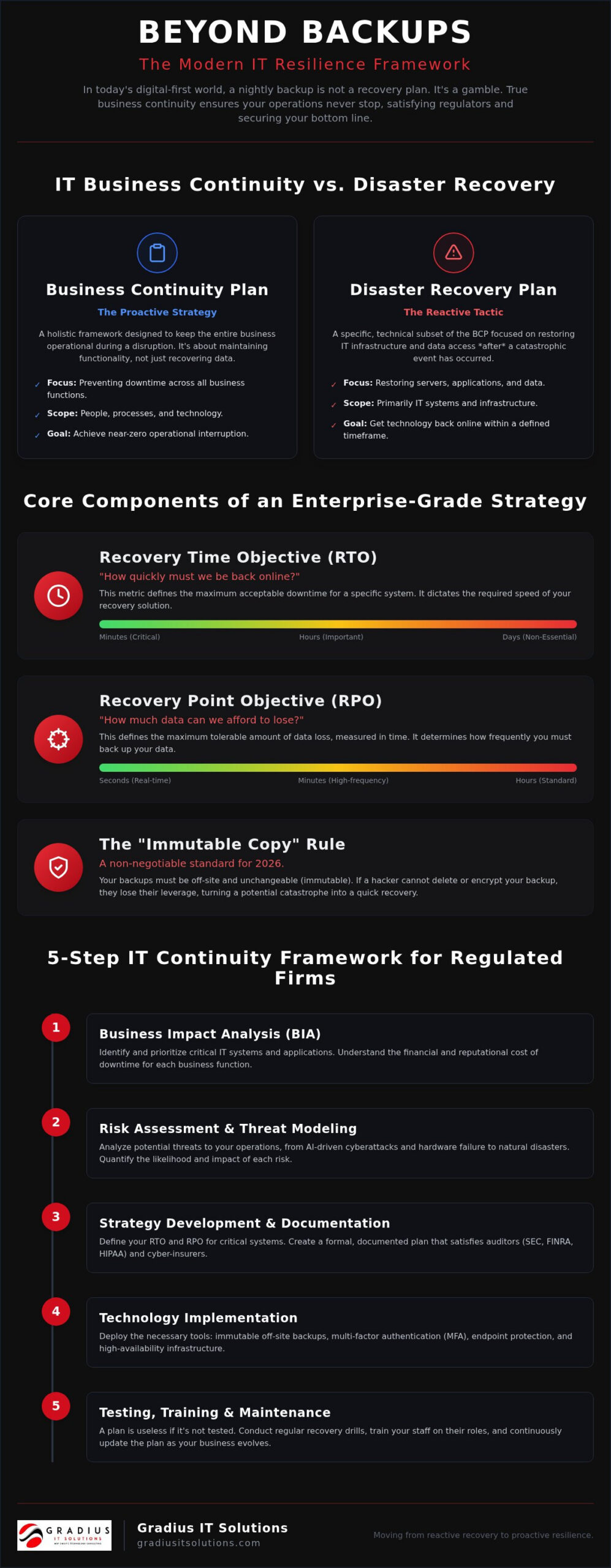
- Understand the difference between broad continuity strategies and the specific technical tactics used in disaster recovery.
- Implement a five-step roadmap to satisfy SEC and FINRA audits while securing favorable terms from your cyber-insurer.
- Leverage managed IT services and secure AI automation to move from reactive recovery to proactive protection and predictive threat detection.
Beyond Backups: Defining IT Business Continuity Planning in 2026
Many executives mistake a nightly backup for a complete safety net. It’s not. A backup is just a copy of data; it doesn’t guarantee your team can actually use that data when a crisis hits. In 2026, the definition of business continuity planning overview has shifted toward a strategic framework for maintaining technology operations during any disruption. It’s about ensuring your business functions don’t just recover, but never actually stop.
To better understand how to structure this for your organization, watch this helpful guide:
Why is 2026 different? The threat landscape has evolved. We’re seeing AI-driven threats that can bypass traditional defenses and sophisticated ransomware that targets your backups first. You need a proactive, managed state of continuity. This requires a foundation of compliance-aware managed IT. We focus on engineering resilience into your daily operations so that a system failure never becomes a business failure.
The Evolution of Continuity in a Digital-First World
Traditional planning used to focus on natural disasters like floods or fires. Modern it business continuity planning focuses on cybersecurity and system uptime. We live in a world of “Never-Sleeps IT.” Your employees expect to work from anywhere at any time. If your systems go down for even an hour, the hit to your revenue and reputation is immediate. Every minute of downtime is a direct drain on your bottom line. Uptime isn’t a luxury anymore. It’s your lifeline.
Why Regulated Firms Need an IT-Specific Plan
If you operate in a regulated industry, a plan is a legal mandate. The SEC Cybersecurity Rule and FINRA Rule 4370 set high bars for operational resilience. You must have a Written Information Security Policy (WISP) that details your response to technical incidents. Beyond the regulators, cyber-insurers have become much stricter. They now treat a documented and tested it business continuity planning strategy as a prerequisite for coverage. Without a plan, you might find your firm uninsurable or facing massive premiums. We help you bridge that gap by building a plan that satisfies both auditors and insurers.
The Core Components of an Enterprise-Grade IT Continuity Strategy
A business continuity plan isn’t a “set it and forget it” document. It’s an active engineering requirement for any firm with 5 to 100 employees. Effective it business continuity planning starts with a Business Impact Analysis (BIA). This process identifies which IT systems are non-negotiable for your daily operations. You need to know exactly which applications generate revenue and which ones are just “nice to have” during a crisis. This starts with a business continuity plan framework that prioritizes your most critical digital assets based on their actual impact on your bottom line.
Resilience isn’t just about recovery; it’s about prevention. Layered security controls like firewalls and network segmentation keep a small breach from becoming a total blackout. Multi-factor authentication (MFA) serves as your primary gatekeeper. Then there’s the “Immutable Copy” rule. This is a non-negotiable standard for 2026. Your backups must be off-site and unchangeable. If a hacker can’t delete or modify your backup, they lose their leverage. This simple technical control is often the only thing standing between a quick recovery and a catastrophic loss.
Defining Your RTO and RPO Metrics
Recovery Time Objective (RTO) measures how quickly you need to be back online. Minutes matter for a trading desk. Hours might be okay for a professional services firm. Recovery Point Objective (RPO) defines the “last save” point. Can you afford to lose 15 minutes of data, or 24 hours? When we handle it business continuity planning for our clients, we focus on balancing these costs with speed. We help you find the specific point where your IT metrics align with your actual business goals.
High-Performance Infrastructure: The Foundation
High-performance infrastructure begins with a cloud-first approach. By leveraging Microsoft 365 and Azure, you gain built-in geographic redundancy. If one data center fails, your team keeps working. Your internal network needs similar care. Custom network buildouts create isolated environments to prevent lateral threat movement. This ensures a problem in one department won’t shut down the entire office. Finally, a 24/7 SOC provides the continuous monitoring needed to catch disruptions before they scale. If you aren’t sure where your vulnerabilities lie, a cybersecurity assessment is a smart place to start.
IT Business Continuity vs. Disaster Recovery: Understanding the Critical Difference
Many leaders use the terms interchangeably. They shouldn’t. Business Continuity is your broad strategy for survival. It covers everything from how your team communicates to where they sit during an office closure. Disaster Recovery is a subset of that plan. It focuses specifically on the technical steps to restore your data and systems. You can think of BC as the overall Business Continuity Plan and DR as the technical toolkit used to execute it. In a regulated 2026 environment, having one without the other is a recipe for compliance failure.
Modern it business continuity planning often utilizes a concept called Parallel Observation mode. This allows your security team to contain a threat in an isolated environment while your staff continues to work on a clean, secondary system. It eliminates the old binary choice between shutting everything down or letting a threat spread. You get to keep the business moving while the experts perform surgery on the infected segments. It’s a sophisticated way to manage risk without sacrificing productivity.
Disaster Recovery: The Technical Engine
DR is the technical engine of your resilience. It relies on automated daily backups and, more importantly, scheduled restore tests. If you haven’t tested a restore in the last thirty days, you don’t have a backup you can trust. DR also dictates how you manage compromised environments. Sometimes, an on-site fix is possible. Other times, remote containment is the only way to stop a breach from spreading. In extreme cases, your DR plan should outline a full network rebuild. It’s often safer to decommission a tainted system and start fresh than to spend weeks chasing ghosts in a compromised network.
Continuity: The Strategic Umbrella
While DR fixes the servers, Continuity keeps the lights on. It provides the executive decision-making framework needed during a system outage. Who makes the call to switch to the backup site? How do you keep clients informed? This is where unified communications become vital. If your email is down, your team needs a pre-configured VoIP or secure messaging system to maintain transparency with stakeholders. Continuity also addresses the human element. During a major event, your internal IT team will be overwhelmed. Staff augmentation from a managed partner ensures you have 24/7 support to handle the surge without burning out your staff.
Building Your Roadmap: A 5-Step IT Continuity Framework for Regulated Firms
To learn more about how public status pages can automate this transparency and keep your customers updated in real-time, integrating a dedicated uptime monitoring platform is a best practice for modern firms.
Moving from a reactive posture to a resilient one requires more than just buying software. It requires a disciplined, repeatable process. For firms in regulated sectors, it business continuity planning is the difference between a minor reboot and a permanent shutdown. You need a roadmap that accounts for the technical complexity of 2026 while satisfying the high standards of SEC and FINRA auditors. This five-step framework provides the structure your executive team needs to lead with confidence.
- Step 1: Conduct a comprehensive IT Risk Assessment to map every digital vulnerability in your stack.
- Step 2: Draft your Incident Response Plan (IRP) and Business Continuity Plan (BCP) to define clear roles and responsibilities.
- Step 3: Implement layered security controls, including MFA, EDR/XDR, and 24/7 SOC monitoring.
- Step 4: Execute automated backup verification to ensure your “last save” points are actually functional.
- Step 5: Schedule quarterly stress tests to simulate real-world disruptions and refine your team’s response speed.
Step 1 & 2: Assessment and Documentation
Your roadmap begins with a deep dive into your current environment. We perform a Gap Analysis to identify exactly where your technology stack falls short of modern cyber-insurance requirements. Most firms discover that their existing plans are too vague for 2026. You need a “Continuity Playbook” that gives executives and office managers a step-by-step guide for the first sixty minutes of an outage. This documentation should align with your broader Corporate IT Strategy Consulting. Our vCISO services help you draft a Written Information Security Policy (WISP) that turns these technical steps into a formal, audit-ready document. This ensures your compliance isn’t just a checkbox; it’s a core part of your operational DNA.
Schedule your strategic technology consultation today.
Step 4 & 5: Verification and Continuous Testing
The “set and forget” approach to backups died years ago. In 2026, you can’t assume a backup worked just because a dashboard says “green.” You need automated verification that performs a test restore and documents the results. These reports serve as critical evidence for regulatory audits and insurance renewals. While competitors might suggest annual testing, that frequency is insufficient for today’s threat cycles. We advocate for quarterly stress tests and “Tabletop Exercises.” These simulations force your executive team to make high-pressure decisions in a controlled environment. The goal is simple: find the flaws in your plan before a hacker does. By refining your response times now, you ensure that when a real crisis hits, your team acts with precision rather than panic.
Strategic Resilience: How Managed IT Services Execute Your Continuity Vision
Managed IT services provide the single accountable partner your firm needs to bridge the gap between a written plan and operational reality. While software tools are essential, they require expert hands to manage them effectively. We position it business continuity planning as a core component of our managed operations. This means we don’t just wait for a disaster to happen. We engineer your environment to withstand it. By integrating your security, compliance, and infrastructure under one roof, you eliminate the finger-pointing that often happens between different vendors during a crisis.
Our approach relies heavily on Secure AI Automation to provide a level of protection that manual monitoring can’t match. We use intelligent workflows to handle predictive maintenance and real-time threat detection. This is the “IT That Never Sleeps” promise. With a U.S. based 24/7 SOC and Help Desk, we’re watching your network at 3 AM so you don’t have to. Our vCIO and vCISO services ensure that these technical efforts always align with your high level business strategy.
The Prevent-Instead-React Model
The most effective continuity plan is the one you never have to use. We use predictive analytics to identify hardware failures before they cause a single second of downtime. If a server drive shows signs of wear, we replace it during a scheduled window rather than reacting to a crash. We also leverage real-time threat intelligence to stay ahead of emerging ransomware strains. This proactive stance is supported by flat-fee predictable pricing. You can treat it business continuity planning as a consistent line item in your budget. There are no surprise expenses when a crisis hits because we’ve already built the defense.
Executing with a Strategic Partner
A successful strategy requires a clear path forward. This is why a Business Technology Roadmap is the ultimate continuity tool. It moves you away from “break-fix” cycles and toward a mature, resilient tech stack. Whether your team is in a single office or distributed across the country, our nationwide support network ensures your staff has the help they need. We provide the protective guardianship that allows you to focus on growth while we handle the complexity of your IT environment. It’s about lifting the burden of technical management so you can lead with confidence.
Ready to secure your operations and eliminate the fear of downtime? Schedule your Free IT & Cybersecurity Assessment with Gradius IT Solutions today.
Future-Proofing Your Firm’s Operations
Resilience in 2026 isn’t a technical luxury; it’s a fundamental business requirement for any growth-oriented firm. We’ve moved past the era where simple backups were enough to protect your reputation and revenue from sophisticated AI-driven threats. Modern it business continuity planning requires a proactive, managed approach that integrates layered security, automated verification, and a clear executive playbook. By aligning your technology with compliance standards like SEC and FINRA, you don’t just satisfy auditors. You build a firm that can withstand any disruption without missing a beat.
Our team specializes in compliance-aware managed IT for financial services, providing the U.S.-based 24/7 SOC and Help Desk support you need to stay ahead of threats. We also offer a free cyber-insurance readiness review to ensure your documentation and technical controls meet the strictest requirements for your next renewal. This protective guardianship allows you to focus on your clients while we manage the complexity of your technology stack.
Take the first step toward zero-downtime operations today. You deserve the peace of mind that comes with a tested, proven strategy and a partner who stands firmly in your corner.
Frequently Asked Questions
What is the difference between IT business continuity and disaster recovery?
Business continuity is the broad strategy for keeping your entire operation running during a crisis. It includes communication plans and remote work setups. Disaster recovery is a technical subset of that plan. It focuses specifically on the steps needed to restore your data and systems. You can think of continuity as the umbrella and disaster recovery as the technical engine that fixes the servers when they fail.
Does my small business really need an IT business continuity plan?
Absolutely. Small to mid-sized firms often face higher relative costs for downtime than enterprise giants. If your systems are down for a full day, you lose revenue and client trust. Most cyber-insurers now require a documented it business continuity planning strategy before they’ll issue a policy. It isn’t just about surviving a disaster. It’s about maintaining a professional presence and satisfying SEC or FINRA requirements.
What are RTO and RPO, and why are they critical for my IT strategy?
Recovery Time Objective (RTO) measures how quickly you must be back online after a failure. Recovery Point Objective (RPO) defines how much data loss your firm can tolerate. These metrics aren’t just technical jargon; they drive your entire infrastructure budget. If your RTO is five minutes, you need high-availability cloud solutions. Aligning these goals with your actual business needs is vital for building a cost-effective resilience strategy.
How often should we test our IT disaster recovery and continuity plans?
We recommend quarterly stress tests as the new baseline for 2026. Traditional annual testing is insufficient because the threat landscape moves too fast. You should perform automated restore verifications daily to ensure your data is functional. Tabletop exercises should involve your executive team every few months. This keeps everyone sharp on their roles and reveals gaps in your plan before a real-world incident forces you to react.
What IT systems should be prioritized in a business continuity plan?
You should prioritize systems based on their direct impact on revenue and client service. This typically includes your primary CRM, email, and VoIP communications. Financial firms prioritize trading platforms and client portals. We use a Business Impact Analysis to rank these applications. This ensures your technical resources focus on the most critical assets first. It prevents your team from wasting time on low-priority systems during a crisis.
How does managed IT help with cyber-insurance readiness?
Cyber-insurers have become incredibly strict about operational controls. Managed IT provides the documented evidence they demand, such as proof of MFA, 24/7 SOC monitoring, and tested backups. We help you bridge the gap between technical reality and insurance requirements. Our vCISO services assist in drafting a Written Information Security Policy (WISP). This makes you a lower risk, which can lead to better coverage terms and faster claim processing.
What is an immutable backup, and why is it necessary in 2026?
An immutable backup is a copy of your data that cannot be modified or deleted for a set period. In 2026, ransomware strains often target your backups first to eliminate your recovery options. Immutable structures prevent this by creating a read-only vault. It’s your ultimate last line of defense. If your primary network is compromised, you can rely on these unchangeable copies to restore your operations without paying a ransom.
How do SEC and FINRA rules impact my IT continuity planning?
SEC and FINRA rules require regulated firms to maintain a robust and tested it business continuity planning strategy. FINRA Rule 4370 specifically mandates that firms have plans to meet their obligations to customers during an emergency. You must also designate a senior manager to oversee the plan. Failure to provide evidence of these testing results can lead to significant fines. We build compliance-aware IT environments that meet these high standards.

Article by
Robert Joyce
**Robert Joyce** is the Founder, CEO, and Chief Technology Officer of Gradius IT Solutions, a security first provider of Managed IT Services, Cybersecurity, Cloud, Compliance, and Secure AI solutions serving businesses throughout New Jersey, New York, Connecticut, and across the United States.
With more than 28 years of IT experience, including 23 years supporting hedge funds, global banks, and wealth management firms, Robert has built a career designing and managing secure, resilient, and highly available technology environments where uptime, cybersecurity, and business continuity are essential.
His expertise includes Microsoft 365, cloud computing, cybersecurity, networking, infrastructure, disaster recovery, compliance, virtualization, and strategic IT leadership. Following the events of September 11, Robert helped rebuild critical technology infrastructure for Merrill Lynch, an experience that reinforced the importance of resilience, planning, and operational excellence.
Robert founded Gradius IT Solutions to bring enterprise level technology and security services to small and midsized businesses at a predictable monthly cost. Today, the company delivers fully managed and co managed IT services, cybersecurity, Microsoft 365, cloud solutions, compliance consulting, Secure AI consulting, technology projects, and vCIO services. Through a U.S. based 24/7 Help Desk and a nationwide network of trusted technology partners, Gradius supports organizations across the country with responsive, security focused technology solutions.
Robert partners with business owners and executive leaders to align technology with business goals, reduce risk, strengthen cybersecurity, improve productivity, and create long term IT strategies that support growth. His mission is simple: provide every client with enterprise class technology, exceptional service, and a trusted advisor they can rely on as their business evolves.
Disclaimer
## Disclaimer
The information provided in this article is for general informational and educational purposes only and should not be considered professional IT, cybersecurity, legal, regulatory, or compliance advice. While Gradius IT Solutions strives to provide accurate and up to date information, technology, security threats, and regulatory requirements change frequently, and we cannot guarantee that all information will remain current or applicable to your specific situation.
Every organization has unique technology, security, compliance, and business requirements. Before implementing any recommendations discussed in this article, you should evaluate their suitability for your environment or consult with a qualified technology professional.
Gradius IT Solutions makes no warranties, express or implied, regarding the completeness, accuracy, reliability, or results obtained from the use of this information. Any actions you take based on this content are at your own risk. Gradius IT Solutions shall not be liable for any direct, indirect, incidental, or consequential damages arising from the use of, or reliance upon, the information contained in this article.
References to third party products, services, or vendors are provided for informational purposes only and do not constitute an endorsement unless explicitly stated.
If you would like guidance tailored to your organization, contact Gradius IT Solutions to schedule a consultation with one of our technology experts.