

Table of Contents
- What Is AI Automation in Business?
- How AI Automation Differs from Traditional Automation and RPA
- Core Technologies Behind AI Automation
- AI Automation Use Cases for Small Business
- Key Business Benefits and Operational Improvements
- AI Automation Security Risks and Compliance Considerations
- Getting Started: Implementation Roadmap for SMBs
- Questions to Ask Your IT Provider About AI Automation
- Frequently Asked Questions
Last Updated: September 22, 2026
What Is AI Automation in Business?
AI automation in business is the use of artificial intelligence and machine learning to perform tasks, make decisions, and optimize workflows with minimal human intervention. Unlike traditional automation, which follows rigid, pre-programmed rules, AI automation learns from data patterns and adapts its behavior over time.
At Gradius IT Solutions, we help organizations understand how AI automation can prevent problems before they occur, reduce manual work, and improve decision-making across operations. The technology combines machine learning algorithms, natural language processing, and predictive analytics to handle everything from customer service inquiries to complex data analysis.
The core distinction is this: traditional automation is a tool that executes instructions. AI automation is a system that understands context, recognizes patterns, and improves its performance through experience. A scheduling system might book appointments at fixed times. An AI-powered system learns which time slots your customers actually prefer and adjusts recommendations accordingly.
The real value of AI automation isn’t about replacing workers, it’s about eliminating the tedious parts of their jobs so they can focus on decisions that require judgment and creativity.
How AI Automation Differs from Traditional Automation and RPA
Traditional automation and robotic process automation (RPA) solve specific, repetitive problems through rule-based logic. RPA tools excel at high-volume, structured tasks: moving data between systems, processing invoices with consistent formats, or updating spreadsheets. They follow exact instructions and do nothing more.
AI automation operates differently. It handles tasks with variation, ambiguity, and context. A traditional system might flag an unusual expense for review. An AI system learns what “unusual” means for your specific business and identifies patterns humans might miss.
The practical difference matters for your operations. RPA works best for processes with clear inputs and predictable outputs. AI automation handles the messier parts of business: understanding customer intent from written feedback, prioritizing support tickets by urgency, or detecting anomalies in network traffic that signal a security threat.
Many organizations use both. RPA handles the structured, high-volume work. AI automation sits on top, learning from results and improving over time. This layered approach is common in mature automation environments.
RPA is a hammer for nails. AI automation is a carpenter who learns which nails need hitting and adjusts technique based on results.
Core Technologies Behind AI Automation
Three foundational technologies power most AI automation systems: machine learning, natural language processing, and predictive analytics.
Machine learning enables systems to improve without explicit reprogramming. The system analyzes historical data, identifies patterns, and applies those patterns to new situations. In a business context, this might mean analyzing past customer churn to predict which current customers are at risk of leaving.
Natural language processing (NLP) allows systems to understand and respond to human language. Email filtering uses NLP to distinguish legitimate messages from spam. Customer support automation uses NLP to understand what customers are asking and route inquiries to the right department or provide automated responses when appropriate.
Predictive analytics forecasts future outcomes based on historical trends. Inventory systems use predictive analytics to anticipate demand and adjust stock levels. Cybersecurity systems use predictive analytics to identify potential breaches before they cause damage.
These technologies work together. An AI-powered security system uses machine learning to recognize attack patterns, natural language processing to understand threat intelligence reports, and predictive analytics to estimate which vulnerabilities your organization is most likely to face.
The integration happens through workflow orchestration, the infrastructure that connects these systems, manages data flow between them, and ensures they operate as a coordinated whole rather than isolated tools.
AI Automation Use Cases for Small Business
Small and mid-sized businesses often assume AI automation is only for large enterprises with dedicated data science teams. The reality is different. Several AI automation use cases deliver immediate value for SMBs without requiring extensive technical expertise.
Customer support automation handles routine inquiries through chatbots powered by natural language processing. When a customer asks about order status, refund policies, or product features, the system provides answers instantly. Complex issues escalate to human support staff. This reduces response time and frees support teams to focus on problems that require judgment.
Email and document processing uses machine learning to classify incoming messages, extract key information, and route documents to appropriate departments. Law firms use this to categorize client communications. Accounting firms use it to organize expense receipts and invoices. Healthcare providers use it to process patient intake forms.
Predictive maintenance analyzes equipment performance data to predict failures before they occur. Manufacturing facilities use this to schedule maintenance during planned downtime rather than responding to unexpected breakdowns. IT departments use similar systems to identify servers or network devices likely to fail and replace them proactively.
Lead scoring and prioritization helps sales teams focus on prospects most likely to convert. The system analyzes prospect behavior, engagement patterns, and firmographic data to rank leads by conversion probability. Sales reps spend time on high-probability opportunities rather than chasing every inquiry.
Anomaly detection identifies unusual patterns in network traffic, user behavior, or transaction data. Financial institutions use this to detect fraud. IT teams use it to spot potential security breaches. The system learns what “normal” looks like and flags deviations for investigation.
Each of these use cases solves a specific business problem without requiring custom AI development. Most run on platforms designed for business users, not data scientists.
A common mistake is implementing AI automation without clear metrics for success. Define what “better” looks like before you start: faster response times, reduced error rates, fewer escalations, or lower operational costs. Without measurable goals, you can’t evaluate whether the system is actually delivering value.
::: Establishing these benchmarks early provides the necessary framework to assess the long-term impact of AI automation services on your core business objectives.
Key Business Benefits and Operational Improvements
AI automation in business delivers benefits across three dimensions: efficiency, accuracy, and insight.
Efficiency gains come from eliminating manual work. When an AI system handles routine customer inquiries, your support team processes more issues per day with less effort. When predictive maintenance prevents equipment failures, you avoid costly downtime and emergency repairs. When document processing extracts information automatically, your team spends less time on data entry and more time on analysis.
Accuracy improvements emerge because AI systems don’t get tired, distracted, or inconsistent. They apply the same logic to every decision. A system trained to identify high-risk transactions catches patterns a human reviewer might miss during their hundredth review of the day. This matters most in compliance-sensitive industries where errors carry regulatory or financial consequences.
Better decision-making happens when AI automation surfaces insights humans can’t easily see. Predictive analytics reveals which customer segments are most profitable. Workflow analysis identifies bottlenecks in your processes. Anomaly detection catches problems before they become crises.
The business impact compounds. Faster processes mean shorter cycle times. Better decisions mean higher success rates. Fewer errors mean lower risk and fewer remediation costs.
For SMBs specifically, AI automation often provides the first opportunity to match capabilities of larger competitors. A small firm using predictive analytics can make inventory decisions as sophisticated as a large retailer. A small support team using intelligent routing can respond as quickly as enterprise support organizations.
AI Automation Security Risks and Compliance Considerations
Implementing AI automation introduces security and compliance considerations that traditional systems don’t create. Understanding these risks is essential before deployment.
Data quality and bias represent the first risk. AI systems learn from historical data. If that data reflects past discrimination, the system perpetuates it. If the data is incomplete or inaccurate, the system makes poor decisions based on flawed patterns. Before deploying any AI automation system, audit the data it will learn from and validate that it represents your actual business fairly.
Model transparency and explainability matter for compliance and trust. Some AI systems operate as “black boxes”, they produce decisions without explaining reasoning. In regulated industries like healthcare, finance, and insurance, regulators increasingly require explainability. You need to understand why the system made a decision and be able to explain it to customers or auditors.
Integration with existing systems creates attack surface. AI automation platforms connect to your databases, email systems, file storage, and applications. Each connection is a potential security vulnerability. Ensure the platform has strong authentication, encryption, and access controls.
AI automation amplifies both good decisions and bad ones. A biased system makes biased decisions at scale. A secure system is only secure if the data it processes is protected and the access controls are enforced.
Getting Started: Implementation Roadmap for SMBs
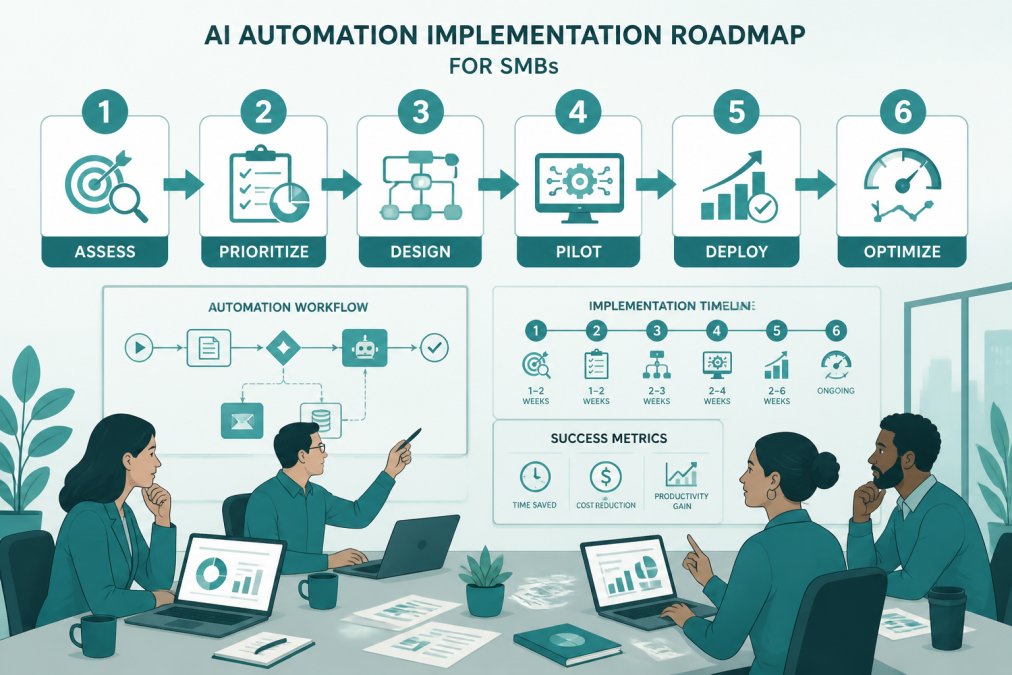
Questions to Ask Your IT Provider About AI Automation
When evaluating whether AI automation makes sense for your organization, and how to implement it responsibly, ask your IT provider these questions.
Frequently Asked Questions
What is AI automation with a real business example?
AI automation combines machine learning and workflow orchestration to handle repetitive tasks with minimal human intervention. For example, an accounting firm uses AI to automatically categorize invoices, extract key data like vendor name and amount, and route them to the correct cost center. The system learns from corrections and improves accuracy over time. Unlike simple automation that follows rigid rules, AI adapts to variations in invoice format, vendor naming, or data layout.
What’s the difference between traditional automation and AI automation?
Traditional automation and robotic process automation (RPA) follow exact, predefined rules. If the input changes slightly, the process breaks. AI automation uses machine learning and natural language processing to handle variation and make decisions. A traditional system might fail if an invoice layout changes; an AI system adapts. AI also learns from outcomes, improving performance over time without manual rule updates.
How does AI automation impact data security and privacy?
AI automation systems access and process sensitive data, creating security and compliance risks. If not properly configured, they can expose customer information, financial records, or regulated data. Key risks include inadequate access controls, unencrypted data in transit, model training on sensitive information, and bias in algorithmic decision-making that may violate compliance rules like HIPAA or financial regulations. Businesses must implement identity and access management, data encryption, audit logging, and regular security assessments before deploying AI automation.
What should a small business look for when evaluating AI automation solutions?
Evaluate based on integration with your existing systems, ease of implementation without requiring deep technical expertise, transparent security and data handling practices, vendor support for compliance requirements relevant to your industry, and clear ROI metrics beyond just cost-cutting. Ask whether the solution requires extensive model training or works out-of-the-box, how the vendor handles data privacy, and whether they provide ongoing monitoring and updates. Request references from similar-sized businesses in your industry.