
For businesses searching for reliable managed protection, the key question is not how many security tools you have. It is whether essential controls work together, alerts reach the right people, and someone knows what to do when an incident occurs. Strong cybersecurity starts with coordinated protection and clear ownership.
It can be difficult to know where to start. Multi-factor authentication (MFA), endpoint protection, email security, backups, and employee awareness all matter, but disconnected tools can create confusion instead of confidence. A managed cybersecurity program from Gradius IT Solutions brings these layers into an ongoing process for monitoring, response, and recovery.
This guide explains how to assess managed cybersecurity, identify controls your business needs, and compare providers based on their approach to risk and accountability. You’ll learn what effective monitoring and incident response look like, how to organize documentation for audits or insurers, and how an assessment can turn potential gaps into prioritized next steps.
Key Takeaways
- Managed cybersecurity is an ongoing program for prevention, monitoring, response, and recovery, not a collection of disconnected tools.
- Layered protection helps secure user access, devices, email, networks, and data. MFA and Zero Trust principles add deliberate checks before access is granted.
- Compare managed cybersecurity services by monitoring coverage, alert escalation, response ownership, reporting, and documentation.
- A practical onboarding process assesses systems, documents gaps, and prioritizes improvements based on business operations, exposure, and compliance needs.
- One accountable partner can coordinate IT, security, and compliance, supported by a U.S.-based 24/7 SOC, incident response, SIEM, and managed EDR/XDR.
What managed cybersecurity should accomplish for a business
Managed cybersecurity is an ongoing program, not a one-time installation. It combines prevention, monitoring, alert investigation, response coordination, and recovery planning. These activities need to keep pace with changes in systems, staff, and business needs. The goal is to reduce avoidable risk and help the organization continue operating when a security issue needs attention.
The practical measure is not the number of tools included. It is whether protections are maintained, alerts are investigated, and response responsibilities are clear. Security controls can reduce risk, but no combination can guarantee that incidents will never occur.
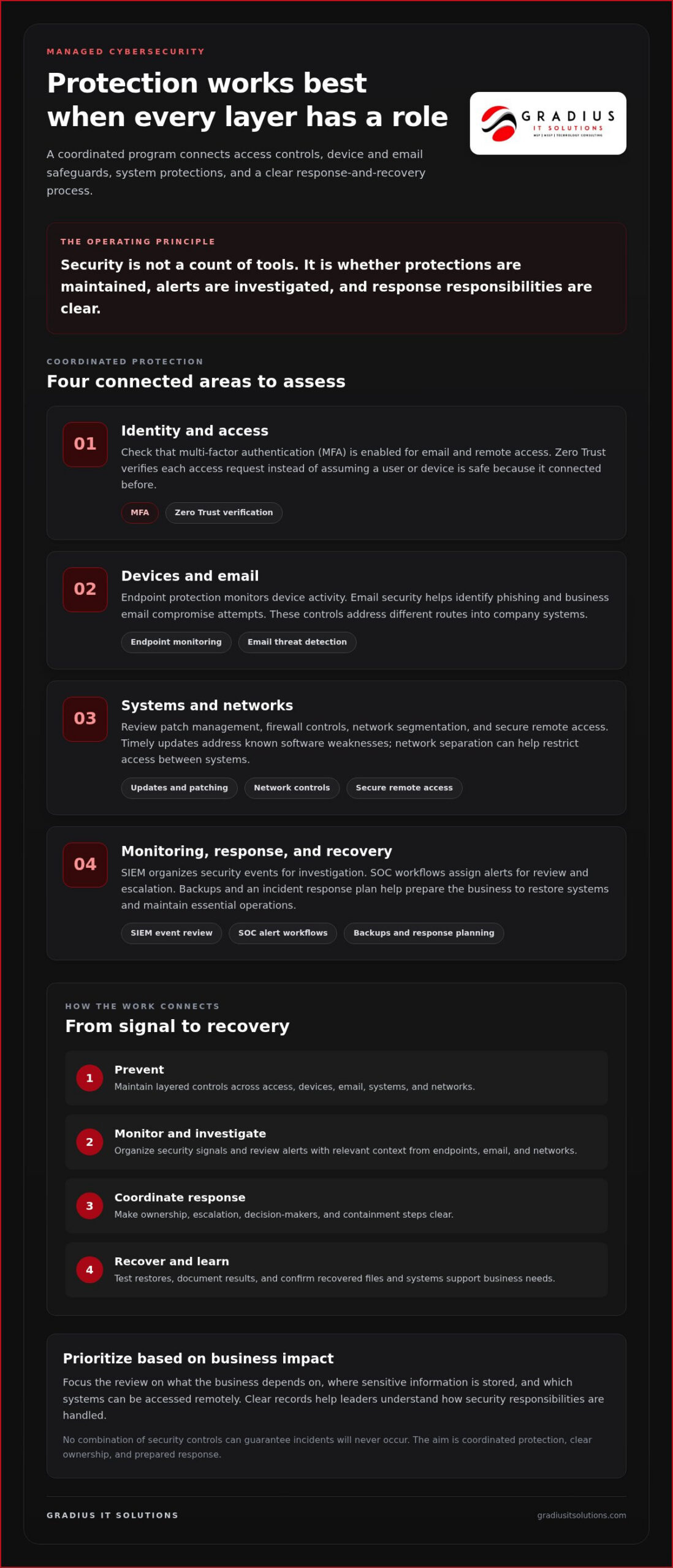
This short overview puts the moving parts in context:
Unlike isolated tools that may generate alerts without clear follow-through, managed security connects routine maintenance with investigation and action. A managed security services (MSS) program gives a business an operational structure for coordinating that work. Strong operations support continuity by helping protect access to business data, identify issues for review, and coordinate next steps. Clear records also help leaders explain how security responsibilities are handled. Gradius provides managed IT for general business, connecting day-to-day technology operations with security through its managed IT services for general business.
What does a managed cybersecurity service include?
Services can include monitoring security signals, maintaining protections such as endpoint detection and response, applying security updates, investigating alerts, and coordinating incident response. A SIEM, or security information and event management system, collects and organizes signals from systems so they can be reviewed together. A SOC, or security operations center, is the team and processes overseeing that work. Gradius provides U.S.-based SOC coverage around the clock.
When does a business need managed security support?
Managed support can help when a small internal team cannot consistently review alerts, maintain controls, and document security work alongside its other responsibilities. It is especially relevant when a business handles sensitive client, patient, employee, or financial information. Leaders need to know who owns security tasks, how concerns are escalated, and where decisions and actions are recorded. That clarity supports informed oversight without requiring every business leader to become a technical specialist.
How layered cybersecurity protects identity, devices, email, and data
Security works best when controls reinforce one another. A secure email filter may block a deceptive message, while multi-factor authentication (MFA) adds another check if a password is exposed. Endpoint detection and response (EDR) monitors computers and servers for suspicious activity, while network controls can help limit how far a problem spreads. Backups support recovery if data or systems become unavailable.
Layered controls reduce reliance on any single defense by giving the business additional ways to prevent, detect, and contain security issues.
Which foundational security controls should buyers assess?
Start with the ways people access business information, then review the systems and safeguards behind those access points. The Federal Trade Commission’s Cybersecurity for Small Business guide offers practical steps for protecting accounts, devices, and data. Use a review like this to identify gaps and set priorities:
- Identity: Check whether MFA is enabled for email and remote access. Zero Trust builds on this by verifying each access request instead of assuming a user or device is safe simply because it connected before.
- Devices and email: Confirm that endpoint protection monitors device activity and email security helps identify phishing and business email compromise attempts. These controls address different routes into company systems.
- Systems and networks: Review patch management, firewall controls, network segmentation, and secure remote access. Timely updates address known software weaknesses, while network separation can help restrict access between systems.
Prioritize controls based on what the business depends on, where sensitive information is stored, and which systems can be accessed remotely. This makes the review a business decision, not just a technical inventory.
How do monitoring, backups, and response planning fit together?
Tools only help when their signals lead to action. SIEM organizes security events for investigation, and SOC workflows help assign alerts for review and escalation. Reviewing endpoint, email, and network signals together can give responders useful context. Gradius connects these capabilities through managed cybersecurity, including SIEM, a U.S.-based 24/7 SOC, and incident response.
Recovery needs its own safeguards. Off-site or immutable backups can help protect recovery copies from changes to the primary environment. Schedule restore tests, document the results, and confirm that recovered files and systems support real business needs. An incident response plan should identify decision-makers, containment steps, recovery priorities, and how the organization will maintain essential operations while systems are restored.
A coordinated security assessment can help turn these layers into clear, prioritized actions. Explore Gradius IT Solutions’ cybersecurity and IT support as a practical next step.
How to compare managed cybersecurity providers and their accountability
A useful comparison goes beyond a list of security tools. Look for clear ownership: who reviews alerts, who decides when to escalate, and how the business is kept informed. The NIST Cybersecurity Framework 2.0 offers a risk-management structure for organizing security responsibilities. Accountability matters because monitoring and response processes should make clear who acts on potential incidents and how follow-up is tracked. IBM’s 2026 Cost of a Data Breach Report estimates the global average breach lifecycle at 247 days to identify and contain.
| Area | What to look for |
|---|---|
| Coverage | Which systems, users, and security controls are included? |
| Monitoring hours | When are alerts reviewed, and how are monitoring limits documented? |
| Response ownership | Who investigates, escalates, and coordinates incident response? |
| Reporting | How are findings, actions, and unresolved risks communicated? |
| Documentation | Are responsibilities, procedures, and security evidence recorded? |
Ask for a clear explanation of the alert path. For example, a routine login alert should be reviewed against available context, then either closed with a record or escalated to the person responsible for the next action. Written responsibilities and incident procedures keep important decisions from depending on assumptions or informal handoffs.
What should a cybersecurity assessment reveal?
A useful assessment reviews identity protections, endpoints, email, network controls, backups, and documented response plans. It should distinguish safeguards that are already operating from gaps that need attention, then organize recommended remediation by business impact and practical priority. Gradius provides cybersecurity services that include assessment, monitoring, and incident response. Findings can guide decisions, but no assessment can promise that every incident will be prevented.
How can businesses assess compliance and insurance readiness?
Review whether policies, incident response procedures, continuity plans, and records of security controls are current and accessible. Organized evidence can help leaders prepare accurate responses to insurer questionnaires and support audit or compliance discussions. It also clarifies ownership by showing decision-makers which controls are in place and which actions remain open. Gradius’ Compliance as a Service supports documentation and compliance-aware operations.
For a practical starting point, schedule a cybersecurity assessment with Gradius IT Solutions to identify gaps and document prioritized next steps. Explore Gradius IT Solutions.
How to prepare for managed cybersecurity onboarding and ongoing operations
A successful onboarding process turns assessment findings into a working security program. It should fit the organization’s systems and priorities rather than apply the same checklist without context. Business-critical operations, exposure to risk, and relevant compliance needs all help determine what to address first.
A practical sequence keeps the work clear:
- Assess the environment. Review systems, users, existing controls, business needs, and relevant documentation.
- Document gaps. Record which safeguards are in place, where coverage is incomplete, and what needs follow-up.
- Prioritize controls. Rank improvements by relevance to business operations, exposure, and compliance needs.
- Deploy improvements. Implement agreed changes in a coordinated way, accounting for how employees rely on affected systems.
- Review results. Track completed work, open items, and changes that may require new security decisions.
What happens during assessment and onboarding?
Gradius offers a no-obligation 30-minute assessment conversation that includes a compliance gap analysis and cyber-insurance readiness review. The review considers the existing technology environment, safeguards, operational requirements, and available documentation. Findings are organized into a written report delivered within a week, giving leaders a practical basis for discussing priorities and next steps.
Assessment is the starting point, not the finish line. Ongoing operations can include patch management, alert monitoring, backup verification, and policy review. Priorities may change as systems, business processes, or compliance needs change. A deeper IT risk assessment framework can help structure that review.
What should ongoing security operations make visible?
Clear operations show who reviews alerts, who escalates concerns, who coordinates incident response, and how follow-up actions are recorded. Leaders should be able to understand what was investigated and whether further action is needed, without having to interpret disconnected technical alerts.
Recovery readiness also needs evidence. Keep records of backup restore tests, document what was recovered, and use the results to refine recovery plans. This helps teams understand whether essential systems and data can be restored in a way that supports business continuity. Gradius’ help desk and SOC support provide context for coordinated ongoing operations.
How Gradius connects managed cybersecurity, IT operations, and compliance
Security works better when everyday IT decisions, cybersecurity operations, and compliance responsibilities are coordinated. Gradius IT Solutions brings these areas together through one accountable partner, helping reduce handoff friction and clarify who owns each action. For example, a technology change can be reviewed for its operational impact, security implications, and documentation needs rather than handled through disconnected workflows.
Gradius’ capabilities include a U.S.-based 24/7 security operations center (SOC), security information and event management (SIEM), managed endpoint detection and response (EDR/XDR), and incident response. The SOC monitors security operations, SIEM organizes signals for investigation, and EDR/XDR helps identify suspicious activity on devices. Together with managed IT, these services connect detection and response to the systems and processes a business relies on. Explore managed IT services for general business and Gradius’ cybersecurity services.
What does one accountable partner change for a business?
Clear coordination can reduce delays caused by separate teams handing off security, IT, and compliance tasks without shared context. Gradius also provides vCISO support, giving business leaders strategic cybersecurity guidance alongside written policies, incident response planning, compliance documentation, and audit support. Priorities can then align with business operations and relevant regulatory context, so security decisions reflect both technical needs and how the organization works.
What is a useful next step after comparing providers?
Start with a straightforward picture of current controls, business priorities, and known concerns. Gradius offers a free, no-obligation 30-minute assessment conversation that includes a compliance gap analysis and cyber-insurance readiness review. A written report is delivered within a week, outlining findings and practical priorities. Gradius responds to assessment requests within one business day. This is a response commitment, not a promise that remediation will be completed by then.
The assessment is designed to provide useful findings, not pressure. Bring questions about existing safeguards, documentation, insurance readiness, or operational concerns. The conversation can help decision-makers identify where to focus next and how managed cybersecurity, IT operations, and compliance work can fit together.
Turn cybersecurity priorities into a practical plan
Effective cybersecurity is an ongoing program, not a stack of disconnected tools. Layered controls help protect identities, devices, email, and data, while monitoring and response planning clarify security responsibilities. Comparing providers on alert ownership, reporting, and documentation can help you identify a partner suited to your business needs.
Gradius IT Solutions connects managed IT, cybersecurity, and compliance-aware operations through a U.S.-based Security Operations Center with 24/7 coverage. A free 30-minute assessment conversation includes a compliance gap analysis and cyber-insurance readiness review, followed by a written report delivered within a week. The findings give your team practical, prioritized next steps.
Start with a clear view of your current controls and the issues you want to address. A focused assessment can help turn uncertainty into an achievable security plan.
With clear priorities and accountable support, your business can strengthen security while keeping technology manageable.
Frequently Asked Questions
What does managed cybersecurity include?
Managed cybersecurity typically combines ongoing monitoring, security maintenance, alert investigation, incident response planning, and recovery coordination. The service agreement should make clear who maintains protections and owns each step when an alert needs attention. Review coverage across user identities, endpoints, email, networks, and backups. Gradius provides cybersecurity and SOC services alongside compliance-aware managed IT, coordinating security operations with broader technology responsibilities.
How do I choose a managed cybersecurity provider?
Compare monitoring coverage, alert escalation, control maintenance, reporting, documentation, and recovery planning. Ask how routine alerts are investigated, who owns follow-up, and how assessment findings become prioritized work. Tools matter, but so does the operating process behind them. Gradius offers a free assessment conversation to review security gaps and cyber-insurance readiness, helping decision-makers identify practical next steps for their environment.
Is 24/7 SOC monitoring necessary for a small business?
A 24/7 security operations center (SOC) can provide continuous coverage for monitoring and investigating alerts. Whether it fits depends on your organization’s exposure, internal capacity, data sensitivity, and response needs. Consider whether security events have clear ownership outside regular business hours. Gradius provides a U.S.-based 24/7 SOC alongside incident response and managed security controls.
What cybersecurity controls should a small business prioritize?
Start by reviewing multi-factor authentication (MFA), endpoint protection, email security, patch management, backups, and a documented incident response plan. These controls address different parts of the environment and work best as coordinated layers. Set priorities based on the systems your business depends on, the sensitive information it handles, and its relevant obligations. A security assessment can identify gaps and help sequence improvements without assuming every business needs the same configuration.
How does a cybersecurity assessment help with cyber insurance?
A cybersecurity assessment can review existing safeguards, identify gaps, and organize evidence relevant to insurer questionnaires. It does not guarantee insurance coverage or approval. Gradius’ free assessment includes a cyber-insurance readiness review and compliance gap analysis. The 30-minute conversation is followed by a written report delivered within a week, giving decision-makers documented findings to consider as they prepare for insurer discussions or plan security improvements.
Can managed cybersecurity support compliance documentation?
Managed cybersecurity can support the controls and documentation an organization uses in its compliance program, though applicable requirements vary by industry and business. Relevant materials may include written policies, incident response plans, business continuity and disaster recovery plans, and audit support records. Gradius provides compliance-aware managed IT and documentation support. Align security practices and records with the rules and obligations that apply to your operations.

Article by
Robert Joyce
**Robert Joyce** is the Founder, CEO, and Chief Technology Officer of Gradius IT Solutions, a security first provider of Managed IT Services, Cybersecurity, Cloud, Compliance, and Secure AI solutions serving businesses throughout New Jersey, New York, Connecticut, and across the United States.
With more than 28 years of IT experience, including 23 years supporting hedge funds, global banks, and wealth management firms, Robert has built a career designing and managing secure, resilient, and highly available technology environments where uptime, cybersecurity, and business continuity are essential.
His expertise includes Microsoft 365, cloud computing, cybersecurity, networking, infrastructure, disaster recovery, compliance, virtualization, and strategic IT leadership. Following the events of September 11, Robert helped rebuild critical technology infrastructure for Merrill Lynch, an experience that reinforced the importance of resilience, planning, and operational excellence.
Robert founded Gradius IT Solutions to bring enterprise level technology and security services to small and midsized businesses at a predictable monthly cost. Today, the company delivers fully managed and co managed IT services, cybersecurity, Microsoft 365, cloud solutions, compliance consulting, Secure AI consulting, technology projects, and vCIO services. Through a U.S. based 24/7 Help Desk and a nationwide network of trusted technology partners, Gradius supports organizations across the country with responsive, security focused technology solutions.
Robert partners with business owners and executive leaders to align technology with business goals, reduce risk, strengthen cybersecurity, improve productivity, and create long term IT strategies that support growth. His mission is simple: provide every client with enterprise class technology, exceptional service, and a trusted advisor they can rely on as their business evolves.
Disclaimer
## Disclaimer
The information provided in this article is for general informational and educational purposes only and should not be considered professional IT, cybersecurity, legal, regulatory, or compliance advice. While Gradius IT Solutions strives to provide accurate and up to date information, technology, security threats, and regulatory requirements change frequently, and we cannot guarantee that all information will remain current or applicable to your specific situation.
Every organization has unique technology, security, compliance, and business requirements. Before implementing any recommendations discussed in this article, you should evaluate their suitability for your environment or consult with a qualified technology professional.
Gradius IT Solutions makes no warranties, express or implied, regarding the completeness, accuracy, reliability, or results obtained from the use of this information. Any actions you take based on this content are at your own risk. Gradius IT Solutions shall not be liable for any direct, indirect, incidental, or consequential damages arising from the use of, or reliance upon, the information contained in this article.
References to third party products, services, or vendors are provided for informational purposes only and do not constitute an endorsement unless explicitly stated.
If you would like guidance tailored to your organization, contact Gradius IT Solutions to schedule a consultation with one of our technology experts.