

What if your next IT project is the wrong priority, even if it solves a real problem? For growing businesses, technology projects compete for limited staff time. Security needs, aging systems, and growth plans can pull in different directions. Effective it strategy and roadmap consulting connects those moving parts to the business outcomes that matter most.
It’s understandable if your technology plan feels more like a backlog than a strategy. Without clear priorities, leaders can struggle to see which risks need attention first, which investments support growth, and who owns each decision. A practical roadmap brings those choices into focus, so your team can act with purpose instead of reacting to the loudest issue.
This guide explains how to turn business goals into a sequenced, secure, measurable technology plan. You’ll learn how to assess your current environment, rank initiatives by risk and readiness, assign ownership, track progress, and build security, continuity, and AI governance into planning. The result is a repeatable approach for tracking progress and adjusting as business needs change.
Key Takeaways
- Anchor technology decisions to business goals so new tools and trends don’t distract from the outcomes that matter.
- Use a practical assessment to build a fact-based view of your people, systems, vendors, security, compliance, and continuity needs.
- With it strategy and roadmap consulting, compare initiatives by impact, risk reduction, dependencies, readiness, and team capacity.
- Keep the roadmap moving by assigning owners, tracking relevant measures, reviewing results, and adjusting priorities as conditions change.
- Learn how vCIO planning can connect strategic recommendations with managed IT and cybersecurity operations, and what to expect from an initial assessment.
What IT Strategy and Roadmap Consulting Does for a Growing Business
As a business grows, technology decisions become harder to separate from day-to-day operations. A new application may solve one team’s immediate problem while adding support demands or security gaps elsewhere. IT strategy and roadmap consulting helps leaders connect these decisions to business priorities, so projects reinforce one another instead of competing for attention.
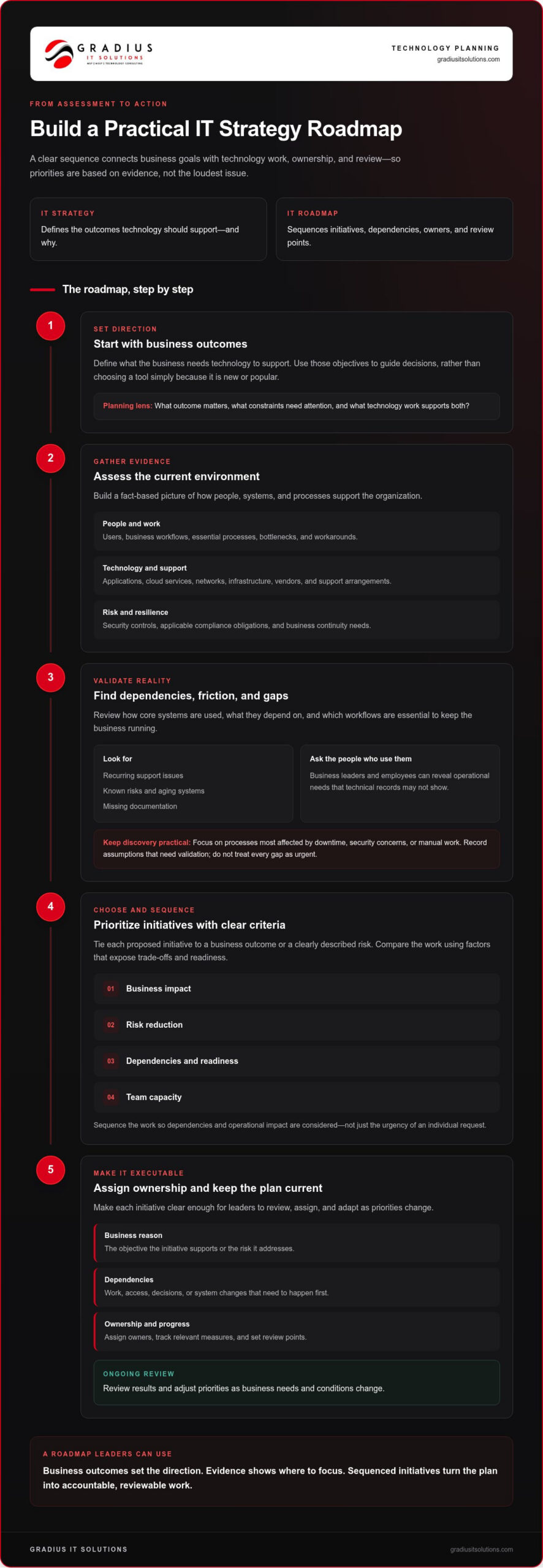
IT strategy defines the outcomes technology should support and why. An IT roadmap sequences the initiatives, dependencies, owners, and review points needed to achieve them. The strategy sets direction. The roadmap makes that direction actionable, showing what should happen first and what needs to follow.
For a foundational overview, explore this explanation of IT strategy. The practical test is whether a technology choice supports a specific business need, not whether a tool is new or popular.
For example, a company planning to expand may need systems that support additional employees, reliable access to shared information, and adequate support capacity. The plan might prioritize reviewing user access and improving support processes before introducing another platform. That sequence reflects the organization’s goals and readiness rather than a technology trend.
For a broader discussion of how organizations build an IT strategy, watch this video:
How an IT strategy differs from an IT roadmap
The strategy explains the rationale behind technology decisions: which business outcomes matter, what constraints need attention, and how technology can support both. The roadmap translates that rationale into coordinated work. It identifies initiatives, dependencies, accountable owners, and review points. Together, they help leadership understand what the team plans to do, why it matters, and why the sequence makes sense.
Suppose growth means onboarding new staff without slowing existing teams. The strategy might focus on secure, consistent access and dependable support. The roadmap could schedule access reviews, process improvements, and support capacity planning in an order that accounts for dependencies and operational impact.
When a business needs roadmap consulting
Roadmap consulting can help when growth, recurring technology issues, new compliance needs, or changing workflows make existing plans harder to manage. It’s also useful when leaders must make technology decisions without a dedicated technology executive. vCIO guidance can structure those discussions, clarify trade-offs, and maintain executive oversight without assuming every challenge requires a major transformation.
Unclear priorities often show up as familiar friction:
- Separate teams pursue overlapping tools or projects.
- Recurring issues consume time without addressing their underlying causes.
- Security or continuity work gets delayed because ownership and urgency are unclear.
A focused roadmap makes these choices visible and manageable. Gradius IT Solutions provides IT consulting and technology strategy that connect planning with practical business needs, giving leaders a clearer basis for deciding what to do next and what can wait.
What a Practical IT Strategy Roadmap Should Assess and Deliver
A useful roadmap starts with evidence, not a shopping list. Before recommending tools or upgrades, establish how the business operates, where technology supports essential work, and what gets in the way. This baseline helps leaders distinguish a genuine business need from a solution that sounds attractive but may not address the underlying issue.
The assessment should connect technology to organizational objectives and examine the people, systems, and processes involved. Include users and their workflows; applications and cloud services; networks and infrastructure; vendors and support arrangements; security controls; applicable compliance obligations; and business continuity needs. Together, these inputs show where dependencies or gaps could affect operations.
Build a reliable current-state picture
Review how core systems are used, what services they depend on, and which workflows are essential to keep the business running. Look for recurring support issues, known risks, aging systems, and missing documentation. A tool inventory alone won’t explain day-to-day impact, so speak with business leaders and employees who use the systems. Their input can reveal workarounds, bottlenecks, and operational needs that technical records don’t capture.
For a lean team without dedicated IT leadership, keep discovery focused and practical. Start with the business processes most affected by downtime, security concerns, or manual work. Confirm what is already known, flag assumptions that need validation, and document gaps without treating every gap as an urgent project.
Translate findings into useful roadmap outputs
Assessment findings become actionable when each proposed initiative is tied to a business outcome or a clearly described risk. Technology strategy and consulting services can turn those findings into a plan leaders can review, assign, and adapt as priorities change.
A practical roadmap records the work and how the organization will know it is progressing. For each initiative, capture:
- Business reason: The objective it supports or the risk it addresses.
- Dependencies: Work, access, decisions, or system changes that must happen first.
- Owner: The person accountable for coordination and decisions.
- Milestones: Meaningful checkpoints, such as completing a review, approving a design, or putting a change into use.
- Evidence and outcome measure: How completion will be verified and what operational result should improve.
For example, if a manual process creates delays, identify the workflow, the people responsible for evaluating a change, any connected systems or security considerations, and how the team will assess whether the revised process reduces friction. If a security or compliance requirement applies, record it as a planning input and identify the relevant owner or subject-matter support. Don’t assume one generic checklist covers every organization.
A clear baseline and well-defined outputs make it easier to move from analysis to decisions without overwhelming a small team. To discuss a practical starting point for your organization, connect with Gradius IT Solutions about your technology strategy.
How to Prioritize IT Roadmap Initiatives Without Chasing Every Trend
A roadmap can quickly become a wish list if every new tool or request gets equal weight. Compare projects against business objectives, risk, dependencies, readiness, and the time your team can realistically commit. The best sequence depends on impact, risk, dependencies, and readiness.
Rate each initiative using consistent qualitative labels, such as high, medium, or low, and record why you assigned each rating. These labels aren’t precise forecasts. They make assumptions visible and help leaders weigh competing priorities without relying on unsupported financial estimates.
Use consistent criteria to compare competing projects
Start with the business objective: how directly does the initiative support it? Consider the risk it reduces, the operational disruption it could prevent, what must happen first, and whether staff and systems are ready. Separate urgent risk treatment from longer-term modernization. An initiative may be important without being the next task if a prerequisite or limited team capacity makes it impractical to start.
This example isn’t a universal ranking. If an AI workflow depends on defined data access and an approved use case, those prerequisites should shape its timing. If the business has identified an access-control gap, addressing it may take precedence. Record the rationale so leadership can revisit the decision when circumstances change.
Sequence security, cloud, and AI work responsibly
Foundational security and resilience work may need to precede new capabilities. Apply Zero Trust principles by checking access based on the user, device, and situation rather than assuming everything inside a network is safe. Use multi-factor authentication (MFA), endpoint protection, email security, and employee awareness as relevant layers.
This governance focus is reflected in the NIST Cybersecurity Framework (CSF) 2.0, published in February 2024, which added a Govern function for organizational oversight of cybersecurity risk. It’s a useful reminder to connect security initiatives to leadership, accountability, and business priorities rather than treating them as isolated technical tasks.
Assess Microsoft 365 and other cloud changes against identity, data, and operational needs. A migration, for example, may depend on confirming who needs access to information and how teams will work during the transition. Treat AI as a governed business use case: define the task, what information it can use, who can access it, and how people will review its results. A trend alone isn’t a business case.
With it strategy and roadmap consulting, this comparison becomes a repeatable decision process rather than a debate driven by the latest request. Gradius IT Solutions connects planning with security and operational considerations. To discuss your priorities, schedule a technology consultation.
How to Keep an IT Roadmap Executable, Measurable, and Current
A roadmap creates value when people can act on it and leadership can see whether the work is delivering its intended result. Keep the operating process simple: make ownership clear, surface blockers early, and review outcomes often enough to respond when business conditions change. A small team doesn’t need a complex governance structure, but it does need consistent decisions and follow-through.
Set ownership and governance before work begins
Before an initiative starts, name a business sponsor who can confirm its purpose and an accountable owner who coordinates the work. Clarify who approves changes, where blockers go for resolution, and what leaders need to see in progress updates. Keep decision-making proportionate to the organization. A brief, regular review and a shared action log may be enough to maintain visibility without creating extra administration.
Use this operating cycle for each initiative:
- Assign owners. Identify the business sponsor and the person responsible for coordination, decisions, and updates.
- Confirm dependencies. Check prerequisites, required access, affected workflows, and other work that must happen first.
- Track milestones. Record meaningful checkpoints, the target outcome, and evidence that each step is complete.
- Review outcomes. Compare progress with the original objective, and note risks, blockers, or results that differ from expectations.
- Adjust the plan. Keep, resequence, pause, or redefine the work based on current capacity, business needs, and dependencies.
Choose measures that fit the initiative instead of relying on a single project metric. Completion can show whether a defined deliverable is finished. Risk treatment can track whether a known exposure has been addressed. Service reliability can reflect whether a system is available as intended, while a workflow measure can show whether a process has become easier to complete. Define the measure before work begins so the team knows what success means.
Review outcomes and adapt the sequence
Schedule reviews around meaningful milestones and material changes, such as a shift in business priorities, an emerging dependency, or reduced staff capacity. Record completed work, unresolved blockers, changed assumptions, and the decisions needed next. This creates a practical record of why the sequence changed and keeps leadership informed without treating the roadmap as fixed.
If recovery readiness is a goal, include continuity planning and documented restore tests. A restore test checks whether backed-up information can be recovered as intended. Record what was tested, the result, and any follow-up actions. This makes recovery work verifiable instead of relying on the assumption that backups alone are sufficient.
For organizations without a dedicated technology executive, vCIO guidance can help maintain this rhythm, connect roadmap choices to business priorities, and keep owners accountable. Strong it strategy and roadmap consulting supports the operating process as priorities evolve, not just the initial plan.
How Gradius IT Strategy and Roadmap Consulting Connects Planning to Action
A technology plan works best when the people shaping priorities understand how systems are supported, secured, and used in daily operations. Gradius IT Solutions brings IT consulting and vCIO guidance together with managed IT, cybersecurity, cloud, and compliance-aware planning. This connects planning with operations, helping leaders consider the practical effects of a recommendation before it becomes a project, including who will support it and how it fits the organization’s business priorities.
That matters for a small or midsize business with limited internal IT capacity. A recommendation to change a network, adjust Microsoft 365, or strengthen security can affect staff workflows and support needs. Coordinating planning with operational teams helps surface these impacts early and gives decision-makers a clearer path from strategic intent to implementation.
Connect strategic recommendations with day-to-day operations
Roadmap planning should account for helpdesk patterns, network operations, Microsoft 365, cybersecurity controls, and continuity needs. For example, a proposed cloud change should consider user access, data handling, and how employees will get support during the transition. One accountable partner can coordinate related IT and security work, reducing the risk that recommendations overlook operational dependencies. Ongoing managed IT services can support the day-to-day environment as priorities move from planning into operation.
vCIO guidance also gives business leaders a structured way to review priorities, raise trade-offs, and maintain oversight without requiring them to manage every technical detail themselves. The goal isn’t to force every recommendation into a large transformation project. It’s to connect the right work to the right business need, then coordinate it with the systems and people affected.
Start with a focused assessment and clear next steps
A focused assessment is a practical starting point, not a commitment to a predetermined solution. Gradius IT Solutions offers a no-obligation 30-minute conversation that includes a compliance gap analysis and cyber-insurance readiness review. The assessment also includes a written report delivered within a week. The report provides a basis for discussing findings and next actions; it doesn’t promise that a complete roadmap will be produced on that timeline.
Bring the business context that can make the discussion useful:
- Business goals: Growth plans, operational changes, or new services technology needs to support.
- Known challenges: Recurring support issues, systems that create friction, or security concerns leadership wants to understand.
- Upcoming changes: New workflows, compliance considerations, or planned technology transitions that may affect priorities.
These details help connect assessment findings to actual operating needs. A compliance gap or cyber-insurance readiness concern can be considered alongside business objectives, existing controls, and the team’s ability to take action. Recommendations can then be discussed in terms of what they address, what may depend on them, and where further planning is useful.
That’s the value of it strategy and roadmap consulting tied to operations: leaders get a practical starting point, while support, security, and business needs remain connected as decisions are made. Share your goals, known technology challenges, and upcoming changes with Gradius IT Solutions.
Put Your Next Technology Decision in Motion
Your next step doesn’t need to be a sweeping transformation. Choose one business priority that deserves clearer technology support, then identify the decision or action that would move it forward. That focused starting point can help leaders build confidence, learn from results, and keep future work connected to real business needs.
With it strategy and roadmap consulting, technology planning becomes an ongoing leadership practice, not a document that sits untouched. As your goals, risks, and operations change, revisit priorities and keep decisions grounded in what the business needs next.
Bring your priorities into a focused conversation with Gradius IT Solutions to clarify your next steps.
A more purposeful technology plan starts with one informed decision. Take that step with a clear view of your priorities and next actions.
Frequently Asked Questions
Can a small business create an IT roadmap without an internal CIO?
Yes. A business owner or operations leader can sponsor the process and involve the people who understand daily workflows. For example, an office manager might document recurring access problems while a finance lead identifies a reporting bottleneck. A consultant or vCIO can help assess these needs and shape next steps. Give each decision and action a clear owner, even if technology isn’t anyone’s full-time role.
What should leadership prepare before an IT strategy consultation?
Bring current business goals, known technology pain points, upcoming changes, and any security or compliance concerns. A short inventory of critical systems, key vendors, and workflows can make the conversation more specific. Don’t delay because documentation is incomplete. Note what the team knows, what remains unclear, and which issues affect staff or customers most. Those observations provide a useful starting point for identifying what deserves closer review.
Can an IT roadmap change after implementation begins?
Yes. A roadmap should guide decisions while leaving room to respond to new information. If a vendor change delays a dependent project or a business priority shifts, document the reason, decision-maker, and effect on other work. Keep a record of what changed and what remains active. This creates a traceable history, helps owners reset expectations, and prevents an outdated assumption from quietly driving the next decision.
How can leadership explain an IT roadmap to a board or executive team?
Use a concise decision brief that connects each initiative to a business objective, operational outcome, risk, owner, and current status. For example, explain that a proposed access-control change supports safer onboarding and identify the approval or staff time it needs. Keep technical detail available as backup, but lead with the business decision. This helps executives compare priorities and see where their direction or support is needed.
Does an IT strategy roadmap replace a business continuity or disaster recovery plan?
No. A roadmap can schedule improvements to recovery readiness, but it doesn’t tell employees what to do during a disruption. Maintain separate procedures that explain who makes decisions, how teams communicate, and how essential work continues. For example, staff should know where to find current contact information if normal systems are unavailable. Review those procedures and test relevant recovery steps so the organization can identify gaps before an incident.
Is IT strategy and roadmap consulting useful when technology is working well?
Yes. A stable environment gives leaders room to check whether current systems still fit business plans, security expectations, and upcoming changes. A review may confirm that existing tools remain appropriate or reveal a dependency, such as one workflow relying on a single employee’s knowledge. The purpose of it strategy and roadmap consulting isn’t to create change for its own sake. It helps leadership make informed decisions before needs shift.
Article by
Robert Joyce
**Robert Joyce** is the Founder, CEO, and Chief Technology Officer of Gradius IT Solutions, a security first provider of Managed IT Services, Cybersecurity, Cloud, Compliance, and Secure AI solutions serving businesses throughout New Jersey, New York, Connecticut, and across the United States.
With more than 28 years of IT experience, including 23 years supporting hedge funds, global banks, and wealth management firms, Robert has built a career designing and managing secure, resilient, and highly available technology environments where uptime, cybersecurity, and business continuity are essential.
His expertise includes Microsoft 365, cloud computing, cybersecurity, networking, infrastructure, disaster recovery, compliance, virtualization, and strategic IT leadership. Following the events of September 11, Robert helped rebuild critical technology infrastructure for Merrill Lynch, an experience that reinforced the importance of resilience, planning, and operational excellence.
Robert founded Gradius IT Solutions to bring enterprise level technology and security services to small and midsized businesses at a predictable monthly cost. Today, the company delivers fully managed and co managed IT services, cybersecurity, Microsoft 365, cloud solutions, compliance consulting, Secure AI consulting, technology projects, and vCIO services. Through a U.S. based 24/7 Help Desk and a nationwide network of trusted technology partners, Gradius supports organizations across the country with responsive, security focused technology solutions.
Robert partners with business owners and executive leaders to align technology with business goals, reduce risk, strengthen cybersecurity, improve productivity, and create long term IT strategies that support growth. His mission is simple: provide every client with enterprise class technology, exceptional service, and a trusted advisor they can rely on as their business evolves.
Disclaimer
## Disclaimer
The information provided in this article is for general informational and educational purposes only and should not be considered professional IT, cybersecurity, legal, regulatory, or compliance advice. While Gradius IT Solutions strives to provide accurate and up to date information, technology, security threats, and regulatory requirements change frequently, and we cannot guarantee that all information will remain current or applicable to your specific situation.
Every organization has unique technology, security, compliance, and business requirements. Before implementing any recommendations discussed in this article, you should evaluate their suitability for your environment or consult with a qualified technology professional.
Gradius IT Solutions makes no warranties, express or implied, regarding the completeness, accuracy, reliability, or results obtained from the use of this information. Any actions you take based on this content are at your own risk. Gradius IT Solutions shall not be liable for any direct, indirect, incidental, or consequential damages arising from the use of, or reliance upon, the information contained in this article.
References to third party products, services, or vendors are provided for informational purposes only and do not constitute an endorsement unless explicitly stated.
If you would like guidance tailored to your organization, contact Gradius IT Solutions to schedule a consultation with one of our technology experts.