
What happens when your accounting team loses access to client files during a filing deadline? Even a brief IT interruption can delay work and pull staff away from clients. Effective it support for accounting firms keeps essential systems accessible, protects sensitive financial information, and makes recovery responsibilities clear.
Dependable technology matters most when workloads peak and client data needs consistent protection. Your team should know who owns backups, incident response, and day-to-day support. A useful IT model addresses all three, rather than waiting to fix problems after they disrupt work.
This article explains what accounting-focused IT support should cover, from helpdesk and proactive monitoring to layered security, compliance documentation, and tested backups. It also outlines how to assess whether a support model fits your firm’s accounting workflows, cloud tools, risk priorities, and continuity needs. The goal is to clarify who handles daily support, security, documentation, and planning, so your team can focus on client work with greater confidence.
Key Takeaways
- Effective it support for accounting firms connects helpdesk, security, system management, and recovery around the workflows that keep client work moving.
- Layered safeguards, proactive monitoring, and tested backups strengthen protection and help prepare the firm to recover from disruption.
- Choose fully managed or co-managed support based on who should own daily assistance, security operations, and technology planning.
- Map critical systems, peak workloads, remote access needs, and recovery responsibilities to build a practical readiness plan.
- Gradius IT Solutions brings managed IT, cybersecurity, compliance support, and business continuity together, with a U.S.-based SOC and unlimited helpdesk support.
What IT Support for Accounting Firms Should Protect and Keep Running
Accounting-firm IT support coordinates people, systems, security, and recovery practices so a firm can carry out its work. It’s broader than a helpdesk. It support for accounting firms should connect everyday user assistance with system maintenance, security oversight, and continuity planning, without promising that outages can never happen.
Accounting work depends on connected systems: email, shared files, tax and bookkeeping applications, identity and access tools, and the devices staff use in the office or remotely. Together, these tools make up an Accounting Information System. If a shared folder stops syncing or staff can’t sign in to an application, client work can stall even when the application itself is operating normally.
Deadlines make clear issue ownership an operational priority. Staff need to know where to report a problem, who will coordinate the response, and which workarounds are appropriate. Routine troubleshooting resolves an immediate user issue. Proactive monitoring and maintenance look for system problems before they spread, while strategic planning aligns technology decisions with peak workloads, remote access, and business continuity. These responsibilities are related, but each requires distinct processes and visibility.
Why Accounting Workflows Need More Than Basic Helpdesk Coverage
A useful support team learns how the firm works: which applications connect to shared records, which roles need access to sensitive files, and when workloads intensify. If email is unavailable during a client review or a staff member can’t reach a shared workbook, support should assess both the immediate issue and its effect on the workflow. That context helps the team prioritize requests by business impact, not only by the order they arrive.
Application problems can have different causes. A software vendor may need to resolve a defect in its product, but access permissions, device settings, network connectivity, or a local configuration can also prevent staff from using the application. Support should identify where the problem sits and coordinate the next step, rather than treating every disruption as either a vendor issue or a generic computer fault. Managed IT support for accounting firms can bring day-to-day technology responsibilities into a more coordinated operating model.
What a Compliance-Aware Support Model Adds
Compliance-aware support makes security practices easier to understand and document. This can include written policies, records of key system controls, and organized information for an audit or internal review. For firms covered by the FTC Safeguards Rule, a Written Information Security Plan describes how the firm manages its information security program. IT support can help maintain technical documentation and evidence, while firm leadership retains responsibility for policies and decisions.
Operational controls support compliance efforts, but they don’t guarantee compliance. Make responsibility explicit: who manages access, maintains records, coordinates security work, and escalates unresolved risks? One accountable partner across IT and security can reduce handoff confusion and make ownership easier to track. That creates a clearer foundation for protecting client information and keeping essential work moving.
How Accounting-Firm IT Support Connects Security, Backups, and Recovery
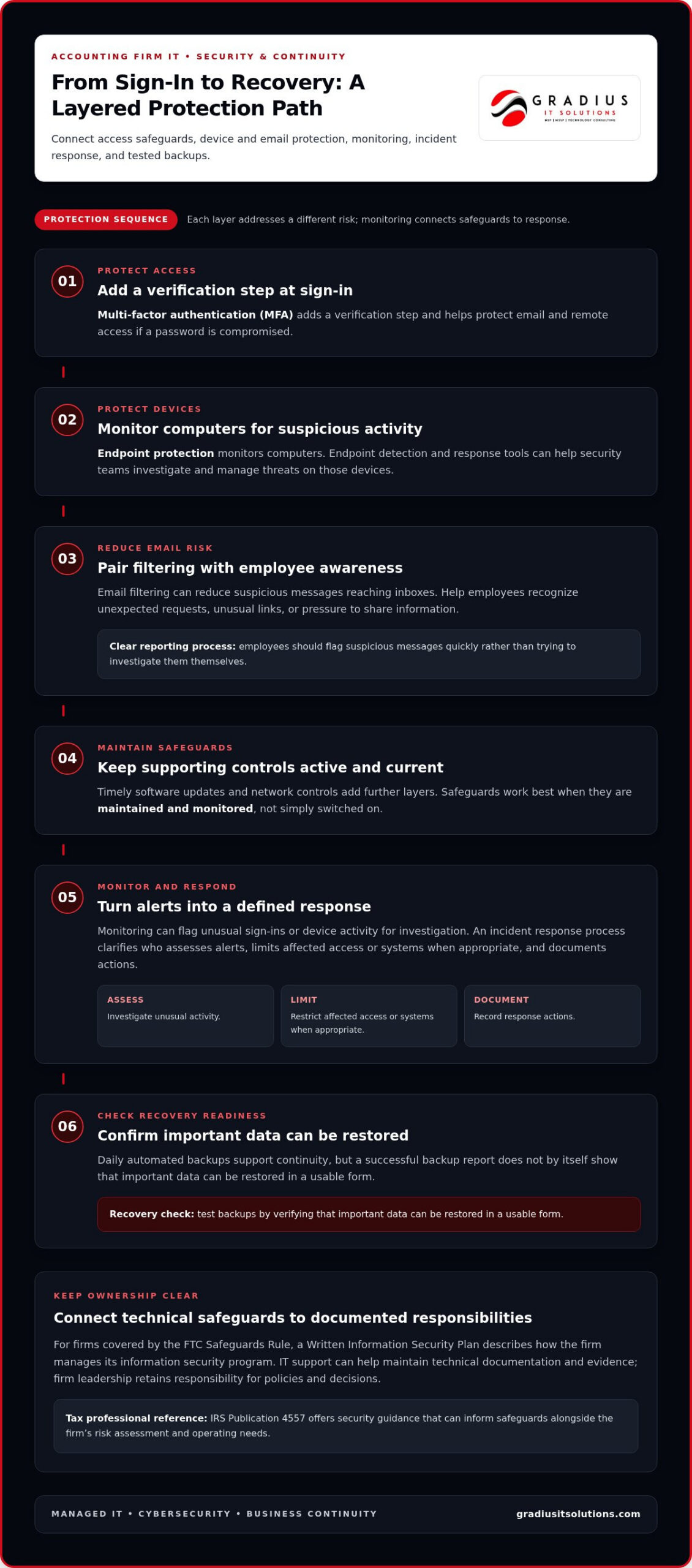
Protecting client data takes more than installing security software. Effective it support for accounting firms coordinates safeguards across user accounts, computers, email, networks, and stored data, then connects monitoring to a defined response process. Each control addresses a different risk. If one layer misses a problem, another may help limit its reach.
For example, multi-factor authentication (MFA) adds a verification step when someone signs in, helping protect email and remote access if a password is compromised. Endpoint protection monitors computers for suspicious activity. Endpoint detection and response tools can help security teams investigate and manage threats on those devices. Email filtering, employee awareness, timely software updates, and network controls add further layers. No single measure prevents every incident, but together these controls make common routes into firm systems harder to exploit.
How Layered Security Reduces Everyday Exposure
Controls work best when they’re maintained and monitored, not simply switched on. Monitoring can flag unusual sign-ins or device activity for investigation. An incident response process clarifies who assesses an alert, limits affected access or systems when appropriate, and documents actions. Tax practices can refer to the IRS Publication 4557 for security guidance aimed at tax professionals. Its recommendations can inform a firm’s safeguards alongside its own risk assessment and operating needs.
Phishing protection also depends on people. Filtering can reduce suspicious messages reaching inboxes, while staff awareness helps employees recognize unexpected requests, unusual links, or pressure to share information. Give employees a clear reporting process so they can flag a message quickly without trying to investigate it themselves.
How Backup and Disaster Recovery Support Continuity
A backup job that reports success is useful, but it doesn’t demonstrate on its own that important data can be restored in a usable form. Daily automated backups, with an off-site or immutable copy, provide a separate recovery source if primary data becomes unavailable or is affected. A restore test checks the practical next step: whether selected files or systems can be recovered and whether the result meets the firm’s needs.
A separate backup copy creates a recovery option; a documented restore test shows whether that option works in practice. Scheduled restore tests should record what was tested, the outcome, and any follow-up actions, with results shared with firm leadership. Gradius IT Solutions documents scheduled restore tests and shares their results with clients, making recovery readiness easier to review.
Connect these technical steps to written incident response and continuity plans. The plans should identify decision-makers, communication responsibilities, critical systems, and the order in which essential work resumes. A practical support model can align those documents with monitoring and recovery processes, so staff aren’t left to improvise during a disruption. Firms reviewing how these services fit together can explore managed IT support for accounting firms.
Fully Managed or Co-Managed IT Support: Which Model Fits an Accounting Firm?
The right support model depends on the firm’s internal capacity and how it wants responsibilities divided. With fully managed IT, a service partner centralizes day-to-day technology responsibilities. Co-managed IT adds specialist support to an internal team, with duties shared by agreement. Neither model is automatically better. The fit depends on who can consistently own helpdesk requests, system monitoring, security operations, vendor coordination, and technology planning.
Use the comparison below to start the discussion. It’s a guide to support needs, not a ranking of providers.
| Firm situation | Support-model consideration |
|---|---|
| No dedicated IT staff | Fully managed support can centralize everyday requests, maintenance, and escalation. |
| Small IT team with limited security capacity | Co-managed support can add monitoring or security expertise while staff retain defined duties. |
| Internal team handles daily needs but planning is inconsistent | Either model can clarify ownership of strategic planning, documentation, and recurring reviews. |
| Responsibilities vary by system or office | Map each responsibility and escalation path before deciding how support should be divided. |
When Fully Managed Support May Better Match Firm Needs
For a firm without dedicated IT capacity, a fully managed model can provide a clear route for staff requests and system issues. The service partner coordinates daily support, monitoring, and agreed security tasks, reducing the need for firm leaders to route every issue themselves. Centralized handling also makes escalation easier to follow. The service agreement should document what’s covered, who makes decisions, and where the firm retains responsibility.
When Co-Managed Support Can Complement an Internal Team
An internal IT person may know the firm’s systems and users well but have limited time for security monitoring or specialized investigations. Co-managed support can add those capabilities without replacing internal knowledge. For example, staff might handle user onboarding and local projects while the partner provides security operations, backup oversight, or escalation support. A clear division of duties helps both teams act without duplication or gaps.
Before choosing, write down how work will flow across shared responsibilities:
- User support: Identify who receives requests, handles common issues, and tracks unresolved cases.
- Monitoring and security: Define who reviews alerts, investigates concerns, and coordinates response actions.
- Projects and vendors: Assign a lead for technology changes and communication with software or service vendors.
- Planning: Set ownership for documenting priorities, risks, and upcoming technology needs.
Review the arrangement as the firm’s workload, systems, and internal capacity change. A managed IT services model can make these assignments part of a broader operating plan, aligning support ownership with continuity and technology priorities.
A Practical Readiness Plan for Accounting-Firm IT Support
A useful readiness review starts with the firm’s work, not a generic technology checklist. Leaders can clarify which systems matter most, where responsibilities sit, and what needs attention before a disruption or busy period. Use this sequence to prepare for a focused review of your IT environment and support model.
- Map users and systems. Record staff and role-based access, work devices, user accounts, cloud services, shared storage, email, and business-critical applications. Note which systems contain or provide access to client information, and who approves access changes when someone joins, changes roles, or leaves.
- Identify critical workflows. Trace the technology behind core tasks such as receiving client documents, preparing returns, reviewing files, and communicating with clients. Identify peak workloads, remote access needs, and systems that directly support client work. This helps leaders distinguish an inconvenience from an interruption that could delay a time-sensitive task.
- Review controls and support paths. Check how account access, device protection, email security, software maintenance, and network safeguards are managed. Confirm where employees report issues, who reviews security alerts, and how an incident is escalated. The goal is to expose unclear ownership and practical gaps, not to assume a tool alone resolves risk.
- Test recovery readiness. Review backup status and confirm that restore tests are scheduled, documented, and relevant to the systems the firm depends on. Discuss who initiates a recovery, who approves decisions, and how staff would access essential information if a primary system were unavailable.
- Document ownership and follow-up. Assign named roles for staff requests, security response, vendor coordination, approvals, and recovery. Record open issues, decisions, and next steps so leaders and support teams share the same understanding.
Inventory Systems, Responsibilities, and Critical Workflows
Keep the inventory practical and current. Include computers and mobile devices, user accounts, cloud services, accounting applications, email, file storage, and any tools that exchange data. Then map each service to an owner and an escalation contact. This gives a support team context to diagnose access and environment issues efficiently. A firm evaluating managed IT support for accounting firms can use this inventory to make scope and handoffs more concrete.
Review Recovery Evidence and Compliance Documentation
Gather current written security policies, incident response procedures, continuity plans, and records of recovery tests. Check that documents identify decision-makers and match how the firm actually operates. If a restore test found an issue, track the corrective action and its status. Compliance support can help organize documentation and audit evidence, but the firm remains responsible for its decisions and obligations.
Use the findings to prioritize practical improvements, clarify ownership, and set follow-up actions. Gradius IT Solutions’ free IT assessment includes a compliance gap analysis and cyber-insurance readiness review.
How Gradius Supports Accounting Firms with Managed IT and Cybersecurity
Accounting firms need IT operations, security, compliance support, and continuity planning to work together. Gradius IT Solutions brings these responsibilities under one accountable partner, helping clarify who supports staff, oversees security, and coordinates technology needs. The aim is a practical operating model that gives firm leaders visibility into technology responsibilities and how they support daily work.
What the Gradius Service Model Covers
Managed support brings together helpdesk, system monitoring and maintenance, Microsoft 365 management, and coordination with technology vendors. Staff can reach Gradius’ unlimited helpdesk support by phone, email, and chat for workplace technology issues. Separately, a U.S.-based SOC provides 24/7 monitoring and security operations, giving security events dedicated attention beyond routine user support.
Security protections address different parts of the environment. Multi-factor authentication helps strengthen sign-ins, endpoint protection monitors devices, email security helps manage suspicious messages, and patch management addresses software updates. Backup practices support recovery planning. Gradius’ layered cybersecurity services connect these safeguards with security operations and managed IT, helping clarify how protection fits into the firm’s broader technology environment.
The support arrangement can account for existing staff. A firm with internal IT resources can share responsibilities with Gradius, while a firm without dedicated IT staff can centralize more day-to-day work with its service partner. In either case, clear ownership helps employees understand where to bring requests and gives leaders a practical way to track support and security responsibilities.
What Happens During a Free IT and Cybersecurity Assessment
A free IT and cybersecurity assessment gives firm leaders a structured review of their technology environment, security posture, and operational priorities. Gradius provides a written assessment report within a week, giving the firm a documented basis for considering findings and planning next steps. The review connects technology decisions to the firm’s workflows, information protection priorities, and continuity needs.
After an assessment request, Gradius commits to responding within one business day. Firms can prepare by identifying key systems, current technology concerns, and questions about how internal and external responsibilities should fit together. This context keeps the discussion focused on the firm’s operations and the decisions leadership needs to make.
For additional strategic context, leaders can use a strategic cybersecurity services framework to connect security priorities with wider business planning. A focused discussion can help turn those priorities into practical actions without assuming every firm needs the same approach.
Schedule a free IT and cybersecurity assessment with Gradius IT Solutions to discuss your firm’s technology and security priorities.
Put Your Firm’s IT Priorities Into Motion
Turn technology concerns into clear decisions by starting with the questions that matter to firm leadership: which work must keep moving during peak periods, who owns each technology and security responsibility, and what needs attention first? A focused conversation can align those priorities with your firm’s capacity and plans.
The right it support for accounting firms should give leaders more than a list of technical tasks. It should create a workable path for strengthening operations, clarifying accountability, and making informed decisions about the systems your team relies on. You don’t need to solve every issue at once. Start with a practical assessment of where your firm stands and what to address next.
Schedule a free IT and cybersecurity assessment with Gradius IT Solutions to discuss your firm’s priorities.
Frequently Asked Questions
What does IT support for an accounting firm include?
IT support for accounting firms can include helpdesk assistance, system monitoring and maintenance, security oversight, backup planning, and compliance documentation. It can also maintain a clear record of technology changes and recurring issues. For example, documenting why an access setting changed can help the firm understand whether a sign-in problem followed a planned update. Reviewing helpdesk trends can reveal repeated friction, such as staff struggling with the same process. That record gives managers useful context for deciding whether to adjust a configuration, procedure, or training.
Can managed IT support work alongside an accounting firm’s internal IT staff?
Yes. To make a shared arrangement workable, agree on one source of truth for system changes, open issues, and approvals. A shared record helps internal staff and the service partner see what has already been tried and who owns the next action. Define which changes require firm approval, too. This reduces confusion during handoffs without forcing the internal team to give up its knowledge of the firm.
How can IT support help an accounting firm prepare for busy periods?
Support planning can help leaders spot operational pressure points before workloads rise. Review whether staff rely on the same shared resources, whether temporary staff need different access, and whether routine technology changes could affect important processes. A brief test of the firm’s issue-reporting and escalation route can also show whether employees know how to get help. These checks focus on readiness and coordination, not on promising that disruption won’t occur.
What should an accounting firm look for in a backup and recovery process?
Check that the recovery plan accounts for the dependencies needed to use restored information, not just the files themselves. A restored dataset may be difficult to use if the related application, configuration, or access method isn’t available. Clarify which records must be restored first, who confirms they’re usable, and how the firm will handle work created since the last available copy. Those decisions ground recovery planning in actual operations.
Does IT support for accounting firms include compliance documentation?
It can, but documentation is most useful when it reflects how the firm actually operates. Assign an owner to review policy changes, retain prior versions, and note why updates were made. During an internal review, this history can help explain how a control or process evolved. Firm leadership should also determine which records are relevant to its obligations and ensure technical documentation supports, rather than substitutes for, its compliance program.
What happens during a free IT and cybersecurity assessment with Gradius?
The assessment is a structured discussion of the firm’s technology environment and priorities. To make it productive, leaders can bring questions about recurring disruptions, upcoming changes, and decisions that need a clear owner. It’s also helpful to identify who should participate, such as the person responsible for technology and a firm leader who can set business priorities. That combination keeps the conversation connected to operational realities and decision-making.
Can an IT provider help coordinate with accounting software vendors?
Yes. Coordination is useful when a problem crosses the boundary between the firm’s environment and a software provider’s product. Agree in advance who is authorized to speak with the vendor, what information can be shared, and who tracks the issue through resolution. This creates a consistent communication trail and reduces the chance that separate teams investigate the same question without sharing findings.

Article by
Robert Joyce
**Robert Joyce** is the Founder, CEO, and Chief Technology Officer of Gradius IT Solutions, a security first provider of Managed IT Services, Cybersecurity, Cloud, Compliance, and Secure AI solutions serving businesses throughout New Jersey, New York, Connecticut, and across the United States.
With more than 28 years of IT experience, including 23 years supporting hedge funds, global banks, and wealth management firms, Robert has built a career designing and managing secure, resilient, and highly available technology environments where uptime, cybersecurity, and business continuity are essential.
His expertise includes Microsoft 365, cloud computing, cybersecurity, networking, infrastructure, disaster recovery, compliance, virtualization, and strategic IT leadership. Following the events of September 11, Robert helped rebuild critical technology infrastructure for Merrill Lynch, an experience that reinforced the importance of resilience, planning, and operational excellence.
Robert founded Gradius IT Solutions to bring enterprise level technology and security services to small and midsized businesses at a predictable monthly cost. Today, the company delivers fully managed and co managed IT services, cybersecurity, Microsoft 365, cloud solutions, compliance consulting, Secure AI consulting, technology projects, and vCIO services. Through a U.S. based 24/7 Help Desk and a nationwide network of trusted technology partners, Gradius supports organizations across the country with responsive, security focused technology solutions.
Robert partners with business owners and executive leaders to align technology with business goals, reduce risk, strengthen cybersecurity, improve productivity, and create long term IT strategies that support growth. His mission is simple: provide every client with enterprise class technology, exceptional service, and a trusted advisor they can rely on as their business evolves.
Disclaimer
## Disclaimer
The information provided in this article is for general informational and educational purposes only and should not be considered professional IT, cybersecurity, legal, regulatory, or compliance advice. While Gradius IT Solutions strives to provide accurate and up to date information, technology, security threats, and regulatory requirements change frequently, and we cannot guarantee that all information will remain current or applicable to your specific situation.
Every organization has unique technology, security, compliance, and business requirements. Before implementing any recommendations discussed in this article, you should evaluate their suitability for your environment or consult with a qualified technology professional.
Gradius IT Solutions makes no warranties, express or implied, regarding the completeness, accuracy, reliability, or results obtained from the use of this information. Any actions you take based on this content are at your own risk. Gradius IT Solutions shall not be liable for any direct, indirect, incidental, or consequential damages arising from the use of, or reliance upon, the information contained in this article.
References to third party products, services, or vendors are provided for informational purposes only and do not constitute an endorsement unless explicitly stated.
If you would like guidance tailored to your organization, contact Gradius IT Solutions to schedule a consultation with one of our technology experts.