
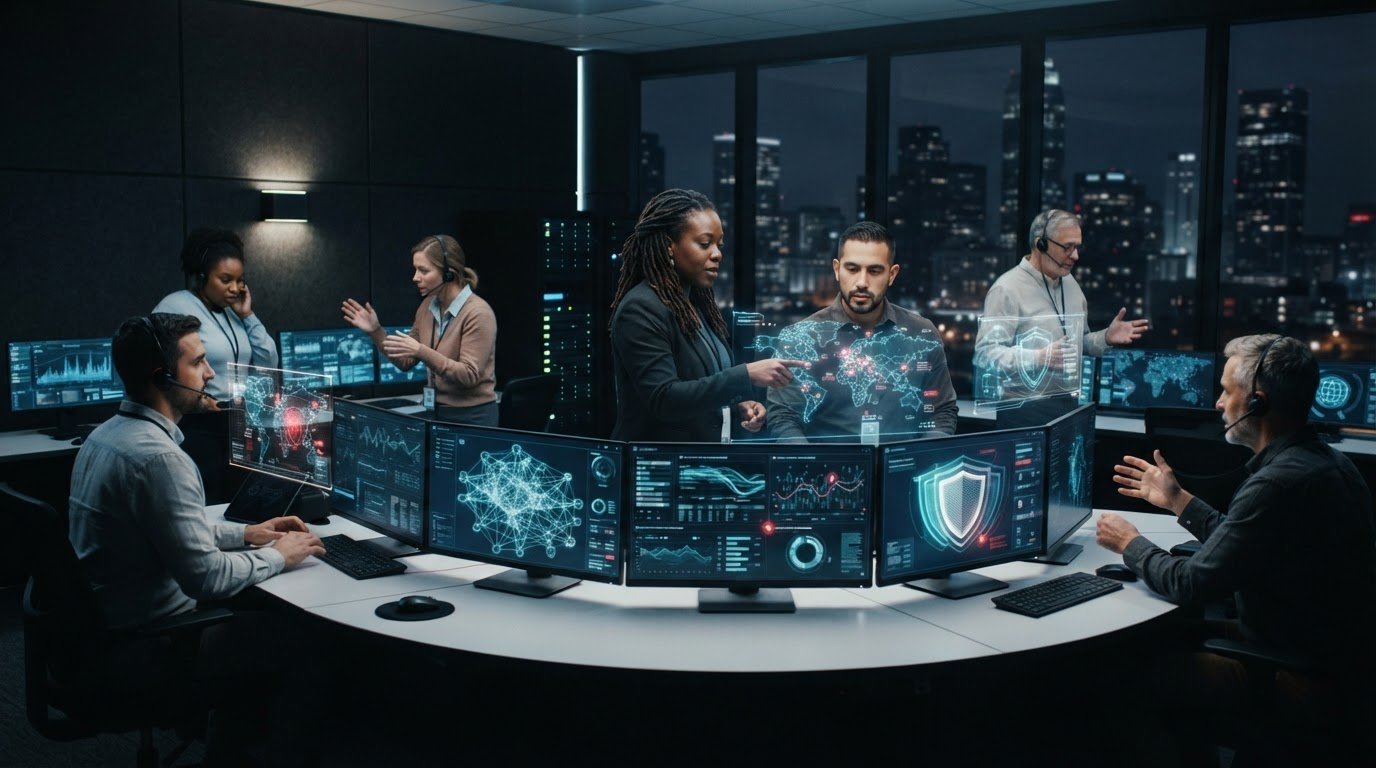
In 2026, a single data breach in the United States costs an average of $11.5 million. That isn’t just a statistic; it’s a business-ending reality for many mid-sized firms. Vulnerability exploitation has now surpassed stolen credentials as the primary way hackers break in. You’re likely facing sophisticated phishing and ransomware every day while your internal IT team struggles to monitor threats 24/7. It feels like you’re always one step behind the next regulatory change or SEC filing deadline.
We understand the stress of managing these risks with limited bandwidth. This guide reveals how ai powered threat intelligence moves your business beyond basic defense. You’ll discover how to shift from a reactive, “fix-it-when-it-breaks” mindset to a predictive posture that stops threats before they impact your bottom line. We’ll explore the difference between reactive and predictive security, provide a framework for evaluating AI partners, and show you how to ensure your business stays resilient in an increasingly automated world. It’s time to turn your cybersecurity from a cost center into a proactive shield for your operations.
Key Takeaways
- Shift your security posture from reactive patching to predictive defense by leveraging behavioral analysis and machine learning.
- See how ai powered threat intelligence decodes hidden patterns and dark web chatter to stop sophisticated attacks before they launch.
- Solve the crisis of alert fatigue by combining high-speed AI filtering with the strategic oversight of a human-led Security Operations Center.
- Start your resilience journey with a comprehensive cybersecurity assessment to identify gaps and implement foundational Zero Trust principles.
- Adopt a “Prevent-Instead-React” strategy to protect your bottom line and stay ahead of evolving 2026 regulatory requirements.
What is AI Powered Threat Intelligence?
At its core, ai powered threat intelligence is the strategic use of machine learning and natural language processing to collect, analyze, and prioritize global data at a scale no human team could manage. Traditional Cyber threat intelligence relied on manual updates and static lists of known “bad” files. Today, that isn’t enough. Modern intelligence acts as a living system that studies how hackers think and act, rather than just what they’ve done in the past.
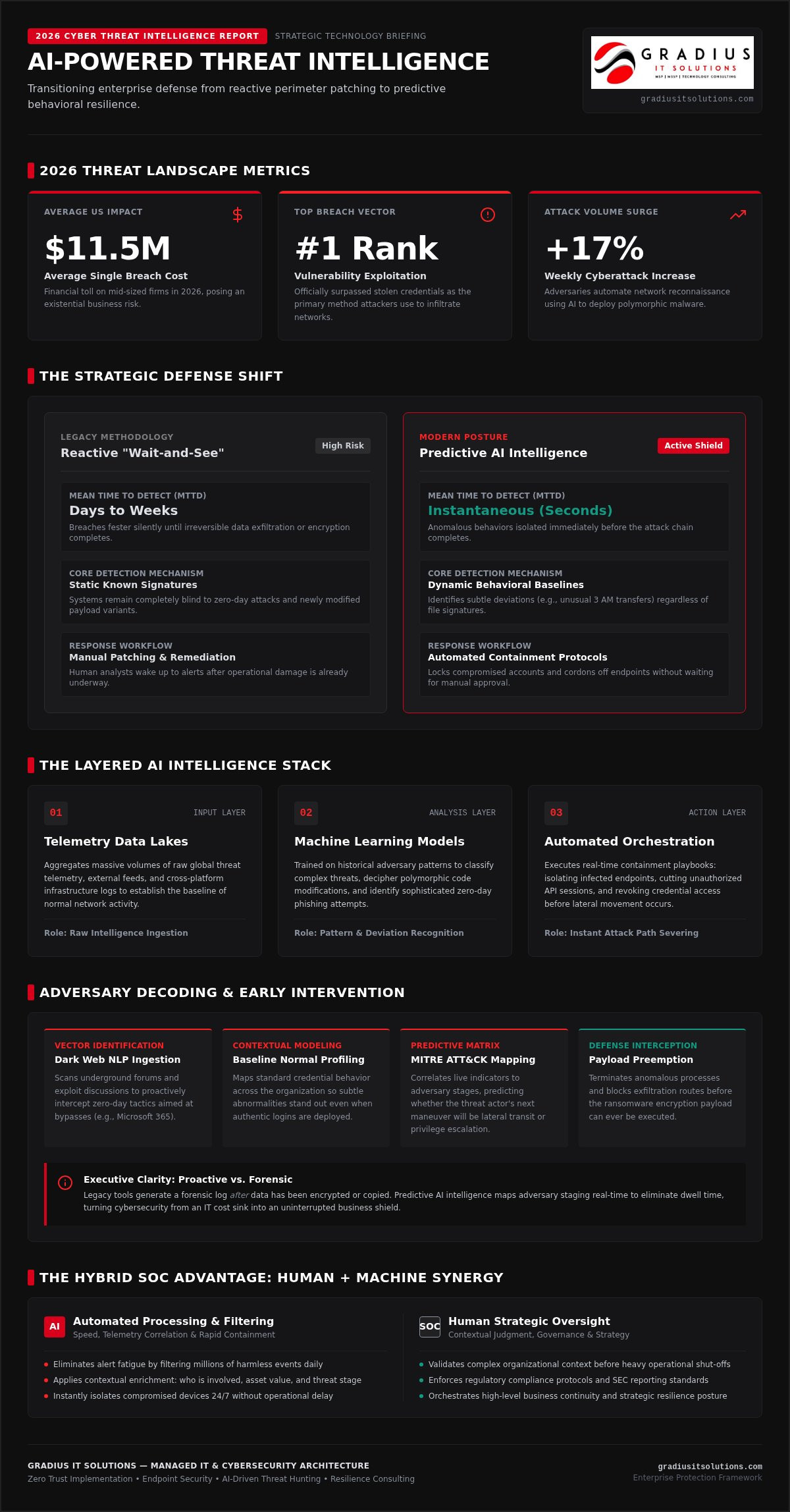
The evolution from signature-based detection to dynamic behavioral analysis marks a massive shift in business protection. In 2026, this isn’t optional. With weekly cyberattacks increasing by 17% this year, adversaries are using their own AI to automate reconnaissance and generate polymorphic malware. If your defense doesn’t match that speed, you’re already behind. The primary goal is simple: reduce the Mean Time to Detect (MTTD). While traditional methods might take days or weeks to spot a breach, ai powered threat intelligence aims to identify and isolate threats in seconds.
The Shift from Reactive to Predictive Defense
Reactive defense is a “wait and see” game. It relies on a known virus signature to trigger an alert. If the signature is new, the system stays silent. Predictive defense changes the math. It identifies anomalous behavior, like an unusual data transfer at 3 AM, which suggests a zero-day attack is forming before it actually executes. This proactive approach is the foundation of cybersecurity services that prioritize business continuity. By stopping the attack in its tracks, you drastically reduce the risk of data loss and expensive downtime.
Key Components of an AI Intelligence Stack
Building a resilient defense requires a sophisticated technical foundation. Through secure AI and automation services, firms can deploy a layered stack that includes:
- Data Lakes: These systems aggregate massive volumes of telemetry from global sources, providing the raw material for analysis.
- Machine Learning Models: These models train on historical attack patterns, allowing the system to recognize new variants of ransomware or phishing.
- Automated Orchestration: This triggers immediate containment protocols. It locks down compromised accounts or isolates infected devices without waiting for a human analyst to wake up.
This level of automation ensures your business operations remain stable, even when the threat landscape shifts overnight. It turns security from a reactive cost center into a reliable, proactive shield.
How AI Decodes Modern Cyber Threats
AI doesn’t just work faster than a human. It works smarter. While a traditional firewall looks for a specific “bad” file, ai powered threat intelligence looks for the behavior behind the file. It decodes the subtle digital fingerprints of threat actors across multiple vectors. This involves identifying patterns in how an attacker moves through a network, even if they’re using legitimate credentials. Since vulnerability exploitation is now the top breach vector in 2026, identifying these fingerprints early is the difference between a minor alert and a catastrophic breach.
One of the most powerful tools in this process is Natural Language Processing (NLP). AI systems scan the dark web and underground forums, translating “exploit talk” into actionable defense. If a hacker mentions a new way to bypass Microsoft 365 security, the AI flags that risk immediately. It then establishes a “baseline of normal” for your specific network behavior. When something deviates from that baseline, the system adds contextual enrichment. It doesn’t just say “there is an alert.” It tells you who is involved, what they’re trying to access, and why it’s a threat.
Predictive Analytics and the MITRE ATT&CK Framework
AI takes these insights and maps them to the MITRE ATT&CK framework, a globally recognized database of adversary tactics. This allows the system to predict the next move in a multi-stage ransomware attack. If an attacker gains initial access, the AI knows the likely next step is lateral movement or credential harvesting. For executive clarity: AI maps real-time behaviors to the MITRE framework to identify exactly which stage of a cyberattack is currently in progress. This foresight allows you to cut off the attack path before the final payload is delivered.
SIEM and EDR/XDR Integration
To be effective, intelligence needs a way to act. We view the Security Information and Event Management (SIEM) system as the “brain” that centralizes intelligence from all your tools. Endpoint Detection and Response (EDR) or Extended Detection and Response (XDR) act as the “hands,” executing AI-driven responses at the device level. When the brain spots a threat, the hands isolate the infected laptop or server in milliseconds. This seamless integration is a core part of modern cybersecurity services. If you aren’t sure where your current gaps are, a quick technology consultation can help you align these tools for maximum protection.
Human Analysts vs. AI: The Hybrid SOC Advantage
AI isn’t a replacement for human expertise; it’s a force multiplier. The current “Alert Fatigue” crisis is a massive risk for mid-sized firms. Security teams are often buried under thousands of notifications daily, which makes it easy to miss a real, sophisticated attack. ai powered threat intelligence solves this by filtering out the noise in real time. It handles the “what”-the massive data correlation and initial detection. This leaves the “so what”-the strategic investigation and high-impact decision-making-to experienced analysts who understand your specific business goals.
This hybrid model is the secret to “IT That Never Sleeps.” AI doesn’t get tired, blink, or take breaks. It monitors your network every second of every day. However, when a complex threat emerges, you need a specialist to orchestrate the containment. Humans provide the strategic layer that AI currently cannot replicate. This partnership reduces the average time to identify and contain a data breach, which currently sits between 247 and 277 days globally.
The Role of the US-Based SOC
For businesses in regulated sectors like financial services or legal, geographic location is critical. A US-based 24/7 Help Desk & SOC ensures your data handling aligns with SEC, FINRA, or HIPAA requirements. The synergy between AI speed and human intuition is vital during incident response. An analyst can quickly determine if an unusual data transfer is a legitimate business process or a breach attempt, preventing unnecessary lockouts that stall productivity. This domestic presence also means clearer communication when every second counts.
Reducing False Positives
One of the biggest drains on business efficiency is the “false positive.” These are the “crying wolf” moments of cybersecurity. AI systems improve by learning from human feedback, becoming more precise with every interaction. Modern AI-driven platforms can reduce alert fatigue by up to 90% in a SOC environment. This creates a smoother workflow for your employees. They won’t be interrupted by constant, incorrect security prompts. By drastically cutting down on noise, ai powered threat intelligence ensures that every alert your team receives is a high-priority event that requires immediate attention. It keeps your operations moving without the friction of unnecessary security hurdles.
Implementing AI Intelligence for Mid-Market Firms
Scaling enterprise-grade security down to a 50-person office doesn’t require a million-dollar budget or a massive internal IT department. It requires a lean, high-impact roadmap. For mid-market firms, ai powered threat intelligence is most effective when integrated into a structured five-step framework. This approach moves you away from disjointed tools and toward a unified shield. Integrating ai powered threat intelligence into your daily operations ensures that your defense is always active, even when your team is offline.
- Step 1: Cybersecurity Assessment. You can’t defend what you haven’t documented. Start by identifying where your sensitive data lives and who has access to it.
- Step 2: Zero Trust and MFA. Establish a foundation where no user or device is trusted by default. Multi-factor authentication is the absolute minimum requirement for every entry point.
- Step 3: AI-Powered EDR/XDR. Deploy ai powered threat intelligence at the endpoint level. These tools identify and block threats on individual laptops and servers before they can spread.
- Step 4: Managed SOC. Connect your tools to a US-based 24/7 Security Operations Center. This ensures that when an AI flags a threat at 2 AM, a professional is ready to respond.
- Step 5: vCISO Consulting. Use regular strategic sessions to optimize your stack. A virtual CISO helps you stay ahead of new threats and changing business needs.
Compliance-Aware AI Security
Regulated industries face increasing pressure to prove their security posture. For small financial institutions, the SEC’s amended Regulation S-P compliance deadline is June 3, 2026. This rule demands a written incident response program that many firms currently lack. AI-driven systems solve this by creating automated, unalterable audit trails of every threat detected and contained. This level of Compliance as a Service protects RIAs and law firms from heavy fines and reputational damage.
The Cloud and Microsoft 365 Factor
Most mid-sized businesses run their operations through the cloud. Hardening these environments is critical, especially with the rise of “Shadow AI” where employees use unapproved tools. By leveraging AI-powered phishing protection within Cloud & Microsoft 365 Services, you can secure a remote workforce without slowing them down. The AI identifies suspicious login patterns and malicious links in real time, keeping your team productive and safe from anywhere.
Future-Proofing Your Business with Gradius AI Solutions
In 2026, the traditional “fix-it-when-it-breaks” model of IT is officially dead. A “Prevent-Instead-React” philosophy is no longer a luxury for mid-market firms; it’s the only way to ensure survival. When you leverage ai powered threat intelligence, you aren’t just buying software. You’re investing in business resilience that shields your operations from the escalating frequency of automated attacks. We believe that elite protection shouldn’t be reserved for the Fortune 500. It belongs in the corner of every growing business that values its data and its reputation.
Gradius IT Solutions bridges the gap by providing enterprise-grade AI tailored specifically for businesses with 5 to 100 employees. Through our subscription-based AI-as-a-Service tiers, you gain access to the same high-performance tools used by global corporations but at a scale that fits your budget. This turns your technology stack into a strategic driver of productivity rather than a lingering expense. It’s about moving from a state of constant anxiety to one of unwavering confidence. We handle the complexity so you can focus on your growth.
Strategic Technology Planning
Technology moves fast, but your business strategy should be methodical. Our ai powered threat intelligence doesn’t just block malware; it provides a wealth of data that informs your long-term technology roadmap. By understanding where your vulnerabilities lie, we can prioritize upgrades that actually improve your bottom line. Our IT Consulting & Strategy services, led by experienced vCIOs, ensure your security posture always aligns with your growth goals. We help you anticipate the challenges of 2027 and beyond, staying three steps ahead of the adversary.
Your Next Steps to Resilience
Building a proactive shield starts with a single, decisive action. As you prepare for your next cyber-insurance renewal, having documented AI controls and a US-based SOC will be a significant advantage. Insurers are increasingly looking for evidence of predictive defense before offering favorable rates. A 30-minute, no-obligation consultation is all it takes to start mapping your path to a more secure future. We’ll review your current setup, identify immediate risks, and show you how to lift the burden of technical complexity from your shoulders. It’s time to partner with a team that is as committed to your success as you are.
Securing Your Competitive Edge in an Automated Era
The shift from reactive patching to predictive defense isn’t just a technical upgrade; it’s a strategic necessity. By 2026, the sheer speed of automated attacks requires a response that never blinks. ai powered threat intelligence provides that unwavering shield, allowing your business to anticipate risks before they disrupt your core operations. Our US-based 24/7 SOC and compliance-aware managed IT services ensure you meet stringent SEC and FINRA requirements while significantly reducing overall business risk. This proactive approach turns cybersecurity into a tangible driver of business resilience and long-term stability.
You don’t have to manage this technical complexity alone. With the right partner, you can transform your technology from a source of daily stress into a high-performance engine for sustainable growth. It’s time to move beyond mediocrity and embrace a security posture that stands firmly in your corner. We are here to lift the burden of technical management from your shoulders so you can focus on what matters most: scaling your business with complete confidence.
Take the first step toward a more secure and productive future today.
Frequently Asked Questions
How does AI-powered threat intelligence differ from traditional antivirus?
AI-powered threat intelligence focuses on behavior rather than just known file signatures. Traditional antivirus is reactive; it waits for a match in a database of previously identified threats. AI identifies anomalous patterns in real time, catching “zero-day” attacks that haven’t been documented yet. This shift from signature-based detection to dynamic analysis allows your business to stop sophisticated malware before it executes. It provides a much higher level of protection than basic legacy tools.
Is AI security too expensive for a small business with 20 employees?
AI security is highly accessible for a 20-employee firm through our subscription-based AI-as-a-Service tiers. You don’t need a massive enterprise budget to deploy these tools. By choosing a flat-fee, per-user model, you get predictable monthly costs and elite protection without expensive on-site hardware. This approach ensures that small businesses can leverage the same high-performance security stacks used by global corporations. It effectively levels the playing field against modern, automated cyber threats.
Can AI threat intelligence help my firm meet SEC or HIPAA compliance?
Yes, ai powered threat intelligence is a critical tool for meeting SEC and HIPAA compliance requirements. Regulators now demand written incident response programs and proof of customer data protection. AI systems provide automated, unalterable audit trails of every threat detected and contained. This documentation is essential during audits to prove you’ve implemented reasonable security controls. Our compliance-aware managed IT services specifically help Registered Investment Advisors and healthcare providers simplify these complex regulatory burdens.
What happens if the AI makes a mistake and blocks a legitimate user?
If an AI system blocks a legitimate user, our US-based 24/7 SOC analysts step in immediately to resolve the conflict. While AI is highly accurate, it works best in a hybrid model where human experts provide the final strategic decision. The system learns from these human corrections, becoming more precise over time. This process reduces false positives by up to 90%. It ensures that security doesn’t come at the cost of your team’s daily productivity or workflow.
Do I still need a human IT team if I have AI-powered security?
You absolutely still need a human IT team to oversee the strategic direction of your technology. AI handles the massive data correlation and initial threat detection, but humans are required for complex investigations, governance, and high-level decision-making. For organizations seeking to establish responsible AI policies and upskill staff across management and technical levels, Centrum voor IT provides specialized guidance and training. We provide a hybrid SOC model where our analysts work alongside the ai powered threat intelligence to manage incident response. This ensures your technology stays aligned with your specific business goals while the AI provides the speed needed to stop automated attacks.
Implementation is surprisingly fast because our managed AI platform integrates directly with your existing Microsoft 365 and Azure environments. There is no need for complex client-side hardware installations. Most mid-sized firms can deploy foundational AI-powered security within a few business days following a comprehensive cybersecurity assessment. We prioritize a smooth transition that minimizes disruption. This allows you to upgrade your defense posture quickly and efficiently without stalling your ongoing business operations.
How does AI help with cyber-insurance readiness?
AI intelligence significantly improves your cyber-insurance readiness by providing the documented controls insurers now demand. Most carriers require evidence of MFA, EDR, and 24/7 monitoring before offering favorable rates or renewals. We provide a free gap assessment to verify these controls as an insurer would. Having a proactive, AI-driven defense shows insurers that you’ve moved beyond basic reactive security. This helps you secure the coverage you need to protect your bottom line.
Does AI-powered security work for remote or hybrid workforces?
AI-powered security is specifically designed for the challenges of remote and hybrid workforces. By implementing Zero Trust principles and MFA, the system protects your data regardless of where your employees are located. It monitors for suspicious login patterns and malicious links in real time across all devices. This ensures that a remote laptop in a home office is just as secure as a desktop in your main headquarters. It maintains business continuity without sacrificing employee flexibility.

Article by
Robert Joyce
**Robert Joyce** is the Founder, CEO, and Chief Technology Officer of Gradius IT Solutions, a security first provider of Managed IT Services, Cybersecurity, Cloud, Compliance, and Secure AI solutions serving businesses throughout New Jersey, New York, Connecticut, and across the United States.
With more than 28 years of IT experience, including 23 years supporting hedge funds, global banks, and wealth management firms, Robert has built a career designing and managing secure, resilient, and highly available technology environments where uptime, cybersecurity, and business continuity are essential.
His expertise includes Microsoft 365, cloud computing, cybersecurity, networking, infrastructure, disaster recovery, compliance, virtualization, and strategic IT leadership. Following the events of September 11, Robert helped rebuild critical technology infrastructure for Merrill Lynch, an experience that reinforced the importance of resilience, planning, and operational excellence.
Robert founded Gradius IT Solutions to bring enterprise level technology and security services to small and midsized businesses at a predictable monthly cost. Today, the company delivers fully managed and co managed IT services, cybersecurity, Microsoft 365, cloud solutions, compliance consulting, Secure AI consulting, technology projects, and vCIO services. Through a U.S. based 24/7 Help Desk and a nationwide network of trusted technology partners, Gradius supports organizations across the country with responsive, security focused technology solutions.
Robert partners with business owners and executive leaders to align technology with business goals, reduce risk, strengthen cybersecurity, improve productivity, and create long term IT strategies that support growth. His mission is simple: provide every client with enterprise class technology, exceptional service, and a trusted advisor they can rely on as their business evolves.
Disclaimer
## Disclaimer
The information provided in this article is for general informational and educational purposes only and should not be considered professional IT, cybersecurity, legal, regulatory, or compliance advice. While Gradius IT Solutions strives to provide accurate and up to date information, technology, security threats, and regulatory requirements change frequently, and we cannot guarantee that all information will remain current or applicable to your specific situation.
Every organization has unique technology, security, compliance, and business requirements. Before implementing any recommendations discussed in this article, you should evaluate their suitability for your environment or consult with a qualified technology professional.
Gradius IT Solutions makes no warranties, express or implied, regarding the completeness, accuracy, reliability, or results obtained from the use of this information. Any actions you take based on this content are at your own risk. Gradius IT Solutions shall not be liable for any direct, indirect, incidental, or consequential damages arising from the use of, or reliance upon, the information contained in this article.
References to third party products, services, or vendors are provided for informational purposes only and do not constitute an endorsement unless explicitly stated.
If you would like guidance tailored to your organization, contact Gradius IT Solutions to schedule a consultation with one of our technology experts.