

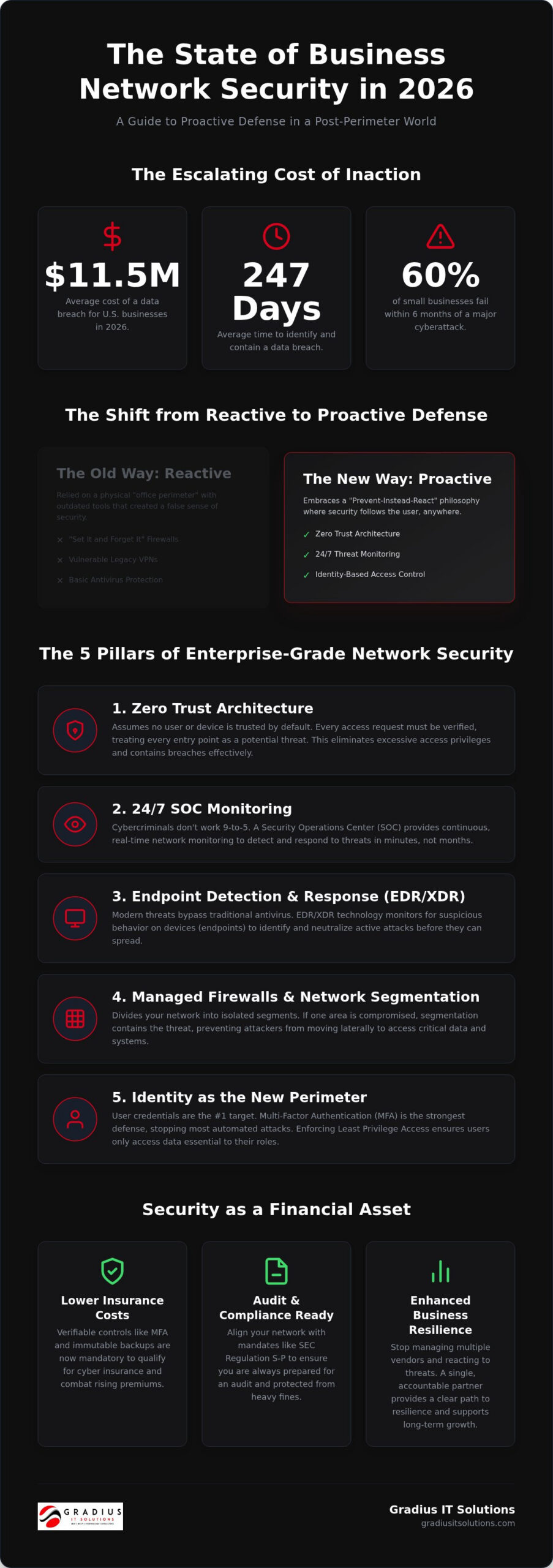
Did you know the average cost of a data breach for U.S. businesses has surged to $11.5 million in 2026? It’s a brutal reality that makes enterprise-grade business network security services a strategic necessity rather than a line-item expense. You’re likely exhausted by the cycle of rising cyber-insurance premiums and the moving targets of strict compliance mandates. It’s frustrating to feel like you’re paying more for protection while the jargon only gets thicker and the threats get faster.
We understand that you need a network that just works: secure, compliant, and ready for any audit. This guide cuts through the noise to show you how to shield your corporate data and lower your insurance costs through a single, accountable partnership. We’ll explore the path to 24/7 protection and a resilient infrastructure that keeps your team productive without the need for a massive internal IT staff. It’s time to stop reacting to threats and start building a foundation that supports your growth and long-term resilience.
Key Takeaways
- The office perimeter is gone. Modern business network security services protect your data across hybrid environments by replacing outdated VPNs with Zero Trust architecture.
- Detection is the new prevention. 24/7 SOC monitoring acts as a proactive guardian, catching threats in real time to minimize the financial impact of a breach.
- Stay ahead of the regulators. Aligning your network with 2026 mandates like SEC Regulation S-P ensures your firm is audit ready and protected from heavy fines.
- Lower your insurance costs. Verifiable security controls like MFA and immutable backups are now mandatory to qualify for coverage and combat rising premiums.
- Stop managing multiple vendors. A single accountable partner for IT and security eliminates technical gaps while providing a clear path to business resilience.
Why Your Business Network is the New Security Perimeter
The traditional office perimeter has collapsed. In 2026, your network isn’t just the physical cables in your office. It’s every home Wi-Fi connection, every mobile device, and every cloud account your team uses. Legacy tools like VPNs are no longer sufficient because they often grant too much access once a single credential is stolen. They create a false sense of security while leaving your back door wide open.
Holistic business network security services address this by focusing on data integrity across your entire digital ecosystem. This approach moves beyond simple hardware to include foundational network security concepts like identity management and behavioral analytics. Modern network security is a layered defense-in-depth strategy that protects every touchpoint of your digital infrastructure. It’s about building a resilient environment where security follows the user, regardless of their location.
The cost of “good enough” security is often terminal. Research shows that 60% of small businesses that suffer a major cyberattack go out of business within six months. Relying on basic protection is a gamble with your company’s future. Investing in comprehensive business network security services is the only way to ensure your doors stay open after a threat actor targets your systems.
The Shift from Reactive to Proactive Defense
Buying a firewall and walking away is a recipe for disaster. Static hardware can’t keep up with AI-powered threats that evolve by the hour. A “set it and forget it” mentality leaves your business vulnerable to zero-day exploits that bypass traditional signatures. We advocate for a “Prevent-Instead-React” philosophy. This requires real-time threat intelligence to stop attacks before they breach your systems. To implement this effectively, many organizations leverage the professional training and consultancy of Insoft Services to empower their security teams. By anticipating moves instead of just cleaning up the mess, you maintain business continuity and protect your reputation.
The ROI of Managed Security Operations
Effective security is a profit center: it builds trust and saves millions. The 2026 IBM Cost of a Data Breach Report shows the average U.S. breach cost has reached $11.5 million. Much of that cost stems from the time it takes to find the problem. The current mean time to identify and contain a breach is 247 days. Comprehensive Managed IT Services reduce this detection time from months to minutes. This efficiency saves money while keeping your employees focused on their work rather than dealing with IT downtime.
The 5 Pillars of Enterprise-Grade Network Security Services
Resilience isn’t a single product. It’s a structure built on integrated layers. For businesses in 2026, enterprise-grade business network security services must rest on five specific pillars to withstand modern threats. These layers work together to ensure that a failure in one area doesn’t lead to a total system collapse.
Zero Trust Architecture is the first pillar. It assumes every user and device is a potential threat. You must verify every request before granting access. Next is 24/7 SOC Monitoring. Cybercriminals don’t work 9 to 5. “IT That Never Sleeps” means having a Security Operations Center watching your network every second. Third, replace basic antivirus with Endpoint Detection and Response (EDR) or XDR. These tools don’t just look for known “bad” files; they watch for suspicious behavior and stop attacks in progress. Fourth, managed firewalls coupled with network segmentation ensure that even if one area is breached, the rest of your data remains isolated. This integrated approach is why modern business network security services are the foundation of a “Prevent-Instead-React” strategy.
Identity as the New Perimeter: MFA and Access Control
Identity is the most vulnerable entry point for hackers. Multi-factor authentication (MFA) is your strongest defense against Business Email Compromise (BEC). It stops the vast majority of automated phishing attacks instantly. We also implement Least Privilege Access. This means employees only have the keys to the data they need for their specific jobs. This strategy limits lateral movement by attackers who manage to slip through initial defenses. Reviewing your current posture with comprehensive cybersecurity services is the best way to close these identity gaps. The Federal Trade Commission provides excellent Cybersecurity guidance for businesses to help you understand these risk management fundamentals.
Continuous Patching and Vulnerability Management
Software bugs are the open windows of your digital house. In a world of automated exploit kits, “patching lag” is a death sentence. Automated patch management is critical for remote and hybrid teams who aren’t always behind your office firewall. It ensures every device stays current without relying on user intervention. It is a staggering reality that 80% of breaches involve unpatched vulnerabilities. Proactive management eliminates this low-hanging fruit and hardens your systems against known exploits. If you’re managing these pillars across multiple vendors, it’s easy for things to slip through the cracks. Working with a single accountable IT partner ensures your defense strategy is unified and effective.
Compliance-Aware Security: Moving Beyond Basic Protection
Generic security is a liability for regulated firms. If you’re an RIA, a wealth manager, or a law firm, a “standard” firewall is just the beginning. Regulators don’t care about your intentions; they care about your documentation and your defensive maturity. This is where Compliance for Financial Services bridges the gap between IT and legal requirements. We treat business network security services as a continuous, audit-ready operation rather than a one-time setup. It’s about ensuring your infrastructure meets the specific, high-bar standards of your industry.
True resilience requires a “Compliance as a Service” (CaaS) model. This ensures that your security controls evolve alongside changing laws. For example, the amended SEC Regulation S-P requires smaller RIAs to comply by June 3, 2026. This mandate includes adopting written policies for incident detection and providing breach notifications within 30 days. If your network doesn’t automatically generate the logs needed to prove these actions, you’re already in violation. Modern business network security services must provide the transparency and reporting necessary to satisfy these aggressive regulatory timelines.
Meeting SEC and FINRA Cybersecurity Mandates
SEC rules and FINRA Rule 4370 demand more than just a password. You need robust data encryption for all sensitive financial information, both at rest and in transit. A deep IT Risk Assessment Services review can identify where your current encryption fails to meet these standards. Continuous monitoring ensures that any deviation from these mandates is caught and corrected before an auditor walks through the door. This isn’t just about avoiding fines. It’s about protecting the client trust that sits at the core of your business.
HIPAA and Legal Industry Standards
Law firms and healthcare providers face unique pressures to protect Protected Health Information (PHI) in cloud-first environments. You need a Written Information Security Policy (WISP) that isn’t just a document in a drawer. It must be a living strategy reviewed annually to reflect new threats. Our 24/7 SOC monitoring directly satisfies the “continuous oversight” requirement found in many modern regulations. It provides the verifiable proof of supervision that insurers now demand before they’ll even quote a premium. This proactive stance turns your security from a cost center into a documented business asset that protects your firm from both hackers and regulators.
Cyber-Insurance Readiness: Turning Security into a Financial Asset
Cyber insurance used to be a simple box to check. In 2026, underwriters are the new gatekeepers of corporate risk. They use rigorous technical gap assessments to decide if you’re even worth the gamble. If your business network security services don’t meet their specific criteria, you face astronomical premiums or a flat rejection. Cyber insurance premiums are projected to increase by 15% to 20% this year. This isn’t just about protection; it’s about financial eligibility.
The 2026 baseline for insurability is clear. Insurers demand Multi-Factor Authentication (MFA), Endpoint Detection and Response (EDR), and immutable backups. Without these, your policy might as well be a piece of scrap paper. Ransomware now accounts for 60% of the value of large cyber insurance claims. Because of this, insurers have stopped taking your word for it. They want evidence. You must prove your controls are active, monitored, and tested. A failed audit leaves your business exposed to unmanageable risk that could end your operations if a breach occurs.
Conducting a Security Gap Assessment
Identifying vulnerabilities before an underwriter does is the only way to stay ahead. We map your current controls against the NIST Cybersecurity Framework 2.0. This includes the “Govern” function to ensure your security aligns with overall enterprise risk management. A remediation roadmap then closes those holes before your next renewal cycle. Strategic IT Consulting and Strategy ensures your technology stack isn’t just functional; it’s insurable. This proactive approach turns your security posture into a verifiable financial asset.
The Role of Immutable Backups in Insurance
Insurers now mandate off-site, immutable copies of your corporate data. These are backups that cannot be changed, encrypted, or deleted, even by a ransomware attacker with stolen admin credentials. It’s the ultimate safety net for business continuity. We go beyond just storage by testing restore procedures to guarantee your Recovery Time Objectives (RTO). If you can’t prove you can recover within a specific window, you aren’t truly ready for 2026. High-performance business network security services integrate these backups into a single, resilient defense strategy.
Get your cyber-insurance readiness assessment today
Scaling with a Single Accountable IT & Cybersecurity Partner
Managing multiple vendors for IT, security, and compliance is a recipe for operational gaps. Most executives end up with “vendor fatigue,” where different providers point fingers at each other when something breaks. This fragmented approach leaves your data vulnerable and your team frustrated. A unified model eliminates this friction. By choosing one partner for your business network security services, you gain a single point of accountability. It’s the “one neck to wring” philosophy that simplifies your management. You get one bill and one team that understands every inch of your infrastructure.
Our flat-fee predictable pricing removes the conflict of interest inherent in the “billable hour” model. We aren’t looking to profit from your downtime; we’re incentivized to keep your systems running perfectly. Gradius IT Solutions acts as your strategic vCIO and security guardian. We don’t just fix computers. We align your technology stack with your business goals, ensuring you stay three steps ahead of both competitors and hackers. This partnership allows you to scale your operations without the constant fear of a security-related setback.
24/7 Support and On-Site Engineering
Fast resolution requires immediate access to experts who know your environment. Our U.S.-based 24/7 Help Desk ensures your team never sits idle while waiting for a response. Whether it’s a midnight security alert or a mid-day software glitch, we’re already on it. For physical needs, we provide nationwide support capabilities through our strategic partner network. This blend of remote vigilance and on-site engineering is a core part of The Executive Guide to Managed IT Services. You get the protection of a large-scale firm with the personalized touch of a dedicated partner.
Getting Started: The 30-Minute Assessment
Securing your business for 2026 starts with understanding where you stand today. Our free IT and Cybersecurity Assessment is a high-impact session designed for busy executives. We don’t just hand you a list of technical jargon. You’ll receive a clear compliance gap analysis and an insurance readiness report. This roadmap shows you exactly how to optimize your technology stack and harden your defenses. It’s a risk-free way to see how comprehensive business network security services can transform your operations from a source of stress into a driver of resilience. We take the burden of complexity off your shoulders so you can focus on growth.
Securing Your Competitive Advantage for 2026
The digital landscape of 2026 demands more than just basic protection. It requires a resilient foundation where security and compliance are woven into every operation. You’ve seen how the office perimeter has shifted to user identity and how insurers now dictate technical standards. Relying on fragmented tools or reactive support is no longer a viable strategy for growth.
By partnering with a single accountable guardian, you eliminate technical gaps and simplify your management. High-performance business network security services provide the 24/7 U.S.-based SOC and Help Desk oversight needed to catch threats before they become disasters. This approach is especially critical for RIAs and law firms who must meet strict regulatory mandates while maintaining client trust.
Taking control of your technology stack starts with a clear understanding of your current posture. A free cyber-insurance readiness review can reveal hidden vulnerabilities before they impact your premiums. You don’t have to navigate these complexities alone. We’re here to help you build a network that is secure, audit-ready, and entirely under your control.
Frequently Asked Questions
What are business network security services?
Business network security services are a comprehensive set of technologies and processes designed to protect your data, users, and infrastructure. This includes everything from managed firewalls and Zero Trust architecture to 24/7 monitoring and endpoint protection. It’s not just a software install; it’s a continuous operation that ensures your digital environment remains resilient against evolving AI-powered threats and strict regulatory requirements.
How much does network security cost for a small business?
Costs vary based on the size of your team and the complexity of your compliance needs. Most small businesses find that a predictable flat-fee model is more cost-effective than hiring a full-time internal security team. Instead of looking at it as an expense, view it as an investment in business continuity. Avoiding a single breach, which averages $11.5 million in the U.S., provides an immediate return.
Does my business need a SOC (Security Operations Center)?
Yes, if you handle sensitive data or operate in a regulated industry like finance or law. A SOC provides the “IT That Never Sleeps” vigilance required to detect and contain threats in real time. Without 24/7 monitoring, a breach could go unnoticed for months. A U.S.-based SOC ensures that expert eyes are watching your network every second, satisfying both insurance requirements and regulatory oversight mandates.
Can managed network security help me get cyber-insurance?
Absolutely, and it’s often the only way to qualify in 2026. Insurers now require verifiable proof of controls like MFA, EDR, and immutable backups. Professional business network security services include readiness assessments that map your current posture against underwriter requirements. We help you close technical gaps and provide the documentation needed to secure coverage and combat the 15% to 20% premium increases seen across the industry.
What is the difference between an MSP and an MSSP?
An MSP (Managed Service Provider) focuses on the availability and performance of your IT systems. An MSSP (Managed Security Service Provider) focuses specifically on the security of those systems. Gradius IT Solutions combines both into a single accountable partner model. This unified approach ensures your network is both fast and secure, eliminating the communication gaps that often occur when managing IT and security through separate vendors.
Is Microsoft 365 secure enough for my business network?
Microsoft 365 is a powerful platform, but it isn’t secure by default for every business. It requires proper configuration of advanced security features like Conditional Access, Intune, and Defender for Office 365. Many businesses leave their cloud accounts vulnerable because they haven’t implemented Zero Trust principles or MFA correctly. Strategic security management ensures your Microsoft environment is hardened against credential theft and Business Email Compromise.
How often should we perform a network security audit?
You should perform a comprehensive audit at least once a year, though many regulations now require continuous monitoring. If your business undergoes significant changes, like moving to a hybrid work model or adopting new AI tools, you need an immediate review. Regular audits ensure your security policies stay current and your controls remain effective against new exploits. Proactive assessments help you stay ahead of auditors and hackers alike.
What happens if our business network is breached?
If a breach occurs, your incident response plan must activate immediately. This includes containing the threat, notifying affected parties within 30 days as required by SEC Regulation S-P, and restoring data from immutable backups. The financial impact can be devastating, as 60% of small businesses fail within six months of a major attack. Having a 24/7 SOC partner ensures the mean time to detect is minutes, not months.

Article by
Robert Joyce
**Robert Joyce** is the Founder, CEO, and Chief Technology Officer of Gradius IT Solutions, a security first provider of Managed IT Services, Cybersecurity, Cloud, Compliance, and Secure AI solutions serving businesses throughout New Jersey, New York, Connecticut, and across the United States.
With more than 28 years of IT experience, including 23 years supporting hedge funds, global banks, and wealth management firms, Robert has built a career designing and managing secure, resilient, and highly available technology environments where uptime, cybersecurity, and business continuity are essential.
His expertise includes Microsoft 365, cloud computing, cybersecurity, networking, infrastructure, disaster recovery, compliance, virtualization, and strategic IT leadership. Following the events of September 11, Robert helped rebuild critical technology infrastructure for Merrill Lynch, an experience that reinforced the importance of resilience, planning, and operational excellence.
Robert founded Gradius IT Solutions to bring enterprise level technology and security services to small and midsized businesses at a predictable monthly cost. Today, the company delivers fully managed and co managed IT services, cybersecurity, Microsoft 365, cloud solutions, compliance consulting, Secure AI consulting, technology projects, and vCIO services. Through a U.S. based 24/7 Help Desk and a nationwide network of trusted technology partners, Gradius supports organizations across the country with responsive, security focused technology solutions.
Robert partners with business owners and executive leaders to align technology with business goals, reduce risk, strengthen cybersecurity, improve productivity, and create long term IT strategies that support growth. His mission is simple: provide every client with enterprise class technology, exceptional service, and a trusted advisor they can rely on as their business evolves.
Disclaimer
## Disclaimer
The information provided in this article is for general informational and educational purposes only and should not be considered professional IT, cybersecurity, legal, regulatory, or compliance advice. While Gradius IT Solutions strives to provide accurate and up to date information, technology, security threats, and regulatory requirements change frequently, and we cannot guarantee that all information will remain current or applicable to your specific situation.
Every organization has unique technology, security, compliance, and business requirements. Before implementing any recommendations discussed in this article, you should evaluate their suitability for your environment or consult with a qualified technology professional.
Gradius IT Solutions makes no warranties, express or implied, regarding the completeness, accuracy, reliability, or results obtained from the use of this information. Any actions you take based on this content are at your own risk. Gradius IT Solutions shall not be liable for any direct, indirect, incidental, or consequential damages arising from the use of, or reliance upon, the information contained in this article.
References to third party products, services, or vendors are provided for informational purposes only and do not constitute an endorsement unless explicitly stated.
If you would like guidance tailored to your organization, contact Gradius IT Solutions to schedule a consultation with one of our technology experts.