

Did you know that 60% of small businesses that suffer a significant cyberattack go out of business within six months? You’ve worked hard to build your company. The thought of a single breach wiping out years of progress is exhausting. Between the pressure of SEC Regulation S-P deadlines and the surge in AI-driven phishing, managing your own cybersecurity services feels like a high-stakes burden you shouldn’t have to carry alone.
It’s natural to feel overwhelmed by complex compliance rules and unpredictable IT costs. This guide will show you how to move from a reactive “break-fix” mindset to a state of total operational resilience. You’ll learn to master the essentials of modern protection to ensure your business is audit-ready and shielded from the latest AI-driven threats. We’re moving beyond technical jargon to focus on what matters: your bottom line.
We’ll break down the 2026 regulatory landscape, the shift toward Zero Trust standards, and how a proactive partnership can turn security into a foundation for growth. It’s time to stop worrying about what might happen and start building a resilient future.
Key Takeaways
- Shift your strategy from reactive “break-fix” support to a proactive model using integrated cybersecurity services designed for 2026 threats.
- Identify the essential pillars of modern defense, including 24/7 SOC monitoring and advanced EDR solutions that provide constant vigilance.
- Navigate complex regulatory requirements like SEC Regulation S-P and HIPAA with a compliance-aware framework that ensures you’re always audit-ready.
- Adopt Zero Trust principles and Secure AI to automate threat detection while eliminating the security gaps found in traditional network configurations.
- Simplify your technology stack by choosing a single accountable partner who provides U.S.-based expertise and a “Prevent-Instead-React” philosophy.
What Are Cybersecurity Services in 2026?
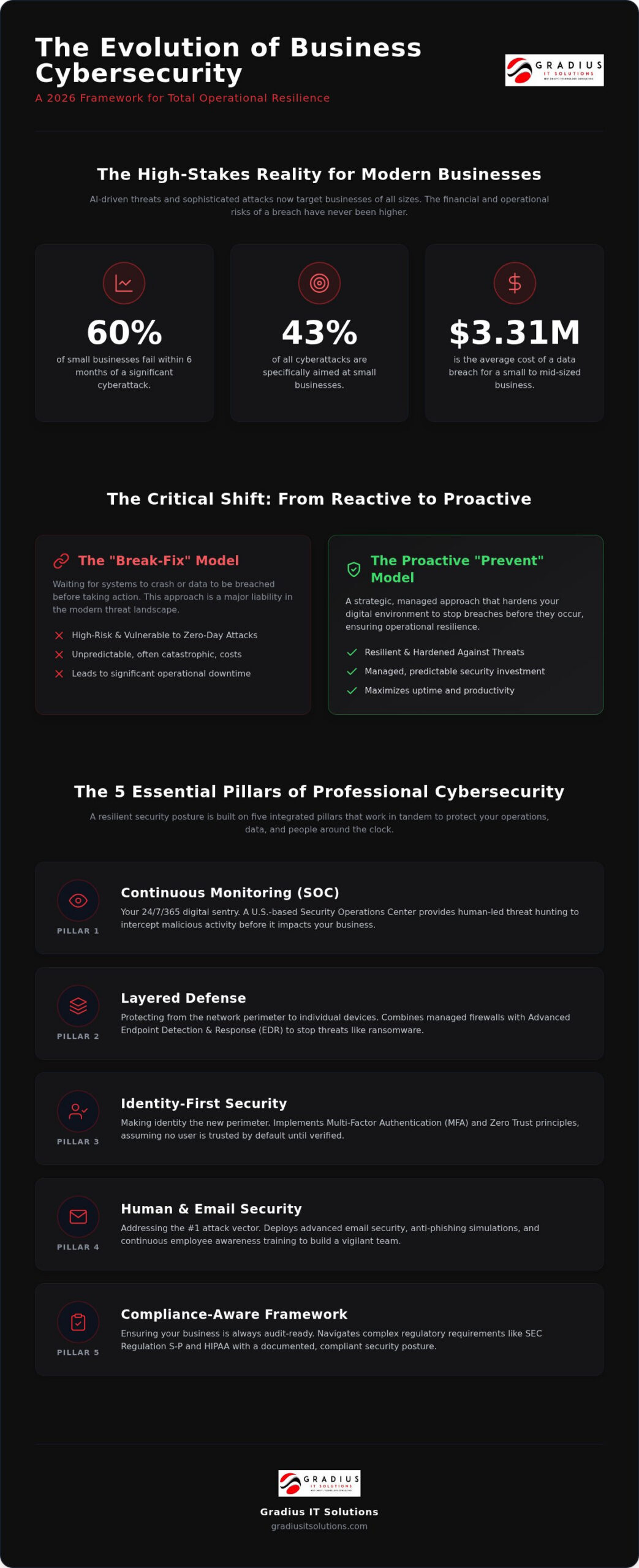
In 2026, What Are Cybersecurity Services is a question that demands a strategic answer. They aren’t just software packages or “set and forget” tools. Instead, they’re a layered suite of professional solutions designed to shield your digital assets from increasingly sophisticated threats. The old “break-fix” model, where you only call for help when a system crashes, is now a major liability. Modern cybersecurity services represent a total shift toward proactive, managed security operations that function around the clock.
The threat landscape has changed significantly. Research shows that 43% of all cyberattacks now target small businesses. These aren’t random hits. Attackers use AI to automate vulnerability discovery and launch precision strikes. This reality requires more than just a defensive posture. It requires operational resilience. If your systems fail, your revenue stops. Proactive security ensures your business continues to run, no matter what the digital world throws at it.
Moving Beyond Basic Defense
Simple firewalls and basic antivirus software are no longer enough for modern firms. They’re reactive by nature. They wait for a known threat to appear before taking action. In 2026, firms need threat intelligence and real-time monitoring to identify “zero-day” exploits before they can do damage. Our “Prevent-Instead-React” philosophy is the new standard. We don’t just focus on recovery. We focus on hardening your environment to stop the breach from happening in the first place. It’s about being the proactive guardian of your data and your reputation. For businesses seeking to understand why this shift in strategy is vital, ITS Canada Inc offers a clear perspective on the benefits of choosing a proactive technology partner.
Robust security is a direct path to cost reduction and risk mitigation. According to a 2026 IBM report, the average cost of a data breach for an SMB has climbed to $3.31 million. That’s a staggering figure that can end a company. By investing in comprehensive cybersecurity services, you’re buying peace of mind. You’re protecting your brand’s reputation. Clients trust you with their most sensitive data. Guarding that trust is essential for long-term growth. Secure workflows also improve productivity by removing the friction and fear of technical failures.
Cybersecurity services are a strategic business asset that fuels growth by providing the stability and trust required to compete in a digital economy.
The 5 Essential Pillars of Professional Cybersecurity
Building a resilient business foundation requires more than a patchwork of software. It demands a structural approach. In 2026, professional cybersecurity services are built on five specific pillars that work in tandem to shield your operations. These pillars move your firm away from a vulnerable state into a position of high-performance security. They ensure that your data stays private, your workflows remain uninterrupted, and your compliance status remains green.
Continuous Monitoring: The Role of the SOC
A Security Operations Center (SOC) is your 24/7 digital sentry. Unlike basic software that only flags known viruses, a U.S.-based SOC provides constant vigilance. It intercepts threats before they impact your operations. There’s a massive difference between automated alerts and human-led threat hunting. Expert analysts in a SOC/NOC support role can distinguish between a routine login and a sophisticated breach attempt in real time. This human element is what prevents a minor incident from becoming a headline-making disaster.
Layered Defense: From Firewalls to Endpoints
Your network perimeter is the first line of defense. Robust managed firewall services act as a high-tech gatekeeper. They filter out malicious traffic before it touches your internal systems. However, the modern office isn’t just a physical building. It’s a collection of laptops, phones, and tablets. This is why Advanced Endpoint Detection and Response (EDR) is critical. It monitors every device for suspicious behavior, stopping ransomware in its tracks. You can find many helpful cybersecurity services and tools to help assess your current posture, but professional management ensures these tools are configured correctly and patched weekly.
The remaining pillars focus on the human and data elements of your business. Multi-Factor Authentication (MFA) and Zero Trust principles ensure that identity is the new perimeter. We assume no one is trusted by default. This is paired with advanced email security and anti-phishing simulations. Since phishing remains a primary entry point for hackers, training your employees to spot fakes is just as important as your firewall. Finally, immutable backups serve as your ultimate safety net. With ransomware figuring into 88% of SMB breaches, having data that cannot be changed or deleted by an attacker is your only guarantee of total data integrity.
If you’re unsure if your current setup covers all five pillars, it’s time to review your security posture with a strategic partner who understands the 2026 threat landscape.
Compliance-Aware Cybersecurity: Why Your Industry Matters
A “one size fits all” approach to security is a dangerous gamble. In 2026, the regulatory environment has shifted from suggested best practices to strictly enforced mandates. If you’re a business owner in a regulated sector, your cybersecurity services must be as much about legal defense as they are about technical protection. Compliance is no longer a checkbox. It’s a fundamental part of your business resilience strategy that protects your license to operate.
Navigating Financial and Legal Regulations
Financial services firms, especially Registered Investment Advisers (RIAs) and broker-dealers, face intense scrutiny. The SEC’s amended Regulation S-P required smaller firms to be fully compliant by June 3, 2026. This means you must have a written incident response program and the ability to notify customers within 30 days of a breach. Failing to meet these standards isn’t just a technical oversight. It’s a regulatory failure that invites heavy fines and reputational ruin. We help firms align with compliance for financial services by integrating The 5 Essential Pillars of Professional Cybersecurity through the NIST framework. This ensures your data protection is both robust and defensible during an audit.
Legal and healthcare sectors face similar pressure. HIPAA standards require strict access controls and encrypted workflows to protect sensitive patient data. Architecture and engineering firms also deal with highly sensitive intellectual property that requires specialized defense. Our Compliance as a Service (CaaS) model simplifies this complexity. It provides a single point of accountability for your IT, security, and regulatory needs. We handle the policy documentation, asset inventories, and regular risk assessments. This proactive approach ensures you’re always audit-ready, shifting the burden of proof from your shoulders to ours.
Cyber Insurance and Risk Mitigation
Maintaining cyber insurance coverage has become a hurdle for many SMBs. Insurers are no longer accepting simple “yes” or “no” answers on applications. They demand proof of verified security controls. If you don’t have Multi-Factor Authentication (MFA), endpoint protection, or a Written Information Security Program (WISP) in place, you might find yourself uninsurable. Compliance-aware IT reduces your liability by ensuring your cybersecurity services meet the specific standards insurers look for today. It’s about proactive risk management. By maintaining a high security posture, you prove to insurers and regulators alike that you’re a low-risk, high-performance partner. This transparency builds trust with stakeholders and keeps your premiums predictable.
Modern Defense: Implementing Zero Trust and Secure AI
Microsoft 365 serves as the hub for most modern workflows. It’s also a primary target. Hardening this environment requires moving past default settings. We implement strict identity management and conditional access policies. This ensures that your sensitive documents remain protected even if a device is lost or a password is compromised. By treating identity as the new perimeter, you eliminate the gaps found in older, legacy network configurations.
The speed of modern attacks requires a high-performance response. Research indicates that 94% of cybersecurity leaders believe AI will be the primary driver of security shifts this year. Attackers use AI to find vulnerabilities in seconds. You need secure ai automation for business to level the playing field. AI-driven analytics identify behavioral anomalies that human eyes might overlook, such as a sudden change in data access patterns at odd hours.
Automating routine security triage allows for near-instant containment of threats. This doesn’t replace human expertise; it empowers it. Automation filters the noise, allowing our team to focus on high-level strategy and threat hunting. This layered approach is essential in a landscape where 87% of leaders view AI-related vulnerabilities as the fastest-growing risk to their operations.
Strategic Roadmap to a Secure Environment
Building a resilient posture is a methodical process. Follow these steps to secure your business infrastructure:
- Conduct a comprehensive IT risk assessment. Map your data, devices, and potential vulnerabilities to establish a defensible baseline for your operations.
- Implement MFA and identity management. Deploy multi-factor authentication across all accounts to block unauthorized access and protect your crown jewels.
- Establish continuous monitoring and incident response plans. Ensure you have the tools and protocols to detect threats in real time and recover before they impact your bottom line.
The final layer of this defense is your people. Employee awareness training turns your staff into a proactive defensive asset. When your team can identify a deepfake or a sophisticated phishing attempt, your overall risk profile drops. This mix of advanced automation and trained personnel is the hallmark of modern cybersecurity services.
Optimize your AI security posture today
Choosing a Strategic Cybersecurity Partner
Choosing a partner isn’t about buying a product. It’s about securing a guardian for your business. In 2026, the complexity of cybersecurity services requires a single accountable partner who can manage your IT, security, and compliance under one roof. When you fragment your technology stack across multiple vendors, you create gaps. One vendor blames the other when a breach occurs. A strategic partnership eliminates this finger-pointing. You get one clear line of communication and one team that’s fully responsible for your uptime and integrity.
A U.S.-based help desk and SOC are non-negotiable for domestic firms. You need technicians who understand the nuances of your business culture and the specific demands of U.S. regulators. Speed is the only metric that matters during a security event. Language barriers or time zone delays can turn a minor incident into a total outage. By keeping your support domestic, you ensure that the experts defending your network are available when you are. It’s about having a team that’s three steps ahead, anticipating problems before they hit your desk.
Strategic guidance shouldn’t require a six-figure executive headcount. Our vCISO (Virtual Chief Information Security Officer) services provide the high-level planning you need to align technology with your growth goals. This includes flat-fee, predictable pricing. SMB budgets can’t handle unpredictable IT costs or surprise invoices. You need to know exactly what you’re spending so you can invest in your core business with confidence. We provide the expertise of a vCIO and strategic consultant without the overhead of a full-time executive.
Accountability and Transparency
Trust is built on proof, not promises. You should only work with a licensed and insured MSP/MSSP that provides documented evidence of their work. This includes regular, verified backup tests and real-time reporting on your security posture. Transparency is our baseline. You’ll always know exactly where you stand. You can explore our full range of cybersecurity services to see how we prioritize this level of accountability and advocacy for our clients.
Your Next Steps Toward Resilience
Resilience begins with a clear understanding of your current state. A free cybersecurity assessment is the most effective way to identify hidden vulnerabilities before an attacker does. We don’t just hand you a list of problems. We help you build a technology roadmap that supports your long-term expansion. This strategic plan ensures your security posture evolves as your business grows. It’s the difference between being reactive and being resilient.
It’s time to elevate your defense. Schedule a consultation with Gradius IT Solutions to see how a proactive, “Prevent-Instead-React” approach can secure your future and provide the peace of mind you deserve.
Securing Your Competitive Edge in 2026
Resilience isn’t just about surviving a breach; it’s about building a foundation where your team can innovate without fear. Modern cybersecurity services turn technical complexity into a strategic advantage by integrating 24/7 monitoring with strict compliance standards. By adopting Zero Trust and leveraging Secure AI, you move from a vulnerable state to one of total operational confidence. This shift ensures your workflows remain secure and your data stays protected, regardless of where your team logs in.
You deserve a partner that offers a U.S.-based 24/7 SOC and help desk to ensure immediate response times. Our compliance-aware managed IT expertise keeps you audit-ready while our predictable flat-fee pricing protects your bottom line from unexpected costs. We stand in your corner as a bold advocate for your success. We handle the complexity so you can focus entirely on growth.
Your business is too valuable to leave to chance. Take the first step toward a more secure and productive future today.
Frequently Asked Questions
What are the most common cybersecurity services for small businesses?
Most small businesses prioritize a core stack that includes 24/7 SOC monitoring, endpoint detection and response (EDR), and multi-factor authentication. These foundational cybersecurity services address the most common entry points for modern attackers. Additionally, managed email security and immutable backups are essential for maintaining data integrity. By layering these specific solutions, firms can protect their digital assets while ensuring secure, uninterrupted workflows for their employees.
How much should a small business spend on cybersecurity services?
Spending typically aligns with a firm’s specific risk profile and regulatory requirements. While dollar amounts vary, industry experts often suggest allocating 10% to 15% of the total IT budget toward security. Rather than focusing on a fixed number, consider the cost of a potential breach. Investing in proactive protection reduces long-term operational risks. Predictable, flat-fee pricing models help SMBs manage their budgets while ensuring they have high-performance defense in place.
What is the difference between an MSP and an MSSP?
A Managed Service Provider (MSP) focuses on the availability and performance of your IT infrastructure. They handle help desk tasks, network management, and software updates. A Managed Security Service Provider (MSSP) provides specialized, high-level protection. This includes 24/7 threat hunting, incident response, and compliance management. In 2026, the best approach is a partner who integrates both roles. This ensures your technology is both functional and resilient against sophisticated attacks. For smaller organizations and home offices that need foundational hardware assistance and day-to-day troubleshooting, visit Aspire Computing to explore practical IT support options.
How do cybersecurity services help with regulatory compliance?
Professional cybersecurity services simplify the audit process by providing the documentation and controls required by law. Whether you’re navigating SEC Regulation S-P or HIPAA, a compliance-aware partner implements the necessary encryption, access controls, and risk assessments. They manage your Written Information Security Program (WISP) and maintain accurate asset inventories. This proactive approach ensures you’re always audit-ready. It effectively shifts the burden of proof from your team to your security partner.
Is 24/7 SOC monitoring necessary for a small firm?
Yes, because cyberattacks are automated and don’t stop at the end of the business day. Small firms are often targeted precisely because hackers expect weaker defenses during off-hours. A 24/7 Security Operations Center provides constant vigilance. It intercepts threats in real time before they can impact your operations. Without this level of monitoring, a breach could go undetected for days, leading to massive data loss and catastrophic recovery costs.
Can cybersecurity services help lower my cyber insurance premiums?
Implementing robust security controls often makes your business more attractive to insurers. Most insurance carriers now require proof of multi-factor authentication, endpoint protection, and regular employee training. By verifying these controls through a professional partner, you demonstrate that your firm is a low-risk client. This transparency can lead to lower premiums and broader coverage options. It also ensures you can successfully navigate the increasingly complex questionnaires insurers use during the renewal process.
What is Zero Trust and how do I implement it?
Zero Trust is a security model based on the principle of “never trust, always verify.” It assumes that threats can exist both inside and outside the network. Implementation starts with identity management and multi-factor authentication. You then apply conditional access policies, ensuring users only access the data they need for their specific roles. This approach moves the security focus from the physical office to the individual user and device, creating a much more resilient environment.
What happens during a free cybersecurity assessment?
A free assessment identifies hidden vulnerabilities within your existing technology stack. We evaluate your network configuration, cloud security, and compliance posture to find potential gaps. After the discovery phase, you receive a clear report detailing your risk profile. This isn’t just a list of problems. It’s a strategic roadmap. We provide actionable advice on how to harden your environment and align your technology with your long-term business goals.

Article by
Robert Joyce
Robert Joyce is the Owner and Chief Technology Officer of Gradius IT Solutions, a security-first provider of managed IT, cybersecurity, cloud, compliance, and secure AI solutions. Headquartered in New Jersey with satellite offices in the Midwest and South Florida, Gradius serves businesses across the Tri-State Area, Midwest, South Florida, and nationwide.
Robert brings 30 years of IT experience, including 23 years in hedge funds, global banks, and wealth management firms where uptime, security, and continuity are non-negotiable. He began in trade floor support at Caxton, Shell Trading, and Knight, provided senior trade floor support at RBC and SAC Capital, served as VP of IT at EntrustPermal, and was CTO of Gerstein Fisher. After September 11, he helped rebuild critical technology infrastructure for Merrill Lynch.
His expertise spans Microsoft 365, cloud, cybersecurity, networking, infrastructure, disaster recovery, compliance, and strategic IT leadership.
Robert founded Gradius to bring enterprise-level technology and security to small and midsized businesses at a predictable monthly cost. Gradius delivers managed and co-managed IT, cybersecurity, Microsoft 365 and cloud, compliance programs supported by a GRC platform, secure AI consulting, and vCIO services, with a full help desk, 24/7 NOC and SOC monitoring, and U.S.-based onsite engineers and SOC.
Robert works directly with business owners and executives as their single accountable point of contact. His philosophy: one trusted partner, complete IT accountability.
Disclaimer
## Disclaimer
The information provided in this article is for general informational and educational purposes only and should not be considered professional IT, cybersecurity, legal, regulatory, or compliance advice. While Gradius IT Solutions strives to provide accurate and up to date information, technology, security threats, and regulatory requirements change frequently, and we cannot guarantee that all information will remain current or applicable to your specific situation.
Every organization has unique technology, security, compliance, and business requirements. Before implementing any recommendations discussed in this article, you should evaluate their suitability for your environment or consult with a qualified technology professional.
Gradius IT Solutions makes no warranties, express or implied, regarding the completeness, accuracy, reliability, or results obtained from the use of this information. Any actions you take based on this content are at your own risk. Gradius IT Solutions shall not be liable for any direct, indirect, incidental, or consequential damages arising from the use of, or reliance upon, the information contained in this article.
References to third party products, services, or vendors are provided for informational purposes only and do not constitute an endorsement unless explicitly stated.
If you would like guidance tailored to your organization, contact Gradius IT Solutions to schedule a consultation with one of our technology experts.