

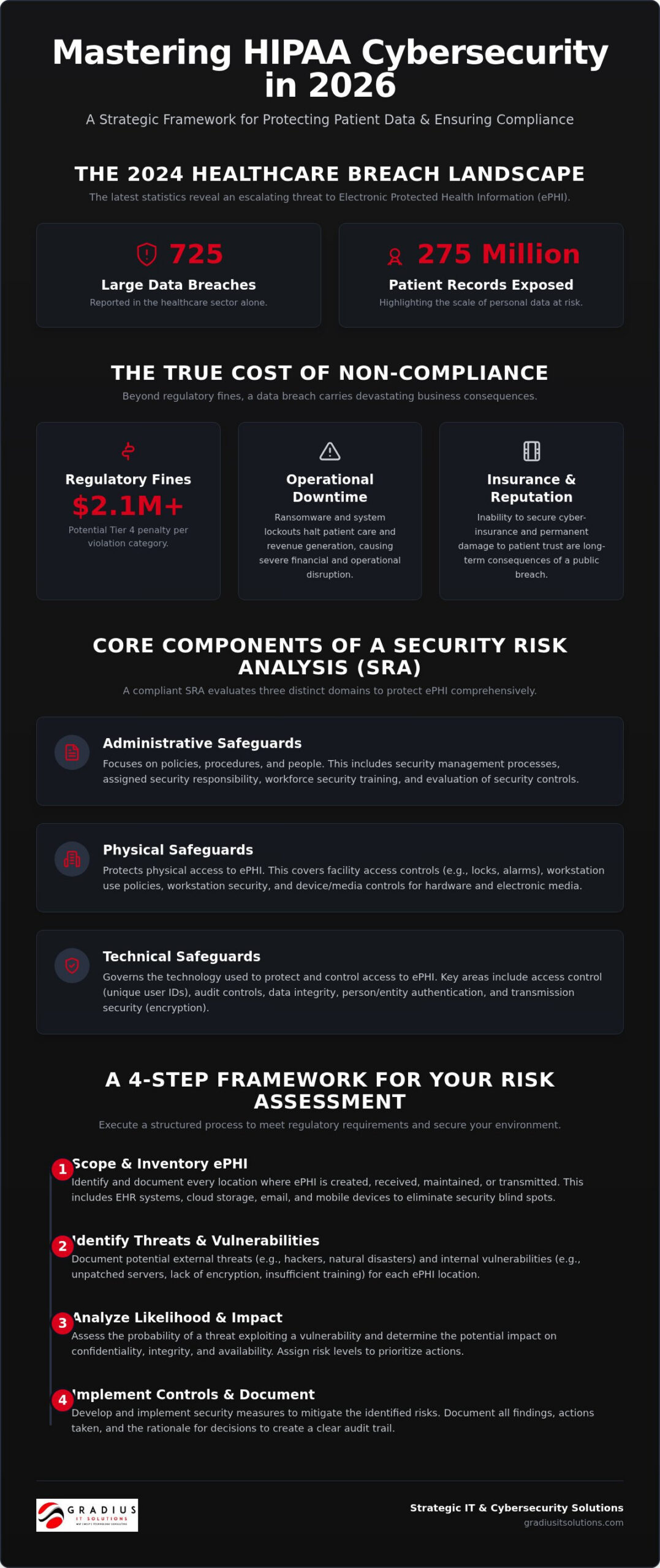
In 2024, the healthcare sector faced 725 large data breaches that exposed the records of 275 million patients. This isn’t just a statistic: it’s a wake-up call for every executive managing sensitive data. For many leaders, the hipaa cybersecurity risk assessment feels like a mandatory distraction that pulls resources away from patient care. You might be struggling with the technical nuances of the SRA Tool v3.7 or the fear of Tier 4 fines that now exceed $2.1 million. It’s a heavy burden to carry while trying to maintain an efficient, productive office environment.
We agree that your focus should be on growth, not deciphering complex federal mandates. This guide provides a strategic framework to help you master HIPAA requirements while building a more resilient organization. You’ll learn how to align with the 2026 regulatory updates, improve your cyber-insurance eligibility, and implement a roadmap for continuous protection. We’re moving beyond basic checklists to show you how a proactive security posture actually drives business value and protects your reputation.
Key Takeaways
- Learn why the 2026 threat landscape requires a more sophisticated approach to your hipaa cybersecurity risk assessment than basic annual checklists.
- Identify every location where ePHI lives to create a comprehensive inventory that eliminates blind spots in your security posture.
- Analyze the differences between the HHS SRA Tool v3.7 and expert-led assessments to choose the most effective path for your organization.
- Execute a structured framework for scoping and data gathering that satisfies regulatory requirements and secures your technical environment.
- Shift from reactive compliance to a continuous security model that protects your data and maintains insurance readiness around the clock.
The Strategic Necessity of a HIPAA Cybersecurity Risk Assessment in 2026
The hipaa cybersecurity risk assessment isn’t just a legal obligation. It’s the primary engine of your organization’s resilience. Under the HIPAA Security Rule, this process serves as your foundational defense. In 2026, attackers use sophisticated AI to automate their reconnaissance. You can’t defend a network you haven’t fully mapped. This assessment provides the visibility needed to identify where your protections are holding firm and where they’re beginning to fray.
To understand how the federal government views these requirements, watch this official webinar from the OCR:
A compliant assessment addresses three distinct areas. Administrative safeguards manage your internal policies and workforce training. Physical safeguards secure your actual office space and hardware access. Technical safeguards protect your digital perimeter through encryption and authentication. Don’t mistake a gap analysis for a true hipaa cybersecurity risk assessment. A gap analysis tells you what tools you’re missing. A risk assessment analyzes the real world probability of those gaps being exploited by a modern threat actor. It moves you from a passive checklist to an active defense strategy.
Why ‘Compliance’ Does Not Equal ‘Security’
Checking a box doesn’t stop a data breach. Many executives treat HIPAA as a hurdle to clear, but this mindset creates dangerous blind spots. The rule distinguishes between “required” and “addressable” implementation specifications. Addressable doesn’t mean optional. It means you must implement an equivalent measure if the standard one doesn’t fit your specific environment. True security means moving beyond minimum standards to build a culture of protection. This approach doesn’t just satisfy regulators. It builds client trust and ensures your business remains productive during a crisis.
The Cost of Inaction: Beyond Regulatory Fines
Fines are a significant risk, but they’re rarely the biggest cost of a breach. While Tier 4 penalties now reach $2,190,294 per category, the operational downtime can be even more devastating. If your systems are locked by ransomware, you can’t treat patients or generate revenue. Additionally, obtaining cyber-insurance has become nearly impossible without a documented risk assessment. Carriers now demand proof of your security posture before they’ll even provide a quote. A public breach notification also causes permanent reputational damage. It’s far more effective to invest in a proactive assessment than to manage the fallout of a public failure, especially when preparing for a business valuation or sale through Healthcare Biz Brokers, Inc..
Core Components of a Compliant Security Risk Analysis (SRA)
A compliant Security Risk Analysis (SRA) is more than a checklist. It’s a deep dive into the specific ways your organization handles data. To meet federal standards, you must follow the Official HHS Risk Analysis Guidance. This process starts with a complete inventory of every location where Electronic Protected Health Information (ePHI) exists. It’s not just your Electronic Health Record (EHR) system. It includes email archives, cloud storage, and even unencrypted text messages on staff phones.
Once you know where the data lives, you must identify potential threats and vulnerabilities. Threats are external forces, like a hacker or a natural disaster. Vulnerabilities are internal weaknesses, like an unpatched server or a lack of encryption. Your hipaa cybersecurity risk assessment must document these findings in detail. You then determine the likelihood of a threat exploiting a vulnerability and the resulting impact on your business. This calculation allows you to prioritize your security investments effectively.
Identifying Vulnerabilities in Modern Workflows
Modern workflows introduce new risks that traditional audits often miss. Cloud storage is a primary example. While Microsoft 365 offers robust security, misconfigurations can leave ePHI exposed to the public internet. Staff often use “Shadow IT,” such as unauthorized file-sharing apps, because they find them more convenient than official tools. Hybrid and remote work also expand your attack surface. Every home router and personal laptop becomes a potential entry point for attackers. Securing these endpoints requires a Zero Trust approach where no device is trusted by default.
The Role of Human Factors in Risk Assessments
Technology alone cannot secure your data. Human behavior is often the weakest link in the security chain. Employee awareness training should be viewed as a technical safeguard, as it directly impacts your system’s integrity. Social engineering and Business Email Compromise (BEC) are top threats in 2026. Attackers use AI to craft highly convincing emails that trick even the most diligent staff. Human Risk Management is the evaluation of user behavior impact on data integrity. By assessing how staff interact with data, you can implement targeted training that reduces the chance of a successful breach. If you’re unsure where your biggest risks lie, a professional cybersecurity assessment can provide the clarity you need.
Automated Tools vs. Managed Security Assessments: Choosing Your Path
Executives often face a critical fork in the road when scheduling their hipaa cybersecurity risk assessment. On one side is the DIY approach using the HHS SRA Tool v3.7. On the other is a managed assessment led by a specialized partner. The right choice depends on your internal expertise and the complexity of your technical environment. While software can identify gaps, it cannot provide the strategic context needed to protect a growing business in a high-threat environment.
The HHS SRA Tool is a reliable starting point. It’s free, official, and aligns with the NIST Risk Assessment Framework. However, it’s fundamentally a data collection tool. It places the burden of interpretation on your shoulders. You’ve got to manually validate every answer and determine if your safeguards are truly effective. This process is time-consuming and lacks the objective “outside eye” that regulators look for during an audit. Third-party assessments provide the Expertise, Experience, Authority, and Trustworthiness (E-E-A-T) that a self-guided tool simply cannot replicate.
When the HHS SRA Tool Is Not Enough
In complex environments, automated tools often fail to capture the nuance of modern data flows. If you rely on hybrid cloud setups or specialized medical software, a generic questionnaire won’t reveal how those systems interact. The biggest danger of a DIY assessment is the “checked box” syndrome. You might technically answer “yes” to a security requirement while missing a critical configuration error. Professional guidance ensures you’re Achieving Audit Readiness with IT Compliance Services that go beyond the surface level. We provide a roadmap for remediation, not just a list of problems.
The Benefits of a Managed Approach
Choosing a managed approach turns compliance into a competitive advantage. You gain a “Single Accountable Partner” who manages both your IT performance and your security posture. This eliminates vendor friction and ensures that security updates don’t break your productivity. A managed hipaa cybersecurity risk assessment offers several distinct advantages:
- 24/7 SOC Monitoring: You get real-time threat detection that mitigates risks as they appear, not months later during an annual review.
- Expert Interpretation: We provide clear explanations of technical findings so you can prioritize high-impact security investments.
- Continuous Evolution: Your security posture stays aligned with the latest 2026 regulatory updates and emerging AI-driven threats.
This proactive model moves your organization from a state of reactive “firefighting” to one of controlled, resilient growth. It’s about lifting the burden of technical complexity so you can focus on your primary mission.
A Step-by-Step Framework for Executing Your 2026 Risk Assessment
Execution is where many organizations falter. You cannot rely on a generic template or a surface level checklist to protect your specific business interests. A successful hipaa cybersecurity risk assessment requires a methodical approach that balances technical precision with practical business logic. We recommend a five step framework that moves from initial discovery to active remediation. This process ensures your security measures are both compliant and effective in a high threat environment.
- Step 1: Scope Definition. Map every touchpoint where ePHI is created, received, maintained, or transmitted. This includes third party vendors, cloud providers, and any external contractors who handle your data.
- Step 2: Data Gathering. Interview key staff members to understand how data actually moves through your office. Reviewing existing technical controls is essential to see where your current defenses might be failing in practice.
- Step 3: Vulnerability Scanning. Use advanced tools to identify technical weaknesses in your network, applications, and endpoints. This step uncovers the hidden “back doors” that attackers exploit.
- Step 4: Risk Determination. Assign a risk score to each identified threat. This calculation considers the likelihood of an event occurring and the severity of the impact on your operations and patient safety.
- Step 5: Remediation Planning. Create a prioritized Written Information Security Policy (WISP) that guides your security investments and sets clear deadlines for improvement.
Scoping Your Assessment for Zero Trust
Zero Trust is the 2026 gold standard for healthcare data protection. The core principle is simple: never trust, always verify. When scoping your hipaa cybersecurity risk assessment, you must account for every remote access point and mobile device used by your team. Mobile Device Management (MDM) is now a mandatory component for hybrid workforces. Every laptop, tablet, and smartphone that touches your network requires strict authentication and continuous monitoring. Integrating these controls into your Microsoft 365 environment creates a resilient perimeter that protects data regardless of where your employees are working.
Developing a Realistic Remediation Roadmap
You do not have to fix every vulnerability at once. Attempting to do so often leads to operational paralysis and wasted resources. Categorize your risks into High, Medium, and Low priorities based on your risk determination scores. Focus your immediate budget on critical fixes that close the most dangerous gaps first. A Remediation Roadmap is a time-bound plan to address security gaps identified during the assessment. This document provides a clear path forward for your technical team and demonstrates a “good faith” effort to regulators. It balances your financial constraints with the absolute necessity of protecting patient data and maintaining business continuity.
Schedule Your Free 30-Minute IT and Cybersecurity Assessment
Moving Beyond the Audit: Transitioning to Continuous Compliance
A static hipaa cybersecurity risk assessment performed once a year is no longer a viable defense strategy. In 2026, the speed of cyberattacks has outpaced traditional compliance cycles. Threat actors launch thousands of automated scans every minute looking for a single misconfigured port or an unpatched vulnerability. If you only look at your security posture annually, you’re essentially leaving your front door unlocked for 364 days. Transitioning to a model of “Continuous Compliance” ensures that your safeguards are active, verified, and evolving in real time. It moves your organization from a state of reactive anxiety to one of proactive resilience.
Managed security services provide the infrastructure needed to maintain this posture without overwhelming your internal team. A 24/7 Security Operations Center (SOC) acts as a proactive guardian. It monitors your network every second of every day to detect and neutralize threats before they escalate into breaches. We also leverage Secure AI to automate the heavy lifting of compliance documentation. AI tools can now identify anomalies in data access patterns and generate the audit trails required by regulators without manual intervention. This automation reduces human error and ensures your records are always current and accurate.
Integrating Compliance into Daily Operations
Moving away from “audit season” stress requires a fundamental shift in mindset. You shouldn’t have to scramble to find documentation when a regulator knocks. By building a culture of security, compliance becomes a byproduct of good management rather than a separate chore. Regular patch management and backup verification aren’t just technical tasks; they’re essential business continuity practices. For a deeper look at this strategy, see our sibling guide on IT Risk Assessment Services: The 2026 Executive Guide to Continuous Compliance. This approach ensures you’re always ready for an inspection, regardless of when it occurs.
The vCISO Advantage for Regulated Firms
Most small to mid-sized firms don’t need a full-time Chief Information Security Officer, but they do need executive-level strategy. A Virtual CISO (vCISO) provides this oversight at a fraction of the cost of a full-time hire. Your vCISO handles the strategic technology planning required to stay ahead of future HIPAA or SEC rule changes. They act as your bold advocate, ensuring that your IT budget is spent on high-impact security measures that actually reduce risk. This partnership provides the unwavering reliability you need to grow your business with confidence while protecting your most sensitive assets.
Securing Your Future with Strategic Compliance
Your organization’s data is its most valuable asset. Protecting it requires more than a checkbox approach to federal mandates. By shifting to a model of continuous compliance, you move beyond the stress of audit season and into a state of unwavering reliability. A comprehensive hipaa cybersecurity risk assessment isn’t just a legal requirement; it’s a strategic blueprint for business resilience and long-term client trust. You’ve seen that annual audits are no longer enough in a world of AI-driven threats. Real protection requires a proactive stance and expert oversight.
We stand ready to act as your single accountable partner. Our U.S.-based 24/7 SOC and help desk provide the proactive guardianship your firm needs to stay ahead of emerging vulnerabilities. We’ll help you navigate the complexities of modern IT while including a free cyber-insurance readiness review to protect your bottom line. You don’t have to carry the burden of technical complexity alone. Our compliance-aware managed IT is built specifically for regulated sectors that demand high performance and total transparency.
Take the first step toward a more secure and productive technical environment today. Our team is ready to help you optimize your security posture and ensure your business remains resilient for years to come. We’re firmly in your corner.
Frequently Asked Questions
Is a HIPAA cybersecurity risk assessment required for small practices?
Yes, the law makes no exceptions for the size of your staff or patient volume. Small practices are often targeted precisely because attackers assume their defenses are weaker than large hospital systems. A thorough assessment ensures your safeguards are appropriate for your specific environment. It’s about ensuring your small team has the same level of protection as a major healthcare network.
How often should my organization perform a HIPAA risk analysis?
You should perform an analysis at least once a year to maintain your compliance posture. However, any major change to your technical environment should trigger an immediate review. This includes moving to a new cloud provider or upgrading your EHR software. Regular reviews ensure your security measures stay ahead of the rapid evolution of AI-driven cyber threats in 2026.
What is the difference between a risk assessment and a gap analysis?
A gap analysis is a high-level comparison of your existing controls against regulatory requirements. It identifies what’s missing but doesn’t evaluate the severity of the threat. A hipaa cybersecurity risk assessment goes deeper by calculating the actual likelihood and impact of a potential breach. It provides the strategic data needed to prioritize your security investments effectively.
Does the HHS SRA Tool guarantee HIPAA compliance?
No, the tool is a self-assessment aid, not a certification of compliance. It helps you organize your findings, but it doesn’t validate that your technical controls are configured correctly. Regulators look for evidence of active management and expert oversight. Relying solely on a tool without professional validation can leave significant security gaps in your infrastructure that attackers easily exploit.
What happens if we fail to perform a risk assessment and have a breach?
Failing to conduct an assessment is often classified as “willful neglect” during an OCR investigation. This classification triggers much higher mandatory fines, which can reach $2,190,294 per violation category in 2026. Beyond the financial penalties, you lose the legal protections that come with demonstrating a proactive, documented effort to secure patient data before an incident occurs.
Can we perform the risk assessment ourselves or do we need an expert?
You can technically do it yourself, but most internal teams lack the specialized tools to uncover hidden network vulnerabilities. An expert brings an objective perspective that regulators and insurance carriers prefer. Gradius IT Solutions acts as your single accountable partner, handling the technical heavy lifting while ensuring your documentation is audit-ready, accurate, and aligned with current federal standards.
Does HIPAA require us to use specific cybersecurity software?
No, the regulation is technology-neutral and does not mandate any specific brand or software. It focuses on functional outcomes, such as ensuring data is encrypted and access is logged. However, to meet the “standard of care” in 2026, you generally need advanced tools like MFA and EDR. We help you select the right solutions that integrate seamlessly with your specific business needs.
How does a risk assessment help with cyber-insurance applications?
Insurance carriers use your risk assessment as proof that you are a “defensible” risk. Most modern applications require you to verify that you’ve conducted an assessment within the last 12 months. Having a documented hipaa cybersecurity risk assessment ready shows the insurer that you’ve implemented the mandatory controls they require for coverage, such as immutable backups and multi-factor authentication.

Article by
Robert Joyce
**Robert Joyce** is the Founder, CEO, and Chief Technology Officer of Gradius IT Solutions, a security first provider of Managed IT Services, Cybersecurity, Cloud, Compliance, and Secure AI solutions serving businesses throughout New Jersey, New York, Connecticut, and across the United States.
With more than 28 years of IT experience, including 23 years supporting hedge funds, global banks, and wealth management firms, Robert has built a career designing and managing secure, resilient, and highly available technology environments where uptime, cybersecurity, and business continuity are essential.
His expertise includes Microsoft 365, cloud computing, cybersecurity, networking, infrastructure, disaster recovery, compliance, virtualization, and strategic IT leadership. Following the events of September 11, Robert helped rebuild critical technology infrastructure for Merrill Lynch, an experience that reinforced the importance of resilience, planning, and operational excellence.
Robert founded Gradius IT Solutions to bring enterprise level technology and security services to small and midsized businesses at a predictable monthly cost. Today, the company delivers fully managed and co managed IT services, cybersecurity, Microsoft 365, cloud solutions, compliance consulting, Secure AI consulting, technology projects, and vCIO services. Through a U.S. based 24/7 Help Desk and a nationwide network of trusted technology partners, Gradius supports organizations across the country with responsive, security focused technology solutions.
Robert partners with business owners and executive leaders to align technology with business goals, reduce risk, strengthen cybersecurity, improve productivity, and create long term IT strategies that support growth. His mission is simple: provide every client with enterprise class technology, exceptional service, and a trusted advisor they can rely on as their business evolves.
Disclaimer
## Disclaimer
The information provided in this article is for general informational and educational purposes only and should not be considered professional IT, cybersecurity, legal, regulatory, or compliance advice. While Gradius IT Solutions strives to provide accurate and up to date information, technology, security threats, and regulatory requirements change frequently, and we cannot guarantee that all information will remain current or applicable to your specific situation.
Every organization has unique technology, security, compliance, and business requirements. Before implementing any recommendations discussed in this article, you should evaluate their suitability for your environment or consult with a qualified technology professional.
Gradius IT Solutions makes no warranties, express or implied, regarding the completeness, accuracy, reliability, or results obtained from the use of this information. Any actions you take based on this content are at your own risk. Gradius IT Solutions shall not be liable for any direct, indirect, incidental, or consequential damages arising from the use of, or reliance upon, the information contained in this article.
References to third party products, services, or vendors are provided for informational purposes only and do not constitute an endorsement unless explicitly stated.
If you would like guidance tailored to your organization, contact Gradius IT Solutions to schedule a consultation with one of our technology experts.