

Did you know that 85% of businesses report that compliance has become significantly more complex in just the last three years? If you feel like you’re constantly chasing moving targets while drowning in regulatory jargon, you aren’t alone. Most executives live in a cycle of periodic audit panic, fearing that a single oversight could bring their entire operation to a grinding halt. You’ve likely spent too many hours on manual data collection that pulls your team away from actual growth.
Achieving it compliance audit readiness shouldn’t feel like a recurring emergency. We understand the pressure of protecting your reputation while meeting strict standards like PCI DSS 4.0 and the latest NIST CSF 2.0 requirements. It’s time to shift your perspective and treat compliance as a continuous business state rather than a stressful annual event. This is about building a resilient foundation that keeps you three steps ahead of regulators and prepared for any inquiry.
In this guide, we’ll provide a strategic executive checklist for 2026. You’ll learn how to automate evidence collection, navigate the new HIPAA Security Rule updates, and implement a framework that ensures you’re always prepared for scrutiny. We’re going to show you how to turn your compliance burden into a competitive advantage that wins more deals and protects your bottom line.
Key Takeaways
- Move beyond the cycle of periodic audit panic by adopting a framework for continuous, permanent readiness.
- Bridge the gap between daily IT operations and regulatory mandates through a structured 4-layer readiness architecture.
- Strengthen your technical posture and simplify it compliance audit readiness by enforcing Zero Trust principles and MFA across all critical systems.
- Establish a rock-solid governance foundation with a comprehensive Written Information Security Policy and a battle-tested Incident Response Plan.
- Reduce complexity and eliminate vendor sprawl by consolidating your security and compliance needs under a single accountable partner.
What is IT Compliance Audit Readiness?
IT compliance audit readiness is the operational state of being prepared to demonstrate regulatory adherence at any given moment. It isn’t a one-time project or a seasonal fire drill. Instead, it’s a permanent posture where your controls, data, and documentation are always synchronized. When an auditor walks in, readiness means you aren’t searching for evidence; you’re simply presenting it. This process often starts with a formal Information technology audit to establish a baseline of your current security controls and gaps.
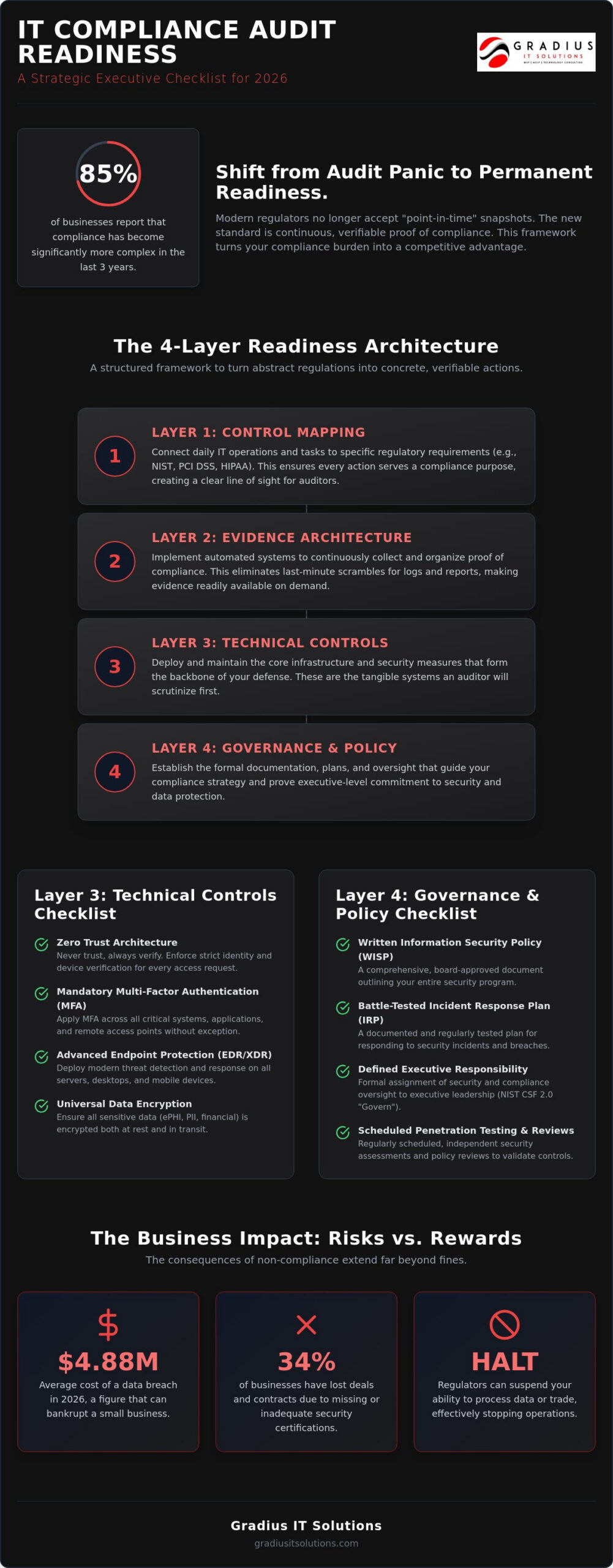
The 2026 shift has changed the rules of the game. Modern regulators no longer accept “point-in-time” snapshots as proof of security. With 85% of companies reporting that compliance has become more complex since 2023, the focus has moved toward continuous monitoring. With PCI DSS 4.0 now fully enforced, the margin for error has disappeared. If your systems only look compliant on the day of the audit, you’re already failing. True readiness requires a framework that captures evidence in real time, ensuring that a change in your infrastructure doesn’t create a hidden gap in your regulatory standing.
To better understand this concept, watch this helpful video:
The business impact of this preparation is massive. Organizations that maintain high readiness often see reduced cyber insurance premiums because they represent a lower risk to underwriters. With the average cost of a data breach hitting $4.88 million in 2026, the stakes couldn’t be higher. Failure triggers a cascade of business disasters:
- Operational Halts: Regulators can suspend your ability to process data or trade.
- Contract Loss: 34% of businesses have lost deals due to missing certifications.
- Reputational Erosion: Trust is harder to regain than revenue.
The Regulatory Landscape in 2026
For businesses across the nation, the regulatory pressure is immense, encompassing federal, state, and industry-specific mandates. Organizations must navigate evolving frameworks like the SEC Cybersecurity Rule and FINRA Rule 4370 for financial services, alongside broader federal requirements such as SOX or various state-level data privacy acts. Healthcare providers face the 2026 HIPAA Security Rule update, which now mandates universal encryption for ePHI and strict penetration testing schedules. Across all industries, the NIST CSF 2.0 remains the gold standard, especially with its new “Govern” function that places responsibility directly on executive leadership.
Readiness vs. Compliance: Understanding the Gap
Being compliant is your goal, but it compliance audit readiness is your proof. You might have a firewall in place, but if you can’t produce the last six months of change logs, you aren’t ready. We utilize a proactive approach to verify your readiness state without disrupting your daily workflow. This involves monitoring your controls as they happen, ensuring that every technical action creates a corresponding piece of evidence. If a control isn’t documented, it doesn’t exist in the eyes of an auditor. Our Compliance as a Service model bridges this gap, turning your technical infrastructure into a verifiable asset.
The 4-Layer Readiness Architecture
Achieving it compliance audit readiness isn’t about luck; it’s about design. You need a structured framework that turns abstract regulations into concrete technical actions. This architecture moves your organization away from manual, error-prone spreadsheets and toward a high-performance system that works in the background. We break this down into four distinct layers that ensure your business remains protected and verifiable at all times.
The first two layers focus on your foundation. Layer 1, Control Mapping, involves connecting your daily IT tasks to specific regulatory requirements. If you’re managing user identities, you’re satisfying an access control requirement. Layer 2, Evidence Architecture, is the engine that captures proof. Instead of a frantic search for logs before an audit, you design automated systems to capture and store compliance proof as it happens. This proactive stance is exactly what Compliance as a Service provides by acting as your single accountable partner.
Layer 1 & 2: Building the Foundation
You shouldn’t manage HIPAA, SEC, and NIST as separate silos. We help you create a unified control library that satisfies multiple frameworks simultaneously. By designing a centralized evidence repository, you eliminate the “audit fire drill” entirely. We often leverage Microsoft 365 Purview for automated data lifecycle management. This ensures that sensitive data is classified, protected, and retained according to your specific legal obligations without requiring manual intervention from your staff.
Layer 3 & 4: Maintaining Momentum
The final two layers ensure your readiness doesn’t decay over time. Layer 3, Validation, uses continuous monitoring and internal testing to catch gaps before an auditor ever sets foot in your office. Layer 4, Communication, provides executive-level reporting for stakeholders and insurance providers. This isn’t just technical data; it’s strategic proof of your security posture. It’s about showing that your business is a reliable partner.
Maintaining this momentum requires specialized expertise. We implement real-time threat intelligence to stay ahead of evolving SEC mandates and state-level requirements like the NJ SHIELD Act. Our vCISO services provide the high-level oversight needed for annual policy reviews and stakeholder updates. By using AI-driven compliance tools, we can automate up to 70% of the evidence collection workload. This frees your team to focus on growth while we act as the proactive guardian of your it compliance audit readiness.
Technical Controls: The Infrastructure Checklist
Technical controls are the “teeth” of your compliance program. Without them, your policies are just words on a page. To achieve it compliance audit readiness, your infrastructure must be built on a foundation of proactive defense. This isn’t about having the most expensive tools. It’s about having the right ones properly configured to generate the evidence regulators demand. Your technical environment provides the raw data that proves you’re doing what you say you’re doing.
Identity is the new perimeter. We enforce a Zero Trust Architecture where access is granted based on identity and health of the device, not just location. Multi-Factor Authentication (MFA) is now a non-negotiable requirement across email, remote access, and all critical business applications. It’s the single most effective way to block unauthorized access. When an auditor asks how you protect user accounts, your answer should be a system-wide enforcement policy, not a “best effort” suggestion.
Endpoint protection has moved beyond simple antivirus. We utilize modern EDR and XDR solutions backed by our U.S.-based 24/7 SOC. This ensures active containment of threats before they can spread through your network. Email remains the primary attack vector. We implement advanced anti-phishing and Business Email Compromise (BEC) protection coupled with immutable archiving. This ensures your it compliance audit readiness includes a verifiable trail of all communications.
Identity and Access Management
We enforce the Principle of Least Privilege (PoLP) across all user accounts. This ensures users only have the access necessary for their specific roles. Regular access reviews are vital to your security posture. You need to know exactly who has the keys to your financial or patient data at all times. For remote work, we use MFA-protected tunnels and encrypted device management to keep data secure outside the traditional office walls.
Data Protection and Recovery
Encryption at rest and in transit is the 2026 standard for data integrity. Your backups must be automated, off-site, and immutable to protect against sophisticated ransomware. We don’t just hope your backups work; we prove it. We perform and document regular restore tests to ensure your data is recoverable when it counts. Learn more about our Backup & Disaster Recovery services to see how we protect your business resilience and satisfy regulatory demands for continuity planning.
Governance and Policy: The Documentation Checklist
If it isn’t written down, it didn’t happen. This is the mantra of every auditor who walks through your doors. To achieve it compliance audit readiness, your policy stack must be as robust as your server room. We treat documentation as the narrative that explains your technical controls to regulators. It provides the “why” and “how” behind your security posture, acting as a bridge between technical actions and regulatory expectations.
Your Written Information Security Policy (WISP) is the cornerstone of this effort. It shouldn’t be a generic template gathering digital dust. It needs to reflect your specific operations and receive annual executive sign-off. This proves to auditors that security is a top-down priority, not just an IT afterthought. When leadership is involved in the policy review process, it demonstrates a culture of accountability that regulators find reassuring.
An Incident Response Plan (IRP) is now a legal requirement for many businesses. In 2026, regulators like the SEC and NY DFS have established incredibly strict reporting timelines for breaches. Your IRP must be a tested roadmap for identifying and containing threats within these specific windows. Similarly, a Business Continuity Plan (BCP) ensures your business doesn’t fold during a technical failure. It details how you’ll keep the lights on when systems go dark.
You are only as secure as your weakest link. Assessing the security posture of your software and cloud providers through vendor management is essential. We help you vet these partners to ensure they meet your specific compliance standards. This proactive guardian approach prevents third-party risks from compromising your own regulatory standing.
Essential Policy Documentation
We view the WISP as a living document. It requires constant updates to match the evolving threat landscape. Drafting an IRP that meets 2026 SEC and NY DFS reporting timelines is critical for avoiding heavy fines. Additionally, cyber insurance providers now demand a Written Disaster Recovery Plan before they’ll even consider a renewal. Without these documents, you’re effectively uninsurable and non-compliant.
The Human Element of Readiness
Technology is only half of the it compliance audit readiness equation. We use phishing simulations to turn your staff into a hardened defense layer. Documenting these training sessions is vital. Auditors also want to see that you have documented disciplinary actions for policy violations. This shows that your rules have teeth and that your organization takes data protection seriously. Industries with strict confidentiality obligations, such as those requiring IT support for law firms in NJ, face particularly high scrutiny around staff training and documented policy enforcement. Explore our vCISO and Compliance as a Service to see how we handle this heavy lifting for you.
Schedule your compliance documentation review today
Achieving Permanent Readiness with Gradius IT Solutions
Audit readiness isn’t a software subscription; it’s a managed outcome. Achieving permanent it compliance audit readiness requires more than just a checklist. It demands a partner who understands the intersection of technical infrastructure and regulatory law. We position ourselves as your Single Accountable Partner, consolidating IT management, cybersecurity, and compliance oversight under one roof. This eliminates the vendor sprawl that often leads to critical gaps in your security posture.
Our “Prevent-Instead-React” model changes your relationship with technology. Most firms wait for a failure or an audit notice to take action. We stay three steps ahead. By integrating compliance into your daily IT operations, we remove the stress of the “annual fire drill.” This is the core of our Compliance as a Service (CaaS). We bring enterprise-grade readiness to small and mid-sized firms, providing the same level of protection and documentation usually reserved for global corporations.
Transparency is a pillar of our partnership. Our predictable flat-fee pricing model ensures your technology roadmap remains stable. You won’t face hidden costs or surprise invoices when a new regulation is announced or an audit is scheduled. We believe that security and compliance should be a fixed, manageable part of your business strategy, not a fluctuating emergency expense. To gain further clarity on budgeting for these requirements, you can find out more about Software Licensing and IT Professional Service Fees to ensure your financial planning is as robust as your security.
The Gradius Advantage: Compliance-Aware Managed IT
Our U.S.-based 24/7 SOC provides continuous monitoring that never sleeps. This ensures your systems stay ready for scrutiny every minute of the day. We don’t just provide the tools: we provide the expertise. During an audit, we stand with you, providing direct support to explain your controls and present evidence to regulators. This proactive guardian approach is specifically aligned with top cyber insurance requirements, making your renewals faster and your premiums more competitive.
Next Steps: Your Path to Audit Confidence
Confidence starts with a clear understanding of your current state. Your path to permanent readiness begins with a 30-minute consultation. We’ll perform a high-level compliance gap analysis and readiness review to identify immediate risks. Within one week, you’ll receive a written report: a clear, actionable roadmap to close those gaps and secure your business. Don’t wait for a regulator to find your weaknesses first.
Secure Your Competitive Edge for 2026
The transition from reactive audit panic to a permanent state of readiness is the most significant strategic move an executive can make this year. We’ve explored how a unified architecture, robust technical controls, and living documentation create a shield around your organization. Success in the current regulatory environment requires moving beyond simple checklists to embrace a culture of continuous verification. When your systems are designed for transparency, the stress of an impending inquiry simply disappears.
Achieving it compliance audit readiness isn’t just a defensive maneuver. It’s a powerful way to demonstrate reliability to your clients and partners. You need a partner who provides a U.S.-Based 24/7 SOC and Help Desk to act as a proactive guardian for your data. Our team of compliance-aware managed IT specialists is dedicated to keeping you three steps ahead of regulators. With our flat-fee predictable pricing, you can invest in your security posture without worrying about hidden costs or budget overruns.
Stop viewing compliance as a hurdle and start seeing it as a foundation for growth. By taking these steps today, you ensure that your business remains resilient, protected, and fully prepared for whatever the future of technology brings. To learn more about how strategic IT support can empower your business, visit Mytech Partners. Let’s turn your regulatory obligations into your greatest competitive advantage.
Frequently Asked Questions
How long does it take to become IT audit-ready?
It typically takes three to six months for an SMB to reach a state of full readiness. This timeframe allows your team to identify critical gaps, implement missing technical controls, and begin the automated collection of evidence. Your specific timeline depends on the complexity of your current infrastructure and the specific regulatory framework, such as HIPAA or SEC rules, you need to satisfy.
What is the most common reason firms fail an IT compliance audit?
The most frequent cause of failure is a lack of verifiable documentation for technical controls. You might have excellent security in place, but if you can’t produce historical logs to prove those controls were active, the auditor will mark it as a failure. Consistency is the key to it compliance audit readiness; you must show the control worked yesterday, today, and last month.
Does my small business really need a vCISO for audit readiness?
A vCISO is essential because they translate complex regulatory jargon into actionable business strategy. Small businesses often have technical IT support but lack the high-level governance required to pass a formal audit. A vCISO ensures your policies are drafted correctly, reviewed annually, and signed off by leadership to meet the executive accountability standards required by modern regulators.
Can managed IT services help with cyber insurance renewals?
Managed services are often the deciding factor in whether a business can secure or renew cyber insurance in 2026. Underwriters now demand proof of Zero Trust principles, such as MFA and endpoint protection, before they’ll even consider providing coverage. We provide the documented evidence and technical reporting that insurers require to verify your risk profile and maintain your policy without stress.
How often should we test our Incident Response Plan?
You should conduct a tabletop exercise for your Incident Response Plan at least once every year. Some frameworks, including the 2026 HIPAA Security Rule updates, may require more frequent testing or specific penetration testing schedules. Regular drills ensure your staff can identify and contain threats within the tight reporting windows mandated by the SEC and state-level mandates like NY DFS 23.
What is the difference between a security assessment and a compliance audit?
A security assessment is a technical review of your defenses, while a compliance audit is a formal check against specific legal requirements. Assessments find the holes that hackers might use to enter your network. Audits find the gaps where you aren’t meeting the specific rules of a framework like FINRA or NIST. Both are necessary for a complete it compliance audit readiness posture.
Is Microsoft 365 compliant out of the box?
Microsoft 365 is not compliant by default; it is “compliance-ready.” Microsoft provides the secure infrastructure, but your team must configure the settings to meet your specific legal obligations. This includes setting up data loss prevention, sensitivity labels in Purview, and strict access controls to ensure your cloud environment stays within regulatory bounds and protects sensitive patient or financial data.
How much does an IT compliance audit cost?
Audit costs depend on the complexity of your organization and the specific framework being tested by the third-party auditor. While auditors set their own fees, the cost of “emergency remediation” during an audit is always significantly higher than proactive preparation. Our model focuses on eliminating these surprise expenses by keeping your systems in a permanent state of readiness through a predictable flat-fee structure. Professional services firms with strict confidentiality requirements, such as those seeking IT support for law firms in NJ, can particularly benefit from this predictable approach to compliance cost management.

Article by
Robert Joyce
**Robert Joyce** is the Founder, CEO, and Chief Technology Officer of Gradius IT Solutions, a security first provider of Managed IT Services, Cybersecurity, Cloud, Compliance, and Secure AI solutions serving businesses throughout New Jersey, New York, Connecticut, and across the United States.
With more than 28 years of IT experience, including 23 years supporting hedge funds, global banks, and wealth management firms, Robert has built a career designing and managing secure, resilient, and highly available technology environments where uptime, cybersecurity, and business continuity are essential.
His expertise includes Microsoft 365, cloud computing, cybersecurity, networking, infrastructure, disaster recovery, compliance, virtualization, and strategic IT leadership. Following the events of September 11, Robert helped rebuild critical technology infrastructure for Merrill Lynch, an experience that reinforced the importance of resilience, planning, and operational excellence.
Robert founded Gradius IT Solutions to bring enterprise level technology and security services to small and midsized businesses at a predictable monthly cost. Today, the company delivers fully managed and co managed IT services, cybersecurity, Microsoft 365, cloud solutions, compliance consulting, Secure AI consulting, technology projects, and vCIO services. Through a U.S. based 24/7 Help Desk and a nationwide network of trusted technology partners, Gradius supports organizations across the country with responsive, security focused technology solutions.
Robert partners with business owners and executive leaders to align technology with business goals, reduce risk, strengthen cybersecurity, improve productivity, and create long term IT strategies that support growth. His mission is simple: provide every client with enterprise class technology, exceptional service, and a trusted advisor they can rely on as their business evolves.
Disclaimer
## Disclaimer
The information provided in this article is for general informational and educational purposes only and should not be considered professional IT, cybersecurity, legal, regulatory, or compliance advice. While Gradius IT Solutions strives to provide accurate and up to date information, technology, security threats, and regulatory requirements change frequently, and we cannot guarantee that all information will remain current or applicable to your specific situation.
Every organization has unique technology, security, compliance, and business requirements. Before implementing any recommendations discussed in this article, you should evaluate their suitability for your environment or consult with a qualified technology professional.
Gradius IT Solutions makes no warranties, express or implied, regarding the completeness, accuracy, reliability, or results obtained from the use of this information. Any actions you take based on this content are at your own risk. Gradius IT Solutions shall not be liable for any direct, indirect, incidental, or consequential damages arising from the use of, or reliance upon, the information contained in this article.
References to third party products, services, or vendors are provided for informational purposes only and do not constitute an endorsement unless explicitly stated.
If you would like guidance tailored to your organization, contact Gradius IT Solutions to schedule a consultation with one of our technology experts.