

Cyber adversaries now target or delete backups in 94% of ransomware attacks. This isn’t just a technical glitch; it’s a direct assault on your ability to stay in business. If you’re relying on basic storage to protect your firm, you’re leaving the door wide open. Modern managed cloud backup solutions have evolved from simple off-site copies into sophisticated, compliance-aware shields. They’re designed to withstand the specific pressures of 2026, where SEC Regulation S-P and NYDFS 23 NYCRR Part 500 mandates require more than just having a backup. You need a verifiable path to restoration.
You likely feel the weight of these complex regulatory requirements every time you review your incident response plan. It’s exhausting to balance the fear of downtime with the nagging uncertainty of backup integrity. We understand that burden. This guide promises to show you how to turn that technical debt into a strategic advantage. You’ll discover how a managed approach transforms passive data storage into a robust business continuity strategy that satisfies both auditors and your bottom line.
We’ll break down the 3-2-1-1-0 resilience standard and explain why Microsoft 365 requires third-party protection. You’ll learn how to achieve zero-friction recovery and maintain audit-ready documentation at all times. It’s time to stop worrying about whether you can recover and start operating with the confidence that your data is truly immutable.
Key Takeaways
- Learn why standard cloud sync features in Microsoft 365 and Google Workspace aren’t enough to protect your firm from sophisticated ransomware attacks.
- Discover how managed cloud backup solutions bridge the accountability gap by combining automated data duplication with expert human verification.
- Master the 3-2-1-1-0 rule to ensure your data is redundant, off-site, and stored in an immutable format that attackers can’t encrypt or delete.
- Align your backup strategy with 2026 regulatory mandates from the SEC, FINRA, and HIPAA to maintain audit-ready documentation at all times.
- Shift your focus from passive storage to proactive recovery with documented restore tests that prove your business continuity plan actually works.
Beyond Simple Storage: Why Managed Cloud Backup Solutions are Critical in 2026
Data isn’t just a collection of files; it’s the lifeblood of your organization. In 2026, managed cloud backup solutions have moved far beyond simple digital lockers. They represent a proactive service that pairs automated duplication with expert human verification. This ensures that your data isn’t just stored, but is actively monitored and ready for immediate use. When you choose a managed approach, you’re hiring a team to watch the gates rather than just buying a lock.
Many business owners fall into the “Sync is not Backup” trap. They assume that tools like Microsoft 365 or Google Workspace provide built-in protection against every disaster. They don’t. These platforms are designed for synchronization. If ransomware encrypts a file on your laptop, that corrupted version syncs to the cloud in seconds. Without a dedicated, managed backup strategy, your cloud data becomes just as inaccessible as your local hard drive. True resilience requires a segregated, immutable copy of your information that sits outside your primary production environment.
To better understand how these strategies protect your business, watch this helpful video:
The Evolution of Data Resilience
The days of waiting for a technician to drive a tape to a data center are over. Speed is the new currency of business survival. Modern organizations have shifted focus from simple redundancy to total cyber resilience. This involves utilizing remote and managed backup services that prioritize rapid recovery over mere archival. Managed solutions provide a human layer that software alone cannot replicate. While a tool might report a “successful” backup, an expert looks for configuration drift or unusual file patterns that suggest a silent failure or a looming threat.
Managed IT vs. Self-Service Tools
The most dangerous risk in your technology stack is the accountability gap. Self-service backup tools are notorious for sending automated logs that nobody actually reads. If a backup fails on a Tuesday and you don’t realize it until a server crash on Friday, the tool has failed its only job. A managed IT services partner closes this gap through predictive maintenance. We identify hardware inconsistencies or software conflicts before they spiral into a business-halting event. Having a single, accountable partner ensures that when you need to restore your material operations, the process is fast, verified, and entirely under control.
The Core Pillars of Enterprise-Grade Data Protection
Reliability isn’t a feeling; it’s a measurable architecture. In the current threat landscape, the old ways of protecting data have failed. You need a framework that assumes your primary network will eventually be breached. This is where modern managed cloud backup solutions distinguish themselves from legacy software. They build a fortress around your data using specific, non-negotiable pillars designed for total survivability.
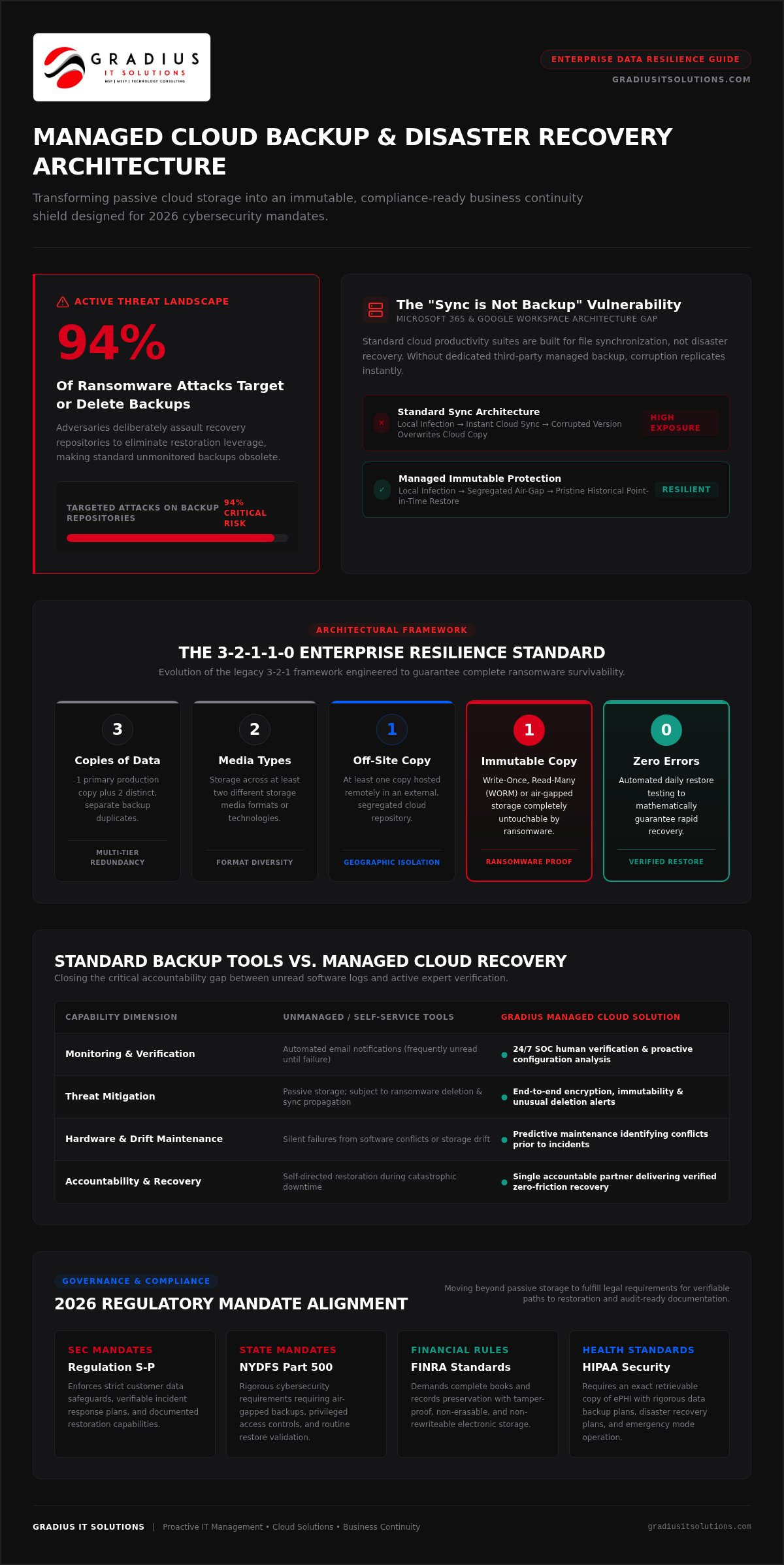
The most significant shift in 2026 is the transition to the 3-2-1-1-0 rule. While the traditional 3-2-1 strategy served us well for years, it’s no longer enough. You still need three copies of your data on two different media types, with one copy stored off-site. However, the critical addition is the ‘1’ and ‘0’. One copy must be immutable or air-gapped; completely untouchable by ransomware. The ‘0’ represents zero errors, confirmed through automated, daily restore testing. If you aren’t hitting all five of these marks, your business is at risk.
Ransomware actors now target backups in 94% of attacks. They want to leave you with no choice but to pay. End-to-end encryption and 24/7 oversight via a Security Operations Center (SOC) prevent this leverage. We monitor for unusual deletion spikes or mass encryption events in real-time. This level of oversight ensures that your managed cloud backup solutions remain a source of strength rather than a point of failure.
Immutable Backups and Ransomware Defense
Attackers now prioritize destroying your backups before they encrypt your production servers. To counter this, we utilize Write-Once-Read-Many (WORM) technology. Once data is written to an immutable repository, it cannot be modified, deleted, or overwritten for a set period. This creates a logical air-gap that protects your history even if an attacker gains administrative credentials. By applying Zero Trust principles to these repositories, we ensure that no single user or process has the permission to wipe your safety net.
Automated Testing and Verification
A backup that hasn’t been tested is just a hope. We move beyond hope by conducting daily automated restore tests. These tests verify that the data is not only present but also functional and uncorrupted. This rigorous approach aligns with NIST contingency planning guidelines, which emphasize the need for documented recovery metrics like Recovery Time Objectives (RTO). These documented results create the paper trail your insurance carrier and auditors demand. When you partner with a specialized cybersecurity and SOC team, you gain the peace of mind that comes from knowing your recovery is deterministic, not accidental.
Standard vs. Managed Backup: Bridging the Accountability Gap
Standard backup software is a tool. Managed cloud backup solutions are a strategy. The difference lies in who is accountable when the “Restore” button fails to respond. With standard tools, the burden of configuration, monitoring, and troubleshooting falls entirely on your shoulders. If a workstation or a specific SaaS application isn’t included in the initial setup, you won’t know until a crisis occurs. A managed approach closes this gap by providing human oversight that verifies every server and application is actually protected.
It’s about more than just having a copy of your data. It’s about how quickly you can return to material operations. This aligns with CISA business data backup recommendations, which stress the importance of isolated, encrypted backups as a core defense. When you manage it yourself, you’re often guessing. When you partner with a professional, you’re operating with a proven blueprint. We ensure that your managed cloud backup solutions are integrated into a larger, cohesive business continuity plan.
Defining RTO and RPO for Your Firm
Recovery Time Objective (RTO) and Recovery Point Objective (RPO) are not just technical acronyms. They are business decisions. RTO asks: how long can we survive without our systems? RPO asks: how much data can we afford to lose? A 4-hour outage might be a minor inconvenience, while a 4-day outage could be catastrophic for a financial services firm or a healthcare provider. The financial impact of downtime grows exponentially every hour.
Managed services optimize these metrics through pre-built recovery orchestration. We don’t just back up files; we back up your entire business process. By setting strategic recovery goals based on business priority, we ensure that your most critical applications come back online first. This isn’t just about IT capacity. It’s about strategic technology planning that protects your bottom line.
The Human Element: 24/7 Support and Incident Response
The real test of any backup solution happens at 2:00 AM during a ransomware event. This is where the human element becomes indispensable. A U.S.-based 24/7 SOC and Help Desk provides immediate disaster containment that software cannot offer on its own. We are the proactive guardians who anticipate problems before they arise.
For firms handling sensitive legal or financial data, knowing your support team is domestic is a matter of security and compliance. We use parallel observation mode to monitor your recovery in real-time. If a restore hits a snag, our engineers are already there to fix it. This proactive guardianship prevents a minor technical glitch from becoming a permanent data loss event.
Aligning Backup Strategy with Regulatory Compliance
Compliance is no longer a passive annual event. In 2026, regulators have shifted their focus from how you store data to how you recover it. This shift is most evident in the financial and healthcare sectors. Managed cloud backup solutions are now the primary evidence required during regulatory examinations. If you can’t prove your data is immutable and recoverable, you aren’t just facing a technical failure; you’re facing a legal one.
For financial institutions, the stakes are higher than ever. Under the amended SEC Regulation S-P rules, all covered entities were required to comply with new incident response mandates by June 3, 2026. These rules demand a written program designed to detect, respond to, and recover from unauthorized access. Similarly, FINRA Rule 4370 mandates that data backup and recovery be the first element of your business continuity plan. These aren’t suggestions. They are requirements for your firm’s continued operation.
Cyber insurance carriers have also tightened their underwriting standards. They now treat verifiable backup documentation as a prerequisite for coverage. To lower your premiums, you must demonstrate multi-factor authentication (MFA) on all backup consoles and provide logs of scheduled recovery drills. This level of transparency turns your IT stack from a liability into a strategic asset.
Documenting Your Business Continuity Plan (BCP)
A robust defense starts with a Written Information Security Policy (WISP). This document outlines how your firm protects sensitive data and who is accountable for its safety. Your Incident Response Plan must include specific, step-by-step instructions for backup restoration. We help you conduct annual reviews of these documents to ensure they stay current with evolving laws like the NYDFS 23 NYCRR Part 500. This proactive approach ensures your team knows exactly what to do when every second counts.
Audit Readiness and Evidence Preparation
Auditors don’t take your word for it. They demand proof. Our daily automated restore tests provide the deterministic evidence needed for HIPAA and SEC exams. We manage the entire lifecycle of your data, ensuring that retention policies and legal holds are strictly enforced. By integrating Compliance as a Service (CaaS) into your technology strategy, you eliminate the stress of manual evidence gathering. You stay audit-ready every day of the year.
Schedule your compliance gap review today.
Securing Your Firm’s Future with Gradius Managed Recovery
Gradius isn’t just another vendor. We are your single accountable partner for IT, security, and compliance. Many organizations struggle with fragmented systems where the backup provider blames the network provider during a system crash. We eliminate that friction entirely. Our Backup & Disaster Recovery service provides automatic daily backups with immutable off-site copies as a standard feature. We don’t just store your data; we ensure it’s protected by a layered security shield. This includes multi-factor authentication (MFA), endpoint protection, and 24/7 oversight from our U.S.-based Security Operations Center (SOC).
Strategic alignment is the core of our approach. We ensure your technology stack drives your business goals forward rather than holding them back. Modern managed cloud backup solutions should be invisible until you need them, and bulletproof when you do. We bridge the gap between technical execution and executive-level strategy. This partnership ensures that your business remains resilient against both hardware failures and sophisticated cyber threats.
Proactive Management: The Prevent-Instead-React Philosophy
Reactive IT is expensive and dangerous. We operate with a “Prevent-Instead-React” philosophy. This means we use real-time threat intelligence and continuous vulnerability assessments to identify risks before they become breaches. Our team utilizes predictive maintenance to solve hardware or software drift before it impacts your material operations. By choosing our Managed IT Services, you gain a proactive guardian that stays three steps ahead of potential failures. We don’t wait for a disaster to test our systems; we work daily to ensure your environment stays stable and secure.
Getting Started: Your Free Technology Assessment
Optimizing your resilience doesn’t have to be a multi-month project. It starts with a clear understanding of where you stand today. Our free technology assessment provides a 30-minute compliance gap analysis tailored to your specific industry. We review your current posture against SEC, FINRA, or HIPAA requirements to identify immediate risks and potential vulnerabilities.
You’ll also receive a custom cyber-insurance readiness review. This document helps you understand exactly what your carrier expects to see during an audit or a claim. We provide a clear roadmap for optimizing your technology stack and improving your overall security posture. It’s time to move beyond basic storage and embrace a strategy of total operational resilience. We help you build a foundation that supports growth while protecting your most valuable digital assets.
Mastering Operational Resilience for a Secure Future
Data resilience is no longer a luxury for small to mid-sized firms. It’s a fundamental requirement for survival. We’ve explored how the 3-2-1-1-0 rule provides the modern blueprint for total data survivability. You now understand that managed cloud backup solutions move beyond simple storage to offer human accountability and continuous verification. This strategic shift ensures you meet the strict demands of SEC and HIPAA auditors while shielding your material operations from ransomware downtime.
At Gradius, we champion your success through our U.S.-based 24/7 SOC and Help Desk. Our compliance-aware managed IT services are specifically designed for RIAs and legal firms who require unwavering reliability. We provide documented daily restore tests to prove your resilience long before a crisis hits. You deserve a partner who anticipates risks and stands firmly in your corner. Let’s transform your technology stack into a high-performance asset that drives your business goals forward.
Frequently Asked Questions
What is the difference between cloud storage and managed cloud backup?
Cloud storage tools like OneDrive are synchronization services designed for file accessibility. If a file is deleted or encrypted by ransomware, that change syncs immediately to the cloud. Managed cloud backup solutions create a separate, point-in-time copy of your entire environment. This allows you to roll back to a clean state from before an incident. It includes expert oversight to ensure every server and SaaS application is actually protected, bridging the accountability gap sync tools leave open.
How often should my business backups be tested for restoration?
You should perform automated backups daily, but a backup is only as good as its last successful restore. We conduct scheduled restore tests with documented results to verify data integrity. This proactive approach ensures your material operations can be recovered within your target Recovery Time Objective (RTO). Documenting these tests is a non-negotiable requirement for regulatory audits and cyber insurance renewals, proving that your business continuity strategy is functional rather than theoretical.
Does managed cloud backup satisfy SEC and FINRA regulatory requirements?
Yes, a compliance-aware backup strategy is essential for meeting SEC and FINRA mandates. SEC Regulation S-P and FINRA Rule 4370 require firms to maintain written incident response programs and protect critical customer records. Managed cloud backup solutions provide the immutable copies and audit-ready documentation these regulators demand. By utilizing a single accountable partner for IT and security, your firm ensures that data integrity and availability standards are consistently met during every examination.
What happens to my backups if our office experiences a total hardware failure?
Your data remains safe and accessible because it’s stored in an off-site, immutable repository. Total hardware failure at your primary location doesn’t impact these isolated copies. We use pre-built recovery orchestration to bring your critical systems back online in a secondary cloud environment or on new hardware. This minimizes downtime and ensures your staff can continue working while the physical infrastructure at your office is being repaired or replaced.
Can managed cloud backup protect my business from ransomware?
Managed cloud backup solutions are your last and most effective line of defense against ransomware. While we use layered security like EDR and 24/7 SOC monitoring to prevent attacks, immutable backups ensure that even a successful breach can’t delete your data history. Because these backups use Write-Once-Read-Many (WORM) technology, they can’t be encrypted or modified by attackers. This allows your firm to restore operations without ever considering a ransom payment.
Why is immutable backup considered the gold standard for data security?
Immutable backup is the gold standard because it creates an environment that no user or process can alter. Even if a cybercriminal gains administrative credentials to your primary network, they can’t delete or encrypt these protected copies. This logical air-gap is critical in 2026, as 94% of ransomware attacks now specifically target backup repositories. Immutability ensures your data survivability remains intact regardless of the attacker’s level of access or administrative privileges.
How does managed backup help with cyber insurance applications?
Insurance carriers now treat verifiable backup documentation as a prerequisite for coverage or claims payout. Managed backup helps by providing documented proof of multi-factor authentication (MFA) on backup consoles, off-site immutability, and regular recovery drills. We assist with cyber insurance readiness by preparing the evidence needed for policy questionnaires. This transparency often leads to lower premiums because it demonstrates a lower risk profile and a higher level of operational resilience.
What is the “3-2-1” backup rule, and is it still relevant in 2026?
The traditional 3-2-1 rule is the foundation, but it has evolved into the 3-2-1-1-0 standard for 2026. You still need three copies of data on two different media types with one copy off-site. However, modern resilience requires one copy to be immutable and zero errors confirmed through daily testing. Managed cloud backup solutions implement this advanced framework to ensure your data is not just stored, but is actually recoverable and protected against sophisticated modern threats.

Article by
Robert Joyce
**Robert Joyce** is the Founder, CEO, and Chief Technology Officer of Gradius IT Solutions, a security first provider of Managed IT Services, Cybersecurity, Cloud, Compliance, and Secure AI solutions serving businesses throughout New Jersey, New York, Connecticut, and across the United States.
With more than 28 years of IT experience, including 23 years supporting hedge funds, global banks, and wealth management firms, Robert has built a career designing and managing secure, resilient, and highly available technology environments where uptime, cybersecurity, and business continuity are essential.
His expertise includes Microsoft 365, cloud computing, cybersecurity, networking, infrastructure, disaster recovery, compliance, virtualization, and strategic IT leadership. Following the events of September 11, Robert helped rebuild critical technology infrastructure for Merrill Lynch, an experience that reinforced the importance of resilience, planning, and operational excellence.
Robert founded Gradius IT Solutions to bring enterprise level technology and security services to small and midsized businesses at a predictable monthly cost. Today, the company delivers fully managed and co managed IT services, cybersecurity, Microsoft 365, cloud solutions, compliance consulting, Secure AI consulting, technology projects, and vCIO services. Through a U.S. based 24/7 Help Desk and a nationwide network of trusted technology partners, Gradius supports organizations across the country with responsive, security focused technology solutions.
Robert partners with business owners and executive leaders to align technology with business goals, reduce risk, strengthen cybersecurity, improve productivity, and create long term IT strategies that support growth. His mission is simple: provide every client with enterprise class technology, exceptional service, and a trusted advisor they can rely on as their business evolves.
Disclaimer
## Disclaimer
The information provided in this article is for general informational and educational purposes only and should not be considered professional IT, cybersecurity, legal, regulatory, or compliance advice. While Gradius IT Solutions strives to provide accurate and up to date information, technology, security threats, and regulatory requirements change frequently, and we cannot guarantee that all information will remain current or applicable to your specific situation.
Every organization has unique technology, security, compliance, and business requirements. Before implementing any recommendations discussed in this article, you should evaluate their suitability for your environment or consult with a qualified technology professional.
Gradius IT Solutions makes no warranties, express or implied, regarding the completeness, accuracy, reliability, or results obtained from the use of this information. Any actions you take based on this content are at your own risk. Gradius IT Solutions shall not be liable for any direct, indirect, incidental, or consequential damages arising from the use of, or reliance upon, the information contained in this article.
References to third party products, services, or vendors are provided for informational purposes only and do not constitute an endorsement unless explicitly stated.
If you would like guidance tailored to your organization, contact Gradius IT Solutions to schedule a consultation with one of our technology experts.