

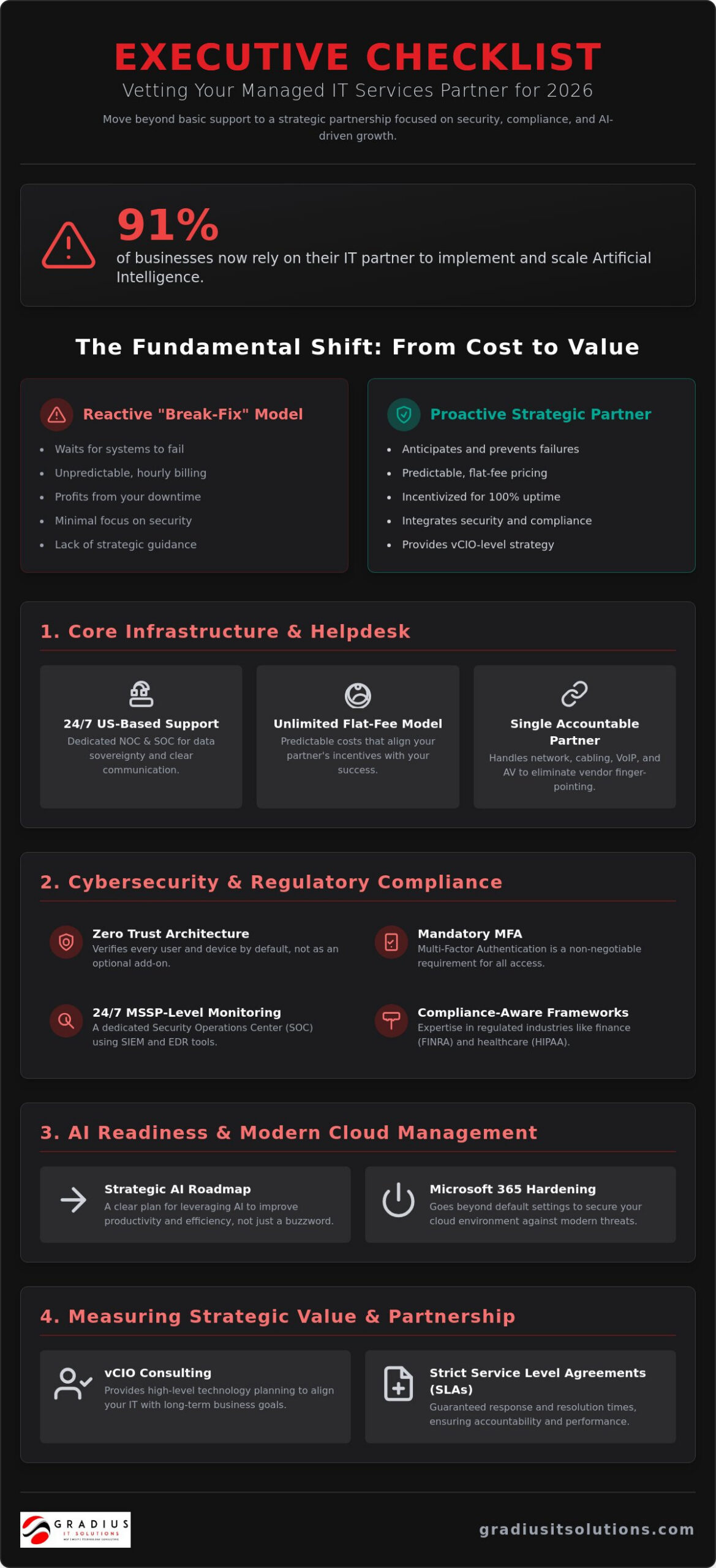
91% of businesses now rely on their managed it services company to implement and scale artificial intelligence. In 2026, the gap between a basic “break-fix” shop and a high-performance partner has become a chasm. You shouldn’t have to choose between keeping the lights on and staying ahead of the next SEC or HIPAA audit. If you’re feeling the weight of unpredictable costs or slow response times, you aren’t alone. Most executives feel the same pressure to modernize while keeping their data locked down.
This article provides a comprehensive, executive-level checklist to vet potential IT partners for security, compliance, and AI-driven performance. We’re moving past generic support to focus on proactive protection and strategic growth. You’ll learn exactly how to identify a partner who treats your technology stack as a competitive advantage rather than a recurring expense. From Zero Trust principles to automated risk reporting, here is what your 2026 IT evaluation must include.
Key Takeaways
- Distinguish between proactive maintenance and reactive “break-fix” models to ensure your technology stack remains resilient.
- Learn why a managed it services company must prioritize compliance-aware security and Zero Trust principles to protect your firm.
- Evaluate your provider’s AI roadmap and Microsoft 365 hardening strategies to drive productivity and maintain regulatory standards.
- Understand the importance of vCIO consulting and strict Service Level Agreements in aligning technology with your business goals.
- Conduct a final audit of industry-specific expertise and insurance credentials to secure a single accountable partner for your organization.
Evaluating Core Infrastructure and Helpdesk Capabilities
Your technology infrastructure is the backbone of your operations. It’s not just about fixing a broken printer; it’s about ensuring the system never stops working. A high-performance managed it services company acts as a proactive guardian. They don’t wait for your server to crash. They anticipate the failure and resolve it before you even notice a lag. This shift from a reactive “break-fix” model to a strategic Managed Service Provider (MSP) partnership is the first step toward business resilience. When your IT partner is incentivized to keep you running rather than billing by the hour, your interests finally align.
To better understand the specific criteria you should look for when selecting a partner, watch this helpful video:
The 24/7 Support Standard
Support isn’t just about availability. It’s about quality, context, and speed. Many firms claim 24/7 coverage but outsource their helpdesk to offshore call centers. This often leads to communication barriers and a lack of accountability. You should verify if the provider offers a US-based NOC and SOC. This ensures your data stays within domestic security standards and your team speaks with experts who understand your local regulatory environment. Look for unlimited support models. Restrictive hourly billing creates a conflict of interest where the provider profits from your downtime. A true partner should offer predictable, flat-fee pricing that covers everything your team needs to stay productive.
Network and Infrastructure Integrity
A truly capable managed it services company manages both the physical and digital layers of your business. This includes network buildouts and low-voltage cabling for new office spaces. If you’re moving or upgrading, you need a “Single Accountable Partner.” This model eliminates the finger-pointing that happens when a VoIP provider blames the network, and the network guy blames the cabling contractor. Your specialist should handle everything from AV integration to de-commissioning compromised legacy systems. They provide a cohesive strategy that covers your entire technology stack. This level of integration ensures that your VoIP, servers, and security protocols work together seamlessly to support your bottom line.
Vetting for Cybersecurity and Regulatory Compliance
In 2026, cybersecurity is no longer an optional layer. It’s the foundation of your business resilience. Most firms realize this too late. They settle for a managed it services company that provides “basic” security, only to fail a FINRA audit or find their cyber-insurance renewal denied. High-performance partners move beyond the basics. They implement a “Compliance-Aware” framework designed specifically for regulated industries like finance and legal. This isn’t just about software. It’s about a culture of protection.
Selecting a partner requires looking at their defense depth. When researching how to choose a managed service provider, prioritize those who bake Zero Trust principles into their standard offering. This means every user and device must be verified, whether they’re at your company premises or working remotely. Multi-factor authentication (MFA) isn’t a suggestion. It’s a requirement. If your current provider treats these as “add-ons,” you’re likely already at risk.
The Managed Security Service Provider (MSSP) Difference
A standard MSP might monitor your uptime. An MSSP monitors your threats 24/7 through a dedicated Security Operations Center (SOC). This team uses Security Information and Event Management (SIEM) tools to correlate data and Endpoint Detection and Response (EDR) to stop attacks in real-time. Your managed it services company should provide:
- Layered Security Controls: Advanced firewalls and network segmentation to contain potential breaches.
- Email Security: Protection against Business Email Compromise (BEC) and automated anti-phishing simulations for your staff.
- Vulnerability Management: Regular penetration testing services to find and fix holes before they’re exploited.
Audit Readiness and Cyber-Insurance
Regulatory bodies like the SEC now demand evidence, not just promises. If you’re looking for compliance for financial services, your partner must provide a Written Information Security Policy (WISP) and a tested Incident Response Plan. With the Digital Operational Resilience Act (DORA) and NIST CSF 2.0 setting higher bars in 2026, your IT partner should lead the way in documentation and governance.
They should also simplify your cyber-insurance renewals. Many providers now offer “Cyber-Insurance Readiness” assessments to ensure you meet the strict technical controls required for coverage. If you’re unsure where your current defenses stand, a comprehensive cybersecurity gap assessment can highlight exactly what needs to be reinforced to keep your organization protected and insurable.
Assessing AI Readiness and Modern Cloud Management
In 2026, the conversation has shifted from moving to the cloud to optimizing what you already have. 91% of companies now rely on their managed it services company to implement and scale artificial intelligence. If your provider is still just talking about “the cloud” as a storage destination, they’re behind the curve. A high-performance partner should offer a clear “Secure AI & Automation” roadmap that identifies exactly how these tools will reduce your specific business risks and improve your bottom line.
Maximizing the Microsoft 365 Ecosystem
Your Microsoft 365 environment is likely the center of your operations. It must be hardened. Your IT partner should demonstrate deep expertise in cloud productivity services by configuring advanced Data Loss Prevention (DLP) policies and Microsoft Purview for compliance. It’s not enough to just “have” M365. You need a partner who enforces Zero Trust through conditional access and regular security posture audits.
- Hardened Configurations: Moving beyond default settings to block legacy authentication and enforce MFA.
- Data Governance: Using Purview to label and protect sensitive information across your entire tenant.
- Resilience Testing: Ensuring daily backups are running and conducting scheduled restore tests to verify data integrity.
Strategic AI Integration
Strategic technology management now includes AI governance. With 56% of companies identifying AI systems as their most important investment area, your managed it services company must be an expert in secure AI automation. Ask potential partners how they use AI to improve their own helpdesk response times. A provider using AIOps can often reduce ticket volumes by 40 to 60% through predictive maintenance and intelligent ticketing.
Measuring Strategic Value: Response Times and vCIO Consulting
Strategic value isn’t a vague concept; it’s a measurable outcome. While many providers focus on uptime, the right managed it services company should be measured by how it aligns technology with your business growth. You need a partner who moves beyond the ticket queue to provide high-level advisory. This begins with a rigorous evaluation of their service standards and strategic depth. If your current provider is only visible when something breaks, they aren’t a partner. They’re a utility.
Step 1: Review the Service Level Agreement (SLA). Don’t settle for industry averages. While the average first response time for a support ticket is over seven hours, high-performance teams resolve critical issues much faster. You should demand a contract that guarantees a response within 15 to 60 minutes for critical business-stopping events. Speed is the difference between a minor hiccup and a catastrophic loss of billable hours. Before committing to any contract, it’s equally important to understand the true cost of managed IT services and how to evaluate ROI so your budget is allocated toward resilience rather than reactive fixes.
Step 2: Evaluate vCIO Depth. A Virtual Chief Information Officer (vCIO) isn’t just a salesperson in a suit. They’re a senior consultant who builds your multi-year roadmap. They should lead regular sessions to review your technology stack and security posture. This ensures you aren’t just buying tools, but investing in solutions that drive efficiency. Your managed it services company should act as a single accountable partner that anticipates your needs three steps ahead.
Virtual CIO and Strategic Planning
True partnership requires a long-term vision. You need IT consulting and technology strategy that scales with your headcount. This includes annual reviews of your Business Continuity and Disaster Recovery (BCDR) plans. Your vCIO should ensure that your AI adoption and cloud management aren’t just buzzwords but integrated parts of your operational plan. They help you avoid the common trap of falling behind on automation while your competitors pull ahead.
Schedule your strategic technology roadmap session today
Accountability and Transparency
Transparency is the bedrock of trust. You should demand a “Prevent-Instead-React” philosophy backed by real-time threat intelligence. This means your provider manages the messy details: internet service providers, phone vendors, and software renewals. This is Step 3: Analyze Vendor Management. You shouldn’t be the middleman in technical disputes. Step 4: Check for Accountability. Look for flat-fee, predictable pricing models. You deserve documented results from daily backup restore tests and security patches. If they can’t prove the system works, assume it doesn’t. Your partner should provide audit support and policy documentation as a core part of the service, ensuring you’re always ready for a surprise regulatory review.
Final Selection: The Managed IT Services Company Partnership Audit
The selection of a managed it services company is the most critical infrastructure decision you’ll make this year. It’s the difference between a technology stack that empowers growth and one that invites risk. By now, you’ve vetted their helpdesk and security protocols. Now, you must audit the partnership itself. You need a “Bold Advocate” who stands in your corner, not a passive vendor who only responds to tickets. This final stage is about verifying expertise and ensuring a cultural fit that lasts for years.
Generalist IT providers often struggle with the granular requirements of regulated sectors. If you’re in the financial sector, your partner must understand the nuances of IT for financial advisors. This includes deep knowledge of FINRA Rule 4370 and the latest SEC Cybersecurity Rules. They shouldn’t be learning about your compliance needs on your dime. They should already have the frameworks in place to protect your data and your reputation. General knowledge isn’t enough when an audit is on the line.
Industry-Specific Alignment
The same standard applies to the legal field. If you handle sensitive litigation data, you must verify their expertise in managed IT services for law firms. Ask how they handle document management system (DMS) integrations and encrypted client communications. Your provider should be licensed and insured as both an MSP and an MSSP. This ensures they have the professional liability and cyber-insurance coverage necessary to protect your business. Don’t just take their word for it. Request evidence of their insurance certificates during the final vetting process.
The Partnership Decision
Never sign a long-term contract without seeing evidence of success. Request Gradius case studies or references from businesses of similar size and regulatory complexity. A high-performance partner will be transparent about their results. They should offer a free IT and Cybersecurity assessment to demonstrate their “Prevent-Instead-React” philosophy in action. This isn’t just a sales pitch. It’s a test of their technical depth and their ability to identify hidden vulnerabilities in your current stack.
Pay close attention to the quality of the compliance gap analysis they provide during this initial process. Does it highlight specific risks you hadn’t considered? Does it offer a clear path to resolution? A managed it services company that provides a thorough, evidence-based audit before you even sign a contract is one that values accountability. This proactive stance is the hallmark of a specialist who is already three steps ahead of the threats. When you find a partner who blends technical superiority with a deep commitment to your specific industry goals, you’ve found the right fit. Before finalizing your decision, it’s also worth reviewing the full it support vs internal staff cost and capability comparison to confirm that a managed partnership delivers the resilience and ROI your organization requires.
Secure Your Competitive Advantage in 2026
The technological landscape of 2026 demands more than just a helpdesk. It requires a strategic partner who understands that compliance isn’t a checkbox; it’s a core business requirement. Choosing the right managed it services company means finding a protector who provides enterprise-grade security as a standard rather than an expensive add-on. You deserve a partner who offers a 24/7 U.S.-based SOC and helpdesk to keep your team productive and your data shielded from increasingly sophisticated threats.
Don’t settle for reactive support that only appears when systems fail. High-performance organizations prioritize vCIO consulting that aligns every technology investment with bottom-line growth. Whether you’re navigating complex SEC audits or scaling secure AI automation, your technology stack should be a competitive asset. It’s time to embrace a “Prevent-Instead-React” model that lifts the burden of technical complexity from your shoulders.
Take the first step toward a more resilient, compliant, and optimized future for your firm. We’re here to stand in your corner as your single accountable partner for IT and security.
Frequently Asked Questions
What should I expect in a free IT and cybersecurity assessment?
Expect a comprehensive deep dive into your current technology stack and security vulnerabilities. A specialist will review your network health, Microsoft 365 configurations, and compliance posture to identify hidden risks. You should receive a documented report that highlights specific gaps, such as missing multi-factor authentication or outdated hardware that could lead to downtime.
How do managed IT services companies help with SEC or FINRA compliance?
They provide the technical controls and documented evidence required to pass regulatory audits. This involves enforcing data encryption, managing detailed access logs, and maintaining a Written Information Security Policy (WISP). A specialist partner ensures your environment meets specific requirements like FINRA Rule 4370 by managing your business continuity and disaster recovery plans.
What is the difference between a standard MSP and a compliance-aware MSP?
A standard managed it services company primarily focuses on uptime and helpdesk response times. A compliance-aware partner prioritizes data governance and regulatory alignment as the foundation of your infrastructure. They build your environment around frameworks like NIST CSF 2.0, ensuring that security and audit readiness are never sacrificed for the sake of convenience.
Can a managed IT services company help my business qualify for cyber-insurance?
Yes, they implement the specific technical safeguards that insurance carriers now require for policy approval and renewal. This includes deploying Zero Trust architecture, endpoint detection and response (EDR), and immutable backups. Many providers perform readiness assessments to verify you meet the strict controls needed to secure favorable premiums and comprehensive coverage.
How often should my managed IT provider test our data backups?
Daily automated checks should be supplemented by monthly manual restore tests to ensure data integrity. It is not enough to simply run a backup job; you must verify that the data is actually recoverable in a disaster scenario. Your provider should offer documented proof of these tests so you can demonstrate business resilience to stakeholders and auditors.
Do managed IT services companies support remote or hybrid workforces?
A modern managed it services company uses cloud-native tools to secure and support employees regardless of their physical location. They manage mobile devices, deploy secure VPNs, and enforce conditional access policies to protect your data on home networks. This ensures your security perimeter extends to every remote laptop, keeping your team productive and your environment shielded.
What are the benefits of combining IT support and cybersecurity with one partner?
Combining these services eliminates the dangerous gap where vendors blame each other for technical failures. A single accountable partner ensures that security protocols are baked into every helpdesk ticket and infrastructure upgrade. This unified approach results in faster incident response, more predictable costs, and a more resilient technology stack for your organization.
How does AI-as-a-Service integrate with traditional managed IT?
It layers secure automation and predictive analytics on top of your existing cloud infrastructure to drive productivity. This integration allows your business to deploy custom AI models and automated workflows without exposing sensitive data to public engines. Your IT partner manages the governance and security of these tools, ensuring they remain compliant with emerging regulations.

Article by
Robert Joyce
**Robert Joyce** is the Founder, CEO, and Chief Technology Officer of Gradius IT Solutions, a security first provider of Managed IT Services, Cybersecurity, Cloud, Compliance, and Secure AI solutions serving businesses throughout New Jersey, New York, Connecticut, and across the United States.
With more than 28 years of IT experience, including 23 years supporting hedge funds, global banks, and wealth management firms, Robert has built a career designing and managing secure, resilient, and highly available technology environments where uptime, cybersecurity, and business continuity are essential.
His expertise includes Microsoft 365, cloud computing, cybersecurity, networking, infrastructure, disaster recovery, compliance, virtualization, and strategic IT leadership. Following the events of September 11, Robert helped rebuild critical technology infrastructure for Merrill Lynch, an experience that reinforced the importance of resilience, planning, and operational excellence.
Robert founded Gradius IT Solutions to bring enterprise level technology and security services to small and midsized businesses at a predictable monthly cost. Today, the company delivers fully managed and co managed IT services, cybersecurity, Microsoft 365, cloud solutions, compliance consulting, Secure AI consulting, technology projects, and vCIO services. Through a U.S. based 24/7 Help Desk and a nationwide network of trusted technology partners, Gradius supports organizations across the country with responsive, security focused technology solutions.
Robert partners with business owners and executive leaders to align technology with business goals, reduce risk, strengthen cybersecurity, improve productivity, and create long term IT strategies that support growth. His mission is simple: provide every client with enterprise class technology, exceptional service, and a trusted advisor they can rely on as their business evolves.
Disclaimer
## Disclaimer
The information provided in this article is for general informational and educational purposes only and should not be considered professional IT, cybersecurity, legal, regulatory, or compliance advice. While Gradius IT Solutions strives to provide accurate and up to date information, technology, security threats, and regulatory requirements change frequently, and we cannot guarantee that all information will remain current or applicable to your specific situation.
Every organization has unique technology, security, compliance, and business requirements. Before implementing any recommendations discussed in this article, you should evaluate their suitability for your environment or consult with a qualified technology professional.
Gradius IT Solutions makes no warranties, express or implied, regarding the completeness, accuracy, reliability, or results obtained from the use of this information. Any actions you take based on this content are at your own risk. Gradius IT Solutions shall not be liable for any direct, indirect, incidental, or consequential damages arising from the use of, or reliance upon, the information contained in this article.
References to third party products, services, or vendors are provided for informational purposes only and do not constitute an endorsement unless explicitly stated.
If you would like guidance tailored to your organization, contact Gradius IT Solutions to schedule a consultation with one of our technology experts.