

80% of organizations are expected to face a cloud data breach in 2026 because of identity drifts. This reality makes cloud security for businesses more than just a technical checkbox; it is a core pillar of your operational survival. You likely feel the weight of securing Microsoft 365 while wondering exactly who is responsible for protecting your data. The anxiety of a looming SEC, FINRA, or HIPAA audit is real, especially when hidden vulnerabilities might be lurking in your hybrid work setup. You need a strategy that moves as fast as the threats do.
You deserve a partner who simplifies this complexity and stands in your corner. This guide helps you master modern cloud protection through a strategic framework built to secure your data, ensure compliance, and empower your team. We will explore the NIST 2.0 framework, clarify your specific security obligations, and provide a clear roadmap for a resilient cloud environment. By the end, you will have the confidence to face any regulatory audit with a posture that is built to last. It is time to stop reacting to threats and start outrunning them.
Key Takeaways
- Move beyond “set and forget” security by adopting a proactive strategy that addresses the complexity of AI-driven cloud ecosystems.
- Clarify your specific obligations within the shared responsibility model to ensure comprehensive cloud security for businesses.
- Replace outdated “castle and moat” perimeters with a Zero Trust architecture that verifies every identity and device continuously.
- Implement a five-pillar framework focusing on identity management and data encryption to protect sensitive information across all cloud apps.
- Leverage a strong security posture as a growth tool to accelerate cloud migration and simplify complex regulatory audits.
The 2026 Cloud Security Landscape: Why “Secure Enough” Is No Longer an Option
The cloud is no longer just a place to store your files. In 2026, it’s a living ecosystem integrated with AI, complex automation, and interconnected apps. This evolution has expanded the surface area for attacks significantly. Many small and mid-sized businesses still rely on basic protections that were sufficient five years ago, but the goalposts have moved. Cloud security for businesses now requires a shift from passive defense to active, strategic resilience. You can’t just hope your settings are right; you have to know they are.
To better understand this concept, watch this helpful video:
Relying on a “set it and forget it” mentality is a recipe for disaster. Misconfigurations are the primary entry point for attackers today. When your team works from home, the office, or a coffee shop, the traditional corporate perimeter vanishes. Your security must follow the user, not the building. Cybercriminals are now using AI to scan for tiny gaps in your cloud settings at lightning speed. If you aren’t proactively managing your environment, you’re essentially leaving the front door unlocked in a digital neighborhood that never sleeps.
The Rise of AI-Driven Threats in the Cloud
Attackers have automated their playbooks. They use AI to launch credential harvesting campaigns that look perfectly legitimate. These aren’t the poorly written emails of the past. They’re sophisticated, targeted, and scaled by machines. Traditional signature-based antivirus cannot keep up because cloud-native attacks don’t always use known malware. Instead, they exploit identity drifts and excessive permissions. You need real-time threat intelligence and predictive analytics to spot these anomalies before they turn into full-blown breaches.
The Business Cost of Inadequate Cloud Protection
A data breach costs more than just the immediate recovery fee. Global spending on information security is forecasted to hit $240 billion in 2026, according to recent industry data, because the stakes are higher than ever. If your data is compromised, your brand reputation and client trust take a hit that can take years to repair. Beyond that, regulatory fines from bodies like the SEC or HIPAA are becoming more aggressive. Cyber insurance providers are also raising premiums for companies that cannot prove a proactive security posture.
This is where managed IT services become a strategic asset. Rather than waiting for a failure, a proactive partner hardens your environment and monitors for threats 24/7. It’s about building a shield that protects your bottom line while you focus on growth. Investing in professional oversight isn’t just an IT expense. It’s a fundamental business strategy for long-term survival.
This proactive approach is shared by top-tier providers globally; you can learn more about sigmavista IT Consulting GmbH to see how they assist businesses with their digital transformation and long-term IT strategy.
Demystifying the Shared Responsibility Model: Who Actually Protects Your Data?
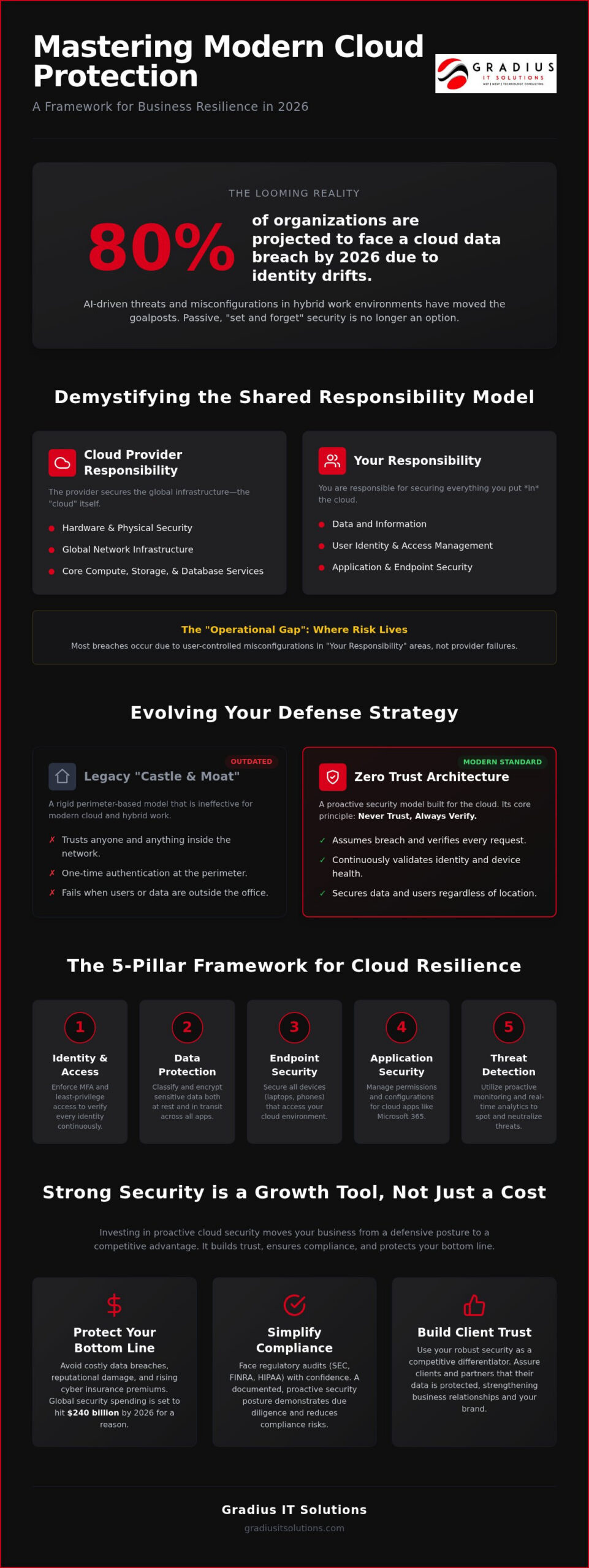
The Shared Responsibility Model is the blueprint for cloud security for businesses. It defines a clear line between what the provider handles and what you must manage. Think of it like renting a high-end office suite. The landlord is responsible for the roof, the plumbing, and the structural integrity of the building. But if you leave your front door unlocked or your filing cabinets open, that’s on you. In the cloud, the provider secures the global infrastructure, while you own the safety of your data and identities.
The “Operational Gap” is where the real risk lives. Research shows that 80% of organizations are expected to face cloud data breaches in 2026 specifically due to identity drifts. These aren’t failures of the cloud provider’s hardware. They’re failures in user-controlled settings like Multi-Factor Authentication (MFA) enforcement and permission levels. Managing these complexities is a full-time job that many mid-sized firms aren’t equipped to handle alone. When these settings are ignored, the gap between “available tools” and “active protection” becomes a playground for attackers.
Microsoft 365 and the SaaS Responsibility Trap
Many business owners believe Microsoft backs up their data and secures their emails automatically. It’s a dangerous assumption. Microsoft provides the tools, but you must configure them. You’re responsible for setting up Data Loss Prevention (DLP) policies and ensuring every user has MFA enabled. Without professional Microsoft 365 management services, these critical settings often go ignored. This leaves your firm exposed to preventable threats like accidental data deletion or targeted phishing attacks. A comprehensive approach to managed M365 security bridges the gap between default configurations and a truly hardened tenant that satisfies compliance demands. To go further and eliminate fragmented workflows alongside security gaps, exploring professional microsoft 365 integration services can transform your tenant into a unified, AI-driven engine for growth.
The Role of an MSP in Shared Responsibility
Partnering with an expert moves the burden of “responsibility” off your shoulders. We act as a proactive guardian, bridging the gap between raw technical settings and your actual business goals. With 24/7 monitoring from a U.S.-based SOC and a compliance-aware approach, we ensure your specific slice of the model is always secure. We don’t just check boxes; we optimize your environment for both safety and performance. If you want to see exactly where your current risks lie, you might consider a cybersecurity assessment to map out your obligations and close any existing gaps.
Zero Trust vs. Legacy Security: A Strategic Comparison for Businesses
Legacy security followed the “castle and moat” strategy. If you were inside the network, you were trusted. In 2026, this approach is a liability. Once a cybercriminal crosses the moat, they have unrestricted access to your entire digital kingdom. Cloud security for businesses now demands a Zero Trust architecture. This isn’t just a software setting; it’s a fundamental shift in how we handle access. The core rule is simple: never trust, always verify. Every user, device, and connection must prove its legitimacy every single time it requests access to your data.
A VPN is no longer enough to secure a remote cloud workforce. VPNs were designed for a world where everyone worked in one building and connected to one server. Today, your team is everywhere, and your data is spread across multiple cloud apps. A stolen VPN credential gives an attacker “trusted” status, allowing them to roam freely. Zero Trust eliminates this risk by using three core pillars: explicit verification, least privilege access, and the “assumed breach” mindset. You operate as if the threat is already inside, which forces you to build stronger internal defenses.
Identity as the New Corporate Perimeter
The physical network wire is no longer your boundary. The user’s identity is. This is why Multi-Factor Authentication (MFA) is the absolute bare minimum. We take it further with Conditional Access. These policies look at the context of a login. Is the device healthy? Is the user in a known location? Is the login happening at an unusual time? By implementing professional cybersecurity services, you ensure that identity is a shield, not a vulnerability. We move the security focus from the hardware to the person.
Micro-segmentation: Containing the Blast Radius
If a single account is compromised, you must prevent it from becoming a company-wide catastrophe. Micro-segmentation creates internal walls within your cloud environment. It prevents “lateral movement.” If an attacker gets into a general user account, they are blocked from jumping over to sensitive financial data or patient records. Using strategic network management services allows you to maintain these barriers automatically. You contain the blast radius of an attack, ensuring that one small leak doesn’t sink the entire ship.
The 5-Pillar Framework for Resilient Cloud Security
Building cloud security for businesses requires more than a collection of disconnected apps. You need a unified framework that addresses technical, operational, and human risks simultaneously. Think of it as an integrated defense system where each pillar reinforces the others. If one layer is challenged, the others stand firm to prevent a total collapse. This structured approach moves your firm from a reactive state to a posture of unwavering reliability.
The framework rests on five essential pillars:
- Identity and Access Management (IAM): This goes beyond basic passwords. It involves managing the entire lifecycle of a user’s access to ensure they only have the permissions necessary for their role.
- Data Protection and Encryption: Protecting data “at rest” and “in transit” is non-negotiable. Proposed 2026 HIPAA updates make AES-256 encryption a mandatory requirement for all ePHI at rest.
- 24/7 SOC Monitoring: Real-time visibility is the only way to catch modern threats. Our U.S.-based Security Operations Center provides constant oversight to detect and neutralize anomalies instantly.
- Vulnerability Assessments: Regular scanning identifies misconfigurations in your cloud apps before cybercriminals can exploit them.
- Human Resilience: Ongoing training ensures your team is your strongest asset. A well-trained workforce acts as a human firewall against social engineering.
Continuous Compliance: Beyond the Annual Audit
Static audits are a relic of the past. In a dynamic cloud environment, your settings can change in minutes. Relying on an annual checkup leaves you exposed for the other 364 days. Integrating Compliance as a Service into your daily operations ensures you’re always audit-ready. This approach automates evidence collection for SEC, FINRA, or HIPAA requirements. It turns a stressful, high-stakes event into a routine business process that runs quietly in the background.
The Human Element: Security Awareness Training
Technology alone can’t stop every threat. Industry data suggests that 90% of cloud breaches still involve some form of human error. This is why employee awareness training is critical for maintaining cloud security for businesses. We use simulated phishing as a resilience tool to help your staff recognize sophisticated AI-driven attacks. It isn’t about punishment. It’s about empowerment. When your C-suite and front-line staff both prioritize protection, you build a culture that values data integrity as a core business principle.
Schedule a compliance consultation to harden your cloud framework today.
Positioning Your Business for Growth with Managed Cloud Security
Cloud security for businesses is often viewed as a defensive cost, but the most successful firms treat it as a strategic growth engine. When your security posture is robust, you remove the barriers that slow down your expansion. Proving your reliability becomes a competitive advantage during client acquisitions. Large partners and regulated industries won’t work with firms that can’t demonstrate a hardened digital environment. By leading with security, you reduce sales friction and build immediate trust.
A solid framework also accelerates your ability to adopt new technology. It provides the foundation for a seamless cloud migration, allowing you to move workloads without the fear of exposing sensitive data. When your infrastructure is secure by design, scaling becomes a predictable process rather than a chaotic risk. You move from a “break-fix” mindset to a strategic model where IT drives value directly to your bottom line.
The Gradius Advantage: Compliance-Aware Managed IT
Our approach to cloud security for businesses focuses on accountability and transparency. We provide enterprise-grade protection specifically tailored for the needs of mid-sized firms in New York and New Jersey. You get more than just a helpdesk; you get a single accountable partner for IT, security, and compliance. This includes direct access to vCIO consulting services. We align your technology roadmap with your long-term business goals to ensure your tools support your growth, not hinder it.
Next Steps: Securing Your Digital Future
Your journey toward resilience starts with a baseline risk assessment. You can’t protect what you haven’t identified. From there, we develop a roadmap that includes emerging technologies like secure AI automation. These tools improve efficiency while maintaining the strict security standards we’ve discussed throughout this guide. Protecting your business isn’t a one-time event. It’s a continuous conversation about how to optimize your digital future.
The 2026 landscape is fast-moving, but you don’t have to navigate it alone. Our team acts as your bold advocate, anticipating threats and optimizing your stack before problems arise. It’s time to lift the burden of technical complexity off your shoulders so you can focus on what you do best. Contact Gradius IT Solutions today to schedule your free cybersecurity assessment and take the first step toward a more resilient future.
Take Command of Your Cloud Strategy
The shift toward 2026 demands a proactive approach to cloud security for businesses. You’ve seen that the shared responsibility model isn’t a safety net; it’s a call to action. By implementing a Zero Trust framework and focusing on the five pillars of resilience, you move from a state of constant anxiety to one of strategic confidence. Protecting your data isn’t just about avoiding a breach. It’s about building a foundation that supports your long-term growth and client trust.
Gradius IT Solutions stands as your bold advocate in this complex landscape. Our U.S.-based 24/7 SOC monitoring and compliance-aware approach for RIAs and law firms ensure that your environment is hardened against modern threats. We specialize in reducing your operational risk while simultaneously improving your team’s productivity. You don’t have to carry the burden of technical management alone.
The future of your business depends on the resilience you build today. Let’s work together to optimize your technology stack and secure your digital future. You deserve a partner who is three steps ahead, keeping your data safe and your operations running at peak performance.
Frequently Asked Questions
Is the cloud actually more secure than on-premise servers?
Yes, the cloud is generally more secure than on-premise servers because of the massive investment providers make in physical security and infrastructure. Most small businesses don’t have the budget to match the redundant power, global cooling, and biometric access controls of a tier-one data center. However, the cloud is only as secure as your configuration. While the provider secures the building, you must still lock the office door through proper identity management.
Does Microsoft 365 include full cloud security for businesses?
No, Microsoft 365 does not provide full cloud security for businesses by default. It offers a robust set of security tools, but you are responsible for turning them on and configuring them correctly. Features like Multi-Factor Authentication, Data Loss Prevention, and email encryption require specific setup based on your business needs. Relying on default settings often leaves gaps that cybercriminals exploit. You need active management to ensure your tenant is truly hardened.
How does cloud security impact my business compliance (HIPAA/SEC)?
Cloud security simplifies your compliance journey by providing built-in encryption and detailed audit logs. For regulated firms, this is a major advantage. Proposed 2026 HIPAA updates make AES-256 encryption mandatory for all ePHI at rest; a secure cloud environment helps you meet these standards automatically. By using a compliance-aware framework, you can automate evidence collection for SEC or FINRA audits. This reduces the burden on your staff while ensuring you remain audit-ready at all times.
What is the most common cause of cloud data breaches?
Misconfigurations and human error are the primary causes of cloud breaches. It’s almost never a failure of the provider’s physical data center. Instead, an incorrectly set permission or a weak password gives an attacker the keys to your kingdom. Identity drifts are expected to cause breaches for 80% of organizations in 2026. This is why active monitoring of user roles and continuous training for your staff are essential to prevent a catastrophic data leak.
Can a small business afford enterprise-grade cloud security?
Yes, small businesses can access enterprise-grade protection through a managed services model. You don’t need a massive internal IT budget to secure your data. By partnering with a specialist, you gain access to high-level tools like 24/7 SOC monitoring and advanced endpoint protection. This approach allows a 20-person firm in New York to maintain the same security posture as a Fortune 500 company. It turns high-end security into a predictable, manageable business expense.
What happens if our cloud provider experiences an outage?
Your business continuity plan must account for provider outages. While major cloud platforms offer high uptime, they aren’t invincible. A resilient strategy involves having redundant backups stored in a different cloud environment. This ensures that if one provider goes down, your data remains accessible. We focus on building disaster recovery plans that allow your team to stay productive during a service failure. You should never rely on a single provider as your only point of access.
How often should we perform a cloud security audit?
You need a deep audit at least once a year, but continuous monitoring is the modern standard. Cloud environments are dynamic; a setting that is secure today could be changed tomorrow. Static audits are no longer enough to protect your business. We recommend using automated tools that scan for misconfigurations in real-time. This proactive approach ensures that your security posture remains strong every day of the year, not just on the day of your annual checkup.
Do we need a 24/7 SOC for our cloud environment?
Yes, 24/7 monitoring is essential because cybercriminals operate across every time zone. They often target businesses during off-hours, hoping for a slow response. A U.S.-based SOC provides the constant oversight needed to detect and neutralize threats instantly. It removes the burden of monitoring from your shoulders and places it with a team of specialists. This level of protection is critical for maintaining client trust and ensuring your operations never miss a beat.

Article by
Robert Joyce
**Robert Joyce** is the Founder, CEO, and Chief Technology Officer of Gradius IT Solutions, a security first provider of Managed IT Services, Cybersecurity, Cloud, Compliance, and Secure AI solutions serving businesses throughout New Jersey, New York, Connecticut, and across the United States.
With more than 28 years of IT experience, including 23 years supporting hedge funds, global banks, and wealth management firms, Robert has built a career designing and managing secure, resilient, and highly available technology environments where uptime, cybersecurity, and business continuity are essential.
His expertise includes Microsoft 365, cloud computing, cybersecurity, networking, infrastructure, disaster recovery, compliance, virtualization, and strategic IT leadership. Following the events of September 11, Robert helped rebuild critical technology infrastructure for Merrill Lynch, an experience that reinforced the importance of resilience, planning, and operational excellence.
Robert founded Gradius IT Solutions to bring enterprise level technology and security services to small and midsized businesses at a predictable monthly cost. Today, the company delivers fully managed and co managed IT services, cybersecurity, Microsoft 365, cloud solutions, compliance consulting, Secure AI consulting, technology projects, and vCIO services. Through a U.S. based 24/7 Help Desk and a nationwide network of trusted technology partners, Gradius supports organizations across the country with responsive, security focused technology solutions.
Robert partners with business owners and executive leaders to align technology with business goals, reduce risk, strengthen cybersecurity, improve productivity, and create long term IT strategies that support growth. His mission is simple: provide every client with enterprise class technology, exceptional service, and a trusted advisor they can rely on as their business evolves.
Disclaimer
## Disclaimer
The information provided in this article is for general informational and educational purposes only and should not be considered professional IT, cybersecurity, legal, regulatory, or compliance advice. While Gradius IT Solutions strives to provide accurate and up to date information, technology, security threats, and regulatory requirements change frequently, and we cannot guarantee that all information will remain current or applicable to your specific situation.
Every organization has unique technology, security, compliance, and business requirements. Before implementing any recommendations discussed in this article, you should evaluate their suitability for your environment or consult with a qualified technology professional.
Gradius IT Solutions makes no warranties, express or implied, regarding the completeness, accuracy, reliability, or results obtained from the use of this information. Any actions you take based on this content are at your own risk. Gradius IT Solutions shall not be liable for any direct, indirect, incidental, or consequential damages arising from the use of, or reliance upon, the information contained in this article.
References to third party products, services, or vendors are provided for informational purposes only and do not constitute an endorsement unless explicitly stated.
If you would like guidance tailored to your organization, contact Gradius IT Solutions to schedule a consultation with one of our technology experts.