

Is your Microsoft 365 environment a strategic asset or just an expensive collection of digital silos? By August 2026, Microsoft 365 paid seats have surpassed 400 million, yet many organizations still struggle with fragmented workflows and security anxiety. You likely feel the pressure of rising license costs and the complexity of managing compliance in a world where ISO 27001:2026 standards are now in effect. It’s frustrating to pay for premium tools while your team remains bogged down by manual tasks. Professional microsoft 365 integration services solve this by aligning your technology stack with your actual business goals.
We agree that technology should empower your business, not complicate it. This article promises to show you how to transform Microsoft 365 from a simple software bundle into a unified, secure, and AI-driven engine for growth. You can achieve a seamless digital workspace that automates the mundane and protects your data. We’ll preview the latest 2026 resilience strategies, from hardening your security posture to deploying computer-using agents that save your team an average of 26 minutes every day. It’s time to stop managing apps and start driving performance.
Key Takeaways
- Move beyond basic software installation to treat Microsoft 365 as a centralized operating system that drives measurable business growth.
- Secure your digital perimeter by closing default security gaps and integrating advanced protection against business email compromise.
- Audit data permissions before deploying AI agents to ensure tools like Copilot operate within a secure and compliant framework.
- Professional microsoft 365 integration services bridge the gap between core apps and third-party tools through automated Power Automate workflows.
- Align your technology roadmap with long-term business goals by partnering with a vCIO for predictable costs and strategic resilience.
Beyond the License: Defining Microsoft 365 Integration Services
Businesses often mistake a subscription for a solution. Buying a license is just the entry fee. True business resilience depends on how those tools interact with your unique workflows. Standard tenant configurations are designed for the masses. They are broad, permissive, and often insecure by default. Professional microsoft 365 integration services bridge the gap between “standard” and “strategic.” Without this bridge, your data remains trapped in silos. Employees waste time on “work about work.” They search for files across multiple platforms or manually update client records. This fragmentation breeds inefficiency and frustration.
The Connective Tissue of Modern Workflows
Integration defines how your data flows between M365 and the rest of your tech stack. It connects your Outlook to your CRM and your SharePoint to your project management tools. For businesses striving for a competitive edge, speed and efficiency are paramount. You can’t afford the friction of disconnected systems. Regulated industries face even higher stakes. Default settings rarely meet the rigorous demands of FINRA or SEC audits. Strategic integration ensures your Microsoft 365 ecosystem is hardened from day one. It replaces “app fatigue” with a streamlined experience where every tool has a clear, productive purpose. This isn’t just about convenience; it’s about closing the security gaps that lead to data leaks and phishing vulnerabilities.
Integration as a Foundation for Scalability
Scalability isn’t just about adding more users. It’s about maintaining control as you grow. A unified identity management system is the backbone of this control. When you integrate M365 with your internal directories, you create a single source of truth for access. This simplifies employee lifecycle management. You can grant or revoke permissions across dozens of apps with one click. It’s a proactive approach to security that also lowers operational costs. M365 integration is the strategic alignment of cloud tools with specific corporate goals. By working with an IT strategy partner, you move away from reactive IT. You build a foundation that supports automation and future AI adoption. This proactive stance ensures your tech stack grows alongside your revenue, not your overhead.
Core Pillars of a High-Performance Microsoft 365 Ecosystem
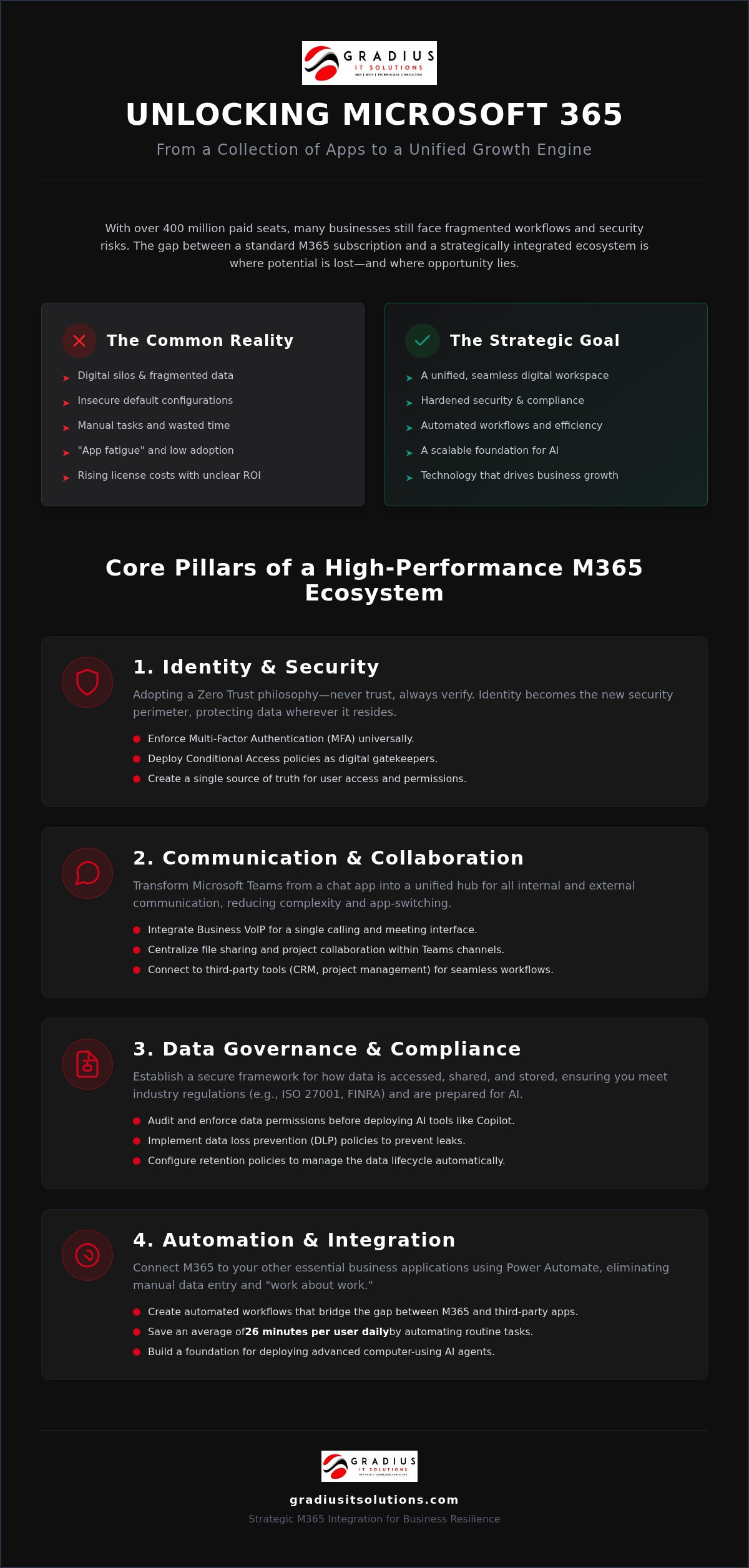
High performance in a digital environment isn’t just about speed. It’s about building a structural foundation that remains stable under pressure. For small to mid-sized firms, this means moving away from a collection of loosely connected apps toward a unified ecosystem. Professional microsoft 365 integration services focus on four critical pillars: identity, communication, data governance, and endpoint management. When these elements work in harmony, your team stops fighting the tools and starts using them to drive revenue. This architecture is what separates a resilient business from one that’s constantly putting out IT fires.
Identity and Security: The Zero Trust Approach
The traditional office perimeter has vanished. Your data now lives on laptops in home offices and mobile devices in transit. Identity is your new perimeter. We adopt a Zero Trust philosophy: never trust, always verify. This starts with enforcing Multi-Factor Authentication (MFA) across your entire user base without exception. We then layer on Conditional Access policies. These policies act as digital gatekeepers. They evaluate the risk of every login attempt based on location, device health, and user behavior. By implementing proactive security management, you ensure that sensitive company data stays within your control. You can learn more about deep hardening in our guide to managed M365 security.
Streamlining Collaboration and Communication
Teams is often the most underutilized tool in the suite. Most firms use it for basic chat, but its true power lies in integration. Connecting Teams with business VoIP systems creates a single, unified communication hub. Your staff can handle client calls, internal meetings, and file sharing from one interface. This reduces the cognitive load of switching between apps. Beyond voice, your SharePoint environment should serve as a structured corporate intranet. It’s not just a file dump. It’s a governed space where permissions are clear and external guest access is strictly monitored. Proper microsoft 365 integration services ensure that when you share a document with a partner or client, you aren’t accidentally opening a back door to your entire server.
Effective data governance also requires managing the devices themselves. Every endpoint accessing your M365 data must be secure and compliant. We use automated policies to ensure that only encrypted, updated devices can sync with your cloud environment. This level of control provides the peace of mind you need to scale. If you’re unsure where your current setup stands, a quick technology strategy consultation can identify the gaps in your existing architecture before they become liabilities.
Hardening the Stack: Integrating Security and Compliance
Default Microsoft 365 settings are designed for accessibility, not high-level security. This makes standard tenants a primary target for hackers. Business Email Compromise (BEC) remains one of the most significant threats to small and mid-sized firms. You need advanced layers that go beyond basic spam filters to identify sophisticated phishing attempts. Effective microsoft 365 integration services include configuring Microsoft Purview to automate Data Loss Prevention (DLP). This ensures sensitive information, such as client financial records or proprietary data, cannot leave your environment without authorization. It’s about building a wall around your data that is both high and smart.
Even the most robust configurations require constant oversight. A U.S. based 24/7 SOC provides the continuous monitoring necessary to spot anomalies before they escalate into full-scale breaches. While integrating AI and Third-Party Automation through tools like Copilot enhances how your team works, it also requires a hardened security stack to prevent the accidental exposure of internal data. We move you from a reactive posture to a “prevent-instead-react” philosophy. This strategy ensures your technology remains an asset rather than a liability. For a comprehensive look at building total operational resilience, our cybersecurity services executive guide outlines the 2026 regulatory landscape and Zero Trust standards every business leader needs to understand.
Meeting Regulatory Standards (SEC, FINRA, HIPAA)
For firms in regulated sectors, audit readiness is a daily requirement. We automate email archiving and discovery to meet strict retention and legal hold standards. This is where compliance as a service maps directly to your M365 tenant. We also strictly enforce the 3-2-1 backup rule for cloud data. Your information is backed up in three places, on two different media, with one copy stored offsite. This protects your business from accidental deletion, hardware failure, and ransomware attacks simultaneously. For a deeper look at architecting a resilient data environment, our guide to secure cloud storage for business outlines the framework needed to meet 2026 compliance demands.
Proactive Threat Prevention
Prevention is always more cost-effective than recovery. We utilize Microsoft Defender for Office 365 to neutralize zero-day threats in real-time by sandboxing suspicious attachments and links. This isn’t just about installing software. Regular penetration testing for your cloud environment identifies hidden vulnerabilities before a bad actor can exploit them. Security integration is a continuous process, not a one-time toggle. It requires a dedicated partner who stays ahead of the evolving threat landscape to protect your bottom line and your reputation.
Driving Efficiency: Integrating AI and Third-Party Automation
Deploying AI isn’t a “set it and forget it” project. It’s the pinnacle of strategic microsoft 365 integration services. Before you roll out Microsoft 365 Copilot, you must address data hygiene. Most small to mid-sized firms suffer from over-permissive data structures. If an employee has access to a folder they shouldn’t, AI will find that information and present it in a summary. Cleaning up permissions in SharePoint and OneDrive is a non-negotiable prerequisite for secure AI adoption. This ensures your corporate intelligence stays in the right hands while empowering your team with high-speed insights.
Secure AI Adoption for Small Business
You don’t need an enterprise budget to leverage enterprise-grade AI. The key is integrating secure AI automation into existing daily tasks. This starts with building custom AI agents. These specialized bots can handle routine internal queries, such as HR policy lookups or IT ticket status updates. However, tools are only as good as the people using them. We prioritize employee training on AI awareness and prompt engineering. This ensures your staff knows how to ask the right questions to get accurate, secure results without exposing sensitive data.
Third-Party App Integration
Your business relies on more than just Microsoft. Whether it’s legal case management, financial planning, or specialized platforms to discover FeedbackGraph for capturing bug reports, these tools must talk to each other. We specialize in connecting M365 with industry-specific applications to create a unified workflow. This also helps manage the growing risk of Shadow IT. When employees find their own unapproved app integrations, they create security holes. We solve this by implementing Single Sign-On (SSO). It secures your entire software stack under one identity. It’s a proactive way to keep your data safe while giving your team the tools they need to excel. Professional microsoft 365 integration services ensure these connections are built on a foundation of security and efficiency.
Optimize your workflows with secure AI and automation.
The Strategic Advantage: Why Managed M365 Integration Wins
Managing a complex cloud environment in-house often leads to technical debt. You pay for features you don’t use and ignore vulnerabilities you don’t see. Professional microsoft 365 integration services solve this by providing a single accountable partner for your entire stack. You no longer have to mediate between a software vendor, a security firm, and a hardware provider. We take full responsibility for the performance and protection of your digital workspace. This model allows your leadership team to focus on growth while we handle the technical heavy lifting.
The vCIO advantage is a core component of this partnership. We don’t just fix what’s broken. We align your M365 roadmap with your three-year business goals. This proactive planning ensures your technology supports your expansion rather than hindering it. You move from a reactive, emergency-based IT model to a predictable, flat-fee structure. This stabilizes your budget and eliminates the stress of unexpected technical costs. Our U.S. based help desk and 24/7 SOC provide the local expertise and immediate response times your team needs to stay productive.
Continuous Optimization and Training
The cloud never stands still. Microsoft releases hundreds of updates and security patches every year. Effective managed IT services include monthly reviews of your tenant health. We identify new features that can improve your specific workflows and disable legacy tools that create security risks. Employee awareness training is the final, most critical layer of this integration. We turn your staff from a potential liability into a proactive line of defense through ongoing education on phishing and AI best practices.
Executing the Integration Roadmap
We approach every integration with a methodical, three-phase plan. This ensures nothing is missed and every action provides maximum business value.
- Phase 1: Assessment and Gap Analysis. We perform a deep dive into your current tenant. This identifies identity risks, data silos, and licensing inefficiencies.
- Phase 2: Remediation and Hardening. We close the security gaps identified in Phase 1. This includes identity cleanup, MFA enforcement, and data permission resets.
- Phase 3: Strategic Automation and AI. With a secure foundation, we deploy custom Power Automate workflows and AI agents to drive your ROI.
This structured approach ensures your microsoft 365 integration services deliver a resilient, high-performance environment that scales with your ambition. You get the peace of mind that comes from knowing your technology is under control, fast, and entirely focused on your bottom line.
Future-Proofing Your Digital Operating System
Your technology should be a multiplier for your success, not a source of friction. We’ve explored how a unified ecosystem protects your data through Zero Trust and drives efficiency through secure AI adoption. Transitioning to a high-performance workspace requires more than just apps. It demands a proactive strategy that aligns your tools with your long-term corporate goals. Transforming your M365 environment from a collection of apps into a unified engine requires a shift in mindset. You’ve seen how automated workflows and hardened security settings create a foundation that supports both compliance and growth. This isn’t just about IT management. It’s about business resilience in an AI-driven market.
Gradius IT Solutions stands as your single accountable partner for this journey. Our team specializes in compliance-aware management for RIAs and legal firms, ensuring you meet SEC, FINRA, and HIPAA standards without sacrificing speed. By utilizing specialized microsoft 365 integration services, you gain the peace of mind that comes from U.S. based 24/7 SOC monitoring and a roadmap built for your specific goals.
Take control of your digital future. A more secure, automated, and productive business is within reach.
Frequently Asked Questions
What is the difference between M365 management and M365 integration?
Management focuses on maintaining the status quo through tasks like password resets and license assignments. Integration is far more strategic. It aligns the platform with your specific business goals by connecting M365 to your CRM or ERP. Professional microsoft 365 integration services move beyond basic support to create a unified digital operating system that automates workflows and hardens your security posture.
Is Microsoft 365 secure enough for financial services right out of the box?
No, default settings are built for broad accessibility rather than the rigorous security required by financial firms. Out of the box configurations often lack strict Multi-Factor Authentication (MFA) enforcement or advanced data loss prevention. You must harden the tenant to meet SEC and FINRA standards. This involves configuring conditional access and encrypted archiving to prevent unauthorized data leaks and ensure audit readiness.
How does Microsoft 365 integration help with HIPAA or SEC compliance?
Integration automates the technical controls required by these strict regulations. We configure Microsoft Purview to handle immutable email archiving and sensitive data labeling automatically. This ensures every piece of communication is tracked and stored according to legal retention policies. By integrating these controls directly into your daily workflow, you eliminate human error and simplify the audit process for your team.
Can Microsoft 365 be integrated with my existing CRM or legacy software?
Yes, we use Power Automate and custom connectors to bridge M365 with your industry specific tools. Whether you use legal case management software or a financial planning CRM, we can sync data across platforms. This connectivity removes manual data entry and ensures your staff has a single source of truth. It’s about making your entire software stack talk to each other seamlessly.
What are the risks of a poorly integrated Microsoft 365 environment?
The primary risks are data silos and significant security vulnerabilities. When apps don’t talk to each other, employees waste hours on manual updates and searching for files. Even worse, fragmented systems often have inconsistent permissions that hackers exploit to gain access. Poor integration leads to “app fatigue” and increases the likelihood of a successful phishing attack or a costly data breach. Understanding how to implement secure cloud storage for business is a critical step in closing these vulnerabilities before they can be exploited.
Do I need a special license for AI and Copilot integration?
Yes, Microsoft 365 Copilot requires a specific add-on license beyond your standard subscription. As of 2026, these are available for Business Premium and Enterprise plans. However, the license is only the first step. You also need a hardened data structure to ensure the AI doesn’t accidentally expose sensitive internal intelligence to unauthorized users during a routine search or query.
How often should we review our Microsoft 365 security and integration settings?
We recommend a comprehensive review at least once a month. Microsoft releases hundreds of feature updates and security patches annually, making a “set it and forget it” approach dangerous for your business. Monthly audits allow us to optimize new automation features and disable legacy protocols. Regular reviews ensure your microsoft 365 integration services continue to provide maximum protection as the threat landscape evolves. Staying current with the latest cybersecurity services and business resilience strategies is essential to keeping your defenses ahead of emerging AI-driven threats.
What is the role of a vCIO in Microsoft 365 management?
A vCIO acts as your strategic technology architect. Instead of just managing tickets, they align your M365 roadmap with your three-year business objectives. They help you navigate license changes, plan for AI adoption, and ensure your technology spend delivers a high ROI. It’s about having a high-level expert who looks at the big picture to drive long-term business resilience.

Article by
Robert Joyce
**Robert Joyce** is the Founder, CEO, and Chief Technology Officer of Gradius IT Solutions, a security first provider of Managed IT Services, Cybersecurity, Cloud, Compliance, and Secure AI solutions serving businesses throughout New Jersey, New York, Connecticut, and across the United States.
With more than 28 years of IT experience, including 23 years supporting hedge funds, global banks, and wealth management firms, Robert has built a career designing and managing secure, resilient, and highly available technology environments where uptime, cybersecurity, and business continuity are essential.
His expertise includes Microsoft 365, cloud computing, cybersecurity, networking, infrastructure, disaster recovery, compliance, virtualization, and strategic IT leadership. Following the events of September 11, Robert helped rebuild critical technology infrastructure for Merrill Lynch, an experience that reinforced the importance of resilience, planning, and operational excellence.
Robert founded Gradius IT Solutions to bring enterprise level technology and security services to small and midsized businesses at a predictable monthly cost. Today, the company delivers fully managed and co managed IT services, cybersecurity, Microsoft 365, cloud solutions, compliance consulting, Secure AI consulting, technology projects, and vCIO services. Through a U.S. based 24/7 Help Desk and a nationwide network of trusted technology partners, Gradius supports organizations across the country with responsive, security focused technology solutions.
Robert partners with business owners and executive leaders to align technology with business goals, reduce risk, strengthen cybersecurity, improve productivity, and create long term IT strategies that support growth. His mission is simple: provide every client with enterprise class technology, exceptional service, and a trusted advisor they can rely on as their business evolves.
Disclaimer
## Disclaimer
The information provided in this article is for general informational and educational purposes only and should not be considered professional IT, cybersecurity, legal, regulatory, or compliance advice. While Gradius IT Solutions strives to provide accurate and up to date information, technology, security threats, and regulatory requirements change frequently, and we cannot guarantee that all information will remain current or applicable to your specific situation.
Every organization has unique technology, security, compliance, and business requirements. Before implementing any recommendations discussed in this article, you should evaluate their suitability for your environment or consult with a qualified technology professional.
Gradius IT Solutions makes no warranties, express or implied, regarding the completeness, accuracy, reliability, or results obtained from the use of this information. Any actions you take based on this content are at your own risk. Gradius IT Solutions shall not be liable for any direct, indirect, incidental, or consequential damages arising from the use of, or reliance upon, the information contained in this article.
References to third party products, services, or vendors are provided for informational purposes only and do not constitute an endorsement unless explicitly stated.
If you would like guidance tailored to your organization, contact Gradius IT Solutions to schedule a consultation with one of our technology experts.