

If you believe your default subscription is a security fortress, you’re mistaken. Microsoft 365 is a world-class productivity suite, but it isn’t hardened for the 2026 threat landscape right out of the box. Without specialized microsoft 365 security services, you’re likely struggling with the complexity of Microsoft Purview and the looming June 2026 SEC Regulation S-P deadlines. It’s exhausting to stay ahead of business email compromise while trying to scale your company.
You deserve a tech stack that protects your legacy. This guide explains how to turn your standard environment into a compliance-ready, enterprise-grade ecosystem. We’ll show you how to implement NIST CSF 2.0 standards, deploy phishing-resistant passkeys, and establish the 24/7 monitoring needed for true peace of mind. You’re about to learn how to transform your digital workspace into a secure, audit-ready asset that’s built to withstand modern threats and satisfy even the most demanding cyber insurance providers.
Key Takeaways
- Default Microsoft 365 configurations prioritize user convenience over defense. These “out-of-the-box” settings leave critical gaps that require intentional hardening to close.
- Understanding the Shared Responsibility Model is vital. While Microsoft secures the infrastructure, your business remains legally and operationally accountable for the data within it.
- Professional microsoft 365 security services transform standard licenses into fortified ecosystems. They do this by implementing phishing-resistant MFA and strict Data Loss Prevention (DLP) policies.
- A proactive hardening roadmap starts with a comprehensive gap assessment. This moves your organization toward a Zero Trust architecture that eliminates unauthorized access.
- Real-time monitoring through a 24/7 U.S.-based SOC ensures threats are neutralized. This happens before they disrupt your business operations or compromise compliance.
Beyond the License: Why Default Microsoft 365 Settings Leave Gaps
Buying a subscription for the Microsoft 365 suite is only the first step. Most executives assume that because they’re paying for premium licenses, their data is automatically shielded from hackers. This is a dangerous misconception. Microsoft builds its platform to be accessible and user friendly; they want your team to start working immediately without technical friction.
This “out-of-the-box” approach creates a trap where convenience overrides defense. Default configurations often leave legacy authentication protocols active and file sharing settings wide open. To close these gaps, businesses need specialized microsoft 365 security services that harden the tenant against modern exploits. Relying on default settings is like buying a high-end safe but leaving the combination set to 0000 for the sake of convenience.
To better understand how these security layers work in practice, watch this helpful video from Microsoft Security:
The Reality of Modern Business Email Compromise (BEC)
Standard email filters can’t keep up with the 2026 threat landscape. Attackers now use generative AI to craft hyper-realistic social engineering campaigns that mirror your internal writing style perfectly. These attacks don’t rely on malicious links alone; they rely on psychological manipulation. In 2026, BEC is a multi-stage, AI-orchestrated campaign designed to manipulate human trust and bypass traditional identity verification through hyper-realistic deepfakes and social engineering. Standard antivirus is no longer sufficient because these threats often involve living off the land techniques that use legitimate system tools against you.
Regulatory Consequences of Misconfiguration
Regulators have moved past checking for the mere existence of security tools. The SEC’s amended Regulation S-P, which hits a major compliance deadline on June 3, 2026, requires documented proof of incident response and service provider oversight. If your environment is set to default, you won’t have the audit logs or policy enforcement needed to satisfy an examiner. Utilizing Compliance as a Service ensures that your technical settings translate into defensible evidence. You need a partner who understands that security is a governance issue, not just an IT task.
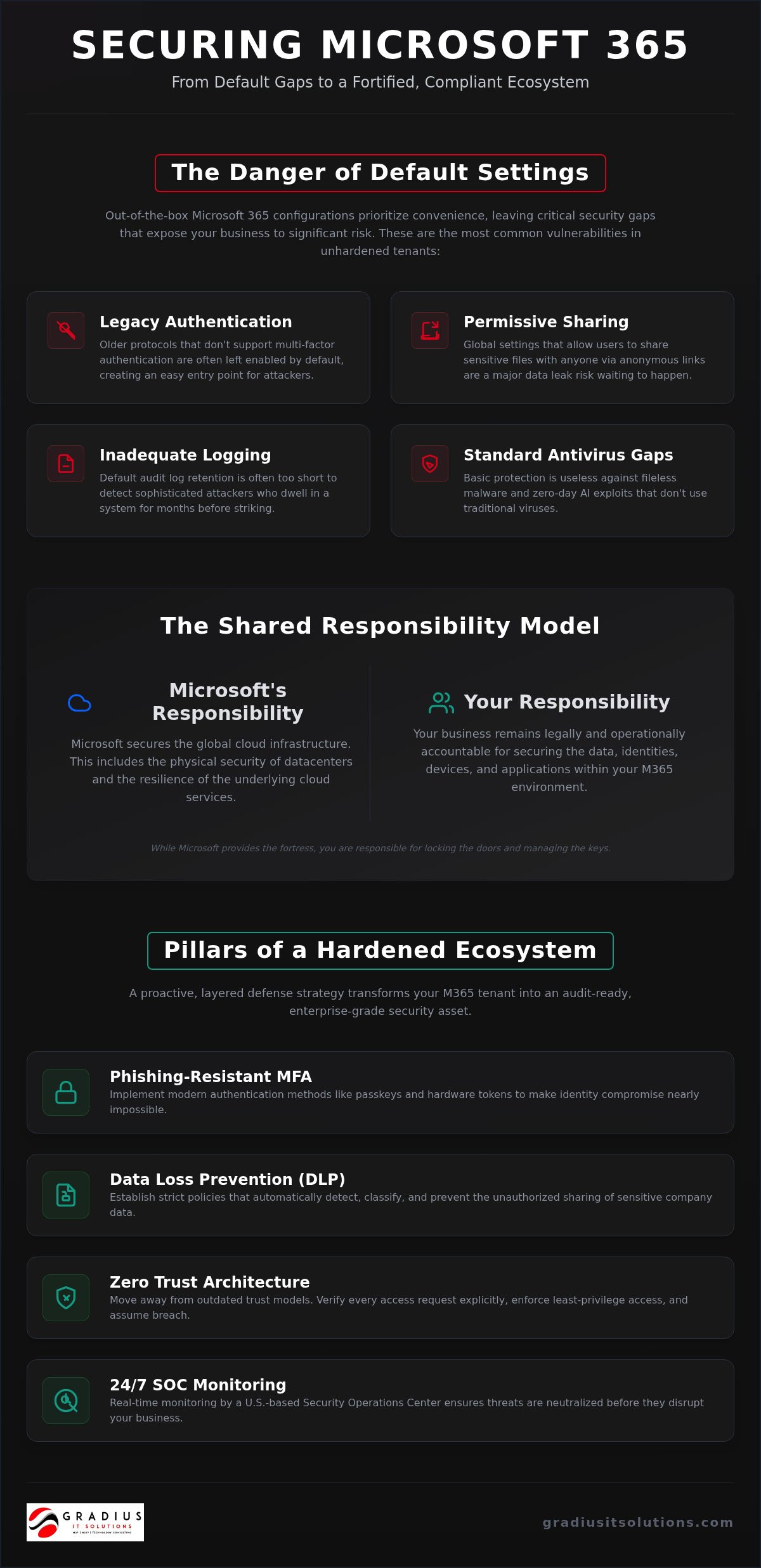
Common vulnerabilities in unhardened tenants include:
- Legacy Authentication: Older protocols that don’t support multi-factor authentication are often left enabled by default.
- Permissive Sharing: Global settings that allow users to share sensitive files with anyone via anonymous links are a major data leak risk.
- Inadequate Logging: Default audit log retention is often too short to catch sophisticated attackers who dwell in a system for months.
- Standard Antivirus Gaps: Basic protection is useless against fileless malware and zero-day AI exploits that don’t use traditional viruses.
By investing in professional microsoft 365 security services, you move beyond the license and into a state of active, managed defense. This proactive approach is the only way to satisfy cyber insurance providers and regulatory bodies in an increasingly hostile digital environment.
The Pillars of Modern Microsoft 365 Security Services
Effective microsoft 365 security services aren’t just about turning on a feature; they’re about creating a layered defense that protects your most valuable assets. For regulated firms like RIAs and legal practices, this means moving beyond the basic toggles found in the admin center. You need a cohesive strategy that addresses identity, data governance, and communication channels simultaneously. Organizations looking for a baseline should consult the CISA Strategic Hardening: A Roadmap, which provides a technical foundation for these configurations.
Identity as the New Perimeter
The traditional network perimeter has vanished. In its place, identity has become the primary line of defense. This starts with Microsoft Entra ID hardening. Zero Trust principles dictate that we never trust and always verify every access request. Basic multi-factor authentication (MFA) is no longer enough because fatigue attacks and session hijacking are common. We implement conditional access policies that evaluate the user’s location, device health, and risk level before granting entry. Establishing these pillars requires a deep understanding of your specific risk profile. You can start by reviewing our Cybersecurity Services to see how we align these tools with your business goals.
Information Protection and DLP Policies
Data Loss Prevention (DLP) is your safety net against accidental leaks. We configure automated policies to detect personally identifiable information (PII), protected health information (PHI), and sensitive financial records. If an employee tries to send an unencrypted email containing a client’s social security number, the system blocks the action or encrypts the message automatically. This ensures that secure document sharing becomes a standard, frictionless workflow rather than a manual chore. This level of automation is a core part of a modern Microsoft 365 integration strategy for resilient businesses.
Microsoft Purview serves as the brain of your data governance. It allows us to leverage unified data governance to manage risks and meet compliance requirements like the June 2026 SEC Regulation S-P deadline. By labeling data based on its sensitivity, we can control how it’s stored, shared, and retained across the entire tenant. This proactive approach reduces the “administrative burden” while providing the audit evidence regulators demand.
Advanced email hardening completes the fortress. While Microsoft Defender for Office 365 is powerful, high-risk firms often benefit from integrating specialized tools like Mimecast or Graphus. These platforms provide superior protection against hyper-realistic phishing and AI-driven social engineering. By layering these microsoft 365 security services, you create a redundant environment where if one layer is challenged, others stand firm. This comprehensive hardening ensures your business remains an unattractive target for modern cybercriminals.
The Shared Responsibility Model: Who Actually Protects Your Data?
Many business owners assume that by moving to the cloud, they have outsourced their entire security burden to Microsoft. This is a critical misunderstanding that leads to significant data exposure. Microsoft operates under a Shared Responsibility Model. This framework specifies that while Microsoft provides a secure infrastructure, the customer is legally and operationally responsible for protecting the identities, data, and devices within that environment. Simply put, Microsoft secures the “house,” but you are responsible for who has a key and what happens inside the rooms.
To maintain a resilient posture, you need specialized microsoft 365 security services that focus on the layers Microsoft does not manage. If a disgruntled employee deletes files or a ransomware attack encrypts your SharePoint libraries, Microsoft is not obligated to recover that data beyond basic, short-term retention periods. Their job is to keep the service running; your job is to keep your data safe.
What Microsoft Does (and Does Not) Secure
Microsoft excels at physical security. They protect their global data centers with biometric scanners, armed guards, and redundant power systems. They also handle host-level protection, ensuring the underlying servers and virtualization layers are patched and shielded from hardware failures. However, user-level data integrity falls entirely on your shoulders. This includes managing who has access through Entra ID and ensuring that your information is not accidentally leaked or intentionally stolen.
A major gap in this model is backup and disaster recovery. Microsoft’s recycle bin is a temporary holding area, not a true backup solution. If data is purged or corrupted, Microsoft cannot “roll back” your tenant to a previous state. High-performance organizations require immutable, off-site backups for M365 data to ensure business continuity. This ensures that even if your primary cloud environment is compromised, your intellectual property remains intact and recoverable.
The Risk of “Set It and Forget It” Mentality
Internal teams often struggle with the “administrative burden” of cloud management. Microsoft 365 is not a static platform; it evolves almost daily with new features, updated protocols, and changing default settings. This leads to “configuration drift,” where a once-secure environment slowly becomes vulnerable as the organization grows and new users are added without proper hardening. Professional Managed IT Services bridge this gap by providing continuous oversight that internal staff rarely have the time to perform.
Securing your tenant requires constant monitoring and adjustment. You cannot simply configure your settings once and assume you are protected forever. As cyber threats become more sophisticated, your microsoft 365 security services must adapt in real time. A proactive partner acts as a guardian, anticipating potential vulnerabilities and adjusting your defense layers before an attacker can exploit a lapse in oversight. This transition from reactive troubleshooting to strategic management is what separates a standard business from a truly hardened enterprise.
Strategic Hardening: A Roadmap for Regulated SMBs
Regulated SMBs can’t afford a haphazard approach to defense. You need a methodical sequence to reach enterprise-grade hardening. This roadmap aligns your microsoft 365 security services with the high standards expected by regulators and insurance carriers. It moves you from a state of vulnerability to one of documented resilience through five critical phases.
- Conduct a Gap Assessment: You can’t secure what you don’t understand. This audit identifies exactly where your current configurations fail to meet NIST CSF 2.0 or CISA secure baselines.
- Implement Zero Trust Identity: Move beyond basic MFA. Enforce phishing-resistant passkeys and conditional access for every remote login to ensure only authorized users on healthy devices can enter.
- Configure Data Classification: Leverage Microsoft Purview to label sensitive records. This ensures data is retained for the legally required duration and blocked from unauthorized export.
- Enable 24/7 SOC Monitoring: Security isn’t a 9-to-5 job. Real-time threat detection ensures that suspicious activity is neutralized by U.S.-based experts before it becomes a full-scale breach.
- Deploy Awareness Training: Build a culture of vigilance. Monthly phishing simulations prepare your team to recognize AI-driven social engineering and hyper-realistic deepfake attempts.
Aligning with Cyber Insurance Requirements
Insurance providers have become sophisticated. They now demand proof of hardening before issuing or renewing policies. By implementing these microsoft 365 security services, you don’t just protect your data; you lower your premiums and guarantee coverage. Preparing evidence for annual insurance questionnaires becomes a seamless process when your controls are already documented and active. For a deeper look at long-term strategy, see The Executive Guide to Managed IT Services in 2026.
Continuous Compliance and Audit Readiness
Compliance is a continuous state, not a year-end project. For firms focused on Financial Services IT, maintaining a Written Information Security Policy (WISP) is mandatory. We align your M365 controls with your WISP to generate automated reporting for SEC or FINRA examinations. This ensures you’re always audit-ready without the last-minute scramble for documentation. The June 3, 2026, Regulation S-P deadline is approaching fast. Don’t wait for an examiner to find your gaps.
Schedule your Microsoft 365 security assessment today.
Elevating Resilience with Gradius Managed Microsoft 365 Security
Hardening your environment is a significant achievement, but maintaining that posture is a daily battle. Standard technical support is often reactive; it waits for a failure before taking action. At Gradius, we challenge this status quo by providing microsoft 365 security services that prioritize a “Prevent-Instead-React” methodology. Our compliance-aware management is specifically designed for regulated industries like finance and law, where a single configuration error can lead to a devastating audit failure. We act as your single accountable partner, managing the intersection of IT, security, and compliance under one roof.
The 2026 threat landscape is dominated by AI-driven social engineering and hyper-realistic deepfakes. You can’t fight these automated threats with manual processes alone. We leverage the latest AI-driven security automation and real-time threat intelligence to stay three steps ahead of attackers. This ensures your defense layers adapt in real time to evolving exploits, protecting your intellectual property without slowing down your team’s productivity. By automating the most repetitive aspects of defense, we free up our experts to focus on the high-level strategy your business needs to thrive.
U.S.-Based Support and Security Operations
Technical expertise is only valuable if it’s reachable when you need it most. Our 24/7 Help Desk & SOC is entirely U.S.-based, providing local expertise that understands the nuances of your industry. While Microsoft’s own support is often technical and distant, our SOC is strategic and immediate. We focus on rapid incident response and containment. Our NOC and SOC teams work in tandem to ensure that performance and security are never at odds. If a suspicious login is detected at 3 AM, our team is already neutralizing the threat before it can impact your operations. We monitor configuration drift continuously, ensuring that the hardening steps you took yesterday remain active tomorrow.
Your Strategic Technology Roadmap
Security isn’t an isolated project; it’s a core component of your business growth. Through our vCIO consulting, we align your microsoft 365 security services with your long-term strategic goals. We help you move away from chaotic, unpredictable IT spending toward a predictable, flat-fee model for enterprise-grade protection. This ensures your technology stack remains an asset rather than a liability as you scale. We take full responsibility for your audit readiness, ensuring that your environment is always prepared for the next regulatory examination or insurance review. This partnership gives you the freedom to focus on your clients while we guard your digital perimeter.
Securing Your Digital Resilience in 2026
The 2026 threat landscape doesn’t forgive “set it and forget it” security. Your default subscription is a productivity tool, not a defensive fortress. Transforming your tenant into a compliance-ready ecosystem requires more than just toggling a few buttons. It demands a strategic alignment of identity protection, data governance, and continuous monitoring. By investing in specialized microsoft 365 security services, you shift the burden of technical complexity to a partner who understands the high stakes of your industry.
Gradius IT Solutions provides compliance-aware managed IT specifically built for RIAs and legal firms. Our U.S.-based 24/7 SOC and help desk ensure that your operations remain resilient against AI-driven threats while you focus on your clients. You don’t have to navigate the pressure of cyber insurance or SEC mandates alone. We act as your proactive guardian, ensuring every configuration is audit-ready and every user is protected. Take the first step with a free gap assessment and cyber-insurance readiness review.
Your business deserves a technology stack that is as ambitious as your goals. We’re ready to help you build a secure, high-performance foundation that stands firmly in your corner.
Frequently Asked Questions
Is Microsoft 365 inherently secure for financial services firms?
Microsoft 365 is not inherently secure enough for financial firms without intentional hardening. While the infrastructure is world-class, the default configurations prioritize accessibility over maximum defense. Firms must configure specific microsoft 365 security services to meet SEC and FINRA standards. This includes enforcing Zero Trust policies and data loss prevention to ensure sensitive client records aren’t exposed through permissive default sharing settings.
What is the difference between basic MFA and hardened identity protection?
Basic MFA relies on vulnerable methods like SMS or push notifications that are susceptible to fatigue attacks. Hardened identity protection utilizes Microsoft Entra ID to enforce phishing-resistant passkeys and conditional access. This means access is only granted if the user, device, and location meet strict security criteria. It eliminates the risk of session hijacking and ensures that a stolen password alone isn’t enough for a breach.
Does Microsoft 365 provide full data backups for my business?
Microsoft 365 does not provide a true backup solution for your business data. Their platform includes a recycle bin and basic versioning, but these don’t protect against malicious deletion or ransomware encryption. You are responsible for maintaining immutable, off-site backups. Gradius includes automatic daily backups with documented restore tests to ensure your intellectual property remains recoverable even if your primary cloud tenant is compromised.
How does Microsoft Purview help with regulatory compliance?
Microsoft Purview provides a unified framework for data governance and risk management. It allows firms to automate the classification of sensitive information like social security numbers or financial records. By applying sensitivity labels, you can control how data is shared and retained. This creates the documented audit evidence required for SEC Regulation S-P compliance and ensures your firm meets strict data sovereignty requirements.
What are the benefits of a 24/7 SOC for Microsoft 365 monitoring?
A 24/7 Security Operations Center (SOC) provides the continuous monitoring that internal teams often lack. Cyberattacks don’t happen on a 9-to-5 schedule; they often occur when your staff is offline. Our U.S. based SOC uses real-time threat intelligence to identify and contain suspicious activity immediately. This proactive oversight prevents attackers from gaining a foothold in your network and keeps your microsoft 365 security services effective around the clock.
Can Gradius help my firm meet SEC or FINRA cybersecurity requirements?
Yes, Gradius specializes in helping firms align with SEC and FINRA cybersecurity requirements. We act as a single accountable partner to handle your technical controls and regulatory documentation. Our services include drafting Written Information Security Policies (WISP), conducting annual reviews, and providing audit support. We ensure your environment meets the high standards of the SEC’s amended Regulation S-P and other critical financial regulations.
Why do I need a third-party email security tool if I have Microsoft 365?
Third-party tools like Mimecast or Graphus provide an essential layer of defense against sophisticated business email compromise (BEC). While Microsoft’s built-in filters are strong, they often miss hyper-realistic, AI-driven social engineering attacks that don’t use traditional malware. Adding a specialized security layer ensures your team is protected from deepfakes and psychological manipulation tactics that are becoming standard in the 2026 threat landscape.
What happens if our Microsoft 365 tenant is compromised?
If your tenant is compromised, our 24/7 SOC initiates an immediate incident response protocol to contain the threat. We isolate affected accounts and devices to prevent lateral movement. Once the environment is secure, we use your immutable off-site backups to restore data integrity. We also provide a full post-incident analysis to document the breach and help you meet mandatory customer notification requirements under federal regulations.

Article by
Robert Joyce
**Robert Joyce** is the Founder, CEO, and Chief Technology Officer of Gradius IT Solutions, a security first provider of Managed IT Services, Cybersecurity, Cloud, Compliance, and Secure AI solutions serving businesses throughout New Jersey, New York, Connecticut, and across the United States.
With more than 28 years of IT experience, including 23 years supporting hedge funds, global banks, and wealth management firms, Robert has built a career designing and managing secure, resilient, and highly available technology environments where uptime, cybersecurity, and business continuity are essential.
His expertise includes Microsoft 365, cloud computing, cybersecurity, networking, infrastructure, disaster recovery, compliance, virtualization, and strategic IT leadership. Following the events of September 11, Robert helped rebuild critical technology infrastructure for Merrill Lynch, an experience that reinforced the importance of resilience, planning, and operational excellence.
Robert founded Gradius IT Solutions to bring enterprise level technology and security services to small and midsized businesses at a predictable monthly cost. Today, the company delivers fully managed and co managed IT services, cybersecurity, Microsoft 365, cloud solutions, compliance consulting, Secure AI consulting, technology projects, and vCIO services. Through a U.S. based 24/7 Help Desk and a nationwide network of trusted technology partners, Gradius supports organizations across the country with responsive, security focused technology solutions.
Robert partners with business owners and executive leaders to align technology with business goals, reduce risk, strengthen cybersecurity, improve productivity, and create long term IT strategies that support growth. His mission is simple: provide every client with enterprise class technology, exceptional service, and a trusted advisor they can rely on as their business evolves.
Disclaimer
## Disclaimer
The information provided in this article is for general informational and educational purposes only and should not be considered professional IT, cybersecurity, legal, regulatory, or compliance advice. While Gradius IT Solutions strives to provide accurate and up to date information, technology, security threats, and regulatory requirements change frequently, and we cannot guarantee that all information will remain current or applicable to your specific situation.
Every organization has unique technology, security, compliance, and business requirements. Before implementing any recommendations discussed in this article, you should evaluate their suitability for your environment or consult with a qualified technology professional.
Gradius IT Solutions makes no warranties, express or implied, regarding the completeness, accuracy, reliability, or results obtained from the use of this information. Any actions you take based on this content are at your own risk. Gradius IT Solutions shall not be liable for any direct, indirect, incidental, or consequential damages arising from the use of, or reliance upon, the information contained in this article.
References to third party products, services, or vendors are provided for informational purposes only and do not constitute an endorsement unless explicitly stated.
If you would like guidance tailored to your organization, contact Gradius IT Solutions to schedule a consultation with one of our technology experts.