

Partnering with an expert ai consultant nj businesses and national organizations trust means an engagement has no fixed timeline. The schedule depends on project scope, data readiness, security needs, and how closely AI must fit existing workflows.
That variability can make planning feel uncertain. A focused strategy and platform decision differs from integrating AI across several business processes. Each step should support business priorities while addressing risk.
This article explains what shapes an engagement timeline and how strategy, platform selection, and workflow integration fit together. You’ll learn what to expect, which decisions can keep work moving, and when experienced guidance from Gradius IT Solutions can turn an AI goal into a practical plan.
Key Takeaways
- Engagement timelines depend on the project’s scope, data readiness, security needs, and level of workflow integration.
- Set AI goals and governance priorities before selecting a platform to keep decisions aligned with business needs.
- Start workflow integration with a clearly defined process, then assess how AI fits into existing systems and staff responsibilities.
- Small and midsize businesses can focus on practical use cases that address specific operational needs rather than pursuing broad, unfocused adoption.
- Consulting can help connect strategy, platform decisions, security, and implementation planning into a coherent path forward.
Generative AI strategy and platform selection
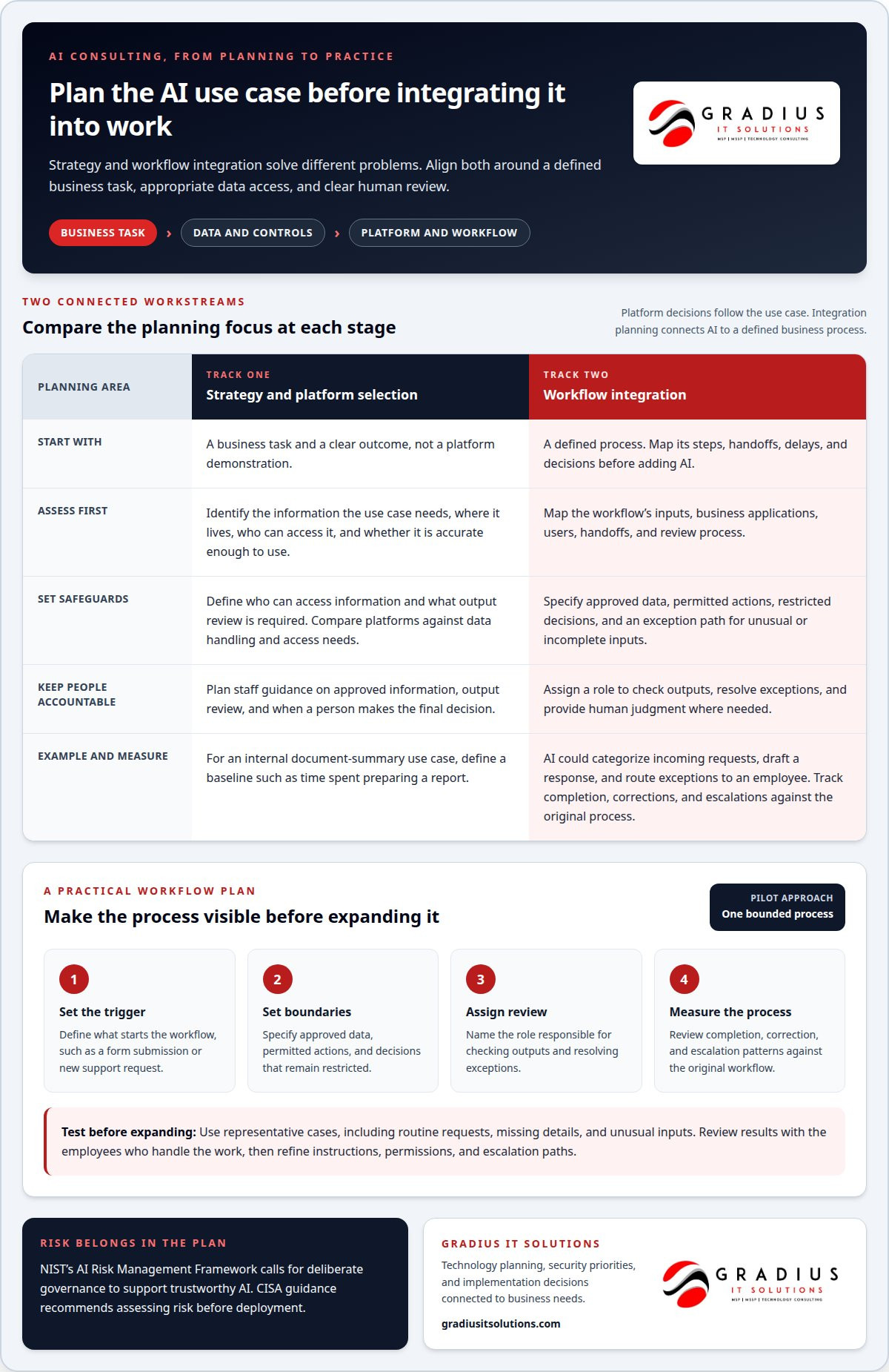
Generative AI can create text, images, computer code, and audio. A useful strategy starts with a business task, not a platform demonstration. For example, an organization might assess whether AI can help staff summarize internal documents, then define who can access those files. The goal is a clear business outcome, with controls for data exposure and review requirements.
Build the foundation before selecting platforms. Map the information a proposed use case needs, where it lives, who can access it, and whether it is accurate enough to use. Then define a baseline measure, such as time spent preparing a report, to assess whether the workflow improves. NIST’s AI Risk Management Framework calls for deliberate governance to support trustworthy AI. CISA guidance recommends assessing risk before deployment.
How do I choose an AI consultant? Choose a consultant who connects strategy to a defined business process, data readiness, security, and adoption. Ask for a phased plan that identifies decision owners, platform criteria, staff training, and how results will be reviewed.
How can I compare AI consulting firms by experience, reviews, and results? Compare relevant project experience, documented processes, and examples of how outcomes were measured. Treat reviews as one input, then assess whether the consultant clearly explains risks, data requirements, and implementation responsibilities.
What data privacy and AI regulations apply to businesses? Requirements depend on the organization’s industry, the information involved, and how it is used. Map personal and sensitive data flows, then have qualified legal counsel assess applicable privacy and sector rules before deployment.
Are there grants, tax credits, or programs for adopting AI? Don’t assume a single grant or tax credit will cover every AI project. Eligibility depends on each program’s rules, the business, and the proposed activity, so treat funding research as a separate planning task.
Platform selection should follow those decisions. Compare options against the intended workflow, data handling needs, integration requirements, access controls, and staff review processes. A platform that fits a document-summary pilot may not suit customer-facing use. For example, a Microsoft 365 environment may shape integration questions, but the business still needs to assess its data and access requirements.
A strategy conversation can clarify the use case, current data, security priorities, platform criteria, and next decisions. Training belongs in that plan: staff need practical guidance on approved information, output review, and when a person must make the final decision. IT consulting and technology strategy can help organizations connect those choices to broader technology planning.
AI automation and workflow integration
Automation works best when it fits a defined process instead of adding another disconnected software layer. For example, a professional services firm might use AI to categorize incoming requests, draft a response, and route exceptions to an employee. The workflow still needs clear rules for what information enters the system and who approves its output. Map the current steps, handoffs, delays, and decisions first. Then identify where AI can assist without obscuring accountability.
A practical workflow architecture connects AI capabilities to their inputs, business applications, users, and review process. Consider a marketing team preparing campaign materials. AI might produce a first draft from approved product details, while a staff member checks accuracy, tone, and customer claims before publication. Define how source material is maintained, how drafts move into existing software, and how staff flag errors. This keeps automation tied to an operational process rather than an isolated demonstration.
Data access needs deliberate design. Limit each workflow to the information required for its task, and assign permissions by user role. For financial processes, separate drafting or document classification from decisions that affect records, approvals, or customer outcomes. Establish an exception path for incomplete data, unusual requests, and outputs requiring human judgment. These controls make it easier to investigate errors and adjust the process without granting broad access across the organization.
- Set the trigger: Define the event that starts the workflow, such as a form submission or a new support request.
- Set boundaries: Specify approved data, permitted actions, and restricted decisions.
- Assign review: Name the role responsible for checking outputs and resolving exceptions.
- Measure the process: Track completion, correction, and escalation patterns against the original workflow.
Marketing automation needs the same discipline. A business could use AI to group inquiries by topic or prepare tailored follow-up drafts. Keep audience criteria understandable, preserve a review step for customer-facing messages, and avoid entering sensitive information into unapproved tools. Because U.S. organizations operate across different industries and handle different data, safeguards should reflect each workflow’s actual use and information.
Before expanding automation, test one bounded process with representative cases. Include routine requests, missing details, and unusual inputs. Review outputs with the employees who handle the work, then refine instructions, permissions, and escalation paths. AI workflow integration planning can connect automation decisions to business processes and technology needs.
How long does an AI consulting engagement take?
An AI consulting engagement has no fixed timeline. The schedule depends on the problem, data readiness, integration requirements, and decisions needed before launch. Assessing an internal document search differs from connecting a machine learning model to customer records. A useful plan breaks the work into stages, with clear outputs and approval points, rather than promising a duration before the systems involved are understood.
The assessment stage identifies the process, users, information, and expected outcome. For example, a professional services firm might want to summarize project documents. The consultant maps where those documents are stored, who may access them, and how staff will review summaries. Gaps in data quality or permissions can change the architecture and add work before implementation begins.
Implementation turns the agreed design into a working process. Integration may involve existing business software, identity controls, data connections, and a route for handling errors. A workflow that drafts internal notes has different dependencies from one that passes information into a financial system. Test each connection against realistic inputs, including missing fields and unexpected requests.
- Assess: Define the business problem, users, data sources, and success measures.
- Design: Document the solution architecture, access boundaries, integrations, and human review.
- Test: Run representative cases, record failures, and resolve issues before broader use.
- Deploy: Release the approved workflow, train users, and assign ongoing oversight.
Stages can overlap when decisions are ready, but unresolved dependencies slow progress. If an application owner must approve a connection, that decision affects integration planning. If records need cleanup, testing cannot represent the real workflow until that work is addressed. A phased plan makes dependencies visible and helps teams decide what to resolve first.
Implementation oversight continues after the first working version. The project lead tracks decisions, open risks, test findings, and responsibility for changes. Staff feedback may show that a machine learning output needs a clearer review step or that an exception should go to a specific role. That feedback informs controlled revisions instead of untracked changes.
To estimate a project responsibly, define the first release narrowly. A single internal workflow with accessible data may need less coordination than several departments, legacy systems, and sensitive records. Scope, integration architecture, data preparation, approvals, and training determine the schedule. A written sequence of deliverables gives leaders a practical way to track progress without treating a guessed completion date as a commitment.
Small and midsize business AI consulting
For a small or midsize organization, useful AI consulting begins with a business constraint: limited staff time, disconnected information, or a repetitive review task. A New Jersey accounting office, for example, could examine how staff organize incoming client documents before considering artificial intelligence. The consultant maps the existing process, identifies sensitive information, and defines where employees must review results. This keeps AI solutions tied to a real operational need.
Which AI consultants and firms serve New Jersey businesses? Businesses can work with AI consultancies, technology advisors, and specialists focused on particular industries or capabilities. The right fit depends on the business problem, such as strategy, data analytics, workflow design, or secure platform integration.
What AI consulting projects are common for New Jersey small businesses? Practical projects include organizing internal knowledge, drafting routine communications, classifying incoming requests, and supporting document review. Before recommending tools, a consultant should define the task, data boundaries, employee review, and success measures.
AI tools can assist with specific steps, but each tool has different capabilities and data-handling considerations. A local professional-services firm might test an internal search assistant using approved procedures, while keeping client records outside that workflow. The project team can compare generated answers with source documents, record errors, and decide whether the tool saves staff effort without weakening accuracy. Start with a narrow task, not a broad promise of artificial intelligence transformation.
Healthcare and life sciences organizations face distinct workflow and information concerns. For example, a clinic might explore drafting administrative summaries while leaving clinical judgment to qualified staff and protecting sensitive records. The design should identify what information enters the system, who can access outputs, and how employees correct errors. Address data privacy, intellectual property leakage, hallucinations, and security vulnerabilities before a pilot moves into routine use.
- Choose one process: Select a repeatable task, such as routing inquiry emails or locating approved policies.
- Define the boundary: Identify allowed information, user access, and actions the system must not take.
- Test real cases: Include ordinary requests, incomplete details, and unusual inputs in the review.
- Train the team: Explain approved uses, output checking, and how staff escalate questionable results.
This sequence helps a smaller team avoid buying overlapping AI tools before understanding its needs. A conversation with an advisor should produce actionable decisions: a scoped use case, platform requirements, data-readiness steps, and a review plan. The work may also reveal that process cleanup or access controls should come before AI adoption. That is a useful outcome: it directs effort toward the foundation the organization needs instead of adding software that cannot solve the underlying problem.
AI consulting
New Jersey organizations can use AI consulting to connect business goals with practical technology decisions. Services may include use-case discovery, platform planning, data and analytics review, governance design, implementation oversight, and employee learning. The right scope depends on the applications involved and the decisions that need human ownership.
A consulting firm should clarify what it will deliver. Strategic oversight and project ownership differ from writing implementation code. For example, an advisor might define requirements for an internal knowledge assistant, coordinate technology stakeholders, and track risks while an implementation team handles configuration. This distinction helps leaders assign responsibility and avoid gaps between recommendations and delivery.
Start with the business process. A New Jersey financial services organization might assess whether AI can help scan regulatory documents for relevant information. The consultant would map document sources, review access needs, define how staff validate findings, and specify how exceptions are handled. The system should support analysis, not replace professional judgment or established review responsibilities.
Governance needs clear ownership. Name who approves use cases, which information applications may process, and who reviews outputs. NIST’s AI Risk Management Framework calls for deliberate governance to support trustworthy AI. CISA guidance recommends assessing risk before deployment. These references can inform planning, while each organization’s industry, data, and intended use shape its controls.
Useful consulting deliverables make decisions actionable. A project plan can document the selected use case, data dependencies, platform requirements, security considerations, staff training, and review measures. For instance, a team testing document summaries can compare generated results with source files and log errors. That evidence helps leaders decide whether to adjust instructions, limit access, or expand the application.
Learning should continue after launch. Employees need guidance on approved tasks, sensitive information, output verification, and escalation paths. A marketing team may need a different review process from analysts working with internal reports. Targeted training links everyday decisions to governance, helping staff recognize when an AI result needs correction or human review.
For New Jersey businesses, available AI consulting services range from early strategy and analytics planning to implementation coordination, governance, and workforce training. A focused engagement can also clarify whether the immediate need is better data organization, platform integration, or a defined pilot. A governance and documentation approach can help keep technology decisions aligned with an organization’s framework.
Plan an AI technology consultation
This approach may help organizations assess whether a proposed application is ready for careful evaluation. Regulatory-document scanning for compliance insights is a potential generative AI use case in financial services. Consider it alongside document sources, access needs, staff validation, and exception handling, keeping compliance insights distinct from a final professional decision.
Account for risks when defining scope. Data privacy, intellectual property leakage, model hallucinations, and security vulnerabilities are business and technical AI risks. Teams can use these categories to ask what information an application processes, how outputs are checked, and when a person intervenes. Clear answers connect a use case to governance, implementation responsibilities, and employee guidance, rather than treating adoption as a technology decision alone.
Gradius IT Solutions
Gradius IT Solutions helps businesses connect AI plans with the technology, security, and operational foundations needed to support them. Turn to the team when platform decisions affect Microsoft 365 or cloud environments, when cybersecurity needs review, or when governance and implementation responsibilities need clearer coordination.
Managed IT Services can support the broader technology environment, while Cybersecurity & SOC helps address security considerations around adoption. Gradius runs a GRC platform that keeps technology aligned with your framework and documentation audit-ready. The right next step depends on your intended use case, existing systems, and the decisions your team needs to make.
For a technology consultation about your AI plans, contact Gradius IT Solutions.
Turn your AI plans into a clear next step
Connect your AI goals with the systems, safeguards, and people that will support them. An AI consultant NJ businesses work with can help clarify whether the priority is a specific workflow, secure access to business information, or a broader technology plan. Start with the operational decision you need to make, then define who owns it and what support will keep it moving.
Gradius IT Solutions brings that technology context together through Managed IT Services and Cybersecurity & SOC. For organizations with governance needs, Gradius runs a GRC platform that keeps technology aligned with the client’s framework and documentation audit-ready. These capabilities can help frame AI adoption within the wider environment, rather than treating it as a disconnected tool.
Choose a next step that matches your immediate planning needs. A focused conversation can help establish which decisions belong in the first phase and what needs further assessment.
Move forward with a plan grounded in your business priorities.
Frequently Asked Questions
What does AI consulting cost?
There is no single standard cost for AI consulting; scope determines the work involved. A strategy review differs from a project requiring data preparation, application integration, security review, and staff training. Ask for a written scope that separates assessment, implementation oversight, and ongoing support. This makes it easier to understand what each phase delivers and decide which work is essential for your business.
How much do AI consultants in New Jersey charge?
Rates vary by consultant and project, and a reliable statewide average cannot be given here. For a useful comparison, focus on the proposed work rather than an hourly figure alone. Clarify whether the engagement includes platform recommendations, technical coordination, governance planning, or staff learning. Also establish who owns implementation tasks and what deliverables mark completion. Those details help you compare proposals without assuming they cover identical services.
What industries in New Jersey benefit most from AI consulting?
AI consulting can help industries with repetitive information tasks and clear review processes. Organizations may explore administrative or document workflows where AI can assist staff, while people retain responsibility for decisions and sensitive information. Legal practices, manufacturers, and real estate organizations may also examine knowledge retrieval or routine communications. The best candidate is a process where AI can assist staff while people retain responsibility for decisions and sensitive information.
How can an AI consultant help with automation, machine learning, and generative AI?
An AI consultant can help determine which approach fits the task. Automation connects defined steps, machine learning can identify patterns in relevant data, and generative AI can draft or summarize content. For example, a consultant might assess whether incoming requests need rule-based routing or language-based categorization. They can also define review controls, data-access boundaries, and testing criteria before teams put an application into regular use.
What should I expect during an AI consulting engagement?
Expect structured decisions, clear responsibilities, and documented outputs. The consulting team should establish the business objective, identify relevant systems and stakeholders, and record assumptions that affect the work. Before deployment, define acceptance criteria, review responsibilities, and how changes will be approved. A useful handoff includes operating guidance and a process for reporting errors, so staff know how to use the solution and raise issues.

Article by
Robert Joyce
Robert Joyce is the Owner and Chief Technology Officer of Gradius IT Solutions, a security-first provider of managed IT, cybersecurity, cloud, compliance, and secure AI solutions. Headquartered in New Jersey with satellite offices in the Midwest and South Florida, Gradius serves businesses across the Tri-State Area, Midwest, South Florida, and nationwide.
Robert brings 30 years of IT experience, including 23 years in hedge funds, global banks, and wealth management firms where uptime, security, and continuity are non-negotiable. He began in trade floor support at Caxton, Shell Trading, and Knight, provided senior trade floor support at RBC and SAC Capital, served as VP of IT at EntrustPermal, and was CTO of Gerstein Fisher. After September 11, he helped rebuild critical technology infrastructure for Merrill Lynch.
His expertise spans Microsoft 365, cloud, cybersecurity, networking, infrastructure, disaster recovery, compliance, and strategic IT leadership.
Robert founded Gradius to bring enterprise-level technology and security to small and midsized businesses at a predictable monthly cost. Gradius delivers managed and co-managed IT, cybersecurity, Microsoft 365 and cloud, compliance programs supported by a GRC platform, secure AI consulting, and vCIO services, with a full help desk, 24/7 NOC and SOC monitoring, and U.S.-based onsite engineers and SOC.
Robert works directly with business owners and executives as their single accountable point of contact. His philosophy: one trusted partner, complete IT accountability.
Disclaimer
## Disclaimer
The information provided in this article is for general informational and educational purposes only and should not be considered professional IT, cybersecurity, legal, regulatory, or compliance advice. While Gradius IT Solutions strives to provide accurate and up to date information, technology, security threats, and regulatory requirements change frequently, and we cannot guarantee that all information will remain current or applicable to your specific situation.
Every organization has unique technology, security, compliance, and business requirements. Before implementing any recommendations discussed in this article, you should evaluate their suitability for your environment or consult with a qualified technology professional.
Gradius IT Solutions makes no warranties, express or implied, regarding the completeness, accuracy, reliability, or results obtained from the use of this information. Any actions you take based on this content are at your own risk. Gradius IT Solutions shall not be liable for any direct, indirect, incidental, or consequential damages arising from the use of, or reliance upon, the information contained in this article.
References to third party products, services, or vendors are provided for informational purposes only and do not constitute an endorsement unless explicitly stated.
If you would like guidance tailored to your organization, contact Gradius IT Solutions to schedule a consultation with one of our technology experts.