

The average cost of a data breach in the United States has surged to a record $11.5 million. For a growing business, that figure represents more than a line item; it’s a catastrophic threat to your reputation and your future. You’re likely balancing the weight of strict SEC or HIPAA compliance against an ever-evolving landscape of AI-driven cyberattacks. Selecting the right data breach prevention services is no longer just a technical choice; it’s a vital strategic move to protect your bottom line from sophisticated modern threats.
We believe technology should empower your growth, not create constant anxiety. This guide explains how to build a resilient, compliance-aware defense that stops attackers before they compromise your sensitive business data. You’ll gain a clear roadmap to secure your infrastructure and meet regulatory audits with total confidence. We’ll show you how to simplify your security posture, ensuring your daily operations remain smooth and uninterrupted. Let’s move beyond reactive IT and build a proactive foundation for 2026.
Key Takeaways
- Shift from reactive cleanup to a proactive “prevent-instead-react” model to outpace 2026 cyber threats.
- Protect your infrastructure with a layered architecture focused on Zero Trust principles and advanced endpoint detection.
- Align your security posture with SEC, FINRA, or HIPAA standards using specialized data breach prevention services that simplify complex regulatory audits.
- Follow a strategic roadmap to identify hidden vulnerabilities and close critical gaps in your current defense.
- Discover the value of 24/7 U.S.-based monitoring to keep your business resilient without disrupting daily operations.
What are Data Breach Prevention Services?
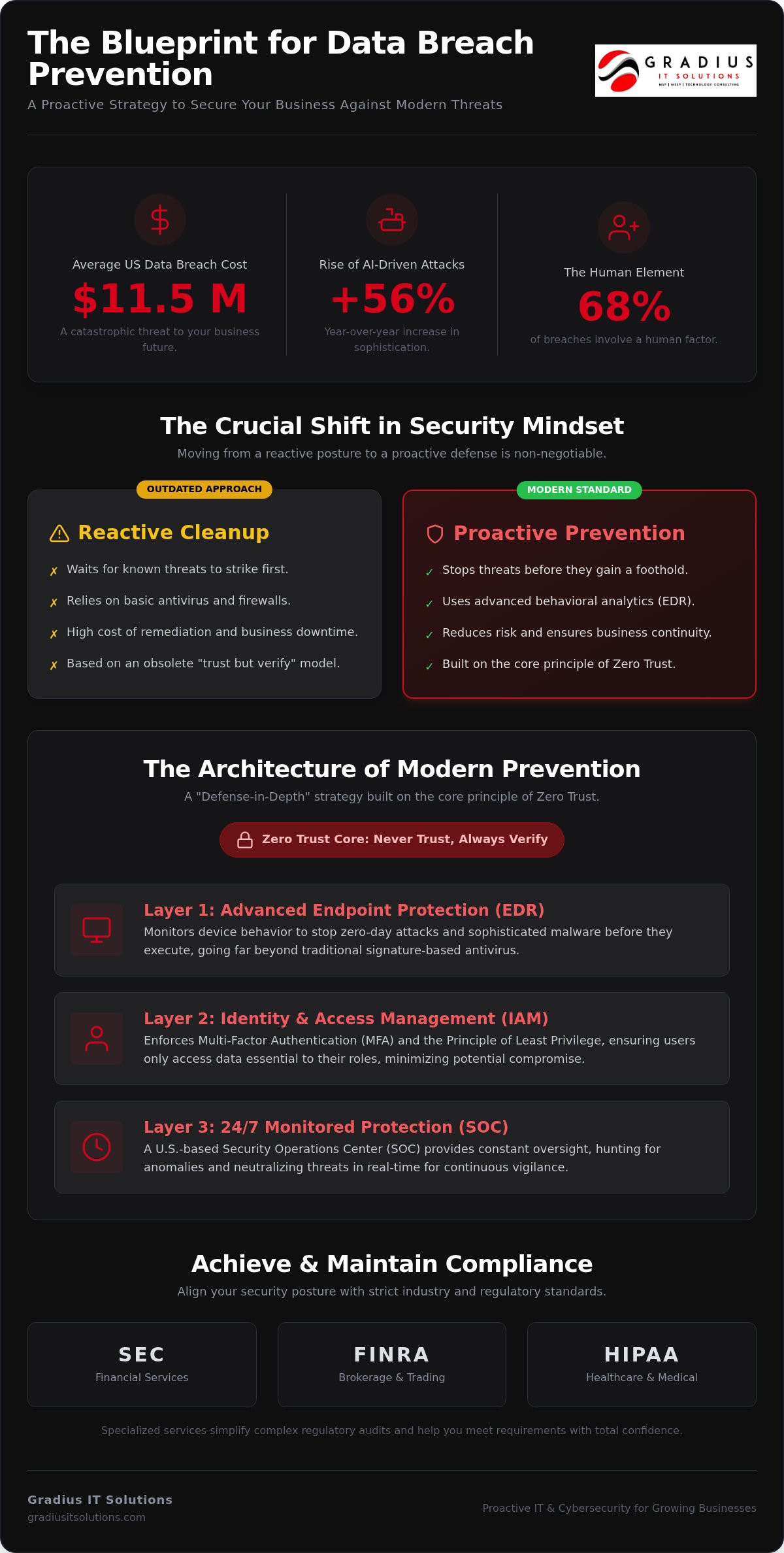
Data breach prevention services represent a specialized framework designed to identify, block, and mitigate unauthorized access to your corporate network. To understand the stakes, we first need to define What is a data breach? at its core. It’s the intentional or unintentional release of secure information to an untrusted environment. In 2026, this isn’t just about a hacker in a basement. It’s about sophisticated AI-driven campaigns that have seen a 56% year-over-year increase. These services combine high-level encryption, real-time monitoring, and strict access controls to form a protective shield around your most valuable assets.
Relying on basic antivirus or a standard firewall is like locking your front door while leaving the windows wide open. These tools are often reactive. They wait for a known threat to strike before sounding the alarm. Modern data breach prevention services focus on a “prevent-instead-react” methodology. This approach uses advanced behavioral analytics to stop threats before they gain a foothold. Managed Service Providers (MSPs) now bridge the gap for small and mid-sized businesses. They provide the same high-level protection once reserved for the Fortune 500, ensuring enterprise-grade security is accessible to everyone.
To better understand how these defenses work in a real-world setting, watch this helpful video:
The True Cost of a Breach in 2026
The financial impact of a security failure is staggering. Research indicates the average cost of a data breach in the U.S. has reached a record $11.5 million. For healthcare firms, the cost per incident averages between $6.4 million and $6.64 million. These numbers account for more than just the immediate ransom. They include lost productivity, regulatory fines from bodies like the SEC or HIPAA, and long-term reputational damage. Today, having robust security is a prerequisite for cyber insurance eligibility. Without proven prevention strategies, your business may be uninsurable.
Managed Security vs. Traditional IT Support
Traditional IT support focuses on fixing computers when they break. Managed security is about securing the network before a crisis occurs. There’s a fundamental difference between a technician who responds to a ticket and a proactive guardian who monitors your environment 24/7. Since 68% of breaches involve a human element, your defense must include employee awareness and constant oversight. Modern business resilience requires a Managed Security Operations Center (SOC). This ensures that while you sleep, a dedicated team is hunting for anomalies. It turns security from a heavy burden into a pillar of business confidence.
The Architecture of Modern Prevention: A Layered Approach
Modern data breach prevention services rely on a “defense-in-depth” strategy. This isn’t just a technical buzzword. It’s a business necessity. Think of your security as concentric circles of protection. If one layer fails, the next stands ready to stop the intruder. At the heart of this architecture lies Zero Trust. The old model of “trust but verify” is obsolete. Today, we assume the network is already compromised. We verify every user, every device, and every access request, every single time.
Traditional antivirus is a relic. It looks for known signatures, like a digital “most wanted” poster. But modern threats change their appearance in milliseconds. Endpoint Detection and Response (EDR) monitors behavior instead. It asks, “Why is this laptop suddenly trying to encrypt thousands of files?” This behavioral analysis is critical for stopping zero-day attacks. Pair this with Multi-Factor Authentication (MFA), and you eliminate the threat of stolen passwords. According to FTC data security guidance, implementing these basic technical controls is the first step toward a defensible security posture.
Identity and Access Management (IAM)
Security starts with identity. We enforce the principle of least privilege. This means employees only have access to the data they need for their specific roles. Why does a marketing coordinator need access to HR payroll files? They don’t. By restricting admin rights, you limit the “blast radius” of a potential compromise. For businesses running on the cloud, Microsoft 365 Hardening ensures that remote work doesn’t become a security liability. We secure every login through encrypted connections and conditional access policies.
AI-Powered Threat Detection
Threat actors are using AI to scale their attacks, which is why we’ve seen that 56% year-over-year increase in AI-driven incidents. You must use AI to defend. Predictive analytics can spot anomalies that a human analyst might miss. For example, if a user logs in from New York at 9:00 AM and then from London at 10:00 AM, the system automatically flags the “impossible travel” and locks the account. Integrating Secure AI and Automation into your defense allows for near-instant incident response. Automation handles the repetitive tasks, freeing up experts to focus on complex strategy.
Email remains the most common entry point for cyberattacks. Phishing attempts are becoming more convincing through deepfakes and AI-generated text. A robust email security layer filters these threats before they reach an employee’s inbox. It’s about building a human firewall through training and technical filters. Comprehensive data breach prevention services integrate these layers into a single, cohesive shield. If you’re unsure where your current gaps lie, you can schedule a professional assessment to see your network through the eyes of an attacker.
Compliance-Aware Security: Beyond Simple Protection
Security and compliance are often treated as separate silos. This is a mistake. While security is the technical wall you build, compliance is the blueprint and the evidence that the wall actually works. For executives, this means moving beyond “feeling secure” to “proving security” through rigorous documentation. Modern data breach prevention services must be compliance-aware from the ground up. If you can’t produce a Written Information Security Program (WISP) during an audit, your technical defenses might as well be invisible to regulators.
Regulatory bodies like the SEC, FINRA, and HIPAA don’t just care about whether you had a breach. They care about your preparation. According to the HHS Cost of Data Breach Report, the financial fallout for healthcare entities often stems from a lack of proactive risk management. Having an incident response plan isn’t just a best practice; it’s a legal requirement. You need to be audit-ready at all times. You must possess the ability to demonstrate that your security posture meets or exceeds industry standards. A structured NIST cybersecurity framework implementation gives executives a proven, regulator-recognized roadmap to document controls, satisfy auditors, and close compliance gaps before they become costly violations. This level of readiness provides a significant competitive advantage when courting high-value clients who demand proof of data integrity.
Specialized Support for Regulated Industries
Different sectors face unique hurdles. Financial advisors must navigate SEC and FINRA Rule 4370, which mandates robust business continuity and data protection. Specialized cybersecurity for RIAs ensures these standards are met without disrupting daily operations. Healthcare providers face the daunting task of securing patient data across cloud environments while remaining HIPAA compliant. They often require dedicated healthcare IT support to manage these complexities. Even law firms now prioritize legal IT services to maintain attorney-client privilege. A “one-size-fits-all” security package won’t satisfy a specialized auditor who knows exactly what gaps to look for in your specific field.
Compliance as a Service (CaaS)
Managing regulatory documentation is a full-time burden that most small businesses can’t handle internally. Compliance as a Service (CaaS) changes this dynamic. Instead of a frantic, annual “check-the-box” scramble, you benefit from continuous monitoring and automated reporting. This managed approach ensures that your policies evolve alongside new threats. It removes the stress of the unknown and keeps you focused on your core business goals. Effective data breach prevention services integrate these regulatory requirements into your daily workflow, making compliance a natural byproduct of good security.
How to Implement a Data Breach Prevention Strategy
Implementing effective data breach prevention services requires a methodical, step-by-step approach. It’s not about buying every tool on the market. It’s about building a customized defense that fits your specific operational risks. A successful strategy moves from identifying weaknesses to establishing a continuous loop of monitoring and improvement. This ensures your business remains resilient even as cyber threats evolve in complexity.
The Vulnerability Assessment: Your Strategic Baseline
You can’t protect what you don’t know exists. Step one is always a comprehensive IT and cybersecurity assessment. This process identifies “shadow IT” and unsecured data silos within your organization. These are often unofficial applications or cloud storage services that employees use without IT oversight. By prioritizing risks based on their potential business impact, you can allocate resources where they’re needed most. A professional Penetration Testing Service is essential for this stage. It verifies your defenses by simulating real-world attacks, showing you exactly how an intruder might bypass your current security.
Once you’ve established your baseline, you must remediate immediate gaps. This means enforcing Multi-Factor Authentication (MFA) and ensuring strict patch management across all systems. From there, deploy layered security controls across every endpoint and network segment. The final technical piece is establishing 24/7 monitoring via a Security Operations Center (SOC). Organizations that extensively use AI and automation in their security operations save an average of $1.9 million per data breach. Continuous oversight ensures that anomalies are caught in minutes, not months.
Employee Awareness: The Human Firewall
Technology is only half the battle. Since 68% of data breaches involve a human element, such as social engineering or simple errors, your staff must be your strongest defense. Step five of your strategy focuses on creating a culture of security. Phishing simulations and continuous education turn your employees into a “human firewall.” When your team feels empowered to recognize and report sophisticated threats, they become a proactive part of your defense. Using Cybersecurity Solutions for Small Business helps simplify this training, making it accessible and effective for teams of any size.
Schedule a strategic technology consultation to begin your assessment
Choosing a Strategic Partner for Continuous Protection
Selecting a provider for data breach prevention services is one of the most critical decisions an executive can make. In 2026, where threats move at the speed of AI, you cannot afford a “set-it-and-forget-it” approach. True protection requires a partner who lives in the trenches with you. This isn’t just about technical support. It’s about finding a “Single Accountable Partner” who understands your specific business goals and the regulatory pressures you face every day.
Industry expertise is non-negotiable. If your provider doesn’t understand the nuances of SEC, FINRA, or HIPAA, they’ll leave you exposed during your next audit. You need a team that integrates Compliance as a Service directly into your security stack. This ensures that every technical control also serves as regulatory evidence. Beyond compliance, look for U.S.-based, 24/7 monitoring. When a critical threat emerges at 2:00 AM, you need an immediate response from an expert who knows your network, not a generic call center.
Predictability is another key factor for business resilience. The old “break-fix” model is fundamentally flawed. It creates a conflict of interest where your provider only makes money when your systems fail. Modern Managed IT Services use a flat-fee, predictable pricing model. This aligns your goals with your partner’s. Both parties want a secure, stable, and high-performing environment. It turns IT from a variable expense into a strategic investment in growth.
The Gradius IT Solutions Difference
We built our framework specifically for regulated firms, including RIAs, wealth managers, and healthcare providers. Gradius IT Solutions acts as your proactive guardian, providing enterprise-grade protection scaled for the mid-market. Our “IT That Never Sleeps” tagline is backed by a U.S.-based SOC that monitors your data around the clock. We don’t just fix computers. We manage the entire intersection of IT, security, and compliance so you can focus on your clients. Our team stays three steps ahead, ensuring your data breach prevention services are always evolving to meet new threats.
Your Next Steps Toward Resilience
Strengthening your defense doesn’t have to be an overwhelming process. It starts with a simple 30-minute conversation to identify your most immediate security gaps. We’ll help you look past the technical jargon to see the real-world business risks. From there, we provide a clear roadmap to move your organization from a reactive state to a proactive, resilient posture. You can take the first step toward total network confidence right now by requesting your free assessment.
Securing Your Competitive Advantage in 2026
The landscape of cybersecurity has shifted. It’s no longer just about defense; it’s about a continuous, compliance-aware state of readiness. Success depends on moving beyond reactive cleanup. You must adopt a layered architecture rooted in Zero Trust principles. By integrating robust technical controls with a culture of employee awareness, you transform security from a cost center into a foundation for business resilience. It’s a strategic move for long-term growth. Security is a strategy, not just a tool.
Investing in comprehensive data breach prevention services ensures that your firm remains audit-ready and protected against AI-driven threats. Our U.S.-based 24/7 SOC and deep expertise in SEC, FINRA, and HIPAA regulations provide the unwavering reliability you need. We take a proactive, prevent-instead-react approach. This keeps your sensitive business data exactly where it belongs. Security shouldn’t be a burden. It should be your greatest strength. We’re ready to stand in your corner.
You don’t have to navigate these complexities alone. Take control of your technology stack today and build a future that is secure and entirely under your control. Let’s build a more resilient business together.
Frequently Asked Questions
What are the most common causes of data breaches for small businesses?
Phishing and human error remain the top vulnerabilities for most organizations. Research shows that 68% of breaches involve a human element, such as clicking a malicious link or falling for a social engineering tactic. Third-party risks are also climbing, with 30% of breaches now involving vendor vulnerabilities. Protecting your business requires a strategy that addresses both technical gaps and employee behavior through continuous training; additionally, to mitigate internal risks through professional background checks and corporate due diligence, you can discover International Investigative Group.
How do I know if my company is compliant with SEC or HIPAA regulations?
Compliance is verified through a formal gap analysis against specific regulatory frameworks. You must have a Written Information Security Program (WISP) and documented incident response plans in place to meet these standards. It’s about more than just having tools; you need to prove that your data breach prevention services are actively protecting sensitive information through continuous logging and auditing. Following a structured NIST cybersecurity framework implementation provides the documented evidence and standardized controls that regulators expect to see during an SEC or HIPAA audit.
Is multi-factor authentication (MFA) really necessary for every employee?
Yes, MFA is an absolute necessity in a modern business environment. Credential theft is the easiest path for an intruder to gain access to your network and sensitive data. MFA acts as a critical roadblock that stops the vast majority of automated account takeover attempts. In a Zero Trust environment, every identity must be verified every time they attempt to access corporate resources.
What is the difference between an MSP and an MSSP?
A standard Managed Service Provider (MSP) focuses on uptime, help desk support, and general IT productivity. A Managed Security Service Provider (MSSP) or a security-first MSP focuses on risk mitigation and proactive defense. While an MSP keeps your computers running, a security-focused partner ensures your network is actively defended by a 24/7 Security Operations Center that hunts for threats.
Can data breach prevention services help with cyber insurance renewals?
Most insurance carriers now require proof of advanced security controls before they will consider a renewal or a new policy. Carriers look for specific technical layers like Endpoint Detection and Response (EDR), MFA, and regular risk assessments. Implementing professional data breach prevention services makes you a lower risk in the eyes of underwriters, which often simplifies the application process and ensures coverage.
How does 24/7 SOC monitoring actually stop an active attack?
A Security Operations Center (SOC) uses behavioral analytics to spot anomalies in real time. If a laptop starts encrypting files or a user logs in from an unusual location, the SOC team intervenes immediately. They can isolate the affected device from the network or lock the compromised account within minutes. This rapid response stops the attacker before they can move deeper into your systems.
What should I do immediately if I suspect a data breach has occurred?
Do not turn off your computers, as this can destroy volatile evidence needed for forensic investigation. Disconnect the suspected device from the Wi-Fi or unplug the ethernet cable to stop the threat from spreading across the network. Your next step is to contact your security partner immediately to activate your incident response plan and begin the containment process.
How often should our firm conduct a cybersecurity risk assessment?
You should conduct a formal assessment at least once a year to stay ahead of evolving threats. However, for firms regulated by the SEC or HIPAA, continuous monitoring is the modern standard for business resilience. Any major change to your network, such as moving to a new cloud platform or adding remote workers, should trigger an immediate review of your security posture.

Article by
Robert Joyce
**Robert Joyce** is the Founder, CEO, and Chief Technology Officer of Gradius IT Solutions, a security first provider of Managed IT Services, Cybersecurity, Cloud, Compliance, and Secure AI solutions serving businesses throughout New Jersey, New York, Connecticut, and across the United States.
With more than 28 years of IT experience, including 23 years supporting hedge funds, global banks, and wealth management firms, Robert has built a career designing and managing secure, resilient, and highly available technology environments where uptime, cybersecurity, and business continuity are essential.
His expertise includes Microsoft 365, cloud computing, cybersecurity, networking, infrastructure, disaster recovery, compliance, virtualization, and strategic IT leadership. Following the events of September 11, Robert helped rebuild critical technology infrastructure for Merrill Lynch, an experience that reinforced the importance of resilience, planning, and operational excellence.
Robert founded Gradius IT Solutions to bring enterprise level technology and security services to small and midsized businesses at a predictable monthly cost. Today, the company delivers fully managed and co managed IT services, cybersecurity, Microsoft 365, cloud solutions, compliance consulting, Secure AI consulting, technology projects, and vCIO services. Through a U.S. based 24/7 Help Desk and a nationwide network of trusted technology partners, Gradius supports organizations across the country with responsive, security focused technology solutions.
Robert partners with business owners and executive leaders to align technology with business goals, reduce risk, strengthen cybersecurity, improve productivity, and create long term IT strategies that support growth. His mission is simple: provide every client with enterprise class technology, exceptional service, and a trusted advisor they can rely on as their business evolves.
Disclaimer
## Disclaimer
The information provided in this article is for general informational and educational purposes only and should not be considered professional IT, cybersecurity, legal, regulatory, or compliance advice. While Gradius IT Solutions strives to provide accurate and up to date information, technology, security threats, and regulatory requirements change frequently, and we cannot guarantee that all information will remain current or applicable to your specific situation.
Every organization has unique technology, security, compliance, and business requirements. Before implementing any recommendations discussed in this article, you should evaluate their suitability for your environment or consult with a qualified technology professional.
Gradius IT Solutions makes no warranties, express or implied, regarding the completeness, accuracy, reliability, or results obtained from the use of this information. Any actions you take based on this content are at your own risk. Gradius IT Solutions shall not be liable for any direct, indirect, incidental, or consequential damages arising from the use of, or reliance upon, the information contained in this article.
References to third party products, services, or vendors are provided for informational purposes only and do not constitute an endorsement unless explicitly stated.
If you would like guidance tailored to your organization, contact Gradius IT Solutions to schedule a consultation with one of our technology experts.