
HIPAA compliance takes more than installing security software. HIPAA compliance IT services help healthcare organizations assess risks, strengthen safeguards for electronic protected health information, and keep security practices and documentation aligned. Vendor agreements also matter when a service provider handles that information.
The challenge is connecting policy to everyday technology: who can access patient data, how activity is tracked, and whether systems can recover after a disruption. This is a practical concern, not just paperwork.
This article explains what these services cover, how risk assessments and business associate agreements fit in, and which administrative, physical, and technical safeguards support HIPAA compliance. You’ll see how the pieces work together to protect sensitive information and make gaps easier to address.
Key Takeaways
- A risk assessment helps reveal where electronic health information moves, which systems can access it, and where safeguards need attention.
- Business associate agreements clarify how vendors must protect health information and respond to breaches.
- Technical safeguards work best as layers, combining controlled access, strong authentication, encryption, and activity tracking.
- Audit logs, workforce training, tested backups, and recovery planning support accountability and resilience when incidents occur.
- Ongoing technology and documentation support can help keep safeguards aligned with your organization’s compliance framework.
How Do Risk Assessments and Gap Analyses Fit In?
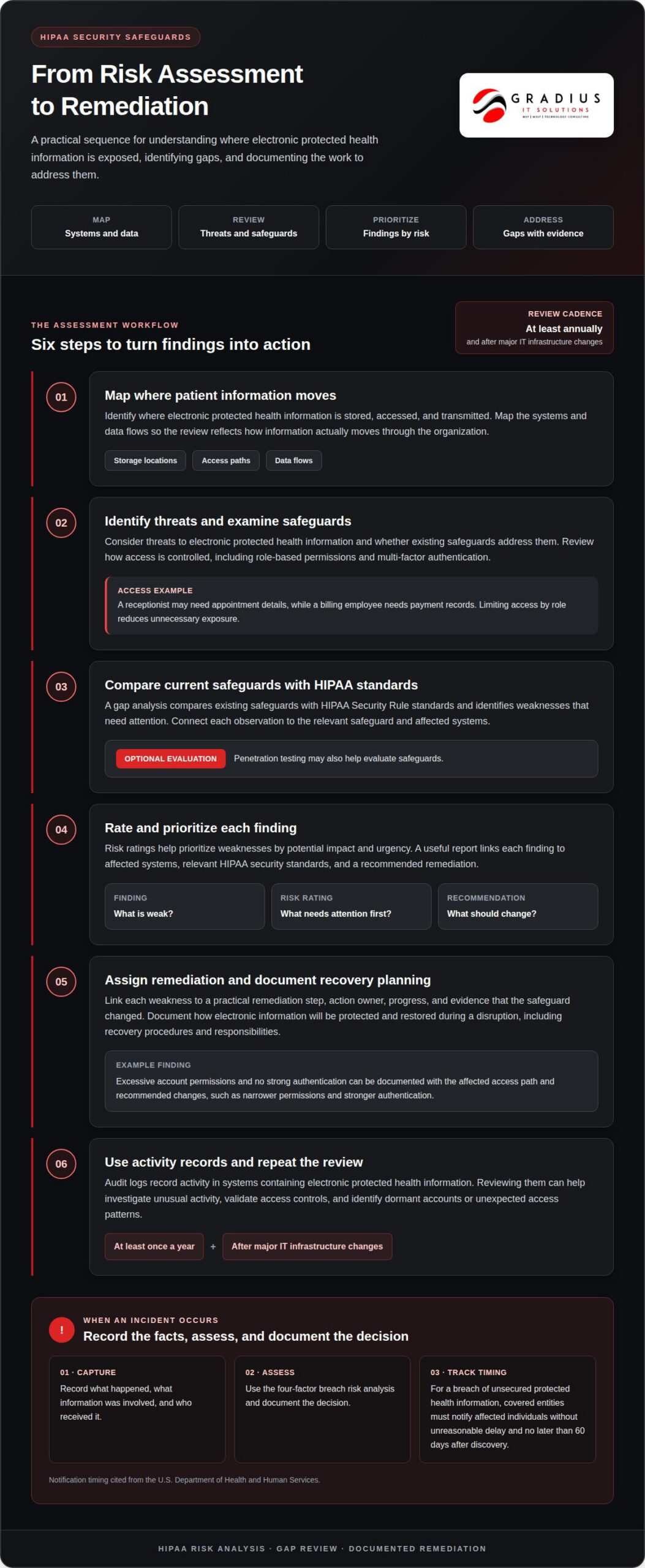
A HIPAA risk assessment examines where electronic protected health information is stored, accessed, and transmitted. A gap analysis compares existing safeguards with HIPAA Security Rule standards and identifies weaknesses that need attention.
Security Risk Analysis and Planning
A security risk analysis identifies threats to electronic protected health information and evaluates whether current safeguards address them. It matters because a clinic cannot prioritize protection without understanding how patient information moves through its systems. Assessments should occur at least once a year and after major IT infrastructure changes.
For example, adding a cloud system changes where information is stored and which accounts can access it. The analysis should map systems and data flows, then examine access controls such as role-based permissions and multi-factor authentication. A receptionist may need appointment details, while a billing employee needs payment records. Limiting access by role reduces unnecessary exposure.
Contingency planning belongs in this review. The organization should document how it will protect and restore electronic information during a disruption. A gap analysis can flag missing recovery procedures or unclear responsibilities. Penetration testing may also help evaluate safeguards. Findings should link each weakness to a practical remediation step.
Breach Risk Assessment and Notification
A breach risk assessment evaluates an incident involving protected health information and helps determine its potential impact. HIPAA breach response procedures include a four-factor analysis. This structured review matters because the organization needs a documented basis for its response, rather than assumptions about whether exposed information creates risk.
For example, if an employee sends a patient file to the wrong recipient, the response begins by recording what happened, what information was involved, and who received it. The organization can then assess the circumstances and document its decision. A clear incident record supports consistent follow-up and helps identify whether access controls or staff procedures need improvement.
Notification timelines also matter. According to the U.S. Department of Health and Human Services, covered entities must notify affected individuals without unreasonable delay and no later than 60 days after discovery of a breach of unsecured protected health information. Documenting discovery and response decisions helps the organization manage those obligations and coordinate its actions.
Compliance Findings and Risk Ratings
Assessment findings describe weaknesses, while risk ratings help prioritize them by potential impact and urgency. A report can link each finding to relevant HIPAA security standards, affected systems, and recommended remediation. This makes documentation useful for decision-making, not simply a record of observations.
Consider an account with excessive permissions and no strong authentication. The finding should identify the affected access path, explain the exposure, and recommend narrower permissions and stronger authentication. A rating helps leaders decide which remediation needs attention first. The assessment team can then track action owners, progress, and evidence that the safeguard changed.
Audit logging strengthens this process by recording activity in systems containing electronic protected health information. Logs can show which account accessed a record and when, helping teams investigate unusual activity and validate access controls. Reviewing those records during assessments can reveal dormant accounts or unexpected access patterns. The resulting documentation links observed activity, risk ratings, and remediation decisions.
What is a HIPAA BAA and when is it required?
A business associate agreement, or BAA, is a contract between a covered entity and a business associate handling protected health information on its behalf. Healthcare organizations should have a signed BAA with IT vendors that access electronic protected health information. Compare providers based on their documented safeguards, access controls, vulnerability updates, and incident response practices. The agreement should define permitted data use, protection measures, breach reporting, and what happens to information when the work ends.
Examples of business associates include technology vendors that maintain systems containing patient information. A cloud platform storing electronic protected health information also needs appropriate safeguards and a BAA. The HIPAA Security Rule applies to electronic protected health information, while the Privacy Rule governs its use and disclosure. A contract supports those responsibilities, but it doesn’t replace the organization’s own policies or safeguards.
A useful BAA sets out practical responsibilities rather than relying on broad promises. It should explain how the business associate will protect information, report incidents, and manage subcontractors that may handle the data. It should also address returning or destroying protected health information when the relationship ends. Clear language helps both parties understand who acts, what information is involved, and how response decisions are documented.
Breach notification duties have specific timelines. According to the U.S. Department of Health and Human Services, business associates must notify the covered entity without unreasonable delay and no later than 60 days after discovery. Covered entities must notify affected individuals without unreasonable delay and no later than 60 days after discovery of a breach of unsecured protected health information, according to the U.S. Department of Health and Human Services.
Covered entities must report breaches affecting fewer than 500 individuals annually to HHS’ Office for Civil Rights. The U.S. Department of Health and Human Services, Office for Civil Rights, requires reporting breaches affecting 500 or more individuals to HHS within 60 days of discovery. For breaches affecting fewer than 500 individuals, covered entities must report to HHS’ Office for Civil Rights annually, according to the U.S. Department of Health and Human Services, Office for Civil Rights.
Security certifications can provide evidence about a vendor’s internal controls, but they don’t certify HIPAA compliance or replace a BAA. Strong provider comparisons also consider how the vendor applies access restrictions, installs security updates, and addresses vulnerabilities. For example, an agreement requiring incident reporting is more useful when the vendor also documents its escalation process and system safeguards.
Review healthcare HIPAA safeguards as part of understanding how technology protections and agreements fit together.
What are HIPAA Compliance Services?
HIPAA compliance IT services connect technical operations with the safeguards an organization uses to protect electronic protected health information (ePHI). Their practical value lies in coordination: technology, staff procedures, and documentation need to work together.
Technical Safeguards for ePHI
Technical safeguards are technology controls that protect ePHI within an organization’s systems. The HIPAA Security Rule addresses administrative, physical, and technical safeguards for electronic information. IT requirements therefore extend beyond a single application. A patient portal, billing platform, and clinical system may each need defined security settings and accountable owners.
Service work can include maintaining secure configurations and reviewing changes that affect how systems handle patient information. For example, a clinic adding a new software connection should assess the integration before it moves information between platforms. Clear change records help staff understand what was modified, who approved it, and which systems are affected. This reduces the risk of overlooked settings during system updates.
Endpoint protection and continuous monitoring add another operational layer. A practice may use clinical workstations, laptops, and mobile devices for different tasks. Defining which device types can connect to sensitive systems helps focus protection. Monitoring can surface unusual behavior for investigation, while documented response ownership clarifies who acts on an alert.
PHI Data Flows
PHI data flows describe how protected health information moves between people, software, and organizations during care and administration. Focus on handoffs and purpose. A patient portal may collect information, a clinical platform may support treatment, and a billing system may process claims. Each transition can involve different users, vendors, and operational responsibilities.
Examining those handoffs helps identify where technical safeguards and written procedures must align. For example, a lab interface may send results into a patient record, while a separate billing workflow uses related details. Documenting the business purpose and responsible teams for each connection can reveal unnecessary transfers or unclear ownership. That makes system changes easier to review and explain.
Implementing Healthcare Compliance Services
Implementation translates an organization’s framework into technology practices and repeatable operating decisions. A practice can define which systems handle ePHI, assign an owner to each platform, and set a process for reviewing configuration changes. It can then coordinate software updates, endpoint protection, monitoring, and supporting documentation across its environment.
For organizations adopting HIPAA compliance IT services, scope depends on the systems, connected platforms, endpoint environment, and support responsibilities involved. Those factors also shape service costs, so there is no single price that fits every practice. The practical next step is to define the environment and support needs before setting a service scope.
Healthcare HIPAA safeguards work best when technology settings, operational ownership, and documentation stay connected.
Business associate agreements
A business associate agreement (BAA) documents how a service provider must handle protected health information for a covered entity. It turns privacy and security expectations into specific responsibilities between the organizations.
Covered Entities and Business Associates
A covered entity is the healthcare organization responsible for its HIPAA obligations, while a business associate performs work involving protected health information on its behalf. The distinction matters because a vendor may handle electronic patient records without becoming the organization that decides how care is delivered.
For example, a medical practice may use a software provider to store records or an IT vendor to maintain systems containing them. When that work involves protected health information, the relationship needs clear boundaries. The practice remains responsible for its own policies, workforce training, and decisions. The business associate must meet the applicable safeguards and contractual duties for the information it handles.
Map the relationship by identifying which vendor receives or can access patient information, what service it performs, and whether subcontractors also handle that information. A vendor’s security certification may describe certain controls, but it does not replace a BAA or establish HIPAA compliance by itself.
Business Associate Responsibilities
A BAA sets out the business associate’s permitted uses of protected health information and the safeguards it must apply. This matters because a general promise to “protect data” may not explain who acts during an incident or how electronic information is handled when services end.
Useful agreements address specific operational responsibilities, including security policies, access restrictions, subcontractor obligations, and breach reporting. They should describe how the business associate will notify the covered entity, what incident details it will provide, and how the parties will coordinate response activities. For example, an IT provider that detects an exposed account needs a defined path to report the event and support the investigation.
The agreement should also explain what happens to electronic protected health information when the relationship ends. It can specify whether the associate returns or destroys the information and how any retained copies are protected. Clear terms give both organizations a practical reference for routine service changes, incidents, and termination.
HITECH Act Changes and Liability
The HITECH Act was enacted as part of the American Recovery and Reinvestment Act in 2009. Section 13401 extended HIPAA Security Rule safeguards, policies, procedures, and documentation requirements to business associates. This matters because vendors handling protected information have direct responsibilities, not merely duties passed through a customer contract.
The Omnibus Rule extended HIPAA obligations and penalty exposure to business associates and their subcontractors in 2013. A subcontractor handling electronic health information therefore cannot be treated as an invisible link in the service chain. The covered entity should understand which parties may access the information, while agreements define how those parties protect it.
Strong oversight connects contract language with actual operations. Review whether vendor safeguards match the services performed, whether subcontractors are covered by written terms, and whether responsibilities remain clear as software or services change. A BAA supports accountability, but it does not replace security practices, workforce training, or the covered entity’s own oversight.
Audit logs, training, backups, and disaster recovery
Audit evidence, workforce practices, and recovery arrangements turn written safeguards into operational controls. Together, they help protect patient information during routine work and service disruptions.
Audit Logs and Workforce Access
Audit logs record and support examination of activity in systems containing electronic protected health information. HIPAA Security Rule audit controls at 45 C.F.R. § 164.312(b) call for mechanisms to record and examine that activity. These records matter because an organization needs evidence of access when investigating unusual activity.
For example, a log can show which account opened a patient record and when. Pairing that evidence with role-based permissions helps limit access to job-related needs. Reviewing account activity can also reveal former staff accounts that remain enabled or access patterns requiring investigation.
Employee Training and Human Error Prevention
Employee training teaches workforce members how to handle protected health information and follow privacy and breach notification procedures. It matters because a misdirected email or mishandled record can expose information despite strong technical controls.
Use realistic examples in training, such as verifying a recipient before sending a patient file or reporting a suspicious email. Explain how staff should report a misplaced device or unexpected account prompt. Training should link each action to the relevant policy so employees know what to do and whom to notify.
Reinforce the material when procedures or systems change. A new platform may alter how staff share files, while a revised access process can affect daily workflows. Clear instructions help employees apply safeguards consistently instead of improvising under pressure.
Training Records and Workforce Documentation
Training records document who received instruction and which policies or procedures it covered. They matter because a healthcare organization needs evidence that workforce education is part of its privacy program.
Keep records linked to employee roles, training topics, and completion dates. Document sanctions when workforce members violate established policies, and retain sanctions records for at least 6 years. This documentation supports consistent accountability and helps distinguish a training gap from a deliberate policy violation.
Use a repeatable process to record new-hire instruction, policy updates, and follow-up training. For example, after a clinic changes how it sends records, document the updated instruction and which affected staff received it.
Recovery planning protects availability as well as confidentiality. The HIPAA Security Rule contingency plan standard under § 164.308 includes data backup, emergency mode operations, and disaster recovery plans. A practice can document how it will preserve and restore electronic information if its primary system becomes unavailable. Test the recovery process against practical scenarios, such as a failed workstation or disrupted access to a clinical platform. Record test outcomes, gaps, and corrective actions. These steps help teams understand which systems and workflows need restoration, and keep recovery procedures connected to operational needs.
Discuss healthcare continuity safeguards
Gradius IT Solutions: Compliance as a Service
Gradius IT Solutions supports healthcare organizations through Compliance as a Service, connecting technology safeguards with the framework they follow. Gradius uses a GRC platform to help keep technology aligned with the client’s framework and documentation audit-ready. This support can help teams track gaps, organize evidence, and maintain visibility as systems or processes change.
When technical risks span user access, endpoints, cloud platforms, and incident response, Managed IT Services and Cybersecurity & SOC can strengthen the operational foundation. Cloud & Microsoft 365 support can also help keep protections aligned across the tools staff use to work with information. Gradius provides technology support, while your organization retains responsibility for its compliance decisions and policies.
If you’re ready to discuss your healthcare technology and documentation needs, schedule a Free Assessment with Gradius IT Solutions.
Make Your Next Compliance Decision Count
HIPAA compliance IT services are most useful when they connect security work to real operational decisions. A change in clinical workflows, a new platform, or a shift in how staff access records can affect safeguards. Treat these moments as opportunities to revisit priorities and keep technology decisions connected to patient care.
That work takes coordination. Gradius IT Solutions offers Managed IT Services, Cybersecurity & SOC, and Compliance as a Service to support the technology and security efforts behind your organization’s framework. Your team remains responsible for its policies and compliance decisions, while practical technology support can help put those priorities into operation.
Start with the challenge that feels most pressing, whether it involves access, security operations, or keeping technology aligned with documented requirements. A focused conversation can help clarify a sensible next step for your organization.
With a clear next step, your team can move forward with greater confidence and focus.
Frequently Asked Questions
Can I trust cloud-based HIPAA providers?
You can evaluate a cloud provider by its safeguards, access practices, incident procedures, and willingness to sign a business associate agreement when it handles protected health information. A certification or security report can inform that review, but it doesn’t establish HIPAA compliance by itself. Consider a practical scenario: if a provider stores patient files, your organization needs clarity about who can access them and how the provider responds to suspected exposure.
Can an MSP be held responsible for a HIPAA violation?
Yes. An IT provider that handles protected health information for a covered entity may qualify as a business associate and have direct HIPAA responsibilities. The HITECH Act extended relevant safeguards and documentation requirements to business associates, and the Omnibus Rule extended obligations and penalty exposure to associates and subcontractors. For a clinic, both the agreement and the vendor’s actual handling practices matter. Contract terms don’t replace operational safeguards.
What Are the Core HIPAA Rules IT Teams Need to Know?
IT teams should understand the HIPAA Privacy Rule, Security Rule, and Breach Notification Rule. The Privacy Rule concerns the use and disclosure of health information, while the Security Rule focuses on safeguards for electronic protected health information. The Breach Notification Rule addresses notices after qualifying breaches. In practice, an IT team should know how its access controls, system records, and incident escalation procedures support the organization’s policies under these rules.
What Happens If Your Business Isn’t Compliant?
Noncompliance can lead to investigations, required corrective actions, and civil penalties, depending on the circumstances and the organization’s response. A weak access process, for example, may become more serious if it exposes patient records and the organization cannot show how it responded. Documented controls and clear incident handling help establish what happened and what changed. Treat a discovered gap as an issue to assess, remediate, and document promptly.
What IT services are required for HIPAA compliance?
HIPAA doesn’t prescribe a single package of IT services that every organization must buy. The appropriate support depends on the systems, information flows, and risks involved. Common capabilities include risk analysis, access management, security updates, endpoint protection, activity monitoring, backup and recovery planning, and maintained documentation. A small clinic using cloud scheduling and electronic records may need different technical coverage from a larger provider with multiple locations and platforms.
How do HIPAA-covered entities and business associates determine their compliance responsibilities?
They start by identifying each party’s role and the information it handles. A covered entity determines how its workforce uses health information, while a business associate performs services involving that information on the entity’s behalf. For example, a practice and its hosted-records vendor should define access, permitted handling, incident communications, and subcontractor responsibilities in their agreement. Each organization also needs clear internal ownership of its policies and actions.
How do HIPAA IT providers handle risk assessments, risk management, and security audits?
A capable IT provider can document the systems and information in scope, identify weaknesses, and organize findings so the organization can prioritize remediation. Risk management then links those findings to assigned actions, status, and supporting evidence. During a security review, a provider may examine access settings or system records and explain gaps. The organization retains responsibility for its compliance decisions, while clear documentation helps it track follow-through.
What technical safeguards does HIPAA require for electronic protected health information?
The HIPAA Security Rule sets technical safeguard standards for electronic protected health information, but implementation depends on the organization’s environment and risks. IT controls commonly include individual access permissions, authentication, mechanisms to record system activity, and protections for information in storage or transmission. For instance, a shared workstation in a treatment area needs controls that prevent one user’s session from remaining available to the next person.

Article by
Robert Joyce
Robert Joyce is the Owner and Chief Technology Officer of Gradius IT Solutions, a security-first provider of managed IT, cybersecurity, cloud, compliance, and secure AI solutions. Headquartered in New Jersey with satellite offices in the Midwest and South Florida, Gradius serves businesses across the Tri-State Area, Midwest, South Florida, and nationwide.
Robert brings 30 years of IT experience, including 23 years in hedge funds, global banks, and wealth management firms where uptime, security, and continuity are non-negotiable. He began in trade floor support at Caxton, Shell Trading, and Knight, provided senior trade floor support at RBC and SAC Capital, served as VP of IT at EntrustPermal, and was CTO of Gerstein Fisher. After September 11, he helped rebuild critical technology infrastructure for Merrill Lynch.
His expertise spans Microsoft 365, cloud, cybersecurity, networking, infrastructure, disaster recovery, compliance, and strategic IT leadership.
Robert founded Gradius to bring enterprise-level technology and security to small and midsized businesses at a predictable monthly cost. Gradius delivers managed and co-managed IT, cybersecurity, Microsoft 365 and cloud, compliance programs supported by a GRC platform, secure AI consulting, and vCIO services, with a full help desk, 24/7 NOC and SOC monitoring, and U.S.-based onsite engineers and SOC.
Robert works directly with business owners and executives as their single accountable point of contact. His philosophy: one trusted partner, complete IT accountability.
Disclaimer
## Disclaimer
The information provided in this article is for general informational and educational purposes only and should not be considered professional IT, cybersecurity, legal, regulatory, or compliance advice. While Gradius IT Solutions strives to provide accurate and up to date information, technology, security threats, and regulatory requirements change frequently, and we cannot guarantee that all information will remain current or applicable to your specific situation.
Every organization has unique technology, security, compliance, and business requirements. Before implementing any recommendations discussed in this article, you should evaluate their suitability for your environment or consult with a qualified technology professional.
Gradius IT Solutions makes no warranties, express or implied, regarding the completeness, accuracy, reliability, or results obtained from the use of this information. Any actions you take based on this content are at your own risk. Gradius IT Solutions shall not be liable for any direct, indirect, incidental, or consequential damages arising from the use of, or reliance upon, the information contained in this article.
References to third party products, services, or vendors are provided for informational purposes only and do not constitute an endorsement unless explicitly stated.
If you would like guidance tailored to your organization, contact Gradius IT Solutions to schedule a consultation with one of our technology experts.