

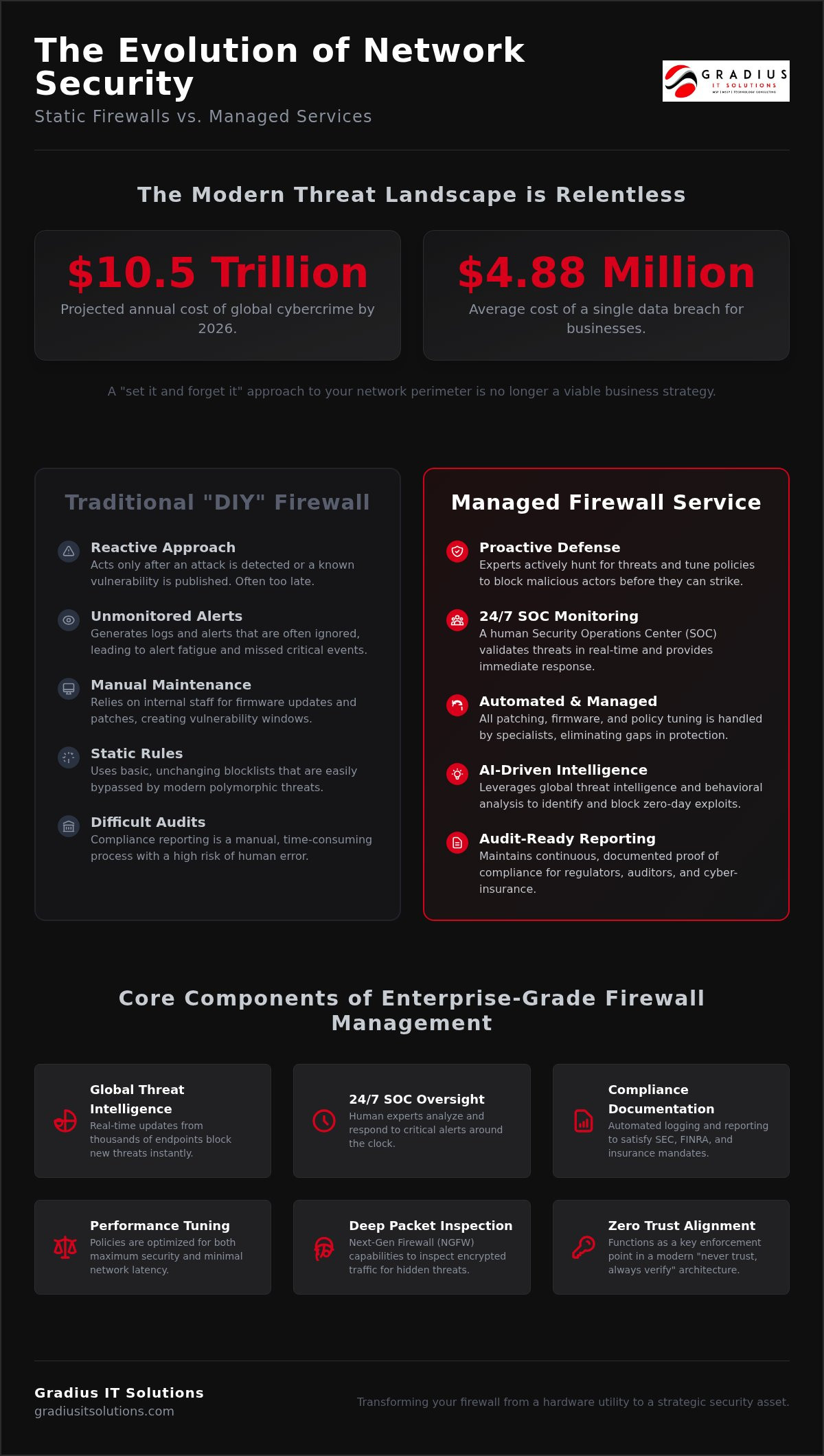
Global cybercrime costs are projected to hit $10.5 trillion in 2026. With the average data breach now costing $4.88 million, a basic “set it and forget it” approach to your network perimeter is no longer a viable business strategy. You likely feel the weight of this reality every time a new firmware patch drops or your inbox fills with overwhelming security alerts. It’s exhausting to manage vulnerability windows while worrying about your next compliance audit or cyber-insurance renewal. You need your security to work as hard as you do without requiring a dedicated internal team.
We believe your technology should empower you, not create more anxiety. This guide explains how managed firewall services move beyond simple traffic filtering to provide a compliance-aware, SOC-backed defense for your infrastructure. You’ll discover how to offload the burden of daily maintenance and ensure your business stays 24/7 protected and audit-ready. We’ll break down the shift toward Zero Trust architecture and show you how a single accountable partner can turn your firewall into a strategic asset for growth and resilience.
Key Takeaways
- Learn why static security rules fail against modern threats and how proactive monitoring keeps your perimeter secure in a changing landscape.
- Understand the strategic advantage of 24/7 SOC integration to ensure immediate human response to automated security alerts at any hour.
- Discover how managed firewall services eliminate the high cost of hiring in-house experts while maintaining audit-ready documentation for compliance and insurance.
- Explore how integrating your firewall with endpoint protection creates a unified, layered defense across your entire business infrastructure.
- Shift from reactive fixes to a proactive model that aligns your security posture with strict regulatory requirements and cyber-insurance mandates.
Beyond the Perimeter: Why Managed Firewall Services are Critical in 2026
The days of buying a black box, plugging it into a rack, and walking away are over. In 2026, a static firewall is little more than a speed bump for modern polymorphic threats. These attacks change shape constantly to bypass traditional filters. True protection requires expert configuration, 24/7 monitoring, and proactive maintenance from a partner specializing in Managed Security Services (MSS). Managed firewall services represent a strategic security layer that functions as a proactive defense engine rather than a simple hardware utility.
Static rules fail because they lack context. A traditional firewall might block a known “bad” IP address, but it won’t notice a legitimate user account behaving strangely. Next-Generation Firewalls (NGFW) solve this by providing deep packet inspection and application-level visibility. They don’t just look at where data is going; they look at what the data is actually doing. This visibility is the difference between stopping a breach and being the next headline. Managing these complex tools requires constant tuning that most internal IT teams simply don’t have the time to execute.
The Evolution of Threat Detection
Modern defense has moved from simple port blocking to sophisticated behavioral analysis. We use AI-driven threat hunting to identify patterns that suggest an attack is brewing before it actually launches. This is critical for handling encrypted traffic. Most web traffic is now encrypted, and hackers use that privacy to hide malicious code. High-performance managed firewall services inspect this traffic in real time without causing network lag. This capability is a cornerstone of a modern Zero Trust architecture. It ensures that every connection is verified and every packet is scrutinized, regardless of where it originates.
Compliance and Regulatory Pressure
Regulators have lost patience with “annual checkups.” For firms governed by SEC and FINRA, continuous monitoring is now a baseline requirement. You can’t prove compliance with a spreadsheet from six months ago. Your firewall serves as the primary source of truth for audit logs and incident reporting. It tracks every attempted entry and exit, providing the forensic trail needed during an investigation. Managed services provide the “Policy Documentation” and real-time oversight that regulators demand. We take the guesswork out of audits by maintaining a continuous, documented state of readiness. This moves the burden of proof from your shoulders to a partner who lives in the data every day.
The Anatomy of Modern Management: SOC Integration and Threat Intelligence
A firewall without active monitoring is like a security camera that no one watches. It might record the event, but it does nothing to stop the intruder in real time. High-performance managed firewall services solve this by integrating directly with a Security Operations Center (SOC). This connection transforms your firewall from a static barrier into a live sensor. 24/7 SOC monitoring ensures that when an anomaly occurs at 3 AM, a human expert is there to validate the threat and act immediately. Automated alerts provide the data; humans provide the context and the cure.
Technical management involves more than just watching alerts. It requires constant policy tuning and firmware hygiene. We adjust rules based on global threat intelligence feeds to block malicious actors before they ever reach your doorstep. This proactive approach eliminates the vulnerability windows that zero-day exploits rely on. By following established NIST firewall guidelines, we ensure your policies are optimized for both security and network performance. Your infrastructure stays lean, fast, and remarkably difficult to penetrate.
Continuous Threat Intelligence Feeds
Managed providers aggregate data from thousands of endpoints across the globe. If a new ransomware strain hits a firm in another state, your firewall is updated with those malicious IP addresses within minutes. This is the power of “vetted” intelligence. It moves beyond generic blocklists to provide high-fidelity data that reduces false positives. We also use this oversight for predictive maintenance. By monitoring hardware health, we can identify a failing power supply or overheating component before it causes a catastrophic outage. We solve problems before they become downtime.
Incident Response and Containment
Detection is only half the battle. When a breach is identified, the firewall becomes your primary tool for containment. Through network segmentation, we isolate an infected device to prevent the “lateral movement” that allows hackers to reach your sensitive data. Sometimes, we utilize parallel observation mode. This allows us to monitor suspicious traffic in a controlled environment to understand the attacker’s intent without disrupting your daily operations. Every action taken is logged to maintain a strict “Chain of Custody” for forensic and insurance purposes. If you aren’t sure who is watching your network right now, it might be time to review your current security posture.
The ROI of Outsourcing: Comparing Managed vs. DIY Firewall Administration
Hiring a dedicated cybersecurity engineer in 2026 is a significant investment. The talent gap remains a major hurdle for growing firms. Most small to mid-sized businesses end up tasking a generalist IT manager with complex security duties. This lead to burnout and, more importantly, dangerous oversights. When you choose managed firewall services, you aren’t just buying software; you’re gaining an entire department of experts for a fraction of the cost of a single full-time hire. For a broader look at how smaller organizations can build a complete defense strategy, our cybersecurity solutions for small business strategic roundup covers the full layered ecosystem needed to stay protected in 2026.
Hidden operational costs often sink a DIY budget. Beyond the initial hardware purchase, you have to account for ongoing licensing, specialized training, and the “opportunity cost” of your staff’s time. Every hour your internal team spends troubleshooting a firmware conflict is an hour they aren’t spend on projects that drive revenue. Misconfigurations are the silent killer of network security. A single rule error can render your entire defense useless. We eliminate this risk by using standardized, peer-reviewed configuration templates that follow industry best practices.
| Feature | DIY Administration | Managed Firewall Services |
|---|---|---|
| Patch Management | Reactive; often delayed by internal projects | Proactive; scheduled and verified by experts |
| Threat Monitoring | Business hours only; reliant on alerts | 24/7/365 active human oversight |
| Compliance Reporting | Manual; time-consuming and prone to gaps | Automated; audit-ready documentation provided |
Predictable Cost Structures
Budgeting for unexpected hardware spikes is a headache for any executive. We help you move from a CAPEX model to a predictable OPEX model. Instead of massive one-time expenses, you get a flat, monthly fee that covers both the technology and the expertise. This managed IT services pricing model simplifies your financial planning. You’ll avoid the “emergency service call” premiums that come with traditional break-fix models when things go wrong.
Operational Efficiency for Internal Teams
Your internal IT staff should focus on high-value strategic growth. When we handle the perimeter, your team is free to explore secure AI automation and other tools that improve your bottom line. We filter out the noise of thousands of daily pings. Your team stops suffering from “alert fatigue” because we only escalate the issues that truly matter. You gain a single, accountable partner who ensures your network is fast, secure, and always ready for your next business move.
Strategic Selection: Key Features of Enterprise-Grade Firewall Management
Selecting hardware is only the first step in building a resilient perimeter. The real value lies in the feature set and how those tools are orchestrated to protect your specific business workflow. High-performance managed firewall services integrate directly with your endpoints to create a unified defense. If a laptop becomes compromised while a staff member is working from home, the firewall recognizes the threat signature and blocks that device from accessing your local servers the moment it reconnects to the office network. This level of communication between your firewall and your servers is essential for stopping lateral movement in its tracks, and firms like OAD Technologies provide excellent frameworks for extending this connectivity into a fully unified security ecosystem.
Advanced features like Intrusion Prevention Systems (IPS) and anti-malware sandboxing provide a critical safety net. Sandboxing allows the system to “detonate” suspicious files in a secure, isolated environment to observe their behavior before they reach your inbox or hard drive. For hybrid teams, managing secure remote access is a full-time job. We ensure your VPNs are robust and every entry point is protected by multi-factor authentication (MFA). These logs are meticulously maintained to help you pass IT compliance audits without the typical last-minute scramble for documentation.
Cyber-Insurance Readiness
Insurance underwriters have become significantly more rigorous in their requirements. In 2026, simply having a firewall isn’t enough to secure a policy or a favorable rate. Carriers now look for “Continuous Monitoring” as a mandatory checkbox. Managed firewall services provide the documented evidence underwriters demand, proving that your security posture is active and human-verified. We generate automated reports that verify MFA enforcement and log retention, making the renewal process a matter of data rather than guesswork. This proactive documentation shows that you are three steps ahead of potential threats. Pairing this approach with comprehensive data breach prevention services gives your organization the layered, compliance-aware defense that modern underwriters and regulators increasingly require.
Network Performance and SD-WAN
Security should never come at the expense of productivity. We utilize Quality of Service (QoS) settings to ensure that your VoIP calls and video conferences remain crystal clear even when the firewall is performing deep packet inspection. For businesses with multiple locations, we manage secure SD-WAN buildouts to provide seamless, encrypted connectivity between sites. This architecture includes redundant hardware and high-availability configurations. If one unit fails, the system automatically switches to a backup without a second of downtime. We keep your business moving while keeping the bad actors out.
Schedule your comprehensive cybersecurity assessment today
Strengthening Resilience: The Gradius Approach to Integrated Cybersecurity
We don’t wait for your network to fail before we start working. Our “Prevent-Instead-React” philosophy is built on the idea that predictive maintenance is always more cost-effective than disaster recovery. By using managed firewall services as a proactive shield, we identify and neutralize threats before they can disrupt your operations. This isn’t just about hardware; it’s about a relentless commitment to your business continuity. We treat your perimeter as a living defense system that evolves as quickly as the threats it faces.
Accountability is the bedrock of our partnership. When an issue arises, you need to reach a human who can actually solve the problem. Our U.S.-based 24/7 NOC/SOC ensures that you have immediate access to experts who understand your specific infrastructure. There is no automated maze to navigate and no waiting for a call back from a foreign time zone. We take full ownership of your security posture, providing the peace of mind that comes from knowing a proactive guardian is always on watch. If your current provider is hard to reach when the stakes are high, it’s time for a change.
We believe security data should drive business decisions. By integrating firewall logs into our Technology Consulting and vCIO strategy, we turn technical metrics into actionable insights. This compliance-aware approach ensures your policies are always aligned with SEC, FINRA, and HIPAA standards. We don’t just check boxes; we build a resilient framework that supports your long-term growth while satisfying the most stringent regulatory requirements. Your technology should be a competitive advantage, not a liability.
A Single Accountable Partner
Vendor finger-pointing is a productivity killer. When your IT support and security providers are separate entities, you often get caught in the middle of a “not my problem” loop. We eliminate this friction by serving as your single point of accountability. Our team handles everything from Microsoft 365 hardening to physical network buildouts and upgrades. This integrated approach ensures that every layer of your technology stack is working in harmony to protect your data and empower your team. We manage the complexity so you can focus on your business.
Getting Started with a Strategic Assessment
The best time to find a gap in your security is before a hacker does. Our free cybersecurity assessment provides a clear, objective look at your current vulnerabilities. We don’t just hand you a list of problems; we develop a strategic roadmap that aligns your perimeter defense with your specific business goals. This is about more than just managed firewall services. It’s about building a foundation for a more resilient, productive future. You deserve a partner who stands firmly in your corner and understands the unique challenges of the tri-state business landscape.
Building a Resilient Foundation for Growth
Your network perimeter is the first line of defense against a global cybercrime landscape that is more aggressive than ever. Moving to managed firewall services allows you to shift from a reactive, stressed posture to one of high-performance confidence. You gain the advantage of a U.S.-based 24/7 SOC response and specialized SEC and FINRA compliance expertise without the overhead of internal security engineers. This partnership ensures your infrastructure isn’t just a barrier, but a strategic asset that supports your business goals.
This predictive “Prevent-Instead-React” approach ensures that your business stays protected, your team stays productive, and your compliance documentation is always audit-ready. It’s time to stop worrying about vulnerability windows and start focusing on your long-term growth. We provide the expertise and accountability you need to navigate the complexities of modern cybersecurity with total transparency. By offloading the burden of technical management, you empower your organization to move faster and more securely in an unpredictable world.
We’re here to lift the weight of technical complexity off your shoulders so you can focus on what you do best. Your journey to a more secure and resilient business starts with a single strategic step.
Frequently Asked Questions
What is included in managed firewall services?
These services include hardware provisioning, expert configuration, 24/7 SOC monitoring, and proactive patch management. You also receive intrusion prevention systems (IPS), web content filtering, and secure VPN management. High-performance managed firewall services provide regular security health reports and audit-ready logs to ensure your perimeter is never unmonitored or outdated.
How does a managed firewall help with cyber-insurance?
Managed firewalls satisfy mandatory insurance requirements for continuous monitoring and multi-factor authentication (MFA) enforcement. Underwriters now require proof that your security is active rather than static. We provide the automated reporting and log retention needed to verify your security posture during renewals, which helps secure coverage in a tightening insurance market.
Can managed firewall services replace my internal IT team?
No, these services are designed to augment and empower your internal IT staff rather than replace them. By offloading the burden of 24/7 security monitoring and complex firmware updates, your team can focus on strategic projects like AI adoption and productivity. We act as a specialized extension of your department, providing expertise that most generalist teams don’t have the time to maintain.
Is a managed firewall necessary if we use cloud services like Microsoft 365?
How much does managed firewall service typically cost?
Costs for managed firewall services vary based on your network complexity, user count, and specific compliance requirements. Most firms prefer the predictable monthly fee of an OPEX model over large upfront hardware costs. You should look for a partner who includes 24/7 SOC monitoring and hardware replacement in their flat rate to avoid hidden emergency service fees.
What is the difference between an MSP and an MSSP for firewall management?
A Managed Service Provider (MSP) focuses on general network uptime and performance, while a Managed Security Service Provider (MSSP) focuses specifically on threat detection and risk mitigation. For high-stakes environments like financial services or legal firms, an MSSP approach is often preferred. It provides deeper security integration, such as a dedicated SOC and specialized compliance reporting, going beyond basic connectivity support. Growing organizations looking to understand the full spectrum of cybersecurity solutions for small business will find that pairing MSSP-level firewall management with a broader layered defense strategy is the most effective path to long-term resilience.
How often are firewall rules updated in a managed environment?
Rule updates occur continuously based on real-time global threat intelligence feeds. We don’t wait for a monthly check-up to adjust your defenses. If a new malicious IP is identified globally, your firewall rules are updated within minutes. This proactive tuning ensures your perimeter is always hardened against the latest polymorphic threats and zero-day exploits.
Does a managed firewall protect remote employees working from home?
Yes, it protects remote staff by managing secure VPN tunnels and enforcing MFA-protected entry points to your network. The firewall acts as a secure gateway for hybrid teams. It scrutinizes the traffic coming from home offices to ensure it meets your security standards before allowing access to sensitive company data, preventing a compromised home device from infecting your central servers.

Article by
Robert Joyce
**Robert Joyce** is the Founder, CEO, and Chief Technology Officer of Gradius IT Solutions, a security first provider of Managed IT Services, Cybersecurity, Cloud, Compliance, and Secure AI solutions serving businesses throughout New Jersey, New York, Connecticut, and across the United States.
With more than 28 years of IT experience, including 23 years supporting hedge funds, global banks, and wealth management firms, Robert has built a career designing and managing secure, resilient, and highly available technology environments where uptime, cybersecurity, and business continuity are essential.
His expertise includes Microsoft 365, cloud computing, cybersecurity, networking, infrastructure, disaster recovery, compliance, virtualization, and strategic IT leadership. Following the events of September 11, Robert helped rebuild critical technology infrastructure for Merrill Lynch, an experience that reinforced the importance of resilience, planning, and operational excellence.
Robert founded Gradius IT Solutions to bring enterprise level technology and security services to small and midsized businesses at a predictable monthly cost. Today, the company delivers fully managed and co managed IT services, cybersecurity, Microsoft 365, cloud solutions, compliance consulting, Secure AI consulting, technology projects, and vCIO services. Through a U.S. based 24/7 Help Desk and a nationwide network of trusted technology partners, Gradius supports organizations across the country with responsive, security focused technology solutions.
Robert partners with business owners and executive leaders to align technology with business goals, reduce risk, strengthen cybersecurity, improve productivity, and create long term IT strategies that support growth. His mission is simple: provide every client with enterprise class technology, exceptional service, and a trusted advisor they can rely on as their business evolves.
Disclaimer
## Disclaimer
The information provided in this article is for general informational and educational purposes only and should not be considered professional IT, cybersecurity, legal, regulatory, or compliance advice. While Gradius IT Solutions strives to provide accurate and up to date information, technology, security threats, and regulatory requirements change frequently, and we cannot guarantee that all information will remain current or applicable to your specific situation.
Every organization has unique technology, security, compliance, and business requirements. Before implementing any recommendations discussed in this article, you should evaluate their suitability for your environment or consult with a qualified technology professional.
Gradius IT Solutions makes no warranties, express or implied, regarding the completeness, accuracy, reliability, or results obtained from the use of this information. Any actions you take based on this content are at your own risk. Gradius IT Solutions shall not be liable for any direct, indirect, incidental, or consequential damages arising from the use of, or reliance upon, the information contained in this article.
References to third party products, services, or vendors are provided for informational purposes only and do not constitute an endorsement unless explicitly stated.
If you would like guidance tailored to your organization, contact Gradius IT Solutions to schedule a consultation with one of our technology experts.