
Your employees are already using AI. They just haven’t told you yet. This “Shadow AI” creates a massive security gap that puts your sensitive data at risk. You want the efficiency, but you can’t afford a HIPAA or SEC violation. It’s a common struggle for growing firms. Implementing secure ai automation for business is the only way to harness this power without losing control. It’s time to stop reacting and start leading.
I’ll show you how to build a framework that scales with your specific goals. We’ll move past the confusion of unapproved tools. You’ll learn how to deploy enterprise-grade workflows that protect your intellectual property while meeting strict regulatory standards. This guide covers the essential components of a secure AI ecosystem and provides an actionable roadmap for 2026. Let’s turn AI from a liability into your greatest competitive advantage. We’ll focus on practical steps to improve productivity without increasing your risk profile.
Key Takeaways
- Understand how secure ai automation for business integrates Machine Learning with Zero Trust protocols to safeguard your intellectual property.
- Learn why security-first AI is now a requirement for firms navigating 2026 compliance standards like HIPAA and SEC regulations.
- Identify the hidden dangers of “Shadow AI” and implement controls to stop sensitive data from leaking into public models.
- Follow an actionable adoption roadmap: from conducting readiness assessments to selecting the most productive workflows for automation.
- Discover how Managed AI-as-a-Service tiers offer a scalable, expert-led path to innovation for organizations with 5 to 100 employees.
What is Secure AI Automation for Business?
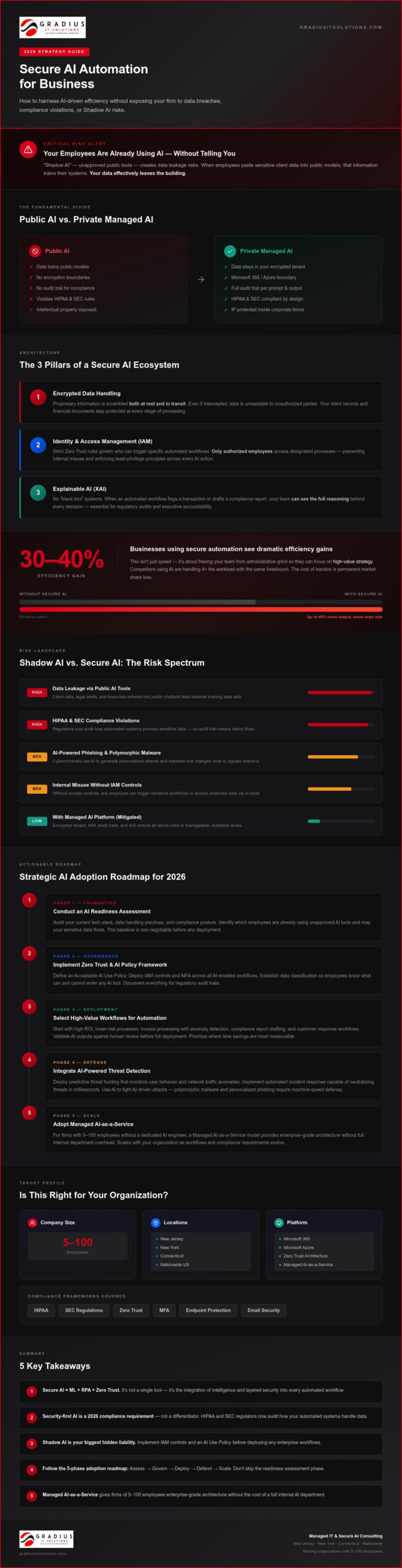
AI is no longer a future project. It’s your current reality, whether you’ve officially deployed it or not. For a small to mid-sized firm, secure ai automation for business represents the convergence of three powerful forces: Machine Learning (ML), Robotic Process Automation (RPA), and Zero Trust security. It’s the difference between a tool that just follows a list of instructions and a system that thinks, protects, and scales with your operations.
Most business owners start with “Public AI” like the free versions of popular chatbots. That’s a massive risk. Public models use your prompts to train their systems. If an employee pastes a client’s financial statement or a sensitive legal brief into a public tool, that data is effectively gone. Private, Managed AI keeps your information inside your own encrypted “tenant,” typically within Microsoft 365 or Azure. Your data stays yours. It never leaves the safety of your corporate fence.
The Core Components of a Secure AI Ecosystem
A resilient ecosystem rests on three specific pillars. First, encrypted data handling ensures that proprietary info is scrambled both at rest and in transit. Second, Identity and Access Management (IAM) applies strict rules. Only authorized employees can trigger specific automated workflows, preventing internal misuse. Third, we implement Explainable AI (XAI). If an automated system flags a transaction or drafts a compliance report, your team must be able to see the logic behind that decision. We don’t believe in “black box” technology; we believe in transparency.
Secure AI vs. Standard Automation
Standard automation is rigid. It follows “if-this-then-that” rules and breaks the moment a single variable changes. AI automation is different because it learns and adapts to new data patterns without manual reprogramming. The “Secure” part adds a real-time security layer that standard tools lack. Imagine an automation that processes invoices but also uses anomaly detection to spot a fraudulent bank account change instantly. Secure AI Automation is the strategic integration of intelligence and layered defense.
Why is 2026 the tipping point? Because AI is now a competitive necessity rather than a luxury. Your competitors are using these tools to handle four times the workload with the same headcount. However, they’re also facing sophisticated AI-driven threats. You need a partner to bridge the expertise gap. Most firms with 5 to 100 employees don’t have a dedicated AI engineer. Secure AI & Automation Services from an MSP provide the high-level architecture you need to win without the overhead of a full internal department.
The 2026 Trend: Why Security-First AI is Now Mandatory
The era of “experimenting” with AI is over. It’s 2026. The baseline for staying competitive has shifted. If you aren’t using secure ai automation for business, you’re fighting a modern war with outdated weapons. Cybercriminals now use AI to generate highly personalized phishing campaigns and polymorphic malware at scale. These threats change their code instantly to bypass traditional antivirus. A human-led defense alone is no longer enough to keep up with that speed. You need AI to fight AI.
The data is clear: businesses that integrate secure automation see efficiency gains of 30% to 40%. This isn’t just about doing things faster. It’s about freeing your team from the administrative grind so they can focus on high-value strategy. The cost of inaction isn’t just a slow workflow. It’s a permanent loss of market share to more agile competitors. If you’re ready to modernize, exploring Secure AI & Automation Services is your next logical step.
Regulatory bodies like the SEC and HIPAA have caught up. They now look specifically at how automated systems process sensitive data. It’s not enough to say you’re secure; you have to prove it. If your AI doesn’t have a built-in audit trail that tracks every prompt and output, you’re looking at heavy fines. You don’t just need automation. You need a proactive guardian that understands the specific rules of your industry and keeps you audit-ready at all times. Pairing your AI strategy with comprehensive IT risk assessment services ensures your automated workflows remain continuously compliant rather than relying on a once-a-year snapshot.
AI-Powered Security: The New Standard
Modern protection requires integrating AI directly into your Cybersecurity & SOC Services. This allows for predictive threat hunting. Instead of waiting for a breach, the system identifies patterns that suggest an attack is brewing. It looks for anomalies in user behavior or network traffic that humans would miss. Automated incident response can then neutralize the threat in milliseconds. It stops the damage before your team even knows there’s a problem. This level of speed is the new standard for enterprise security.
Compliance-Aware Workflows for Regulated Industries
Regulated firms face the highest stakes. Registered Investment Advisors (RIAs) use AI for automated document archiving and instant audit preparation, ensuring every client communication is logged correctly. In healthcare, secure AI manages patient data without risking HIPAA violations by keeping all processing within a private cloud environment; for instance, VigyanLLM provides a sovereign bioinformatics platform for secure sequence analysis and molecular docking. Legal firms are also automating discovery and contract review with high-performance security. These aren’t just IT upgrades. They are essential tools for business resilience that allow small teams to punch way above their weight class.
Navigating the Risks: From Shadow AI to Data Breaches
Shadow AI isn’t just a buzzword. It’s a quiet crisis. Your team wants to work faster. They find a free chatbot and feed it a messy spreadsheet to clean it up. Suddenly, your proprietary formulas or patient records are part of a public training set. This is how data leakage happens. Once that information is ingested by a public model, you can’t pull it back. It’s a permanent breach. Effective secure ai automation for business requires closing these backdoors immediately.
Then there’s the risk of hallucinations. AI models are designed to be helpful, not necessarily accurate. They can invent legal citations or financial figures with absolute confidence. If an automated workflow relies on these hallucinations to make business decisions, the fallout is your responsibility. You can’t blame the machine for a bad outcome. This is why intelligent workflows must include human-in-the-loop validation and strict data boundaries to ensure accuracy.
Compliance failures are the final blow. If you’re in a regulated field, unmanaged AI is a ticking time bomb. The SEC and HIPAA don’t care that your employee was just trying to be efficient. They care that sensitive data was processed on an unapproved, unencrypted platform. The financial and reputational costs of these oversights can be devastating for a mid-sized firm. You need a system that logs every interaction and maintains a clear audit trail.
The Hidden Danger of ‘Free’ AI Tools
Free tools come with a hidden price tag. Usually, your data is the product. Consumer-grade AI lacks administrative controls. You can’t see who’s using it or what they’re saying. A strategic alternative is Microsoft 365 Copilot with enterprise data protection. It gives you the same power but keeps your data within your secure tenant. Your information isn’t used to train the public model. It stays inside your walls, protected by the same security you already trust.
Establishing an AI Governance Policy
You need clear rules. A governance policy defines what data can and cannot be processed by AI. It’s not about banning the technology. It’s about setting the guardrails. You also need continuous monitoring to identify unapproved AI usage across your network. This is where Compliance as a Service becomes vital. It provides the framework to track usage, manage risks, and prove to regulators that you are in total control of your automated environment.
Building Your Framework: A Strategic AI Adoption Roadmap
You can’t just flip a switch on secure ai automation for business. It requires a methodical approach that balances speed with safety. Most firms fail because they rush the “how” without understanding the “what.” This roadmap ensures your transition is smooth, compliant, and profitable. We focus on building a resilient foundation first, so your automation doesn’t become a liability later.
Step 1: The AI Readiness Assessment
Before you buy a single license, you must know what you’re working with. We evaluate your current network infrastructure and data cleanliness. If your data is disorganized, your AI will produce unreliable results. We also identify compliance gaps that automation might solve or accidentally exacerbate. This foundational work is part of our IT Consulting & Technology Strategy services. We ensure your environment is primed for intelligent workflows before deployment begins.
Step 2: Selecting the Right Use Cases
Start where the impact is highest but the risk is lowest. Automated helpdesks can resolve a large percentage of common queries without human intervention. Predictive analytics can flag client churn before it happens. Email management tools can sort and summarize hundreds of messages daily. We focus on ROI by identifying which workflows save the most billable hours for your senior staff. Choosing the right use case is the fastest way to prove the value of secure ai automation for business to your stakeholders.
Once you’ve chosen your tools, wrap them in a Zero Trust architecture. This means the system never assumes a user or device is safe; every single request to trigger an automated workflow is verified in real-time. We implement endpoint protection and multi-factor authentication (MFA) to ensure only authorized personnel interact with your AI ecosystem. This prevents a compromised account from running wild with automated processes and protects your most sensitive data from internal and external threats alike. Firms that want to maximize the output of these protected environments often pair this approach with Microsoft 365 workflow automation to eliminate manual bottlenecks and scale operations without adding headcount. Aligning these efforts within a structured business technology roadmap ensures your AI investments are tied to a 12 to 36 month strategic plan rather than isolated tactical decisions.
Technology is only half the battle. Employee awareness programs are non-negotiable. Your team must know how to spot hallucinations and handle data correctly. Finally, we conduct ongoing performance audits. AI models can drift over time, losing accuracy or efficiency. We fine-tune the system to ensure it remains a high-performance asset as your business grows. This continuous cycle of monitoring and improvement keeps your security posture strong while maximizing your productivity gains.
Schedule your AI readiness assessment today.
Managed AI-as-a-Service: The Gradius Advantage
Trying to build an internal AI department is a costly mistake for most firms with 5 to 100 employees. You don’t need a six-figure data scientist on your payroll to see results. You need a partner who understands the plumbing of secure ai automation for business. Managed AI-as-a-Service allows you to skip the expensive trial-and-error phase. We provide the infrastructure, the security, and the expertise for a predictable monthly fee. It’s about getting enterprise results on an SMB budget.
Our service tiers are designed to scale with your ambition. The Essential tier focuses on foundational automation and security. The Professional tier adds deeper workflow integration and customized logic. For firms with complex regulatory needs, the Enterprise tier provides the highest level of oversight and model fine-tuning. Every tier includes seamless integration with your existing Microsoft 365 and Azure environment. We don’t just add a new tool; we optimize the ecosystem you already use every day.
Eliminating the Need for Internal AI Experts
We act as your outsourced AI department and vCIO. This means you don’t have to worry about model drift or the latest security patches. We handle the technical heavy lifting in the background. Our team provides proactive maintenance to keep your automated workflows running at peak performance. When you partner with us for Secure AI & Automation Services, you gain a proactive guardian. We update your models and security protocols while you focus on billable work and client growth. You get high-level strategy without the overhead of a full-time executive hire.
Enterprise-Grade Security for Every Business
Small firms are often the biggest targets for cyberattacks because they lack the resources of financial giants. We change that equation. Our U.S.-based 24/7 SOC monitors your AI workflows around the clock. We use predictive analytics to anticipate technical issues before they cause a single minute of downtime. This isn’t just about fixing what’s broken. It’s about ensuring your business stays resilient against evolving threats. You get the same level of protection used by the world’s largest institutions, tailored specifically for your organization’s size and scope.
The transition to intelligent workflows doesn’t have to be overwhelming. We’ve built a methodical process that prioritizes your security and your bottom line. You deserve a partner who stands firmly in your corner and refuses to accept mediocrity. Let’s build a roadmap that turns your technology into a high-performance asset while keeping your data under lock and key.
Future-Proof Your Growth with Secure Intelligence
The landscape of 2026 demands more than just speed. It requires a strategic integration of secure ai automation for business that protects your data while multiplying your output. You’ve seen the risks of unmanaged tools and the complexity of shifting regulations. Now, it’s about choosing a path that balances innovation with enterprise-grade protection.
Success today means moving your workflows into a private, monitored ecosystem. This shift eliminates the threat of data leakage and ensures every automated decision is audit-ready. You don’t need a massive internal team to achieve this level of performance. You just need a compliance-aware strategic partner who understands the intersection of productivity and security.
Our U.S.-based 24/7 SOC is ready to monitor your workflows while our Microsoft 365 security specialists keep your environment resilient. We are here to lift the burden of technical complexity from your shoulders so you can focus on the bottom line. Let’s turn your technology into a competitive advantage that works as hard as you do.
Frequently Asked Questions
Is AI automation safe for businesses handling sensitive financial or medical data?
Yes, it is safe when deployed within a private cloud environment like Microsoft 365 or Azure. These platforms use enterprise-grade encryption to isolate your proprietary records from public models. This ensures that sensitive financial or medical data stays strictly within your controlled environment, preventing unauthorized access or accidental data leakage.
How much does it cost to implement secure AI automation for a small business?
Implementation costs depend on your specific goals and the number of workflows you choose to automate. Most small to mid-sized firms find that a subscription-based AI-as-a-Service model is the most cost-effective path. This avoids large upfront fees and allows you to pay for the level of support and complexity your business actually requires.
What is the difference between public AI and private, managed AI?
Public AI tools use your inputs to train their general models, whereas private, managed AI keeps your information entirely isolated. Implementing secure ai automation for business ensures that your data remains your property. It provides the same intelligence as public tools but adds a protective layer that prevents your secrets from being shared with competitors.
Does secure AI automation replace employees or enhance their roles?
Secure AI enhances human roles by automating the repetitive tasks that consume your team’s time. It doesn’t replace the need for human judgment; it frees your staff to focus on higher-value tasks like strategy and client care. By handling routine data entry or scheduling, AI acts as a high-performance assistant for every member of your team.
What are the first steps to take if I suspect ‘Shadow AI’ usage in my office?
You should start with a comprehensive network audit to identify unapproved tools and then move to an educational approach. Don’t just ban the technology; find out what business problem the employees were trying to solve. Providing a secure, managed alternative is the most effective way to eliminate the risks associated with Shadow AI usage.
Can secure AI help my business meet SEC or HIPAA compliance requirements?
Yes, managed AI systems can be configured to automate the logging and reporting required for SEC or HIPAA compliance. These tools create a clear audit trail for every data interaction, making it easier to prove you are following regulatory standards. It turns compliance from a manual burden into a streamlined, automated process. Firms that also invest in dedicated IT risk assessment services gain an additional layer of continuous oversight that transforms regulatory obligations into a strategic advantage.
How long does it typically take to see an ROI from AI automation?
You can typically expect to see a measurable ROI within 90 to 180 days after your initial deployment. The return often comes from a sharp increase in billable efficiency and the ability to scale operations without adding headcount. Using secure ai automation for business allows you to recoup your investment through improved accuracy and faster project turnaround times.
What happens if an automated AI workflow makes a mistake?
You must maintain human oversight for any high-risk or client-facing automated output. This “human-in-the-loop” strategy ensures that a qualified professional reviews AI-generated work for accuracy before it’s finalized. By integrating these checkpoints, you benefit from the speed of automation while keeping a human expert in the driver’s seat to prevent hallucinations.

Article by
Robert Joyce
Robert Joyce is the Owner and Chief Technology Officer of Gradius IT Solutions, a security-first provider of managed IT, cybersecurity, cloud, compliance, and secure AI solutions. Headquartered in New Jersey with satellite offices in the Midwest and South Florida, Gradius serves businesses across the Tri-State Area, Midwest, South Florida, and nationwide.
Robert brings 30 years of IT experience, including 23 years in hedge funds, global banks, and wealth management firms where uptime, security, and continuity are non-negotiable. He began in trade floor support at Caxton, Shell Trading, and Knight, provided senior trade floor support at RBC and SAC Capital, served as VP of IT at EntrustPermal, and was CTO of Gerstein Fisher. After September 11, he helped rebuild critical technology infrastructure for Merrill Lynch.
His expertise spans Microsoft 365, cloud, cybersecurity, networking, infrastructure, disaster recovery, compliance, and strategic IT leadership.
Robert founded Gradius to bring enterprise-level technology and security to small and midsized businesses at a predictable monthly cost. Gradius delivers managed and co-managed IT, cybersecurity, Microsoft 365 and cloud, compliance programs supported by a GRC platform, secure AI consulting, and vCIO services, with a full help desk, 24/7 NOC and SOC monitoring, and U.S.-based onsite engineers and SOC.
Robert works directly with business owners and executives as their single accountable point of contact. His philosophy: one trusted partner, complete IT accountability.
Disclaimer
## Disclaimer
The information provided in this article is for general informational and educational purposes only and should not be considered professional IT, cybersecurity, legal, regulatory, or compliance advice. While Gradius IT Solutions strives to provide accurate and up to date information, technology, security threats, and regulatory requirements change frequently, and we cannot guarantee that all information will remain current or applicable to your specific situation.
Every organization has unique technology, security, compliance, and business requirements. Before implementing any recommendations discussed in this article, you should evaluate their suitability for your environment or consult with a qualified technology professional.
Gradius IT Solutions makes no warranties, express or implied, regarding the completeness, accuracy, reliability, or results obtained from the use of this information. Any actions you take based on this content are at your own risk. Gradius IT Solutions shall not be liable for any direct, indirect, incidental, or consequential damages arising from the use of, or reliance upon, the information contained in this article.
References to third party products, services, or vendors are provided for informational purposes only and do not constitute an endorsement unless explicitly stated.
If you would like guidance tailored to your organization, contact Gradius IT Solutions to schedule a consultation with one of our technology experts.