

Your 2026 budget isn’t a spreadsheet problem. It’s a strategy problem. Most leaders feel the weight of a fragmented tech stack and the constant pressure of evolving cyber threats. It’s exhausting to play catch-up with AI while trying to keep the lights on. You know the cost of reactive IT spending: a black hole for your bottom line. A clear business technology roadmap is the only way to move from putting out fires to driving the ship.
We’re here to help you regain control. This guide delivers a comprehensive template designed to align your infrastructure, security, and AI goals. You’ll master the art of strategic IT planning. You’ll eliminate the uncertainty that stalls growth. We’ll show you how a vCIO acts as the architect of your strategy, building a 12 to 36 month plan that improves operational efficiency and makes IT spending finally predictable. From NIST CSF 2.0 compliance to safe AI automation, we’re covering the essential pillars of your 2026 success. Let’s build a tech environment that works for you, not against you.
Key Takeaways
- Stop reacting and start leading. Learn why the outdated “break-fix” model fails in 2026 and how proactive planning secures your bottom line.
- Master a step-by-step template to build a business technology roadmap that synchronizes infrastructure, security, and AI goals.
- Build for resilience. Discover how to integrate Zero Trust security and strategic network design into your foundation from day one.
- Bridge the expertise gap. Understand why vCIO consulting is the key to moving tech conversations from the server room to the boardroom.
- Gain total visibility. Establish a clear 12-36 month strategy that turns IT spending from a variable cost into a predictable investment for growth.
The 2026 Business Technology Roadmap: Why Strategic Planning is Non-Negotiable
Your business technology roadmap isn’t just a list of upcoming hardware expenses. It’s a high-level visual plan that aligns every tech initiative with your specific organizational goals. Think of it as a strategic bridge. It connects where your company stands today to where you want it to be in 36 months. Without this guide, you’re merely reacting to problems as they arise. A clear Technology roadmap ensures your IT budget supports your vision rather than draining your resources.
The era of the “break-fix” model is over. Relying on reactive support in 2026 is a recipe for disaster. Small and medium-sized businesses are now three times more likely to be targeted by cyberattacks than larger firms. Neglecting your roadmap creates massive technical debt and dangerous security gaps. You lose the ability to scale because your current systems can’t handle the load. You also risk falling behind competitors who use AI to automate routine tasks. Proactive planning is the only way to ensure your stack remains an asset.
To better understand how this planning works, watch this helpful video:
A successful strategy focuses on three core drivers: efficiency, security, and scalability. When these elements align, your technology becomes a growth engine rather than a bottleneck.
The Anatomy of a Modern Roadmap
A modern roadmap differentiates between tactical fixes and strategic investments. Tactical fixes keep the lights on; strategic investments drive the bottom line. This is where IT consulting and vCIO services become essential. A vCIO acts as a translator. They turn your business objectives into specific technical requirements. They don’t just look at next month’s patch cycle. They maintain a 12 to 36 month outlook. This foresight ensures your infrastructure is ready for new regulations like NIST CSF 2.0 or CIRCIA reporting requirements.
Moving Beyond Hardware Lifecycles
Buying new laptops isn’t a strategy. It’s basic maintenance. A true business technology roadmap focuses on the “After State” of your organization. We look at the tangible outcomes of every upgrade. Imagine what your team could achieve with a 20% boost in operational efficiency. We focus on the results: faster workflows, bulletproof security, and seamless communication. This planning prevents the fragmented stack pain point that slows down so many growing firms. Your roadmap is a living document that evolves alongside your business, not a static PDF gathering dust on a digital shelf.
Core Pillars of a High-Performance Technology Blueprint
Building a high-performance organization requires more than just picking the right software. It demands an integrated technology road map that serves as a structural blueprint for every department. Your business technology roadmap must treat infrastructure, security, and productivity as interconnected systems. High-performance starts with robust network infrastructure design. If your network is brittle, even the best AI and cloud tools will fail. We don’t just build for today’s traffic; we architect for the 2026 data load.
For financial and healthcare firms, compliance isn’t a checkbox. It’s a design requirement. SEC, FINRA, and HIPAA standards must be baked into the roadmap from the start. This prevents the costly “rip and replace” cycles that occur when auditors find gaps in your setup. Integrating Cloud and Microsoft 365 ensures your team stays productive while remaining within these strict regulatory boundaries.
Cybersecurity as the Roadmap Foundation
Security isn’t an add-on. In 2026, “bolt-on” security is a liability. It creates friction and leaves dangerous gaps. Small and medium-sized businesses account for 46% of all cyber breaches, making built-in security a survival necessity. We prioritize protection by integrating Zero Trust principles from day one. This includes MFA, EDR, and cybersecurity services that provide 24/7 SOC monitoring. You need a proactive guardian, not just a firewall.
The Secure AI Evolution
AI is the competitive edge for 2026. But it requires a solid foundation. You can’t adopt AI without strict data governance. Your roadmap should include secure AI automation to handle “low-hanging fruit” like data entry or scheduling. Start with Microsoft 365 workflow automation to see immediate ROI. If you’re unsure where to start, our vCIO consultants can help identify the most impactful automation opportunities for your specific business.
Internal IT vs. vCIO Strategic Consulting: Which Path for Your Roadmap?
Choosing between an internal team and a virtual Chief Information Officer (vCIO) isn’t just about head count. It’s about a fundamental shift in perspective. Most internal IT teams operate with a “Server Room” mentality. They focus on keeping the network up, fixing broken printers, and managing daily tickets. While essential, this reactive posture leaves little room for the “Boardroom” strategy required to thrive in 2026. A successful business technology roadmap requires a high-level view that aligns every technical decision with your bottom line.
The cost difference is staggering. A full-time CIO in 2026 can cost your business between $245,000 and $428,000 annually. In contrast, vCIO consulting services typically range from $24,000 to $96,000 per year. This isn’t just a saving; it’s an investment in specialized expertise that internal teams often lack. You gain executive-level leadership without the executive-level price tag. Most importantly, it creates clear accountability. When the roadmap fails, you need a single partner responsible for getting it back on track.
The Internal IT Limitation
Internal staff are often buried under a mountain of daily helpdesk tickets. When you’re constantly putting out fires, strategic planning naturally takes a backseat. This creates a dangerous “echo chamber” where your team only knows what they’ve seen within your own four walls. They lack the external benchmarks needed to spot emerging threats or efficiency gains. If your internal team is talented but overwhelmed, a co-managed IT model offers the perfect strategic balance. It lets your staff handle the day-to-day while an external partner drives the long-term vision.
The vCIO Advantage
A vCIO brings a massive breadth of experience from across multiple industries. They don’t just guess. They use enterprise-grade tools and proven frameworks to secure your future. This expertise is critical for meeting strict cyber-insurance requirements and new regulations like CIRCIA. A vCIO acts as a decisive bridge between technical execution and executive vision. They ensure your business technology roadmap stays on track and remains accountable. With a vCIO, you aren’t just buying hours. You’re buying a proactive guardian who is already three steps ahead of the next tech disruption.
A Step-by-Step Template for Your Technology Roadmap
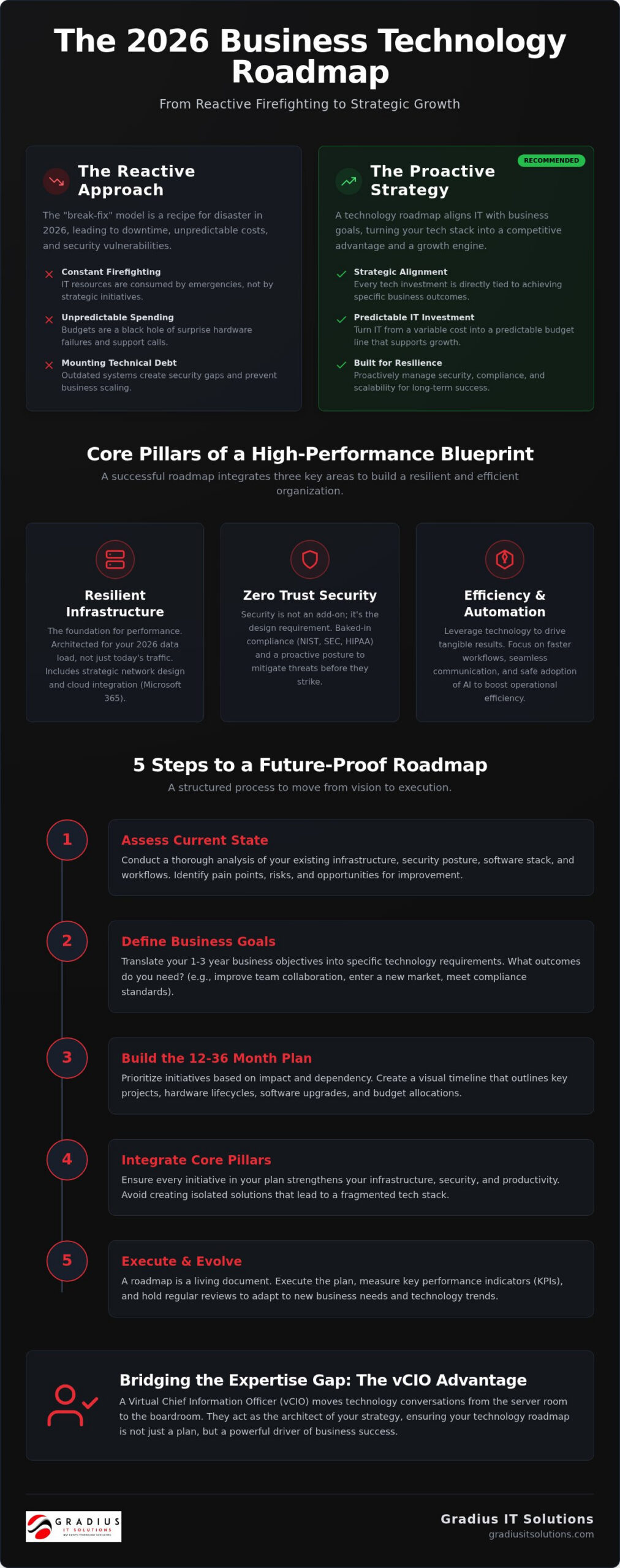
Stop guessing. Start measuring. A successful business technology roadmap isn’t built on gut feelings or trending headlines. It’s built on hard data and strategic alignment. You need a repeatable process that turns technical complexity into a clear path for growth. This template moves your organization from a reactive “fix-it” culture to a proactive, performance-driven powerhouse. We break this down into five distinct steps that ensure no detail is overlooked.
Phase 1: Assessing the Landscape
Inventory is your first priority. You can’t secure or optimize what you don’t see. Step 1 involves a thorough discovery phase where we audit every piece of hardware, software, and cloud license. This is the moment to identify “End of Life” (EOL) risks that threaten your stability. For example, Office 2021 reaches its end of support on October 13, 2026. Running unsupported software after that date is an open invitation to cyber threats. We also review your current regulatory standing through compliance as a service to ensure your foundation is legally sound and audit-ready.
Phase 2: Defining the Future State
Step 2 is your Gap Analysis. We identify the distance between your current setup and your 36 month goals. We map technology directly to your business KPIs: “We need X technology to achieve Y growth.” If you plan to double your employee count, your network must support that scale without a total rebuild. This phase also includes a standard AI readiness check. We verify your data governance is bulletproof before you adopt automation. We focus entirely on the “After State” of your business, ensuring every tool serves a specific, measurable purpose.
Once the future state is defined, we move into Step 3: Prioritization. We rank every initiative based on risk, cost, and business impact. This prevents “project fatigue” and ensures high-value security upgrades happen first. Step 4 focuses on Budgeting. We help you move away from erratic IT bills and toward a predictable, flat-fee spending model. This makes your technology costs a known quantity rather than a monthly surprise. Finally, Step 5 is Execution and Review. Your business technology roadmap is a living document, not a static PDF. We treat it as a cyclical process, reviewing and adjusting every quarter to keep you ahead of the market. A critical component of this review process is ensuring your IT business continuity planning is integrated into every phase, so your operations remain resilient against ransomware, hardware failure, or any unforeseen disruption.
Schedule your strategic roadmap consultation now
Executing Your Vision with Gradius IT Solutions
A roadmap is only as strong as the team executing it. Gradius IT Solutions stands in your corner as a single accountable partner for IT, security, and strategy. We don’t just hand you a document and walk away. We own the results of your business technology roadmap. Our “Prevent-Instead-React” philosophy ensures your strategy stays on track without the interruptions of constant technical fires. We focus on movement and optimization, turning your IT department into a high-performance engine for growth.
Your business deserves unwavering reliability. We provide continuous support through our U.S.-based 24/7 SOC and Help Desk. This proactive guardianship means we’re already three steps ahead, anticipating potential bottlenecks before they impact your productivity. By lifting the burden of technical complexity from your shoulders, we allow you to focus on your core mission. Every roadmap we build is anchored in practical impact, ensuring your infrastructure is both protective and empowering.
Compliance-Aware Managed IT
For firms in the financial, legal, and healthcare sectors, a generic strategy isn’t enough. You need a roadmap built on a foundation of strict compliance. We specialize in navigating the complexities of SEC, FINRA, and HIPAA requirements. Our compliance as a service approach ensures your data is secure and your documentation is audit-ready. We also prepare your business for cyber-insurance readiness. By documenting a clear, strategic path, we help you meet the rigorous standards insurers demand in 2026.
Start Your Strategic Journey Today
The first step toward a predictable IT future is a clear understanding of your current state. Our initial assessment is the vital kickstart to your business technology roadmap. This isn’t a vague sales pitch. It’s a high-value, 30-minute strategic conversation where we identify your immediate risks and growth opportunities. We look at your infrastructure through a results-oriented lens, providing the relief and trust you need to move forward with confidence. Don’t let a fragmented tech stack hold your organization back any longer.
Secure Your Competitive Edge for 2026
Technology moves fast. Your strategy must move faster. You’ve seen how a 12 to 36 month plan replaces chaos with clarity. By prioritizing infrastructure, security, and AI, you transform IT into a growth engine. A robust business technology roadmap is no longer a luxury. It’s the survival guide for a market that doesn’t wait for laggards.
Gradius IT Solutions is ready to lead this charge. We provide compliance-aware managed IT for regulated industries. Our U.S.-based 24/7 SOC and help desk keep your operations resilient. You don’t have to carry the burden of complexity alone. We focus on movement and protection, ensuring your strategy stays on track without interruption.
Take the first step toward total visibility. We offer a free gap assessment and cyber-insurance readiness review. It’s time to align your tech with your vision and eliminate the stress of technical management.
Let’s build a future where your technology finally works as hard as you do.
Frequently Asked Questions
What is a business technology roadmap and why do I need one?
A business technology roadmap is a high level strategic plan that aligns your IT infrastructure with your commercial objectives over 12 to 36 months. You need one to stop reactive spending and ensure your tech stack supports growth. Without it, you are just buying gear without a goal. This roadmap provides a clear path for security, scalability, and efficiency. It turns technical complexity into a predictable business asset.
How often should a technology roadmap be updated?
You should review your roadmap quarterly and perform a full update annually. Technology moves too fast for a “set it and forget it” approach. Quarterly check ins allow you to adjust for emerging threats or new regulatory changes like NIST CSF 2.0. An annual refresh ensures your long term outlook remains accurate as your company scales. Regular updates keep your strategy agile and your budget predictable.
Can a technology roadmap help with cyber-insurance applications?
Yes, insurers now demand documented evidence of a proactive security strategy before approving coverage. A roadmap proves that you have a planned approach to risk management and layered defense. It shows you aren’t just reacting to breaches but are actively implementing controls like MFA and EDR. This documentation can be the difference between a rejected application and a successful policy renewal with favorable terms in 2026.
What is the role of a vCIO in technology roadmapping?
A vCIO acts as the lead architect of your strategy. They translate high level business goals into specific technical requirements and project timelines. Instead of just managing tickets, they focus on long term value and compliance. They bridge the gap between technical execution and executive vision. A vCIO ensures your roadmap stays on track, remains within budget, and anticipates industry disruptions before they impact your daily operations.
How does AI fit into a small business technology roadmap?
AI fits into your plan as a tool for operational efficiency once your data governance is secure. Start by identifying repetitive workflows that can be automated, such as data entry or scheduling. Your roadmap must prioritize secure AI to prevent data leaks or compliance violations. By planning AI adoption in phases, you ensure the technology delivers a measurable ROI without compromising your underlying network security or client privacy.
What is the typical cost of developing a technology roadmap?
The cost varies based on the complexity of your environment and the depth of the initial assessment. Most businesses find that the strategic value far outweighs the investment by eliminating wasteful, reactive spending. While some specialized consultants charge by the hour, many managed service providers include roadmapping as a core part of their strategic vCIO offering. This approach ensures your strategy is continuously managed rather than being a one time expense.
How do I align my IT budget with my technology roadmap?
You align your budget by treating the business technology roadmap as your financial guide for the next three years. Every line item in your budget should correspond to a specific milestone or initiative on the plan. This shift moves your spending from a variable, unpredictable cost to a flat fee, proactive model. It allows you to plan for major upgrades well in advance. You avoid the emergency expenses that typically derail annual financial projections.
What are the most common mistakes in technology roadmapping?
The most frequent error is treating the roadmap as a static document rather than a living strategy. Many leaders also fail to align tech projects with actual business KPIs, leading to “tech for tech’s sake.” Another mistake is ignoring the security foundation, trying to add AI or cloud tools to a brittle network. Finally, failing to assign clear accountability for the roadmap execution often leads to stalled projects and wasted resources. Equally damaging is neglecting IT business continuity planning, leaving your organization without a tested recovery strategy when a ransomware attack or hardware failure strikes.

Article by
Robert Joyce
**Robert Joyce** is the Founder, CEO, and Chief Technology Officer of Gradius IT Solutions, a security first provider of Managed IT Services, Cybersecurity, Cloud, Compliance, and Secure AI solutions serving businesses throughout New Jersey, New York, Connecticut, and across the United States.
With more than 28 years of IT experience, including 23 years supporting hedge funds, global banks, and wealth management firms, Robert has built a career designing and managing secure, resilient, and highly available technology environments where uptime, cybersecurity, and business continuity are essential.
His expertise includes Microsoft 365, cloud computing, cybersecurity, networking, infrastructure, disaster recovery, compliance, virtualization, and strategic IT leadership. Following the events of September 11, Robert helped rebuild critical technology infrastructure for Merrill Lynch, an experience that reinforced the importance of resilience, planning, and operational excellence.
Robert founded Gradius IT Solutions to bring enterprise level technology and security services to small and midsized businesses at a predictable monthly cost. Today, the company delivers fully managed and co managed IT services, cybersecurity, Microsoft 365, cloud solutions, compliance consulting, Secure AI consulting, technology projects, and vCIO services. Through a U.S. based 24/7 Help Desk and a nationwide network of trusted technology partners, Gradius supports organizations across the country with responsive, security focused technology solutions.
Robert partners with business owners and executive leaders to align technology with business goals, reduce risk, strengthen cybersecurity, improve productivity, and create long term IT strategies that support growth. His mission is simple: provide every client with enterprise class technology, exceptional service, and a trusted advisor they can rely on as their business evolves.
Disclaimer
## Disclaimer
The information provided in this article is for general informational and educational purposes only and should not be considered professional IT, cybersecurity, legal, regulatory, or compliance advice. While Gradius IT Solutions strives to provide accurate and up to date information, technology, security threats, and regulatory requirements change frequently, and we cannot guarantee that all information will remain current or applicable to your specific situation.
Every organization has unique technology, security, compliance, and business requirements. Before implementing any recommendations discussed in this article, you should evaluate their suitability for your environment or consult with a qualified technology professional.
Gradius IT Solutions makes no warranties, express or implied, regarding the completeness, accuracy, reliability, or results obtained from the use of this information. Any actions you take based on this content are at your own risk. Gradius IT Solutions shall not be liable for any direct, indirect, incidental, or consequential damages arising from the use of, or reliance upon, the information contained in this article.
References to third party products, services, or vendors are provided for informational purposes only and do not constitute an endorsement unless explicitly stated.
If you would like guidance tailored to your organization, contact Gradius IT Solutions to schedule a consultation with one of our technology experts.