

If your business faced a surprise SEC audit tomorrow, would your nist cybersecurity framework implementation actually hold up, or would it crumble under the weight of manual processes? You’ve likely realized that staying ahead of shifting mandates like the June 2026 SEC Regulation S-P deadline feels like a full-time job you never signed up for. It’s frustrating to deal with technical jargon when all you want is a secure, resilient company. We understand the pressure of managing complex compliance without an army of internal experts.
This guide simplifies the path to mastery by turning NIST CSF 2.0 into a strategic roadmap for your business success. You’ll learn how to leverage the new “Govern” function to satisfy FINRA and HIPAA requirements while significantly reducing your liability. We’re moving past the theory and focusing on the result: a business that’s audit-ready, insurance-eligible, and three steps ahead of the next threat. We’ll explore the exact steps to operationalize your security, automate your compliance, and finally take the burden of technical uncertainty off your shoulders.
Key Takeaways
- Learn why NIST CSF 2.0 is the modern gold standard for enterprise resilience: identify how the six core functions shield your revenue-driving assets.
- Discover how a strategic nist cybersecurity framework implementation acts as a “Rosetta Stone” to satisfy overlapping SEC, FINRA, and HIPAA requirements.
- Follow a proven seven-step roadmap to prioritize your high-value data and orient your defense against industry-specific threats without disrupting operations.
- Understand the “Single Accountable Partner” model and how 24/7 SOC monitoring operationalizes the “Detect” and “Respond” functions of the framework.
- Position your organization for improved cyber-insurance eligibility and reduced business liability by moving from a reactive IT posture to proactive governance.
Why NIST CSF 2.0 is the Gold Standard for Business Resilience
NIST CSF 2.0 is a flexible, risk-based approach to managing digital danger. It’s no longer just for power plants or banks. The 2024 update expanded its reach to every organization, regardless of size. For a high-level view of its history, you can check this NIST Cybersecurity Framework overview. A successful nist cybersecurity framework implementation transforms your security from a hidden cost into a visible competitive advantage. It moves the needle from simple “Internal IT” support to true enterprise resilience.
The most critical addition to version 2.0 is the “Govern” function. This isn’t just another technical layer; it’s a strategic mandate that places cybersecurity responsibility exactly where it belongs: in the boardroom. Governance ensures that your security goals align with your business objectives. This shift creates a direct impact on your bottom line. Insurance providers now look for NIST alignment when calculating premiums. Clients demand it before signing contracts. It’s the ultimate badge of trust in a volatile market. This is why our cybersecurity services prioritize framework alignment over simple tool deployment.
Moving Beyond Basic Security Checklists
Traditional firewalls and antivirus software are the bare minimum. They are no longer sufficient to stop modern attackers. A checklist tells you what you have. A framework tells you how to survive. By transitioning to a proactive, NIST-aligned defense, you move away from “putting out fires.” You stop reacting to breaches and start preventing them. This structured approach is essential for avoiding the catastrophic data breaches that cost mid-sized firms millions in recovery and lost reputation. Our Compliance as a Service helps you bridge this gap by turning static checklists into living security cultures.
The 2026 Threat Landscape and NIST Relevance
The 2026 threat environment is dominated by AI-driven phishing and advanced persistent threats (APTs). Hackers are faster and more sophisticated than ever. NIST provides a common language that bridges the gap between your technical teams and your executive leadership. It turns complex “tech speak” into clear business risk assessments. This clarity is vital for directors who face increasing personal liability for corporate security failures. In 2025 alone, the Identity Theft Resource Center reported 3,322 publicly reported data theft compromises. A robust nist cybersecurity framework implementation is your best defense against becoming a statistic. Understanding the full scope of modern threats is essential, and our cybersecurity services executive guide to business resilience breaks down exactly how to move from a reactive posture to total operational protection.
Decoding the Six Core Functions of the NIST Cybersecurity Framework
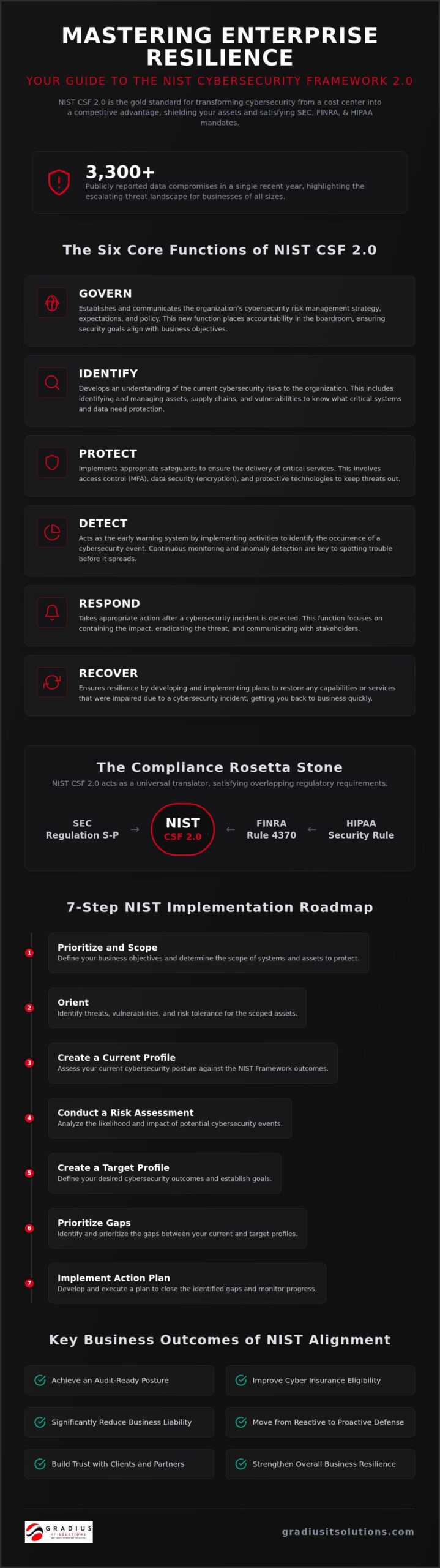
Strategy is everything in 2026. A successful nist cybersecurity framework implementation isn’t a one-and-done project. It’s a continuous cycle of improvement designed to protect your bottom line. The official NIST Cybersecurity Framework 2.0 organizes this lifecycle into six core functions. These functions provide a common language for your team to manage risk effectively. They move your business away from guesswork and toward a structured, defensible security posture that auditors and insurance carriers trust.
Each function plays a specific role in your defense. Govern sets the tone from the top by establishing your strategy and risk tolerance. Identify uncovers exactly what systems and data drive your revenue. Protect builds the safeguards, like multi-factor authentication (MFA) and encryption, to keep threats out. Detect acts as your early warning system, spotting trouble before it spreads. Respond contains the damage when an event occurs. Finally, Recover ensures you can get back to business quickly with immutable backups and tested restoration plans.
Govern and Identify: The Strategic Foundation
The Govern function requires a Written Information Security Policy (WISP). This document isn’t just paperwork for a shelf. It’s a blueprint for how your firm handles sensitive data and meets regulatory demands. A thorough asset inventory is the first step in a realistic nist cybersecurity framework implementation. You can’t protect what you don’t know you have. Our vcio consulting services help you align these technical requirements with your long-term business goals. This ensures your security spend actually supports your growth instead of just being a line-item expense.
Protect, Detect, and Respond: The Operational Shield
Protection starts with Zero Trust principles. We focus on Microsoft 365 hardening and employee awareness training to stop social engineering at the door. But even the best walls need a watchtower. You need 24/7 SOC monitoring to spot anomalies in real time. If a breach occurs, your Incident Response Plan must contain the threat in minutes. Not days. This rapid response is what separates a minor technical hiccup from a business-ending disaster. If you’re ready to see how these functions apply to your specific environment, consider a professional security review to identify your current maturity level.
Mapping NIST CSF to SEC, FINRA, and HIPAA Regulatory Requirements
Think of NIST CSF 2.0 as the “Rosetta Stone” for modern compliance. If your business operates in the financial or healthcare sectors, you’re likely buried under a mountain of overlapping rules. Instead of building separate security programs for every auditor, a strategic nist cybersecurity framework implementation provides a single, unified language. It translates technical controls into the specific evidence required by different regulators. This approach doesn’t just save time. It drastically reduces the risk of conflicting policies that leave your data vulnerable.
The SEC Cybersecurity Rule and the June 3, 2026, compliance deadline for Regulation S-P amendments have raised the stakes. These mandates require covered institutions to maintain written incident response programs and notify individuals within 30 days of a breach. By aligning with the “Respond” and “Recover” functions of NIST, you satisfy these disclosure requirements automatically. Similarly, FINRA Rule 4370 demands a robust business continuity plan. NIST provides the technical backbone for this, ensuring your disaster recovery isn’t just a document on a shelf but a functional shield for your operations. For more practical details on these steps, you can refer to CISA’s implementation guidance.
Compliance-Aware Managed IT for Financial Services
Registered Investment Advisers (RIAs) and wealth managers face unique scrutiny. The SEC’s 2026 examination priorities focus heavily on governance and data loss prevention. A framework-based posture helps you meet these expectations by providing audit-ready documentation. You need to prove your access controls and vendor management are under control. Our expertise in compliance for financial services ensures that your technology stack meets the rigorous demands of FINRA Rule 3110, which holds firms responsible for all technology used in their practice.
NIST as a Framework for HIPAA and Legal Compliance
Healthcare organizations use NIST to protect Protected Health Information (PHI) and satisfy the HIPAA Security Rule. The U.S. Department of Health and Human Services (HHS) even provides a “crosswalk” that maps HIPAA requirements directly to NIST subcategories. This same nist cybersecurity framework implementation also covers you for the NJ SHIELD Act and NY DFS requirements. It’s about efficiency. You can protect PII and PHI through a single set of encryption and access standards. Leveraging compliance as a service allows you to automate the heavy lifting of regulatory reporting. You get back to your business while we handle the technical evidence.
Executing the NIST Implementation Roadmap: A Seven-Step Strategic Process
Moving from theory to action requires a disciplined approach. You don’t need to overcomplicate the process to see immediate results. A successful nist cybersecurity framework implementation follows a logical path that aligns your technical defenses with your business goals. It’s about moving from a state of uncertainty to a state of controlled resilience. This roadmap ensures you aren’t just buying tools; you’re building a defensible security culture.
- Step 1: Prioritize and Scope. Define your business objectives. Identify the high-value assets and data that drive your revenue.
- Step 2: Orient. Identify the specific regulatory requirements and threats facing your industry. This includes SEC mandates or HIPAA rules.
- Step 3: Create a Current Profile. Assess your existing security controls honestly. Don’t sugarcoat the gaps.
- Step 4: Conduct a Risk Assessment. Use professional it risk assessment services to identify vulnerabilities. This step uncovers the hidden risks in your environment.
- Step 5: Create a Target Profile. Define exactly where your security posture needs to be to meet your risk tolerance.
- Step 6: Determine, Analyze, and Prioritize Gaps. Focus on the most critical risks first. You can’t fix everything at once.
- Step 7: Implement Action Plan. Execute the roadmap through managed security services. This is where your nist cybersecurity framework implementation becomes operational.
Schedule your strategic NIST implementation consultation today
Gap Analysis and Cyber-Insurance Readiness
Insurance carriers in 2026 are more selective than ever. They want proof of alignment with recognized frameworks. By completing a gap analysis, you satisfy insurer questionnaires and can often reduce your premiums. You’ll need evidence of multi-factor authentication (MFA), endpoint detection and response (EDR), and immutable backups. Learn how cybersecurity solutions for small business facilitate this process. We help you gather the documentation needed for policy renewal so you stay covered and compliant.
Continuous Improvement: The Framework Core
NIST implementation is a cycle. It’s not a one-time project you finish and forget. Business environments change. Threats evolve. You must conduct annual reviews of your Written Information Security Policies (WISPs) and Incident Response Plans. Regular penetration testing is vital to validate your NIST controls. It ensures your “Detect” and “Respond” functions actually work under pressure. This commitment to continuous improvement is what separates resilient businesses from those that struggle to recover after a breach.
Strengthening Your NIST Posture with Compliance-Aware Managed Security
Managing separate vendors for IT, security, and compliance is a risk you don’t need to take. Gaps in communication between different providers often lead to gaps in your defense. A “Single Accountable Partner” model ensures your nist cybersecurity framework implementation is seamless and airtight. We integrate these three pillars to eliminate the finger-pointing common in traditional IT models. Your cloud environment, network, and regulatory reporting move in lockstep. This unified approach is the only way to maintain a true NIST-aligned fortress in 2026. For executives looking to understand the full spectrum of protection available, our 2026 executive guide to cybersecurity services and business resilience provides a comprehensive breakdown of how modern managed security addresses today’s most critical threats.
Our “Prevent-Instead-React” philosophy is built into every service we provide. We don’t just wait for an alarm to go off. We harden your infrastructure to ensure the alarm never has a reason to sound. This involves continuous Microsoft 365 hardening and turning your cloud environment into a compliant vault. By verifying every login and data access point through Zero Trust principles, we ensure your configuration meets the highest standards for encryption and access control.
Managed Security Operations Center (SOC) and NIST
Achieving the “Detect” and “Respond” functions of the framework requires eyes on your network at all hours. You don’t need an enterprise-level budget to get enterprise-level protection. Our U.S.-based 24/7 SOC monitoring provides the real-time threat intelligence you need to stay ahead of attackers. We don’t just alert you to anomalies; we contain them automatically before they escalate. This rapid response is critical for meeting the strict 30-day notification requirements of SEC Regulation S-P. Explore our cybersecurity services to see how we turn passive monitoring into a proactive shield for your business assets.
Secure AI and the Future of Compliance
The 2026 compliance landscape is increasingly automated. NIST’s release of the Cyber AI Profile highlights the need to address AI-specific risks while leveraging the technology for defense. Our secure ai automation services identify compliance anomalies that human eyes might miss. We use intelligent workflows to automate policy documentation and evidence collection for audits. This significantly reduces the high cost of manual compliance and eliminates human error. Automation ensures your nist cybersecurity framework implementation remains current even as your business scales and threats evolve.
Ready to move beyond technical jargon and secure your company’s future? Schedule a free cybersecurity assessment or technology consultation with Gradius IT Solutions today to build your 2026 NIST roadmap.
Securing Your Business Future with Strategic NIST Alignment
NIST CSF 2.0 is more than a technical standard; it’s your blueprint for survival in a complex 2026 threat environment. We’ve explored how the “Govern” function shifts accountability to the boardroom. We’ve also seen how NIST serves as a universal translator for SEC, FINRA, and HIPAA mandates. By following a seven-step roadmap, you replace operational chaos with a methodical, defensible security posture.
A successful nist cybersecurity framework implementation transforms your compliance burden into a competitive edge. It ensures you’re ready for the next audit and eligible for the best cyber-insurance rates. Our U.S.-based 24/7 SOC monitoring and expert guidance provide the “Detect” and “Respond” capabilities you need to stay protected.
Take the first step toward total resilience today. We provide a free compliance gap analysis and deliver an audit-ready report within one week. You don’t have to manage this complexity alone; we’re here to stand in your corner.
Frequently Asked Questions
What is the NIST Cybersecurity Framework (CSF) 2.0?
NIST CSF 2.0 is the updated version of the standard guidelines released by the National Institute of Standards and Technology to manage and reduce digital risk. This version, released in February 2024, expanded its scope to include all organizations regardless of size or sector. It provides a structured language that helps technical teams and executives talk about security in terms of business outcomes rather than just technical tools.
Is NIST CSF implementation mandatory for small businesses?
How long does it take to implement the NIST framework?
A full implementation typically takes between six and eighteen months depending on your current security maturity and business complexity. It’s not a race to a finish line but a commitment to a continuous cycle of improvement. You can often see significant risk reduction within the first 90 days by focusing on high-priority gaps like multi-factor authentication and incident response planning.
What is the difference between NIST CSF and ISO 27001?
NIST CSF is a flexible, risk-based framework focused on security outcomes, while ISO 27001 is a more rigid, certification-based international standard. NIST is free to use and aligns closely with U.S. federal regulations, making it the preferred choice for many domestic firms. ISO 27001 requires a formal and often expensive audit process to maintain a certificate, which can be overkill for mid-sized businesses.
Can NIST CSF help my business get cyber insurance?
Yes, insurance carriers use NIST categories to evaluate your risk profile and determine your eligibility for coverage. A mature nist cybersecurity framework implementation provides the exact evidence insurers look for during the renewal process. By proving you have functional controls for detection and response, you position your business as a lower risk, which can lead to more favorable premiums and better policy terms.
How much does it cost to align with NIST standards?
Costs vary based on the current state of your technology and the specific controls you need to implement. Your primary investment will be in the managed security services and technical upgrades required to meet the framework’s goals. Most executives find that the cost of proactive alignment is much lower than the expense of a single data breach or the legal fees associated with a regulatory audit.
Does NIST CSF apply to cloud-based businesses using Microsoft 365?
The framework is perfectly suited for cloud environments and modern hybrid work models. You must configure your Microsoft 365 settings to meet NIST’s “Protect” and “Detect” standards. This involves hardening your tenant through conditional access policies, enforcing encryption, and ensuring your cloud data is backed up with immutable copies that are protected from ransomware and accidental deletion.
What is the ‘Govern’ function in NIST CSF 2.0?
The “Govern” function is the newest core pillar that requires leadership to establish a clear cybersecurity strategy and risk tolerance. It ensures that security decisions are made at the executive level rather than being left entirely to the IT department. This function focuses on creating clear policies, identifying legal requirements, and ensuring that every employee understands their role in protecting the organization’s high-value assets.

Article by
Robert Joyce
**Robert Joyce** is the Founder, CEO, and Chief Technology Officer of Gradius IT Solutions, a security first provider of Managed IT Services, Cybersecurity, Cloud, Compliance, and Secure AI solutions serving businesses throughout New Jersey, New York, Connecticut, and across the United States.
With more than 28 years of IT experience, including 23 years supporting hedge funds, global banks, and wealth management firms, Robert has built a career designing and managing secure, resilient, and highly available technology environments where uptime, cybersecurity, and business continuity are essential.
His expertise includes Microsoft 365, cloud computing, cybersecurity, networking, infrastructure, disaster recovery, compliance, virtualization, and strategic IT leadership. Following the events of September 11, Robert helped rebuild critical technology infrastructure for Merrill Lynch, an experience that reinforced the importance of resilience, planning, and operational excellence.
Robert founded Gradius IT Solutions to bring enterprise level technology and security services to small and midsized businesses at a predictable monthly cost. Today, the company delivers fully managed and co managed IT services, cybersecurity, Microsoft 365, cloud solutions, compliance consulting, Secure AI consulting, technology projects, and vCIO services. Through a U.S. based 24/7 Help Desk and a nationwide network of trusted technology partners, Gradius supports organizations across the country with responsive, security focused technology solutions.
Robert partners with business owners and executive leaders to align technology with business goals, reduce risk, strengthen cybersecurity, improve productivity, and create long term IT strategies that support growth. His mission is simple: provide every client with enterprise class technology, exceptional service, and a trusted advisor they can rely on as their business evolves.
Disclaimer
## Disclaimer
The information provided in this article is for general informational and educational purposes only and should not be considered professional IT, cybersecurity, legal, regulatory, or compliance advice. While Gradius IT Solutions strives to provide accurate and up to date information, technology, security threats, and regulatory requirements change frequently, and we cannot guarantee that all information will remain current or applicable to your specific situation.
Every organization has unique technology, security, compliance, and business requirements. Before implementing any recommendations discussed in this article, you should evaluate their suitability for your environment or consult with a qualified technology professional.
Gradius IT Solutions makes no warranties, express or implied, regarding the completeness, accuracy, reliability, or results obtained from the use of this information. Any actions you take based on this content are at your own risk. Gradius IT Solutions shall not be liable for any direct, indirect, incidental, or consequential damages arising from the use of, or reliance upon, the information contained in this article.
References to third party products, services, or vendors are provided for informational purposes only and do not constitute an endorsement unless explicitly stated.
If you would like guidance tailored to your organization, contact Gradius IT Solutions to schedule a consultation with one of our technology experts.