

In 2026, the traditional “check-the-box” audit is officially dead. Regulators like the SEC and NYDFS now demand continuous proof of security, making soc as a service for compliance a necessity rather than a luxury. For many firms, the June 3 deadline for the amended Regulation S-P feels like a countdown to a potential disaster. You’re likely juggling overwhelming regulatory complexity while trying to find security talent that’s either unavailable or far too expensive. It’s a high-stakes environment where a single missed alert leads to a mandatory breach notification within four business days.
This guide reveals how a managed SOC provides the documented evidence and continuous monitoring required to pass audits with confidence. You don’t have to build a multi-million dollar internal team to achieve 24/7 visibility across your environment. We’ll break down the shift toward NIST CSF 2.0 standards, discuss how to optimize your Microsoft 365 security posture, and show you how to reduce business risk through constant prevention. You’ll discover how to transform compliance from a periodic burden into a permanent strategic advantage that protects your bottom line and your reputation.
Key Takeaways
- Transform compliance from a high-stress annual event into a continuous, automated process that keeps your business audit-ready at all times.
- See how soc as a service for compliance bridges the gap between technical security controls and the rigorous documentation required by the SEC, FINRA, and HIPAA.
- Evaluate the strategic benefits of a managed Security Operations Center compared to the high cost and complexity of building an internal team.
- Learn to identify the essential features of a modern SOC, from AI-powered threat detection to seamless integration with your existing Microsoft 365 environment.
- Adopt a “prevent-instead-react” philosophy that stops breaches before they happen, effectively lowering your organizational risk and protecting your reputation.
What is SOC as a Service for Compliance?
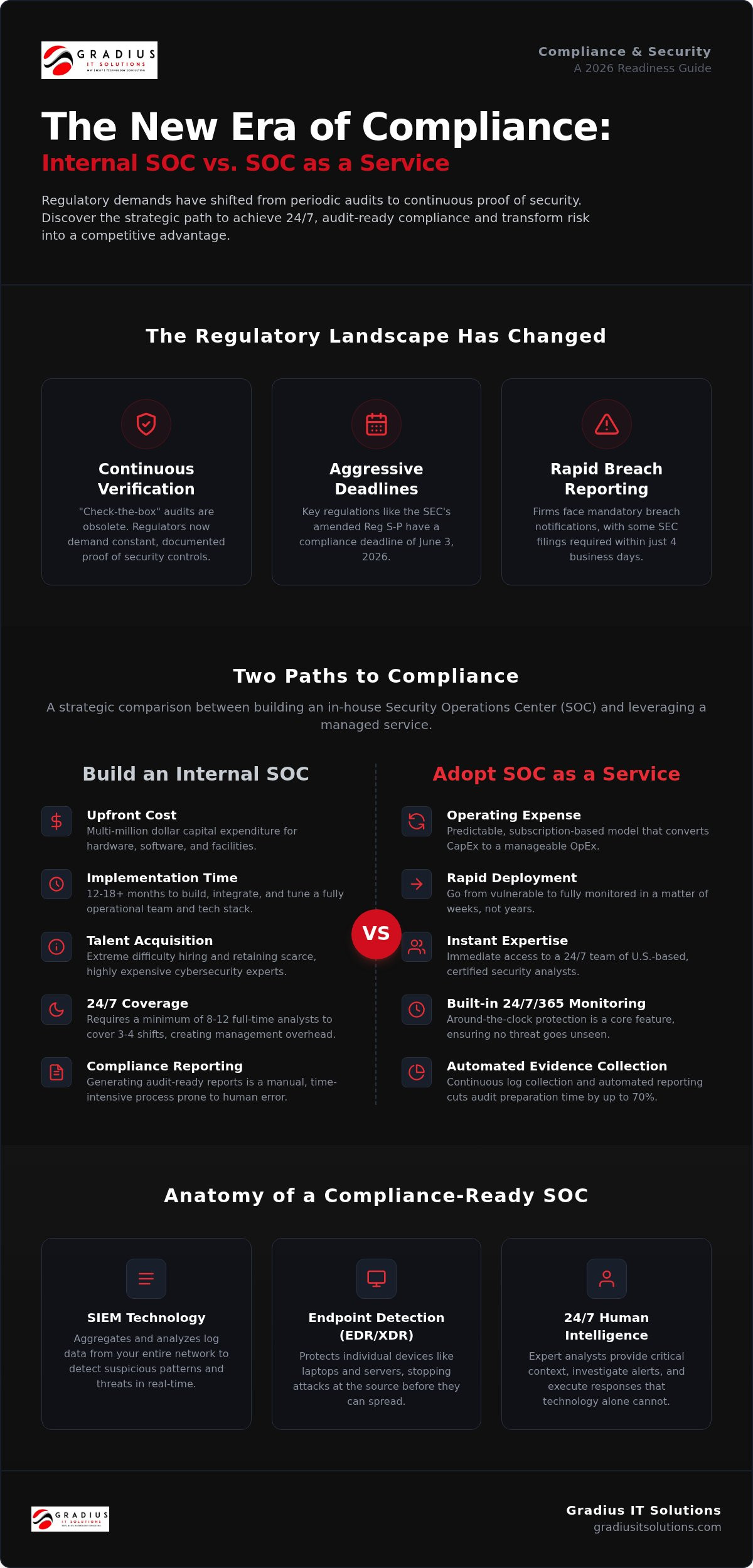
A Security Operations Center (SOC) is the command center of your digital defense. It provides the 24/7 monitoring, detection, and response capabilities that are now non-negotiable for modern regulatory standards. Using soc as a service for compliance allows your firm to access this enterprise-grade protection through a predictable subscription model. It eliminates the need for massive capital expenditure on hardware or specialized staff. Think of SOCaaS as the externalized eyes and ears of your firm’s regulatory defense.
In 2026, simply keeping logs is no longer a defense. Auditors now look for evidence of active oversight. If a threat enters your network at 2:00 AM on a Sunday, a static log file won’t stop it. You need a system that identifies the intrusion, isolates the threat, and documents the entire event in real-time. This shift from reactive IT to proactive security is what separates firms that pass audits from those that face heavy penalties. This is why many firms are moving toward Compliance as a Service to unify their security and regulatory needs.
The Core Components of a Compliance-Ready SOC
A robust SOC isn’t just a piece of software; it’s an integrated ecosystem designed for total visibility. It must protect every layer of your business to satisfy modern auditors.
- SIEM (Security Information and Event Management): This is the central brain that aggregates logs from your entire network, including Microsoft 365 environments, to find patterns of suspicious behavior.
- EDR/XDR (Endpoint Detection and Response): These tools protect the specific devices where your sensitive data lives, providing a layer of defense that stops attacks at the source.
- Human Intelligence: Technology can’t do it all. Our 24/7 U.S.-based analysts provide the critical context and decision-making skills needed to stop sophisticated threats.
From Periodic Audits to Continuous Monitoring
Traditional audits are snapshots of a single moment in time. They offer no guarantee of security the day after the auditor leaves. Using soc as a service for compliance transforms this process into a continuous movie of your security posture. It provides the “audit trail” required by modern regulations like the SEC’s amended Regulation S-P or HIPAA. You’re always ready for an inspection, not just once a year.
Real-time threat intelligence allows you to meet the proactive requirements of 2026 regulations by proving you are actively hunting for risks. Automated reporting is a major part of this advantage. By consistently collecting evidence of your security controls, you can reduce audit preparation time by up to 70%. This efficiency turns a month-long compliance headache into a streamlined process that supports your business growth.
Mapping SOC Capabilities to Regulatory Requirements
Writing a policy is easy. Proving you follow it every second of every day is the hard part. Regulators in 2026 aren’t interested in your “best efforts.” They want documented proof of detection and response. This is where soc as a service for compliance becomes your most valuable asset. It creates the digital paper trail that auditors demand while giving you the peace of mind that your network is actually secure.
The CISA on SOCaaS guidance highlights how externalized monitoring provides consistent security posture management across an organization. For small and mid-sized firms, this means enterprise-level oversight without the enterprise-level price tag. It also helps satisfy the increasingly strict requirements of cyber insurance providers. Many insurers now mandate 24/7 endpoint monitoring and multi-factor authentication (MFA) as a baseline for coverage.
SEC and FINRA Compliance for Financial Services
The regulatory environment for finance has never been more aggressive. Under the amended Regulation S-P, smaller firms must comply by June 3, 2026. This includes a strict 30-day notification window for data breaches. If an incident is deemed material, the SEC requires a Form 8-K filing within just four business days. A managed SOC ensures you meet these deadlines by identifying “material” events as they happen. It also supports cybersecurity for financial advisors and RIAs by maintaining immutable logs. These logs prove that your data integrity remained intact during a crisis, satisfying FINRA Rule 4370 requirements for business continuity and disaster recovery.
HIPAA and Healthcare Data Protection
In healthcare, the HIPAA Security Rule requires constant vigilance over Protected Health Information (PHI). You must be able to detect and respond to unauthorized access in real-time, not weeks after the fact. A compliance-aware SOC monitors user behavior within your Microsoft 365 environment to flag unusual file downloads or logins from unrecognized locations. This level of HIPAA compliance for healthcare protects patient trust and prevents the massive fines seen in recent years. If you’re unsure if your current setup meets these 2026 standards, it might be time for a professional cybersecurity assessment to identify your hidden gaps.
Internal SOC vs. SOC as a Service: A Strategic Comparison
Building an in-house Security Operations Center is a massive undertaking. It isn’t just about software. It’s about people. The “Talent Gap” is real. Finding qualified security analysts is hard. Keeping them is harder. For a small to mid-sized firm, the cost of a full 24/7 rotation is often prohibitive. Choosing soc as a service for compliance solves this by providing immediate access to a team that is already trained and operational. You get enterprise-grade protection without the hiring headache.
Even the government recognizes this shift. According to the Federal Perspective on SOCaaS, the drive toward externalized security is fueled by the need for specialized skills and the pressure of strict mandates. Most businesses face “Technology Fatigue.” They buy too many disconnected security tools but lack the time to manage them. This leads to alert blindness. You end up with a dashboard full of red lights and no clear path to resolution. A managed SOC unifies these tools, including your Microsoft 365 Security logs, into a single pane of glass.
The True Cost of a DIY Security Operations Center
A DIY approach has hidden traps. Software licenses and hardware are just the beginning. You must also account for the ongoing operational burden that drains your internal resources. These hidden expenses include:
- Continuous training for staff to combat 2026 AI-driven threats.
- High turnover costs in a competitive security job market.
- Redundant infrastructure to ensure the SOC itself stays online during an outage.
Then there is the “3 AM Gap.” Many internal teams claim to be 24/7 but rely on “on-call” staff. On-call isn’t active monitoring. If a breach happens at midnight, you need someone already watching the screen. Outsourcing moves these unpredictable capital expenses into a flat, predictable monthly rate. It’s the most efficient way to follow The Executive Guide to Managed IT Services principles for business resilience.
Leveraging the ‘Single Accountable Partner’ Model
Separating your IT provider from your security provider creates friction. When an incident occurs, the “blame game” starts. The security team blames the network. The network team blames the software. This delay is dangerous. We combine these functions into a unified SOC and Network Operations Center (NOC) approach. You get a single accountable partner. One team sees the threat. The same team stops it. This synergy makes soc as a service for compliance more than just a checkbox. It makes it a strategic extension of your leadership team. We handle the technical burden so you can focus on growth.
Critical Features of a Compliance-Aware SOC in 2026
If your current security strategy relies on a generic dashboard, you’re falling behind. Mid-market firms in 2026 require a specialized engine that understands the nuances of regulatory pressure. Effective soc as a service for compliance must do more than just flag anomalies; it must categorize them according to their impact on your specific regulatory framework. We’ve seen a massive shift toward AI-driven compliance. This technology automates the tedious evidence collection process, ensuring that when an auditor asks for proof, it’s already waiting for them.
Zero Trust principles are no longer optional. Your SOC monitoring strategy must assume every user or device is a potential risk until proven otherwise. This requires deep integration with your Microsoft 365 environment to track identity and access patterns. By combining these modern security architectures with Compliance as a Service (CaaS), you create a defensive shield that regulators respect. It’s about moving from a reactive posture to a “prevent-instead-react” philosophy that stops threats before they manifest as breaches.
24/7 U.S.-Based Monitoring and Incident Response
Regulated data requires a high level of trust. This is why 24/7 U.S.-based monitoring is essential. Our analysts have the local expertise and background to handle sensitive data under SEC or HIPAA jurisdiction. We operate in a parallel observation mode. This means we watch your network constantly without slowing down your business flow or causing downtime. Rapid containment is the goal. We stop a breach in its tracks before it escalates into a mandatory, reportable event. Under the 2026 SEC rules, you only have four business days to report material incidents. You can’t afford to waste three of them figuring out what happened.
Integrated Audit Support and Documentation
The best SOC doesn’t just protect you; it documents that protection. You need automatic generation of compliance reports tailored for SEC, FINRA, or HIPAA audits. This includes maintaining your Written Information Security Policy (WISP) and conducting annual reviews to ensure everything stays current. This documentation is also a powerful financial tool. When it’s time for Cyber Insurance renewals, providing documented proof of your security controls can significantly reduce your premiums. It proves you are a lower risk, which directly impacts your bottom line and improves your business resilience.
Schedule your 24/7 cybersecurity assessment today.
Partnering with Gradius for Managed Security and Compliance
Compliance is a moving target. In 2026, you can’t afford a partner who only shows up when something breaks. You need an advocate who anticipates threats and removes the burden of regulatory oversight from your shoulders. Gradius IT Solutions provides soc as a service for compliance specifically designed for firms with 5 to 200 employees. We believe that smaller organizations deserve the same enterprise-grade protection as global corporations. Our Gradius Guarantee ensures your security posture is robust, documented, and audit-ready at all times.
Our “Prevent-Instead-React” philosophy is the foundation of everything we do. We don’t just wait for an alarm to go off; we actively hunt for vulnerabilities before they can be exploited. This proactive stance includes deep Microsoft 365 hardening. Most firms already pay for advanced security features within their Microsoft subscriptions but leave them unconfigured. We leverage the tools you already own to build a layered defense that satisfies both regulators and cyber-insurance providers. It’s a smarter way to manage risk without unnecessary spending.
The Gradius IT Solutions Difference
We act as your single accountable partner for both IT management and cybersecurity. This eliminates the friction and finger-pointing that often happens when multiple vendors are involved. Our U.S.-based 24/7 SOC and Help Desk staff are always available. You won’t deal with outsourced communication barriers or delayed response times. Beyond technical monitoring, we provide strategic leadership. Our Cybersecurity Services Pillar model includes vCISO and vCIO guidance. We help you plan for the future, ensuring your technology stack supports your growth while maintaining strict compliance with SEC, FINRA, or HIPAA standards.
Next Steps: Your Free Cybersecurity Assessment
The first step toward continuous audit readiness is knowing exactly where you stand. We offer a 30-minute cybersecurity assessment that focuses on your compliance gaps and cyber-insurance readiness. This isn’t a high-pressure sales pitch. It’s a professional consultation designed to provide immediate value. We’ll look at your current controls, identify hidden risks, and discuss your business goals. Within one week of the assessment, we deliver a comprehensive written report. This document provides a clear roadmap to improve your security and resilience. You’ll have the facts you need to make informed decisions about your firm’s future.
Schedule your free IT & Cybersecurity Assessment today
Command Your Compliance Strategy
The regulatory landscape of 2026 demands more than just basic security. It requires a relentless commitment to visibility and documented proof. By integrating soc as a service for compliance, you replace the chaos of manual reporting with the precision of 24/7 U.S.-based SOC operations. This transition doesn’t just satisfy the SEC or HIPAA. It builds a resilient foundation for your entire organization and protects your hard-earned reputation.
You now understand that building an internal team is often a costly distraction compared to a managed model. You’ve seen how leveraging your existing Microsoft 365 tools can harden your environment without inflating your budget. Most importantly, you know that a single accountable partner is the key to stopping threats before they become reportable incidents. Our specialized expertise for RIAs and wealth managers ensures your firm stays ahead of every mandate.
Our free gap analysis and cyber-insurance readiness review provide the clarity you need to move forward with confidence. Don’t let regulatory complexity stall your momentum.
Schedule Your Free IT & Cybersecurity Assessment
You deserve a partner who stands firmly in your corner. Take the first step toward total audit readiness today.
Frequently Asked Questions
Is SOC as a Service required for HIPAA compliance?
HIPAA doesn’t explicitly mandate the term “SOC as a Service,” but it does require continuous monitoring of access to Protected Health Information (PHI). Using soc as a service for compliance ensures you meet these technical safeguards without hiring a massive internal security team. It provides the audit logs and real-time alerts needed to satisfy the HIPAA Security Rule. This proactive oversight protects patient trust and prevents the heavy penalties associated with undetected breaches.
Can SOCaaS help my firm pass an SEC cybersecurity audit?
Yes, our managed SOC is designed to meet the rigorous evidence requirements of an SEC cybersecurity audit. We provide the immutable logs and incident response documentation required under the 2026 amended Regulation S-P. This includes identifying material incidents within the mandatory four-day reporting window. Having a SOC in place proves to auditors that your firm maintains active, continuous oversight of its digital environment and Microsoft 365 security posture.
What is the difference between an MSP and a SOC provider?
A traditional Managed Service Provider (MSP) handles daily IT needs like helpdesk and server maintenance, while a SOC provider focuses on security monitoring. Gradius IT Solutions acts as a single accountable partner by combining both functions. We provide 24/7 NOC and SOC coverage alongside strategic vCIO consulting. This unified approach eliminates the friction and finger-pointing that often occurs when a firm tries to manage separate IT and security vendors.
How does a managed SOC help with cyber insurance premiums?
Managed SOC services help lower cyber insurance premiums by providing documented proof of the security controls insurers demand. Most policies now require 24/7 endpoint monitoring and rapid incident response capabilities as a baseline for coverage. By providing evidence of these active controls, you position your firm as a lower risk. This often leads to more favorable premium rates and ensures you meet the strict eligibility requirements for comprehensive coverage limits.
Will a SOC as a Service provider handle my incident response plan?
Yes, we provide the documentation and the team to execute your incident response plan. Gradius drafts and maintains your Written Information Security Policy (WISP) and your Incident Response Plan (IRP) as part of our core offering. These documents are reviewed annually to stay current with 2026 regulations. When a threat is detected, our SOC follows these pre-approved protocols to contain the incident quickly, often before it disrupts your business operations.
Does Gradius IT Solutions support firms outside the Tri-State area?
Yes, Gradius IT Solutions provides comprehensive support to firms across the United States. While we have a physical presence in certain areas, our nationwide network of strategic MSP partners ensures seamless coverage from coast to coast. This allows us to deliver consistent, high-level security and compliance support to wealth managers and healthcare providers regardless of their location. You receive the same 24/7 U.S.-based SOC monitoring and expert technology consulting everywhere.
How quickly can a managed SOC detect a ransomware attack?
Detection often happens in real-time, typically within seconds or minutes of an initial intrusion. Modern ransomware moves fast, so your defense must be faster. Our SOC uses advanced EDR and XDR technology to identify unauthorized encryption patterns or unusual data movement immediately. Because we operate with a “prevent-instead-react” philosophy, we can isolate a compromised device and stop the attack before it spreads to your backups or other sensitive network segments.
Is my data safe when being monitored by a third-party SOC?
Yes, your data is safe because we use parallel observation mode to monitor security events without moving your files. We only see the metadata and logs required to identify threats, so your sensitive client data never leaves your environment. Our U.S.-based analysts follow strict privacy protocols to ensure your information remains secure. This setup allows you to benefit from enterprise-grade security monitoring while maintaining total control over your sensitive corporate data.

Article by
Robert Joyce
**Robert Joyce** is the Founder, CEO, and Chief Technology Officer of Gradius IT Solutions, a security first provider of Managed IT Services, Cybersecurity, Cloud, Compliance, and Secure AI solutions serving businesses throughout New Jersey, New York, Connecticut, and across the United States.
With more than 28 years of IT experience, including 23 years supporting hedge funds, global banks, and wealth management firms, Robert has built a career designing and managing secure, resilient, and highly available technology environments where uptime, cybersecurity, and business continuity are essential.
His expertise includes Microsoft 365, cloud computing, cybersecurity, networking, infrastructure, disaster recovery, compliance, virtualization, and strategic IT leadership. Following the events of September 11, Robert helped rebuild critical technology infrastructure for Merrill Lynch, an experience that reinforced the importance of resilience, planning, and operational excellence.
Robert founded Gradius IT Solutions to bring enterprise level technology and security services to small and midsized businesses at a predictable monthly cost. Today, the company delivers fully managed and co managed IT services, cybersecurity, Microsoft 365, cloud solutions, compliance consulting, Secure AI consulting, technology projects, and vCIO services. Through a U.S. based 24/7 Help Desk and a nationwide network of trusted technology partners, Gradius supports organizations across the country with responsive, security focused technology solutions.
Robert partners with business owners and executive leaders to align technology with business goals, reduce risk, strengthen cybersecurity, improve productivity, and create long term IT strategies that support growth. His mission is simple: provide every client with enterprise class technology, exceptional service, and a trusted advisor they can rely on as their business evolves.
Disclaimer
## Disclaimer
The information provided in this article is for general informational and educational purposes only and should not be considered professional IT, cybersecurity, legal, regulatory, or compliance advice. While Gradius IT Solutions strives to provide accurate and up to date information, technology, security threats, and regulatory requirements change frequently, and we cannot guarantee that all information will remain current or applicable to your specific situation.
Every organization has unique technology, security, compliance, and business requirements. Before implementing any recommendations discussed in this article, you should evaluate their suitability for your environment or consult with a qualified technology professional.
Gradius IT Solutions makes no warranties, express or implied, regarding the completeness, accuracy, reliability, or results obtained from the use of this information. Any actions you take based on this content are at your own risk. Gradius IT Solutions shall not be liable for any direct, indirect, incidental, or consequential damages arising from the use of, or reliance upon, the information contained in this article.
References to third party products, services, or vendors are provided for informational purposes only and do not constitute an endorsement unless explicitly stated.
If you would like guidance tailored to your organization, contact Gradius IT Solutions to schedule a consultation with one of our technology experts.