

Completing a cutover isn’t the finish line of IT modernization; it’s simply where your true operational exposure begins. Achieving dependable server migration and management requires far more than moving virtual disks and hoping services reconnect cleanly. You already know the acute stress surrounding migration day: the looming dread of unplanned downtime halting business operations, corrupted databases during cutover, and an internal staff that lacks the bandwidth to patch, monitor, and safeguard workloads 24/7 once live.
Treating migration as an isolated project leaves your critical systems vulnerable to severe performance bottlenecks and compliance lapses. True operational resilience demands continuous, proactive lifecycle governance. This strategic playbook delivers the exact framework you need to master server migration and management, ensuring zero data loss, predictable post-migration baseline performance, and unyielding data protection. Ahead, we will walk through the pre-flight workload assessments, fail-safe cutover protocols, and ongoing monitoring practices required to keep your infrastructure secure, compliant, and operating at peak performance.
Key Takeaways
- Comprehensive pre-migration dependency mapping pinpoints hidden database links and third-party integrations, preventing unexpected operational failures before cutover begins.
- Continuous delta synchronization protects production environments, enabling zero-data-loss transfers without forcing your organization into prolonged offline maintenance windows.
- Adopting a structured lifecycle approach to server migration and management turns cutover milestones into stable, predictable long-term baselines.
- Post-migration resilience relies on proactive operational hygiene, pairing automated vulnerability scanning with continuous performance baselining to preempt emerging security threats.
- Consolidating migration execution and ongoing monitoring under a single accountable technology partner eliminates vendor friction and enforces enterprise-grade compliance controls.
Why Strategic Server Migration and Management Dictates Business Resilience
Server migration transfers vital data, operating systems, and business-critical software between physical machines or virtual cloud instances. Yet treating this transition as a simple digital moving day invites disaster. Hardware degrades, unpatched legacy operating systems harbor severe security flaws, and unchecked background workloads cause compounding latency. Without active governance, infrastructure crumbles silently until a sudden outage halts customer billing or enterprise operations.
Operational continuity requires proactive stewardship instead of reactive fire-drill troubleshooting. Modern infrastructure leaders design every data migration process to safeguard critical assets while establishing baseline controls that ensure predictable long-term performance.
To see standard system-level utilities in action before planning complex workload shifts, watch this helpful walkthrough:
The Hidden Operational Costs of Aging Server Hardware
Running legacy servers past their useful lifecycle creates severe financial drag. Aging components face escalating hardware failure rates and exorbitant third-party maintenance contracts. Meanwhile, unpatchable operating systems leave exposed network ports that bypass modern endpoint protection. Outdated compute resources also choke day-to-day employee output, creating invisible bottlenecks across line-of-business software that drain organizational productivity.
Defining Modern Server Lifecycle Governance
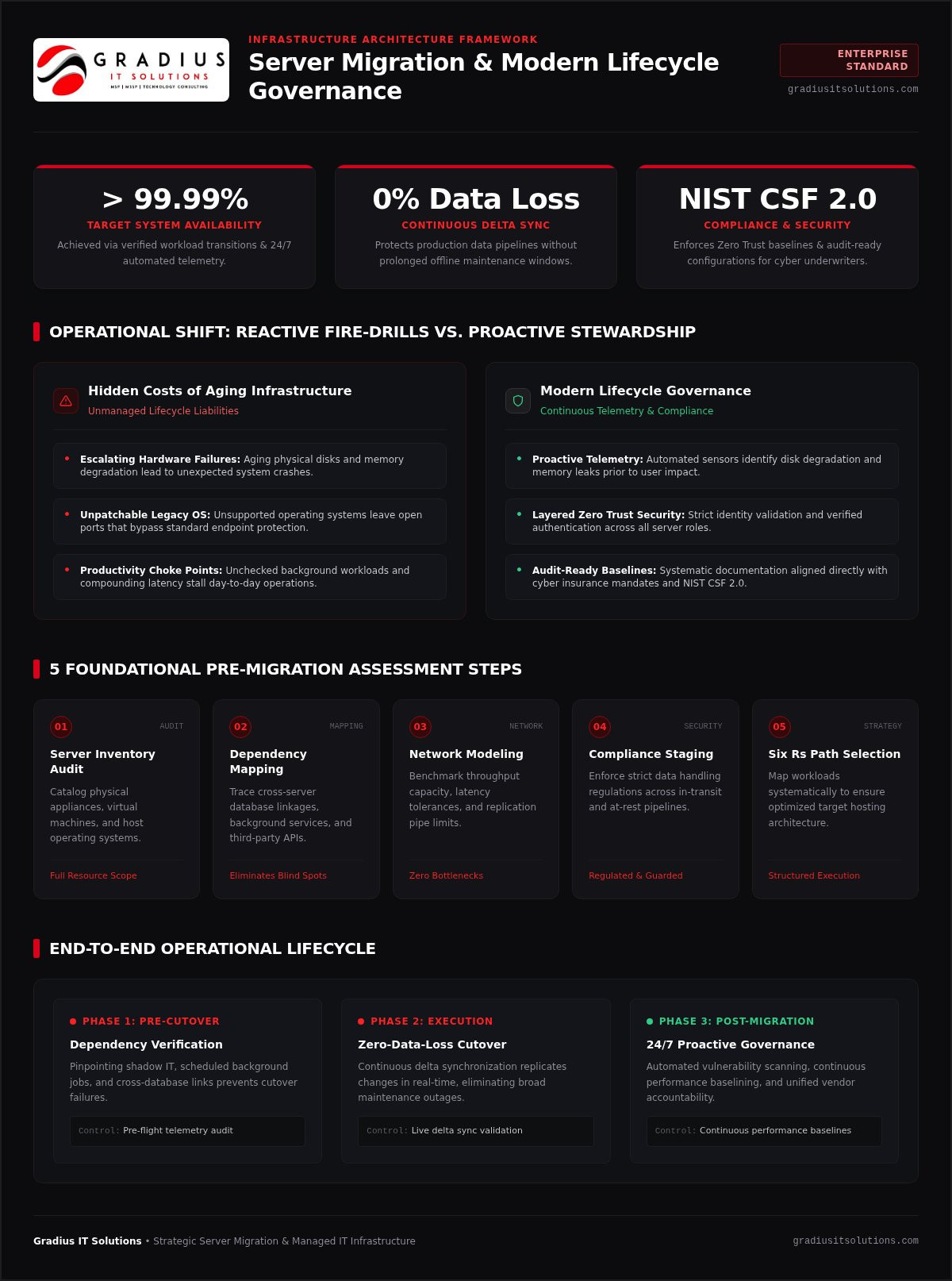
Modern lifecycle governance trades guesswork for continuous, automated telemetry that detects disk degradation, memory leaks, and performance anomalies before users submit tickets. For organizations facing stringent oversight, this discipline aligns directly with cybersecurity insurance mandates and core frameworks like the NIST Cybersecurity Framework 2.0. Integrating these standards with professional managed IT services gives leadership verifiable control over every asset.
True server migration and management delivers continuous system availability above 99.99% by synchronizing verified workload transitions with automated, 24/7 telemetry and proactive operational patching.
- Proactive oversight: Continuous telemetry detects underlying bottlenecks before systems fail.
- Layered security baselines: Zero Trust principles ensure every server role enforces verified authentication.
- Regulatory compliance: Documented configurations keep systems audit-ready for cyber underwriters and regulators alike.
Pre-Migration Assessment: Architecting Workloads for Minimal Downtime
Discovery is the difference between an orderly transition and an operational standstill. Executing an enterprise-grade server migration and management roadmap requires methodical pre-flight engineering. Before copying a single block of data, organizations must execute five foundational assessment steps:
- Server inventory audit: Catalog every physical appliance, virtual machine, and host OS.
- Dependency mapping: Trace cross-server database linkages, background services, and API hooks.
- Network capacity modeling: Benchmark network throughput, latency tolerances, and replication bandwidth.
- Compliance control staging: Enforce data handling rules for transit and storage pipelines.
- Migration path selection: Map every workload against the structured Six Rs framework.
Workload and Interdependency Discovery Mapping
Automated discovery tools pinpoint active virtual machines, but they frequently overlook shadow IT, scheduled background scripts, and hardcoded legacy database connections. Grouping interconnected applications into verified operational tiers prevents sudden application breaks when dependent services move across subnet boundaries. Aligning these groupings with a clear cloud migration strategy guarantees database connectors and local services maintain uninterrupted communication throughout staggered cutovers.
Evaluating Migration Paths: The Six Rs Applied
Workloads rarely share the same operational destiny. Rehosting (lift-and-shift) moves workloads quickly with zero architectural modifications. Replatforming swaps underlying components, such as adopting cloud-managed databases, without rewriting core application logic. Refactoring modernizes critical software into cloud-native architectures for maximum elasticity—an effort where engineering firms like The Code Factory can assist with production readiness reviews and code remediation to stabilize complex applications. For legacy platforms, Retiring obsolete workloads frees compute resources, while Retaining stable, air-gapped systems often minimizes unnecessary operational disruption.
Compliance Baselines and Data Security Auditing
Most public migration guides ignore compliance during transit, creating immense legal liability. Regulations like HIPAA, FINRA, and updated SEC cybersecurity rules mandate written safeguards and strict oversight for sensitive records while moving across networks. Migration pipelines must enforce TLS 1.3 encryption across all replication pathways, paired with strict Role-Based Access Control (RBAC) and immutable audit logging. Adhering to verified server management best practices protects sensitive records and simplifies eventual insurer audits. If you need clarity on your regulatory readiness before moving production assets, booking a brief infrastructure consultation with Gradius IT Solutions confirms your target architecture meets every mandatory standard.
Execution Phase: Zero-Data-Loss Cutover Strategies and Risk Mitigation
The cutover window is where theory meets reality. A clumsy cutover can paralyze operations for days, while an engineered cutover reduces business disruption to mere seconds. High-stakes server migration and management depends on continuous delta synchronization. By streaming transactional and block-level updates in the background while users work, your technical team shrinks the final cutover window down to a brief, predictable event.
Cutover Methodologies: Phased Migration vs. Big Bang
A Big Bang cutover flips an entire infrastructure environment over a single weekend. While it eliminates running parallel platforms, it concentrates catastrophic risk into a single blast radius. If one integration fails, the entire company stalls. Phased migrations systematically isolate workloads into sequenced waves. Core database engines run in parallel with legacy hosts until performance checks pass. System administrators drop DNS Time-to-Live (TTL) values days beforehand, allowing client routing to shift smoothly to new hosts without network delays.
Establishing Immutable Backups and Rollback Safeguards
Never pull the trigger on a live cutover without an unassailable rollback point. Before running the final delta sync, take an isolated, immutable backup snapshot of all production databases and virtual disks. This immutable copy guarantees protection against corruption, sync drift, or unexpected system lockouts. Establish explicit rollback triggers in advance: if core services remain unresponsive after 120 minutes, abort immediately. Reviewing structured business continuity frameworks gives leadership the objective Recovery Point and Recovery Time parameters required to make that call without hesitation.
Post-Cutover Validation and User Acceptance Testing
The moment traffic routes to the target environment, structured validation begins. Synthetic transactions should immediately simulate database read and write cycles, stress test queries, and verify third-party API payloads. System engineers verify Active Directory sync, user access policies, and endpoint security agents to confirm Zero Trust standards remain intact. Finally, establish a dedicated rapid-response triage channel so departmental managers can report localized issues before they disrupt company-wide productivity.
Ongoing Server Management: Proactive Maintenance and 24/7 Operations
Completing a cutover is just the opening move. Sustainable server migration and management centers on what engineers call “Day-2 operations,” the disciplined, continuous upkeep required to keep production workloads performant and resilient. Many organizations invest heavily in migration planning only to let their newly minted environments decay through neglected updates and reactive administration. Infrastructure health demands continuous, automated hygiene.
Proactive Patch Management and Vulnerability Remediation
Modern vulnerability management is a deliberate balancing act. Applying emergency security updates protects against active exploits, but deploying untested patches directly to live production servers risks severe software crashes. A mature maintenance workflow routes critical updates through isolated staging environments first. Once stability is verified across core business applications, patches roll out systematically to production hosts. This structured deployment process also creates the verifiable audit logs cyber insurance underwriters require before binding or renewing coverage.
24/7 NOC Telemetry, Log Auditing, and SOC Integration
Basic server uptime checks offer false comfort. A green ping status won’t reveal runaway memory leaks, failing disk arrays, or saturation across storage queues. Modern operations require deep telemetry monitoring that flags resource exhaustion long before users encounter degraded software response times. Feeding system logs into a dedicated Security Operations Center (SOC) turns isolated error alerts into actionable threat intelligence. Discover how our 24/7 NOC and SOC monitoring protects critical server environments around the clock.
Disaster Recovery Testing and Backup Verification
A backup is merely an unverified assumption until it survives a live restoration test. Resilient server management incorporates automated, recurring recovery drills that validate both file-level recoveries and complete bare-metal restorations. These exercises produce documented evidence confirming your business meets its target Recovery Time Objectives (RTO) and Recovery Point Objectives (RPO). Storing encrypted, immutable off-site copies ensures that even if ransomware compromises active domain controllers, your clean data remains entirely out of reach.
Structuring an Enterprise-Grade Server Infrastructure with Gradius IT Solutions
Executing high-stakes infrastructure changes requires specialized capability that few internal IT departments possess in-house. Routine administrative tasks keep daily operations functional, but migrating complex, multi-tiered workloads introduces architectural risks that demand battle-tested engineering. Partnering with an experienced provider transforms server migration and management from a high-stress operational hazard into an engine for business growth.
The Single Accountable Partner Advantage
When an application underperforms following a cutover, disjointed vendors routinely blame one another. Hosting hosts blame the software developers, while software developers fault local network firewalls. That finger-pointing stalls business operations and burns executive time. Consolidating infrastructure administration, cybersecurity, and regulatory controls under a single accountable team eliminates that ambiguity entirely.
Whether your organization needs turnkey project delivery or a co-managed partnership to relieve overextended internal staff, Gradius IT Solutions bridges the technical divide. Our comprehensive managed IT services combine around-the-clock NOC telemetry, SOC oversight, Zero Trust security controls, and verified disaster recovery workflows to protect your production workloads from day one.
Strategic Technology Planning and vCIO Alignment
Infrastructure architecture should never sit in isolation from executive goals. Strategic virtual Chief Information Officer (vCIO) guidance connects compute capacity, cloud storage thresholds, and licensing cycles directly to organizational headcount projections and expansion plans. This strategic alignment replaces emergency hardware replacements and surprise cloud bills with predictable, structured technology roadmaps that protect capital reserves.
Approaching server migration and management as an ongoing strategic priority gives leadership predictable baseline performance, verified operational resilience, and seamless regulatory compliance. Take the uncertainty out of your next infrastructure milestone. Contact Gradius IT Solutions today to schedule a complimentary 30-minute IT assessment and evaluate your environment alongside our senior technology consultants.
Transform Infrastructure Complexity Into Long-Term Operational Resilience
Modernizing your core workloads shouldn’t trigger operational paralysis or late-night troubleshooting fire drills. Lasting business resilience pairs methodical dependency mapping and zero-downtime delta synchronization with disciplined post-cutover hygiene. When you treat server migration and management as an ongoing strategic lifecycle rather than an isolated IT chore, you safeguard mission-critical data, maintain peak application baselines, and shield your bottom line.
Achieving that standard becomes straightforward with dedicated technical specialists in your corner. Gradius IT Solutions protects your production environments with U.S.-based 24/7 NOC and SOC monitoring, verified compliance workflows tailored for regulated sectors, and a comprehensive cyber-insurance readiness review that eliminates audit surprises.
Elevate your infrastructure today, and give your organization the reliable, high-performing backbone it needs to scale with confidence.
Frequently Asked Questions
How much business downtime occurs during an enterprise server migration?
Modern server migrations typically require near-zero downtime, often limited to just a few scheduled minutes during final DNS cutover. Technical teams use continuous delta replication to stream data blocks in the background while staff work uninterrupted. The only disruption occurs when shifting network routing from the legacy host to the destination. Scheduling that final switch during off-peak hours protects active business operations completely.
Can legacy line-of-business software migrate seamlessly into modern cloud environments?
Yes, legacy software can migrate successfully, provided the underlying system dependencies and database architectures are mapped out beforehand. Specialized runtime frameworks or hardcoded local paths might prevent native cloud execution. In those scenarios, hybrid architectures, secure remote application streaming, or containerized lift-and-shift techniques preserve critical workflows without forcing you to replace functioning business tools.
What is the difference between server migration and simple data backup?
A data backup merely stores static copies of raw files and databases for disaster recovery purposes. Complete server migration and management transfers running operational systems, active software installations, user access directories, and security configurations to new hardware or cloud environments. Backups safeguard stored information; migrations relocate your functional computing infrastructure so business operations continue without rebuilding systems from scratch.
How do managed IT service providers protect server data during the transition?
Providers protect your data through end-to-end encryption, strict role-based access controls, and verified immutable pre-flight snapshots. Before data pipelines open, engineers isolate the original workloads and capture baseline copies that cannot be altered or overwritten. Workload transfers travel exclusively across encrypted network tunnels, ensuring customer records remain compliant with strict regulatory standards like HIPAA and SEC rules throughout transit.
What happens if a server migration encounters unexpected software incompatibilities?
Structured cutover plans incorporate fail-safe rollback procedures that redirect network traffic back to the original operational environment without data loss. Technical teams establish strict time limits and testing checkpoints. If deep validation testing detects application crashes, corrupted database linkages, or missing permissions, systems immediately revert to the original host. Engineers then resolve the issue within an isolated sandbox before rescheduling.
Why is ongoing server management necessary after successfully migrating to the cloud?
Cloud providers maintain physical hypervisors and facilities, but your organization remains entirely responsible for operating systems, identity permissions, application updates, and data security. Ongoing server migration and management prevents configuration drift, software bloat, and unpatched security vulnerabilities. Continuous 24/7 telemetry monitoring and proactive patch testing ensure workloads stay performant, cost-effective, and fully aligned with cyber insurance mandates.
How frequently should automated server backup restorations be audited and tested?
Automated backup integrity should be evaluated daily, with documented restoration drills conducted at least quarterly. Simply confirming that a backup file was created does not prove the data will boot cleanly. Routine testing requires spinning up target virtual machines in an isolated sandbox to confirm transactional database integrity, providing verifiable proof that your recovery time objectives can be met.

Article by
Robert Joyce
**Robert Joyce** is the Founder, CEO, and Chief Technology Officer of Gradius IT Solutions, a security first provider of Managed IT Services, Cybersecurity, Cloud, Compliance, and Secure AI solutions serving businesses throughout New Jersey, New York, Connecticut, and across the United States.
With more than 28 years of IT experience, including 23 years supporting hedge funds, global banks, and wealth management firms, Robert has built a career designing and managing secure, resilient, and highly available technology environments where uptime, cybersecurity, and business continuity are essential.
His expertise includes Microsoft 365, cloud computing, cybersecurity, networking, infrastructure, disaster recovery, compliance, virtualization, and strategic IT leadership. Following the events of September 11, Robert helped rebuild critical technology infrastructure for Merrill Lynch, an experience that reinforced the importance of resilience, planning, and operational excellence.
Robert founded Gradius IT Solutions to bring enterprise level technology and security services to small and midsized businesses at a predictable monthly cost. Today, the company delivers fully managed and co managed IT services, cybersecurity, Microsoft 365, cloud solutions, compliance consulting, Secure AI consulting, technology projects, and vCIO services. Through a U.S. based 24/7 Help Desk and a nationwide network of trusted technology partners, Gradius supports organizations across the country with responsive, security focused technology solutions.
Robert partners with business owners and executive leaders to align technology with business goals, reduce risk, strengthen cybersecurity, improve productivity, and create long term IT strategies that support growth. His mission is simple: provide every client with enterprise class technology, exceptional service, and a trusted advisor they can rely on as their business evolves.
Disclaimer
## Disclaimer
The information provided in this article is for general informational and educational purposes only and should not be considered professional IT, cybersecurity, legal, regulatory, or compliance advice. While Gradius IT Solutions strives to provide accurate and up to date information, technology, security threats, and regulatory requirements change frequently, and we cannot guarantee that all information will remain current or applicable to your specific situation.
Every organization has unique technology, security, compliance, and business requirements. Before implementing any recommendations discussed in this article, you should evaluate their suitability for your environment or consult with a qualified technology professional.
Gradius IT Solutions makes no warranties, express or implied, regarding the completeness, accuracy, reliability, or results obtained from the use of this information. Any actions you take based on this content are at your own risk. Gradius IT Solutions shall not be liable for any direct, indirect, incidental, or consequential damages arising from the use of, or reliance upon, the information contained in this article.
References to third party products, services, or vendors are provided for informational purposes only and do not constitute an endorsement unless explicitly stated.
If you would like guidance tailored to your organization, contact Gradius IT Solutions to schedule a consultation with one of our technology experts.