
Last Updated: October 31, 2026
Quick Summary
Firewall configuration is the practice of defining, ordering, and maintaining the rules that decide which traffic your business allows, logs, or blocks. Choose a provider that scopes both the initial build and ongoing rule management, including rule cleanup, documentation, and a stated change process. Ask for named deliverables and measurable commitments in writing before you sign.
- A provider quoting only for setup has quoted for half the job.
- Every permit rule should map to a business need, not a convenience.
- Firewalls evaluate top-down and stop at the first match, so rule order matters.
- A quarterly rule review is common; some environments warrant monthly.
- Ask for a sample monthly report, a sample rule register, and a scope-of-work excerpt.
Table of Contents
- What Firewall Configuration Services Actually Deliver
- Firewall Configuration Best Practices That Separate Providers
- Managed Firewall Services: What the Contract Should Cover
- A Firewall Rule Review Checklist You Can Run Today
- Firewall Monitoring and Maintenance: The Ongoing Work
- Evaluating Providers: Scope, Certifications, and Contract Terms
- Compliance Requirements That Shape Firewall Configuration
- Requesting a Firewall Configuration Review From Gradius
- Frequently Asked Questions
What Firewall Configuration Services Actually Deliver
Firewall configuration is the practice of defining, ordering, and maintaining the rules that decide which network traffic a business allows, logs, or blocks.
Most buyers assume the work ends at deployment. It doesn’t. Rule sets decay: temporary exceptions get added during a project and never removed, vendors request broad access “just in case,” and six months later nobody can explain why a rule exists.
Setup Versus Ongoing Management
Setup covers the initial build: interface configuration, zone assignment, address objects, NAT rules, VPN tunnels, and a baseline policy that reflects how your business actually uses its network.
- Reviewing rule usage and removing stale entries
- Applying firmware and signature updates on a schedule
- Adjusting policy when you add a location, a cloud service, or a new line of business
A provider that quotes only for setup has quoted for half the job. For the full picture of what a managed firewall engagement delivers beyond basic filtering, see The Executive Guide to Perimeter Defense and Compliance.
Firewall Configuration Best Practices That Separate Providers
The best firewall configuration practices start with a default-deny posture, documented rule ownership, and a change process that survives staff turnover.
Here is what strong work looks like in practice:
- Deny by default, allow by exception. Every permit rule should map to a business need, not a convenience.
- Rule order matters. Firewalls evaluate top-down and stop at the first match, so a broad permit placed above a specific block silently defeats the block (Security Policy Rulebase Best Practices).
- Name objects clearly. “Allow-Any-Vendor” tells the next engineer nothing. “Vendor-X-SFTP-Outbound” tells them everything.
Rule hygiene is a people problem as much as a technical one. The firewall rarely fails because of a bad appliance. It fails because nobody owns the policy.
NIST guidance on firewall and boundary protection controls
Managed Firewall Services: What the Contract Should Cover
A managed firewall services agreement should spell out device management, rule change handling, monitoring scope, response obligations, reporting, and what happens at contract end.
A well-written engagement describes deliverables, not activities. “We manage your firewall” is an activity. “We deliver a documented rule register, a quarterly rule review, and a monthly change log” is a deliverable you can hold a provider to.
What a Configuration Engagement Should Include
A complete firewall configuration scope typically breaks into phases. Ask any provider to map their proposal against these, and note which are missing or marked “optional.”
- Discovery and inventory. Document the existing topology, interfaces, zones, address objects, NAT rules, VPN tunnels, and the business owner of each network segment.
- Policy design. Define the default-deny baseline, the permit rules each business function requires, and how logging is applied to sensitive segments versus general traffic.
- Rule cleanup and reordering. Remove or expire stale rules, place specific blocks above broad permits, and rename objects so purpose and owner are obvious.
If a proposal lists only “configuration” and “monitoring” without naming these outputs, the scope is undefined and the price is not comparable.
Service Commitments Worth Putting in Writing
Beyond scope, the contract should state measurable commitments. These separate a real managed service from a support line:
- Rule change turnaround. A stated target for standard changes and a separate path for urgent ones, with after-hours coverage defined.
- Alert response. The time from alert to a human triage decision, and whether that triage includes investigation or only notification.
- Firmware and signature update cadence. Who schedules updates, how they are tested, and what happens if an update causes a regression.
A common contract gap is confusing monitoring with response. A provider that watches your firewall and emails you an alert is not the same as one that investigates, contains, and remediates. Ask which one you are paying for, and get the answer in writing.
Questions to Ask Before You Sign
- Who owns the hardware and the license subscriptions, and what happens to both if we leave?
- What is the turnaround time for a rule change request, and is after-hours work included?
- Does monitoring include investigation and containment, or alerting only?
If a provider cannot answer the offboarding question, that tells you something about how they document environments. For a fuller breakdown, see our guidance on managed IT service level agreement requirements.
A Firewall Rule Review Checklist You Can Run Today
A firewall rule review checklist is a repeatable set of checks that confirms every rule is still needed, correctly ordered, properly logged, and owned by someone.
- Export the full rule set with hit counters
- Flag rules with zero hits over the review period
- Identify any “any-any-allow” rules and justify or remove them
Zero-hit rules deserve scrutiny, not automatic deletion. Some rules exist for quarterly processes or disaster recovery and legitimately sit idle.
A rule review is one slice of a wider picture, since firewall policy fits into a broader vulnerability and risk ranking exercise.
Firewall Monitoring and Maintenance: The Ongoing Work
Firewall monitoring and maintenance is the continuous work of watching traffic, investigating alerts, applying updates, and adjusting policy as the business changes. Specialized environments often require a more granular approach to these ongoing tasks, which is why evaluating the specific requirements of managed WordPress security remains a critical step for organizations operating on that platform.
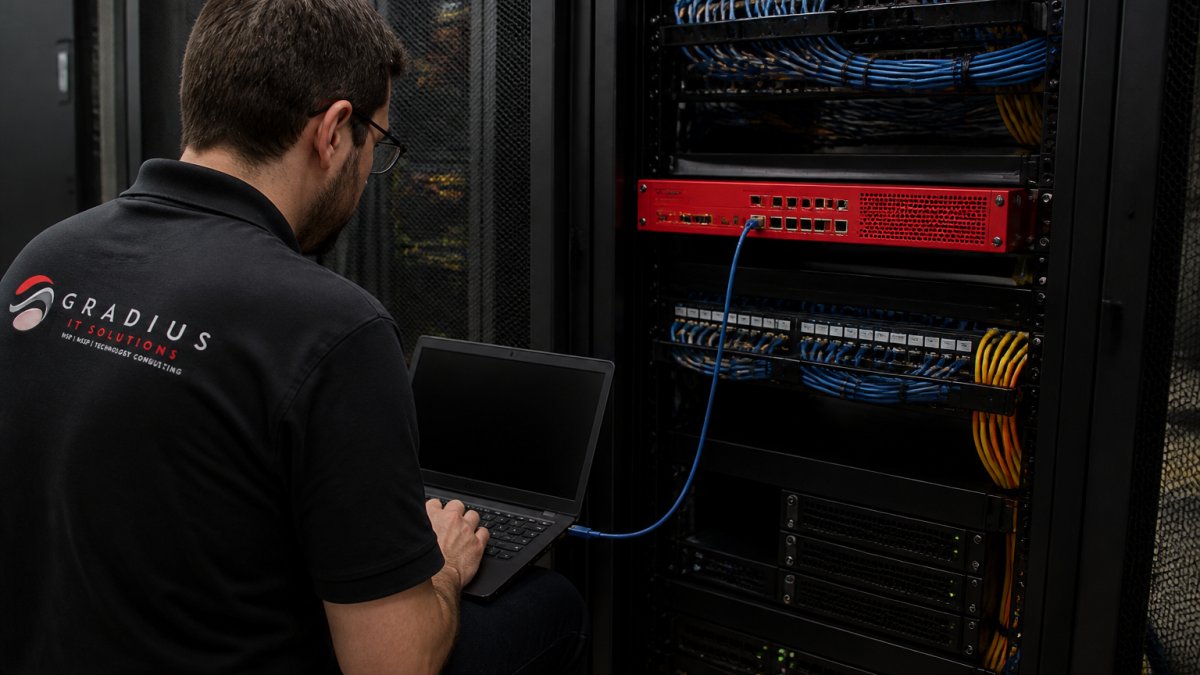
Practically, that means a few things happening on a schedule. Firmware and signature updates get tested and applied outside business hours.
Then there is the quieter work: reviewing logs for patterns, checking that VPN sessions look normal, and confirming that segmentation still matches how the network is actually used.
Gradius offers 24/7 NOC and SOC coverage, so monitoring and alert investigation can sit with the same team that manages the policy.
Evaluating Providers: Scope, Certifications, and Contract Terms
Provider evaluation comes down to three things: a written scope of work, verifiable technical credentials, and contract terms you can exit without losing your configuration. Most buyers compare providers on the wrong axis, weighing brand and certifications first and scope last, which is backwards. A credentialed team with a vague scope will still leave gaps.
A more useful approach is to score each provider against the same criteria and ask for evidence, not assurances. Below is a framework you can run in a single conversation.
A Practical Evaluation Framework
Score each provider on these areas. Ask for a sample of each artifact, a redacted report, a rule register template, a scope-of-work excerpt, rather than accepting a verbal description.
| Evaluation Area | Weak Signal | Strong Signal | Evidence to Request |
|---|---|---|---|
| Scope of work | “Managed firewall” with no detail | Named deliverables: discovery, policy design, rule cleanup, deployment, testing, documentation, ongoing changes | Written scope mapped to phases |
| Monitoring | Alerts forwarded to your inbox | 24/7 SOC with investigation and escalation path | Sample alert-to-triage workflow |
| Documentation | None offered | As-built config and rule register handed over | Redacted rule register sample |
| Response commitments | Verbal assurances | Written response times with measurement method | SLA excerpt with measurement definition |
| Certifications | Logos without context | Named analyst credentials and framework experience | Team credentials and framework references |
| Contract term | Multi-year with auto-renewal | Clear term, defined exit, config export on request | Contract excerpt on termination |
| Reporting | Nothing until you ask | Scheduled reports with rule change history | Sample monthly report |
| Platform experience | “We support all firewalls” | Named platforms with depth of experience | Reference environments by platform type |
Two rows deserve extra attention. Platform experience matters because firewall vendors differ in rule syntax, object models, and management tooling; a team fluent in one platform is not automatically fluent in another. Reporting matters because it is the only way to verify the other commitments are being met, a report showing rule changes, alert volumes, and open items is evidence; a report showing uptime only is marketing.
Measurable Outcomes to Ask About
Ask each provider how they would report on:
- Alert response time. The interval from alert generation to a documented triage decision, not just an acknowledgment.
- Rule review completion. Whether the quarterly review actually happened and what it produced.
- Remediation time. How long it takes to close a confirmed issue once identified.
Certifications and Credentials: What Actually Matters
Certifications are a useful filter but a poor proxy for fit. A few practical notes:
- Framework experience beats framework logos. A team that has produced audit evidence for HIPAA, PCI DSS, or SOC 2 environments understands what documentation regulators and auditors expect. Ask for a description of that experience, not a badge.
- Analyst credentials matter for SOC work. If monitoring and response are in scope, ask who is triaging alerts and what their escalation path looks like.
- Vendor training matters for configuration. Platform-specific training signals depth on the device you actually run.
Before you sign anything, ask for three artifacts: a sample monthly report, a sample rule register, and a scope-of-work excerpt that names deliverables. If a provider cannot produce them, the scope is undefined regardless of what the proposal says.
We also recommend asking how the provider handles a device failure. Business continuity depends on having a tested path back, whether that is a spare appliance, a documented rebuild procedure, or a supported configuration backup. That answer tells you as much about their operational discipline as any certification.
Compliance Requirements That Shape Firewall Configuration
Compliance requirements change what your firewall policy must do, not just how it’s documented. Regulated businesses need boundary protection they can evidence, not just boundary protection that exists.
For healthcare organizations, HIPAA requires technical safeguards around access control and audit controls, which means firewall rules that segment systems holding protected health information and logging that supports an audit trail.
None of that means a firewall configuration makes you compliant.
CISA guidance on network perimeter security and segmentation
Requesting a Firewall Configuration Review From Gradius
A firewall review can pull the existing configuration and rule register, map rules to current business needs, check monitoring and logging, and produce a written summary of findings.
If you already have an internal IT team, a co-managed arrangement can make sense: your team keeps day-to-day control while Gradius can handle firewall policy and monitoring.
Many businesses cannot say with confidence which firewall rules are still active, who requested them, or when they were last reviewed.
Frequently Asked Questions
What does a firewall configuration service include?
A complete firewall configuration service covers discovery of your network and traffic flows, rule design and deployment, VPN and remote access setup, logging and alert configuration, and documentation of every change. It should also include a configuration review at handoff so you can see what was built and why. Ask any provider to list these deliverables in writing before work begins, including who owns the device credentials and how changes are approved.
How often should a business firewall be reviewed?
Most organizations should review firewall rules at least quarterly and after any major change: a new office, a cloud migration, a new line of business application, or staff turnover in IT. A firewall rule review checklist helps here. Look for rules that no longer match a business need, overly broad any-any permits, unused objects, and logging gaps. Reviews catch rule creep before it becomes a security problem, and they give you documentation for cyber insurance and compliance questions.
What is the difference between firewall setup and ongoing firewall management?
Setup is a one-time project: the device is configured for your current network and handed over. Ongoing management is the recurring work that keeps it correct, including firewall monitoring and maintenance, rule updates, firmware patching, alert triage, and periodic configuration reviews. A firewall configured well in year one can drift badly by year two without management. When comparing quotes, confirm which model you are buying and what happens when a rule change is needed at 9pm on a Friday.
How can a business tell whether its firewall rules are too permissive?
Three signs point to overly permissive rules: any-any allow rules between internal segments, outbound rules that permit all traffic to all destinations, and rules with no owner or documented business reason. Ask for a rule export and check how many rules exist versus how many are actually hit. A provider performing managed firewall services should be able to show you rule hit counts and propose cleanup. Fewer, tighter rules are easier to audit and reduce the blast radius if something gets through.
