

Your company’s growth shouldn’t be held hostage by a server room that looks like a tangled mess of spaghetti. In 2026, professional network buildouts for business are no longer just about plugging in routers. They’re about creating a resilient, invisible foundation for AI integration and unbreakable security. You deserve a system that works as hard as you do, without the constant headache of dropped VOIP calls or sluggish speeds that kill your team’s momentum.
We understand that the fear of hidden infrastructure costs and complex SEC or HIPAA compliance can make expansion feel like a gamble. It’s a valid concern, and you’re right to prioritize it. This guide provides a clear roadmap to deploying high-performance infrastructure that meets modern standards and scales with your vision. We’ll walk through the essentials of strategic cabling, Zero Trust hardware, and the proactive philosophy that keeps your operations running 24/7. Let’s build a network that empowers your success instead of slowing it down.
Key Takeaways
- Modern network buildouts for business involve more than running wire; they require a strategic blend of physical cabling and logical security.
- Accurate capacity planning for a three to five year horizon prevents expensive infrastructure upgrades as your team grows.
- Professional low-voltage cabling and cable management improve hardware performance by reducing heat and simplifying future maintenance.
- Implementing Zero Trust principles and network segmentation ensures that guest Wi-Fi and IoT devices don’t compromise your core data.
- A successful buildout concludes with detailed documentation and a transition to proactive managed services for long-term resilience.
Defining the Network Buildout: More Than Just Cables
A network buildout is not just a weekend project involving a few Ethernet cables and a ladder. It’s a strategic investment in your company’s operational backbone. When we talk about professional network buildouts for business, we’re describing the synchronized deployment of physical hardware and logical software configurations designed to sustain your growth. It’s the difference between a system that survives and a system that thrives.
The scope of a buildout covers three main pillars: low-voltage cabling, hardware procurement, and security configuration. For businesses with 5 to 100 employees, relying on consumer-grade “plug-and-play” hardware is a recipe for frustration. Professional infrastructure is built to handle the heavy lifting of modern business. It provides the heat management, port density, and security features that retail routers simply don’t have. High-quality infrastructure directly correlates with employee productivity. When the network is fast and invisible, your team stays in the flow. When it’s slow, they’re stuck waiting for files to sync or calls to reconnect.
Physical vs. Logical Infrastructure
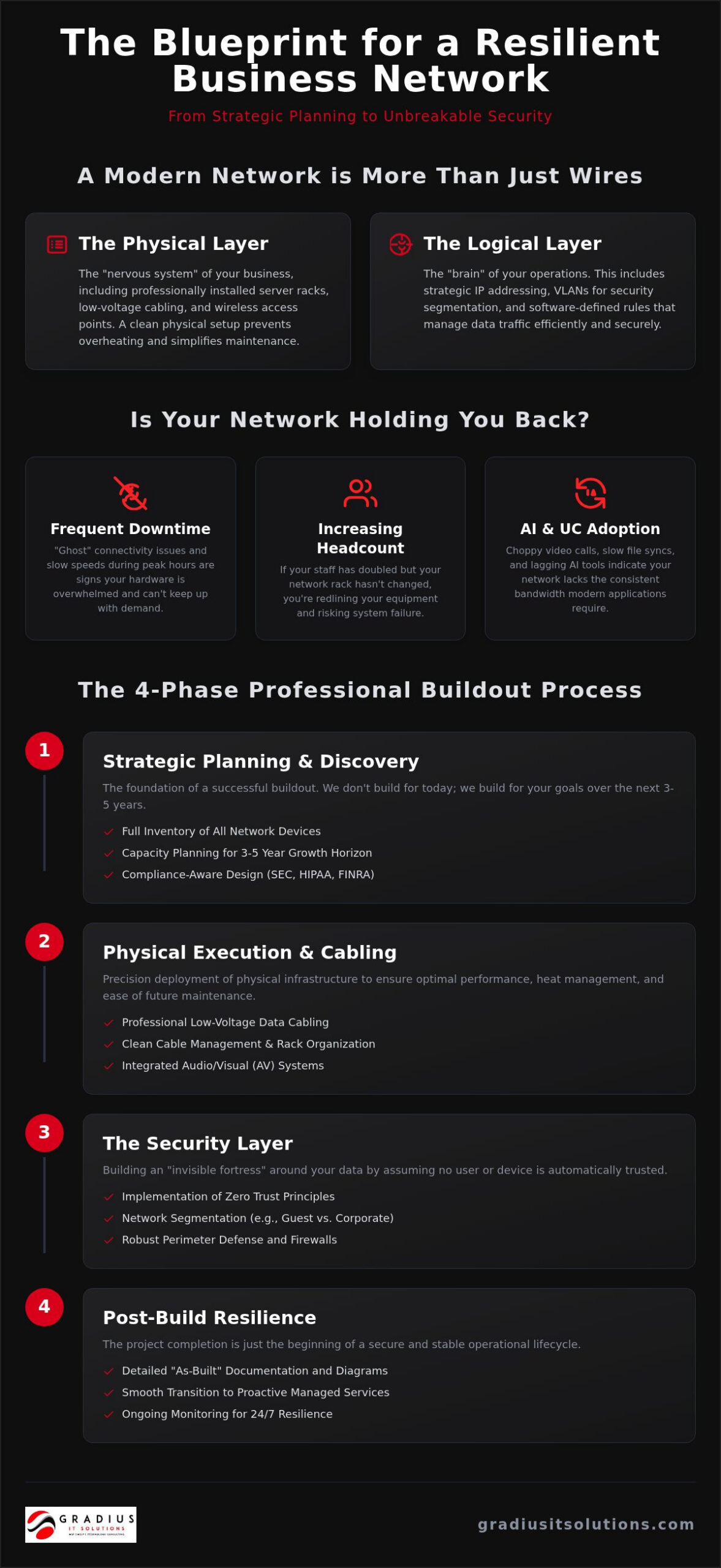
Think of your network as having two distinct but inseparable parts. The physical layer is the nervous system. It includes the actual cables, server racks, and wireless access points that live in your office. If this layer is messy or outdated, the whole system suffers. The logical layer is the brain. This involves your IP addressing, VLANs, and software-defined networking rules. Designing these in tandem is critical. You can’t achieve maximum uptime if your high-speed fiber is plugged into a poorly configured switch. A professional buildout ensures the physical “pipes” and the logical “traffic rules” work together perfectly.
Signs Your Business Needs a Network Upgrade
How do you know when your current setup has reached its limit? Look for these red flags:
- Frequent downtime: “Ghost” connectivity issues that happen during peak hours are a sign your hardware is overwhelmed.
- Increasing headcount: If you’ve doubled your staff but haven’t touched your network rack, you’re likely redlining your equipment.
- AI Adoption: Modern AI tools and unified communications require consistent, high-bandwidth connections. If your video calls are choppy, your network isn’t ready for the future.
Expanding into a new office space is the perfect time to reset. It’s much easier to build a high-performance foundation from day one than it is to retroactively fix a tangled server room later. This logic applies to all critical site infrastructure; for instance, rural commercial projects often require specialized utility management from best-cistern-septic-solutions.com to ensure the physical facility is as reliable as the digital network.
Strategic Planning: Assessing Capacity and Compliance
Planning a network without a deep discovery phase is like building a skyscraper without surveying the soil. You’ll hit obstacles you didn’t see coming. High-performance network buildouts for business begin with a rigorous inventory of every device on your premises. This includes workstations, mobile devices, printers, and the IoT sensors in your HVAC system. Knowing exactly what’s connecting to your pipes is the first step toward security and performance. It eliminates the “shadow IT” that often creates bottlenecks or security gaps.
Capacity planning is the next critical pillar. We don’t build for the team you have today. We build for the team you’ll have in 2029. Anticipating data growth over a three to five year horizon prevents the “rip and replace” cycle that drains capital. Integrating a solid network infrastructure design into your business roadmap ensures your tech stack supports your revenue goals rather than hindering them. It’s about creating a foundation that’s ready for whatever the market throws at you next.
The Compliance-Aware Design Framework
If you operate in financial services or healthcare, compliance isn’t optional; it’s the law. Regulatory bodies like the SEC, FINRA, and HHS have strict requirements for data isolation and encryption. A compliance-aware buildout identifies these needs before the first cable is pulled. We focus on building audit-ready documentation from day one. This proactive approach to IT consulting prevents the nightmare of expensive retrofitting after an auditor finds a gap in your segmentation. If you’re unsure about your current standing, a compliance assessment can reveal where your infrastructure needs reinforcement today.
Future-Proofing for AI and Automation
The rise of secure AI automation has fundamentally changed bandwidth requirements. Real-time predictive analytics and AI-driven workflows demand extremely low latency. If your backbone is thin, these tools will lag, and your investment in AI will go to waste. Over-provisioning your network backbone now is significantly cheaper than a mid-cycle upgrade. It provides the “headroom” necessary for high-performance operations without the risk of bottlenecking during peak hours. We look at your network as a living system that must stay three steps ahead of the software it hosts. This forward-thinking mindset is what separates a standard installation from professional network buildouts for business.
The Physical Execution: Low Voltage and AV Integration
Executing the physical phase of network buildouts for business is where the strategic blueprint meets the real world. This process isn’t just about pulling wire through a ceiling. It’s about precision engineering. Low-voltage cabling is the critical foundation for your data, voice, and security systems. If it’s poorly terminated or unmanaged, your high-speed hardware will never reach its potential. Professional cable management is a performance requirement, not an aesthetic choice. Neatly organized racks reduce heat buildup and cut troubleshooting time from hours to minutes. It’s the difference between a quick fix and a day of downtime.
We also conduct wireless site surveys to eliminate dead zones before your team moves in. Modern office layouts are complex. Concrete, glass, and even modular furniture can degrade your signal. A data-driven survey ensures your wireless access points are placed for maximum coverage and seamless roaming. This ensures that a VOIP call won’t drop just because someone walked from their desk to a huddle room.
Cabling Standards for 2026
For 2026, Cat6a is the minimum standard for copper workstations. It supports 10-Gigabit speeds and offers superior shielding against interference compared to older Cat6 options. For internal backbones connecting your server rooms, Fiber is the only choice. It provides the massive throughput required for modern data loads. We also leverage Power over Ethernet (PoE) to simplify your hardware deployment. PoE allows us to power access points, security cameras, and VOIP phones directly through the data cable. This reduces the need for expensive electrical work at every device location. For businesses planning integrated surveillance alongside their low-voltage rollouts, resources like pensmartcare.com.au detail how commercial security systems tie directly into unified network infrastructure. Physical security for your network closets is equally vital. Lockable racks and environmental monitoring protect your core assets from unauthorized access and overheating.
Unified Communications and AV Integration
Modern work happens in hybrid environments. This requires integrating VOIP with office AV systems to create a frictionless experience. Your conference rooms should be designed for high-performance meetings where remote participants feel as present as those in the room. This involves high-fidelity microphones, 4K cameras, and intuitive control interfaces that actually work. By standardizing your communication hardware for unified business communications, you reduce the learning curve for your staff. Everyone knows how to start a meeting in every room. This consistency drives adoption and ensures your technology investment actually gets used. It’s about building a space where collaboration happens naturally.
The Security Layer: Zero Trust and Perimeter Defense
Security isn’t a software update you run after the cables are tucked away. In 2026, the most successful network buildouts for business integrate defense directly into the physical and logical architecture. We start with network segmentation. This process creates digital walls between different types of traffic. Your guest Wi-Fi, smart office sensors, and sensitive financial data should never live on the same pipe. If a guest’s laptop is compromised, segmentation ensures the threat can’t hop over to your internal server. It’s about containment and control.
We move beyond the old perimeter model by implementing Zero Trust principles. In this framework, no device or user is trusted by default, even if they’re plugged directly into a wall jack in your executive suite. Every connection request is strictly verified. By integrating cybersecurity services during the initial build, we deploy managed firewalls and XDR systems that act as a proactive shield. This layered approach stops attacks before they can disrupt your operations. It turns your network into an active asset rather than a passive vulnerability.
Hardening the Microsoft 365 Environment
Your physical office network must be a seamless extension of your M365 security policies. We focus on three core areas during the buildout:
- MFA Enforcement: Configuring the network to require multi-factor authentication for all cloud access.
- Edge DLP: Implementing Data Loss Prevention to stop sensitive data from leaving the network.
- Conditional Access: Restricting cloud logins to recognized, secure office IP addresses.
This alignment ensures that your local infrastructure and cloud environment work as a single, fortified unit. It’s a critical step for businesses handling HIPAA or SEC-regulated data where a single leak can lead to massive fines. We build the guardrails so your team can work without fear.
Incident Response and Visibility
You can’t protect what you can’t see. A professional buildout is designed to provide 24/7 SOC monitoring and total visibility. We implement SIEM logging at every network access point. This data feed allows our security team to identify patterns and anomalies in real time. This visibility is the first step in our “Prevent-Instead-React” approach. Instead of cleaning up after a breach, we identify the reconnaissance phase of an attack and shut it down. Your network becomes a proactive guardian that never sleeps, providing the peace of mind you need to focus on growth.
Schedule your comprehensive cybersecurity assessment today.
Post-Build Resilience: Transitioning to Managed Operations
The physical installation is complete. The cables are labeled. The switches are blinking. However, the true value of professional network buildouts for business isn’t realized on the day of the ribbon-cutting. It’s realized during the months and years of uninterrupted uptime that follow. A successful project must transition smoothly into a lifecycle of proactive care. We act as your single accountable partner, moving your infrastructure from a capital expense project into the reliable ecosystem of managed IT services.
Documentation is the first requirement of this phase. We provide detailed “as-built” diagrams and configuration backups so your team isn’t left guessing during a future expansion. Training is equally vital. We ensure your stakeholders understand how to use the new AV systems and how to report issues effectively. To maintain this high-performance state, a vCIO provides ongoing strategic oversight. They ensure your network evolves alongside your business goals, preventing the technical debt that often plagues growing firms.
24/7 Monitoring and Maintenance
A network is a living organism. Hardware components can fail, and software vulnerabilities are discovered daily. Our Network Operations Center (NOC) provides the “Always On” surveillance needed to maintain health and uptime. We utilize predictive maintenance to resolve hardware issues before they impact your users. If a fan in a core switch starts to struggle, we know before the switch overheats. Automated patch management ensures every connected device is running the latest, most secure firmware without manual intervention. This proactive foundation is what allows your business to operate at full speed while we manage the complexity in the background.
Scaling Your Network with Business Growth
Your business won’t look the same in two years. Professional network buildouts for business utilize a modular design philosophy that simplifies future scaling. We build with “room to grow” so you can add capacity without tearing down existing infrastructure. Periodic technology reviews help us align your network with evolving AI tools or new compliance requirements. It’s about maintaining momentum. If you’re ready to stop reacting to tech failures and start building for resilience, take the first step. You can baseline your current environment and identify hidden risks today.
Schedule your free IT and cybersecurity assessment with Gradius IT Solutions to optimize your technology stack and secure your future.
Securing Your Business Foundation for 2026 and Beyond
Your network is the invisible engine driving every decision, transaction, and communication in your company. Professional network buildouts for business are no longer just about basic connectivity. They’re about creating a fortified, scalable environment that supports AI adoption and rigorous compliance standards. By prioritizing high-quality low-voltage cabling, Zero Trust architecture, and proactive monitoring, you’re investing in your firm’s long-term resilience and productivity.
We specialize in compliance-aware managed IT for regulated firms. We provide U.S.-based 24/7 SOC monitoring to keep your data safe around the clock. Our flat-fee predictable pricing means you can plan your growth without the stress of hidden costs or unexpected invoices. You don’t have to manage this technical complexity alone. We’re here to act as your bold advocate and high-performance specialist, ensuring your technology always stays three steps ahead of the competition.
Take control of your technology stack today and build the high-performance future your business deserves. We’re ready to stand in your corner and protect your progress.
Frequently Asked Questions
How long does a typical network buildout take for a small business?
A standard project for a business with 20 to 50 employees typically spans two to four weeks from discovery to final testing. This timeline accounts for site surveys, hardware procurement, and physical installation. While the cabling phase may only take a few days, the logical configuration and security hardening require dedicated time to ensure the system is resilient and fully optimized for your specific workflows.
What is the difference between a network refresh and a full buildout?
A refresh replaces aging hardware like switches or access points within your existing infrastructure to improve speed. A full buildout is a complete architectural overhaul. This often includes new low-voltage cabling, redesigned server racks, and a fresh security framework. Buildouts are necessary when moving offices or when the current wiring can no longer support the bandwidth required by modern cloud applications and AI tools.
Does my business need low-voltage cabling if we use Wi-Fi for everything?
Yes, because every wireless access point requires a high-speed wired backbone to function. High-performance network buildouts for business rely on cabling to power VoIP phones, security cameras, and desktop workstations that require maximum stability. Relying solely on Wi-Fi for every device creates congestion and latency. Physical wires provide the dedicated lanes necessary for high-bandwidth tasks like video conferencing and large file transfers.
How does a network buildout impact our regulatory compliance?
It serves as the physical foundation for meeting SEC, FINRA, or HIPAA standards. A professional buildout allows for strict network segmentation, isolating sensitive data from guest networks and IoT devices. We implement hardware-level encryption and logging that auditors require. By designing with compliance in mind, you avoid the risk of data leaks and ensure that your infrastructure is audit-ready from the moment it goes live.
What are the most common mistakes businesses make during a network upgrade?
The most frequent errors include underestimating future growth and choosing lower-grade cabling like Cat5e instead of Cat6a. Many firms also ignore the logical security layer during the physical installation or fail to conduct a professional wireless site survey. This leads to dead zones and security gaps. Neglecting cable management is another common pitfall, as it makes future troubleshooting nearly impossible and increases the risk of hardware overheating.
Can we execute a network buildout without disrupting our daily operations?
Yes, we often schedule the most invasive work, such as ceiling cabling or core switch replacements, during off-hours or weekends. Our team uses a phased approach to migrate users to new segments of the network. This ensures that your critical business functions stay online throughout the process. This “zero-downtime” strategy allows your team to stay productive while we modernize the infrastructure in the background.
Do I need a new network buildout to support AI and automation tools?
You likely need an upgrade if your current infrastructure is more than five years old. Modern AI and secure automation services demand extremely low latency and high throughput. Professional network buildouts for business provide the 10-Gigabit backbone and advanced traffic prioritization required to run these tools without bottlenecking. Without a robust foundation, your investment in AI will be hampered by slow data processing and synchronization errors.
What is the role of a vCIO in a network buildout project?
A vCIO acts as the strategic architect who aligns your technical project with your long-term business goals. They ensure that the hardware you buy today won’t be obsolete in three years. During a buildout, the vCIO manages vendor relationships, oversees compliance mapping, and ensures the project stays within your strategic roadmap. They bridge the gap between technical execution and executive-level business objectives, providing essential accountability.

Article by
Robert Joyce
**Robert Joyce** is the Founder, CEO, and Chief Technology Officer of Gradius IT Solutions, a security first provider of Managed IT Services, Cybersecurity, Cloud, Compliance, and Secure AI solutions serving businesses throughout New Jersey, New York, Connecticut, and across the United States.
With more than 28 years of IT experience, including 23 years supporting hedge funds, global banks, and wealth management firms, Robert has built a career designing and managing secure, resilient, and highly available technology environments where uptime, cybersecurity, and business continuity are essential.
His expertise includes Microsoft 365, cloud computing, cybersecurity, networking, infrastructure, disaster recovery, compliance, virtualization, and strategic IT leadership. Following the events of September 11, Robert helped rebuild critical technology infrastructure for Merrill Lynch, an experience that reinforced the importance of resilience, planning, and operational excellence.
Robert founded Gradius IT Solutions to bring enterprise level technology and security services to small and midsized businesses at a predictable monthly cost. Today, the company delivers fully managed and co managed IT services, cybersecurity, Microsoft 365, cloud solutions, compliance consulting, Secure AI consulting, technology projects, and vCIO services. Through a U.S. based 24/7 Help Desk and a nationwide network of trusted technology partners, Gradius supports organizations across the country with responsive, security focused technology solutions.
Robert partners with business owners and executive leaders to align technology with business goals, reduce risk, strengthen cybersecurity, improve productivity, and create long term IT strategies that support growth. His mission is simple: provide every client with enterprise class technology, exceptional service, and a trusted advisor they can rely on as their business evolves.
Disclaimer
## Disclaimer
The information provided in this article is for general informational and educational purposes only and should not be considered professional IT, cybersecurity, legal, regulatory, or compliance advice. While Gradius IT Solutions strives to provide accurate and up to date information, technology, security threats, and regulatory requirements change frequently, and we cannot guarantee that all information will remain current or applicable to your specific situation.
Every organization has unique technology, security, compliance, and business requirements. Before implementing any recommendations discussed in this article, you should evaluate their suitability for your environment or consult with a qualified technology professional.
Gradius IT Solutions makes no warranties, express or implied, regarding the completeness, accuracy, reliability, or results obtained from the use of this information. Any actions you take based on this content are at your own risk. Gradius IT Solutions shall not be liable for any direct, indirect, incidental, or consequential damages arising from the use of, or reliance upon, the information contained in this article.
References to third party products, services, or vendors are provided for informational purposes only and do not constitute an endorsement unless explicitly stated.
If you would like guidance tailored to your organization, contact Gradius IT Solutions to schedule a consultation with one of our technology experts.