

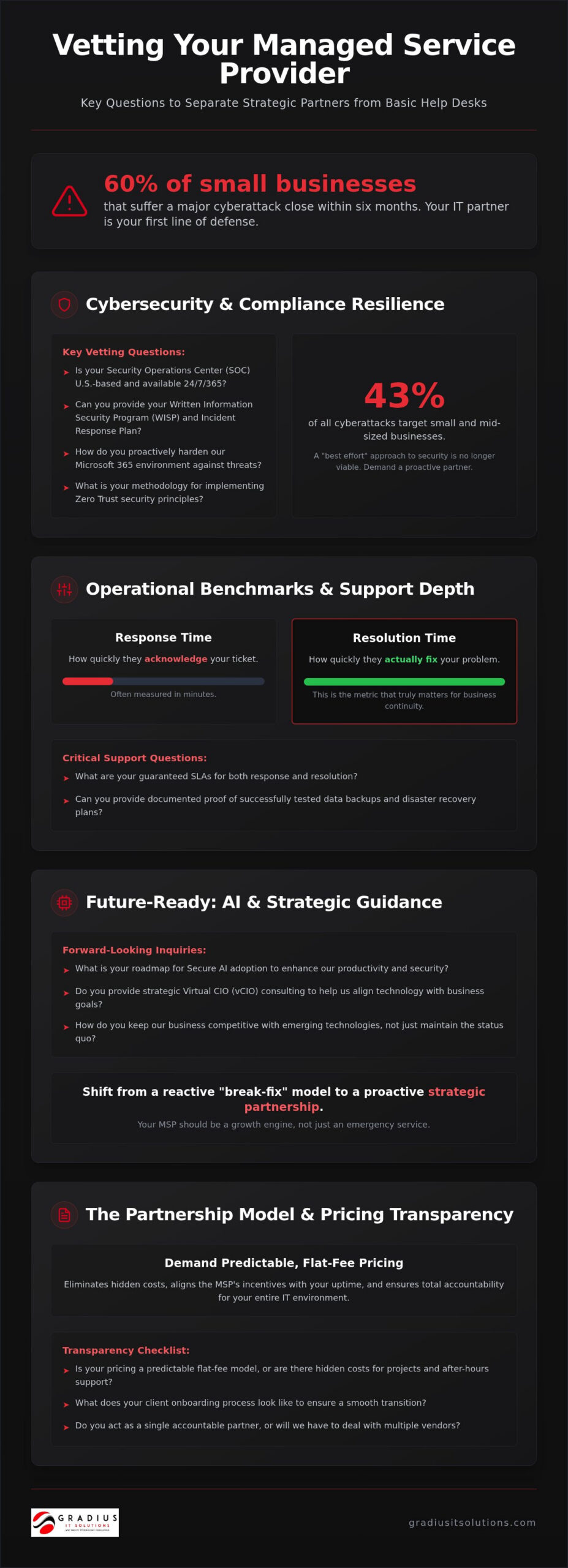
60 percent of small businesses that suffer a major cyberattack close their doors within six months. It’s a sobering reality in 2026. You’ve likely felt the sting of hidden IT costs or the anxiety of a looming SEC audit. Maybe you’re worried your competition is outpacing you with AI while your current support team struggles with basic response times. You deserve more than a vendor. You need a proactive guardian. Knowing the right questions to ask a managed service provider is the only way to separate high-performance specialists from basic help desks.
We understand the pressure to maintain 24/7 uptime while navigating complex regulations like FINRA or HIPAA. This article provides a strategic vetting framework to help you identify a single accountable partner who balances security, compliance, and AI-driven growth. We’ll walk through 21 essential questions that reveal if a provider is truly ready to protect your bottom line and accelerate your productivity in an AI-first world. This guide ensures you find a partner who anticipates problems before they arise, giving you the freedom to focus on your core business.
Key Takeaways
- Shift from reactive “break-fix” support to a proactive partnership that treats technology as a strategic asset for your business growth.
- Use our vetting framework of questions to ask a managed service provider to identify partners who offer U.S.-based security and deep compliance expertise.
- Prioritize operational excellence by demanding documented proof of backup tests and clear distinctions between response times and resolution times.
- Ensure your organization stays competitive by evaluating a provider’s roadmap for Secure AI adoption and Microsoft 365 hardening.
- Secure 24/7 peace of mind with flat-fee pricing models that eliminate hidden costs and ensure total accountability for your IT environment.
Why Vetting Your Managed Service Provider is a Strategic Business Priority
Technology isn’t just a background utility anymore. It’s the engine of your business. In 2026, the gap between a “tech guy” and a strategic partner has become a canyon. When you’re determining the right questions to ask a managed service provider, you’re really looking for a partner who can shield your firm from $3.31 million data breaches and ensure you don’t fall behind in the AI arms race. If you’re still relying on a “break-fix” model, you’re essentially waiting for a disaster to happen before you take action.
What is a Managed Service Provider? At its core, an MSP is a professional partner that manages your IT infrastructure and end-user systems on a proactive basis. But the definition is shifting. Today’s leaders need a “Single Accountable Partner.” This means one entity is responsible for your security, your compliance, and your growth. When things go wrong, there’s no finger-pointing. There’s only resolution. This level of managed IT services is what separates high-growth firms from those struggling with constant technical friction.
Moving Beyond the Utility Model of IT
Viewing IT as a cost center like electricity or water is a dangerous mistake. Cheap IT often results in “silent failures”: backups that don’t actually restore or security patches that were never applied. These hidden risks lead to catastrophic downtime and permanent reputational damage. According to industry data, 43% of cyberattacks now target small businesses. A reactive provider only shows up when the smoke is visible. A strategic partner prevents the fire. You aren’t paying for “support hours.” You’re investing in business resilience and 24/7 peace of mind.
The Executive Vetting Framework: What Matters Most
Choosing the right partner requires more than a casual conversation. It requires a rigorous vetting process. You need to look for red flags like vague SLAs, outsourced help desks, or a lack of specialized compliance knowledge. If a provider can’t explain how they protect you from SEC or HIPAA audits, they aren’t a fit for a regulated firm. They should be deeply involved in your strategic technology planning, not just reactive troubleshooting. To explore how leading providers structure their solutions and local support, you can visit Telx Computers for an example of modern managed services criteria.
This is where your strategy begins. To find a partner who truly acts as a proactive guardian, you must know the specific questions to ask a managed service provider. You need to know if they prioritize Microsoft 365 hardening and Zero Trust principles. These aren’t just technical queries; they’re business-critical probes into their accountability, transparency, and technical depth. The following framework will help you peel back the marketing jargon to see the reality of their operations.
Cybersecurity and Compliance: Questions to Reveal True Resilience
Cybersecurity in 2026 isn’t just about preventing viruses. It’s about maintaining business continuity under fire. As you evaluate your options, one of the most critical questions to ask a managed service provider is how they protect you while you sleep. With 43% of cyberattacks targeting small businesses, a “best effort” approach is a recipe for disaster. You need a partner who treats security as a proactive mission, not a reactive ticket. This requires a shift toward a “Prevent-Instead-React” model that integrates Compliance as a Service directly into your IT stack.
It’s no longer enough to just have a firewall. You need a Written Information Security Program (WISP) and a battle-tested Incident Response Plan. If a provider can’t produce these documents for their own firm, they certainly can’t manage yours. They should also be leading the charge on Microsoft 365 hardening. This includes enforcing Multi-Factor Authentication (MFA) across every account and implementing Data Loss Prevention (DLP) policies to keep sensitive data from leaving your control. By adopting Zero Trust principles, you ensure that every access request is verified, regardless of where it originates.
Vetting the Security Operations Center (SOC)
Ask point-blank: Is your SOC U.S.-based and available 24/7/365? Many providers outsource their monitoring to overseas firms with significant language barriers and time-zone delays. In a crisis, every second counts. You need real-time threat intelligence through SIEM and EDR/XDR platforms. These tools allow your partner to contain a threat on a Sunday at 3:00 AM before it spreads to your entire network. If their response plan involves waiting until Monday morning, your business is already at risk. If you aren’t sure where your current security stands, a professional security assessment can reveal the gaps before a hacker does.
Navigating Industry-Specific Regulations
Regulated firms face higher stakes. The SEC now requires registered investment advisors to report material incidents within four business days. This makes IT cybersecurity for financial advisors a specialized field. Your provider must understand FINRA Rule 4370 and NY DFS requirements. They should provide audit-ready evidence and help you prepare for cyber insurance renewals. Without this expertise, you’re left holding the bag during a regulatory audit. High-performance partners don’t just “do IT.” They provide the documentation and strategic guidance needed to satisfy the most demanding regulators.
Operational Benchmarks: Evaluating Support Depth and SLAs
Operational excellence is the heartbeat of a functional business. While security keeps the doors locked, operational depth ensures the work actually gets done. When you’re narrowing down your list of questions to ask a managed service provider, you need to look past the marketing gloss of “24/7 monitoring.” Monitoring is passive; management is active. A provider who only watches for red lights is just a spectator. You need a partner who manages outcomes and takes full responsibility for the health of your stack.
One of the biggest pitfalls for executives is failing to distinguish between a “vendor” and a “Single Accountable Partner.” A true partner handles your vendor management. This means they own the relationship with your internet service provider, your VoIP team, and your software vendors. If the phones go down, you shouldn’t be stuck on hold with a carrier. Your MSP should handle the technical heavy lifting while you focus on your clients. This level of accountability is what creates a friction-free environment.
The Reality of Service Level Agreements (SLAs)
Don’t be fooled by a “guaranteed response time.” A response is just an automated email saying your ticket was received. What actually matters is the resolution time. You should ask: “What is your guaranteed response time for critical outages, and what happens if you miss it?” High-performance firms offer clear, documented penalties for missing these marks. This ensures their skin is in the game as much as yours.
You also need to verify the quality of the help desk. Many firms outsource their first-tier support to overseas call centers. This often leads to communication barriers and slow escalations. Look for a partner that provides always-on IT support through a U.S.-based team available via phone, email, and chat. This ensures that when a critical issue strikes, you’re talking to an expert who understands your specific business context immediately.
Business Continuity and Disaster Recovery (BCDR)
Backups are useless if they don’t restore. One of the most vital questions to ask a managed service provider is how often they perform full system restore tests. Simply seeing a “green checkmark” in a backup log isn’t proof of recovery. Demand to see documented restore logs. Your backups must be off-site and, crucially, they must be immutable. Immutable backups are data copies that cannot be altered or deleted; they provide a final line of defense against ransomware encryption.
A proactive guardian doesn’t just manage data; they manage the plan. Ask if they will assist in drafting and maintaining your Business Continuity Plan (BCP). This document outlines exactly how your business operates during a crisis, from alternate work locations to communication chains. In 2026, with the average cost of a data breach for small firms reaching $3.31 million, having a tested BCDR strategy is not an option. It’s a requirement for survival.
The Future-Ready MSP: Inquiring About AI and Strategic vCIO Consulting
AI is no longer a future concept. It’s a core component of business in 2026. With 89% of small businesses now using AI in some capacity, the gap between leaders and laggards is widening. If your IT partner is only focused on fixing printers and resetting passwords, they’re holding you back. One of the most forward-looking questions to ask a managed service provider is how they intend to secure your data in an AI-driven environment. You need a partner who can turn these tools into a competitive advantage while keeping your intellectual property locked down.
Strategic growth requires more than just technical support. It requires a vision. A high-performance specialist acts as a proactive guardian, ensuring your technology stack doesn’t just work, but actually drives your bottom line. This is where the transition from a vendor to a “Single Accountable Partner” becomes vital. You don’t just need someone to manage your cloud; you need someone to orchestrate your entire digital strategy. For a deeper look at how this works, see our Secure AI Automation: 2026 Guide.
Leveraging Secure AI for Business Efficiency
AI is a force multiplier, but it’s also a risk vector. You must ask: How do you protect corporate data when implementing AI agents or chatbots? A legacy provider might just turn on the features and hope for the best. A high-performance specialist will implement Secure AI & Automation Services that keep your data within your secure tenant. They should be hardening your Microsoft 365 environment to ensure that AI tools only access authorized information. 92% of SMBs using AI report that it saves them time. Your MSP should show you exactly how to capture those savings through intelligent workflow automation.
The Role of the vCIO and vCISO
Strategy wins; support just keeps you afloat. This is why a vCIO is non-negotiable for firms with 5 to 100 employees. You need an annual technology roadmap that aligns with your specific business goals. Ask your prospective partner how they handle IT budgeting and predictive maintenance planning. They should be three steps ahead, anticipating hardware refreshes and software migrations before they become emergencies. This proactive stance is the hallmark of vCIO consulting services. They shouldn’t just be closing tickets; they should be providing the high-level guidance needed to optimize your technology stack and security posture. This is another essential set of questions to ask a managed service provider before signing any long-term contract.
Schedule a Secure AI and automation consultation
The Partnership Model: Pricing Transparency and Onboarding
A partnership is only as strong as its foundation of trust. In the world of IT, that trust is often broken by complex contracts and surprise invoices. When finalizing your list of questions to ask a managed service provider, you must look beyond the monthly fee. You’re looking for a “Single Accountable Partner” who offers a flat-fee predictable pricing model. This approach aligns your interests. If your systems are down, the provider loses money. If your systems are healthy, everyone wins. This is the opposite of the old “break-fix” model, where the provider only makes money when your business is in trouble.
You also need to confirm their ability to support your entire footprint. Whether you have a single office or a distributed team across the country, your partner should provide nationwide support. Remote work and branch offices shouldn’t be treated as “out-of-scope” headaches. A high-performance specialist ensures that every user receives the same level of protection and response, regardless of their physical location. This consistency is vital for maintaining a unified security posture and high productivity levels.
Predictable Pricing vs. Hidden Fees
The “nickel-and-diming” model is a major red flag. Some providers offer a low base price but then charge extra for every “add-on” like MFA, EDR, or immutable backups. In 2026, these aren’t optional extras; they’re the minimum requirements for survival. Ask point-blank: “Is your pricing per-user or per-device, and what exactly is excluded?” You need to know how they handle major projects like network rebuilds or office moves. A transparent partner will provide a clear definition of what falls under the flat fee and what constitutes a separate project, preventing budget-busting surprises. For organizations evaluating complex technology proposals, bringing in expert RFP management and negotiation assistance can help secure transparent pricing and protect against hidden contractual fees.
All-inclusive security is non-negotiable. If a provider treats cybersecurity basics as a profit center, they aren’t acting as your proactive guardian. They should be deeply committed to your resilience, not just your monthly check. High-performance managed IT services should always bundle core security layers into the primary service agreement. This ensures your defense is always active and never dependent on a separate purchase order.
Onboarding and the First 90 Days
The transition to a new provider is often the most vulnerable time for a business. You need a partner with a documented, rigorous onboarding process. Ask how they ensure no loss of knowledge during the switch. They should perform a deep-dive IT and Cybersecurity assessment on day one. This includes documenting every asset, user, and security gap in your environment. Without this documentation, you’re left with a “single point of failure” where only one person knows how your systems work.
The first 90 days set the tone for the entire relationship. Your partner should provide a clear roadmap of improvements and quick wins to stabilize your network immediately. This isn’t just about technical setup; it’s about cultural alignment and executive reporting. If you’re ready to see where your current technology stands, it’s time to take the first step toward a more secure future.
Secure Your Future with a High-Performance IT Partner
Vetting your IT partner isn’t just a technical task; it’s a strategic mandate for 2026. By focusing on resolution times and U.S.-based security, you protect your firm from the catastrophic costs of downtime. A true partner must navigate complex SEC and FINRA rules while guiding your team through Secure AI adoption. Imagine the peace of mind that comes with a team that anticipates problems three steps ahead. Your technology should be a force multiplier, not a source of anxiety.
Knowing the right questions to ask a managed service provider empowers you to demand total accountability. You deserve a proactive guardian who offers flat-fee predictable pricing and a 24/7 SOC that acts as your first line of defense. By using this framework, you ensure your organization is ready for regulatory audits and the rapid shift toward intelligent automation. Don’t settle for mediocre support when your business resilience and reputation are on the line.
You now have the strategic framework to identify a high-performance partner. Take the lead today to build a technology stack that protects your assets and accelerates your growth. The right partnership turns IT from a cost center into a primary driver of your success.
Frequently Asked Questions
What is the most important question to ask an MSP during the first meeting?
The most critical question is: “How do you align your technology roadmap with my specific business growth goals?” This moves the conversation from fixing broken computers to a strategic partnership. It forces the provider to demonstrate their vCIO capabilities and show they understand your bottom line. A high-performance specialist will talk about productivity and risk reduction rather than just hardware specs or ticket response times.
How do I know if an MSP is truly ‘compliance-aware’?
Ask for proof of their internal policy documentation and audit support history. A truly compliance-aware partner handles Written Information Security Policies (WISPs), Incident Response Plans, and Business Continuity documentation. They should be deeply familiar with the SEC Cybersecurity Rule and FINRA Rule 4370. If they can’t show you a sample of their regulatory evidence preparation, they aren’t equipped to protect a regulated firm or handle complex audits.
Should I look for an MSP that specializes in my specific industry?
Yes, because specialized expertise ensures regulatory and operational alignment. Financial and legal firms face unique threats and strict reporting mandates that generalist providers often miss. Specialized partners understand the nuances of Microsoft 365 hardening and industry-specific software. This focus allows them to act as a “Single Accountable Partner” who manages both your technical infrastructure and your industry-specific compliance requirements, ensuring you never fall behind in a regulated landscape.
What is the difference between an MSP and an MSSP?
An MSP focuses on operational efficiency and availability, while an MSSP focuses exclusively on high-level security and threat detection. In 2026, the best providers combine both roles. They provide standard help desk support alongside a 24/7 U.S.-based Security Operations Center (SOC). This hybrid model ensures that security isn’t an afterthought but is baked into every technical decision. It provides the proactive protection needed to stay ahead of modern ransomware attacks.
How often should my MSP be testing our disaster recovery plan?
Your provider should perform and document full system restore tests at least quarterly, though daily automated backup verifications are the standard. One of the vital questions to ask a managed service provider is if they provide written proof of these results. Simply seeing a success log isn’t enough. You need to know that your immutable backups can actually be restored to a functional state within your required recovery time objective.
What are the common hidden fees in managed IT contracts?
Watch out for “out-of-scope” charges for onboarding, after-hours support, or security basics like MFA and EDR. Some firms use a low entry price to win the contract and then “nickel-and-dime” you for essential services. High-performance specialists use a flat-fee predictable pricing model where security and proactive management are included. Always clarify if major projects, like full network rebuilds, are included or billed as separate engagements before signing any agreement.
Can a managed service provider help with cyber insurance renewals?
Absolutely, and a strategic partner will treat this as a core service. They should provide a free gap assessment and prepare the technical evidence required by insurer questionnaires. This includes verifying MFA enforcement, EDR implementation, and backup integrity. By aligning your environment with the NIST Cybersecurity Framework 2.0, they help you qualify for better coverage and lower premiums. This proactive stance ensures you meet the strict requirements insurers demand in 2026.
Is it better to have a local MSP or a national provider?
Is it better to have a local MSP or a national provider?

Article by
Robert Joyce
**Robert Joyce** is the Founder, CEO, and Chief Technology Officer of Gradius IT Solutions, a security first provider of Managed IT Services, Cybersecurity, Cloud, Compliance, and Secure AI solutions serving businesses throughout New Jersey, New York, Connecticut, and across the United States.
With more than 28 years of IT experience, including 23 years supporting hedge funds, global banks, and wealth management firms, Robert has built a career designing and managing secure, resilient, and highly available technology environments where uptime, cybersecurity, and business continuity are essential.
His expertise includes Microsoft 365, cloud computing, cybersecurity, networking, infrastructure, disaster recovery, compliance, virtualization, and strategic IT leadership. Following the events of September 11, Robert helped rebuild critical technology infrastructure for Merrill Lynch, an experience that reinforced the importance of resilience, planning, and operational excellence.
Robert founded Gradius IT Solutions to bring enterprise level technology and security services to small and midsized businesses at a predictable monthly cost. Today, the company delivers fully managed and co managed IT services, cybersecurity, Microsoft 365, cloud solutions, compliance consulting, Secure AI consulting, technology projects, and vCIO services. Through a U.S. based 24/7 Help Desk and a nationwide network of trusted technology partners, Gradius supports organizations across the country with responsive, security focused technology solutions.
Robert partners with business owners and executive leaders to align technology with business goals, reduce risk, strengthen cybersecurity, improve productivity, and create long term IT strategies that support growth. His mission is simple: provide every client with enterprise class technology, exceptional service, and a trusted advisor they can rely on as their business evolves.
Disclaimer
## Disclaimer
The information provided in this article is for general informational and educational purposes only and should not be considered professional IT, cybersecurity, legal, regulatory, or compliance advice. While Gradius IT Solutions strives to provide accurate and up to date information, technology, security threats, and regulatory requirements change frequently, and we cannot guarantee that all information will remain current or applicable to your specific situation.
Every organization has unique technology, security, compliance, and business requirements. Before implementing any recommendations discussed in this article, you should evaluate their suitability for your environment or consult with a qualified technology professional.
Gradius IT Solutions makes no warranties, express or implied, regarding the completeness, accuracy, reliability, or results obtained from the use of this information. Any actions you take based on this content are at your own risk. Gradius IT Solutions shall not be liable for any direct, indirect, incidental, or consequential damages arising from the use of, or reliance upon, the information contained in this article.
References to third party products, services, or vendors are provided for informational purposes only and do not constitute an endorsement unless explicitly stated.
If you would like guidance tailored to your organization, contact Gradius IT Solutions to schedule a consultation with one of our technology experts.