

The global average cost of a data breach has surged to $4.88 million. If you’re managing a firm in the financial or healthcare sectors, you know that a single audit failure or security gap can be catastrophic. You’re likely overwhelmed by the complexity of SEC amendments and NY DFS requirements that demand more than just a “check the box” approach. Conducting an IT risk assessment for compliance shouldn’t feel like a guessing game. It’s time to stop fearing the auditor and start building a resilient foundation.
You deserve a partner who translates technical jargon into clear business outcomes. We’ve designed this guide to help you master the strategic process of risk management. You’ll gain a repeatable framework for identifying threats, creating audit-ready documentation, and making smart security investments. We’ll walk through the specific 2026 regulatory updates and show you how to turn your security posture into a competitive edge. It’s about moving from a state of constant worry to one of total control over your digital environment.
Key Takeaways
- Learn how to move beyond static checklists to a dynamic assessment process that keeps pace with the 2026 threat landscape.
- Discover how a strategic it risk assessment for compliance satisfies SEC and NY DFS requirements while hardening your digital infrastructure.
- Quantify your technical vulnerabilities with dollar-value impact scores to lower insurance premiums and prioritize security investments.
- Follow a proven five-step roadmap to generate the verifiable evidence and documentation required for a successful audit.
- Leverage AI-driven automation to reduce manual compliance tasks and streamline your operations with a single accountable partner.
The Strategic Role of IT Risk Assessments in 2026
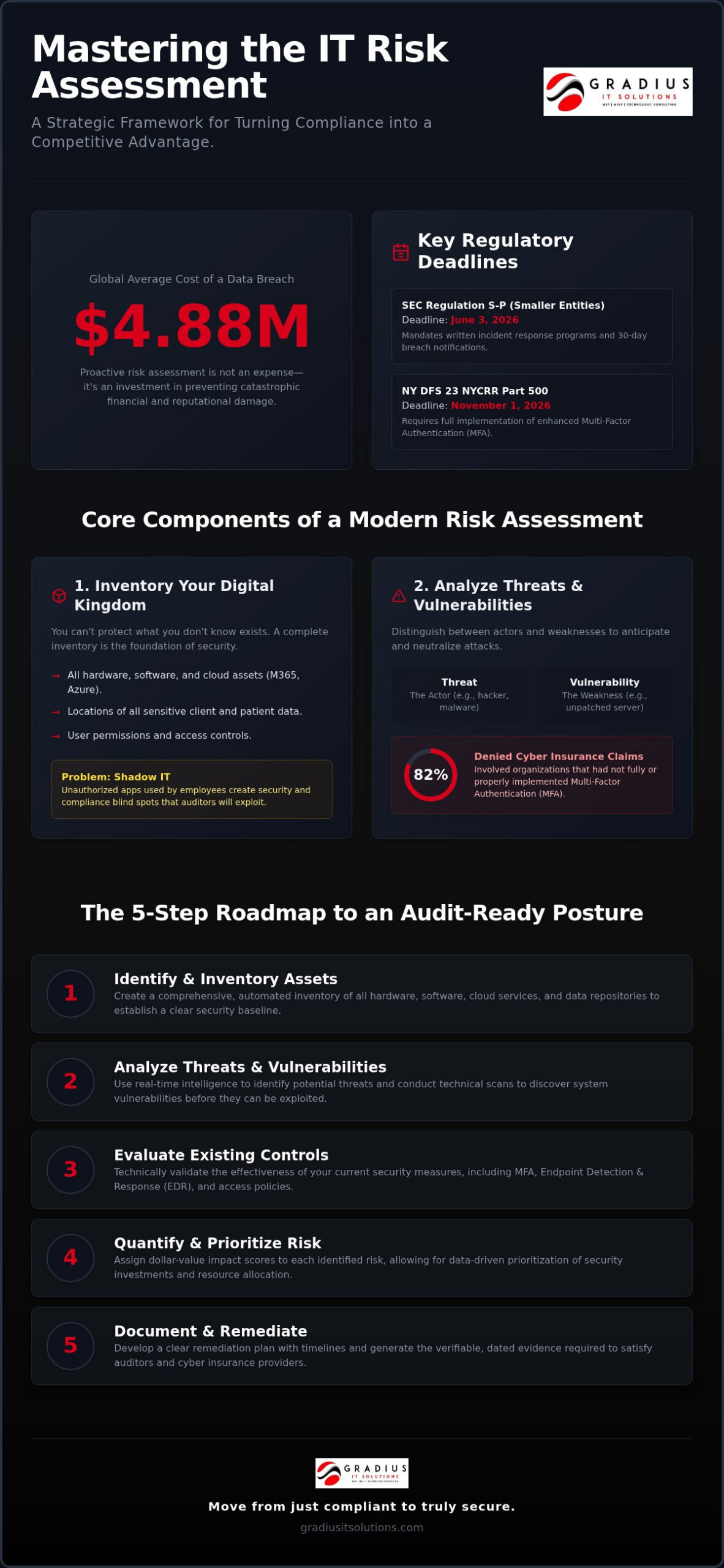
An IT risk assessment is a systematic process designed to identify, analyze, and evaluate threats to your digital infrastructure. In the past, many firms treated this as a once-a-year hurdle to clear for auditors. That approach is now dangerous. In 2026, the speed of technology means a point-in-time snapshot is obsolete before the ink is dry. An effective it risk assessment for compliance must be a living strategy that aligns your technical defenses with your business goals. It protects your bottom line by preventing the $4.88 million average cost of a breach and preserves a brand reputation that took years to build.
Beyond the Audit: Why Compliance is Only the Beginning
Being “compliant” doesn’t mean you’re “secure.” Regulations often lag behind the latest exploits. Relying on an outdated assessment leaves you vulnerable to rapid, AI-driven attacks that bypass traditional defenses. We believe Compliance as a Service should be a byproduct of a strong security posture. By following core IT risk management principles, you build a resilient environment where meeting regulatory standards happens naturally. Your focus shifts from surviving an audit to thriving in a volatile market.
The 2026 Regulatory Landscape: SEC, FINRA, and HIPAA
The regulatory bar is higher than ever. For Registered Investment Advisors (RIAs), the June 3, 2026, deadline for smaller entities to comply with SEC Regulation S-P amendments is a major milestone. These rules mandate written incident response programs and 30-day breach notifications. Similarly, firms falling under NY DFS 23 NYCRR Part 500 must fully implement enhanced Multi-Factor Authentication (MFA) by November 1, 2026. Whether you’re managing patient data under HIPAA or protecting local client info via the NJ SHIELD Act, the shift is clear. Regulators now require dated evidence of continuous control, not just a signed policy. Compliance-Aware IT is the new gold standard for regulated sectors that refuse to leave their future to chance.
We specialize in IT and cybersecurity for RIAs, ensuring that your technology stack meets these rigorous standards without slowing down your operations. Proactive management isn’t just a service; it’s a commitment to accountability and transparency.
Core Components of a Compliance-Aware Risk Assessment
A robust it risk assessment for compliance starts with absolute visibility. You can’t protect what you don’t know exists. Many firms still rely on static spreadsheets or manual logs to track their assets. This approach is prone to error and creates dangerous blind spots. A modern assessment requires a deep dive into every corner of your network to ensure no device or data set is left exposed to modern threats.
Inventorying Your Digital Kingdom
Your inventory must go beyond a simple list of laptops. It needs to include hardware, software, and sensitive client data sets. In 2026, cloud assets like Microsoft 365 and Azure require special attention. These environments are dynamic. Permissions change. New users join. Without constant monitoring, your cloud footprint becomes a liability. Problem: Shadow IT. Solution: Automated discovery tools. Employees often use unauthorized apps to “get things done.” These apps bypass your security controls and create gaps in your compliance reporting that auditors will find.
Analyzing Threats and Vulnerabilities
It’s vital to distinguish between a threat and a vulnerability. A threat is the actor, such as a hacker or a disgruntled employee. A vulnerability is the weakness they exploit, like an unpatched server or a weak password. When we conduct an it risk assessment for compliance, we use real-time threat intelligence to anticipate these moves. We evaluate your existing controls, specifically Multi-Factor Authentication (MFA) and Endpoint Detection and Response (EDR). Technical validation is the key. Questionnaires alone are insufficient. You need dated evidence that your controls are actually working.
Problem: Denied insurance claims. Solution: Verified MFA implementation. Research shows that 82% of denied cyber insurance claims involve organizations that hadn’t fully implemented MFA. We don’t just ask if you have it. We verify that it covers every remote access point and administrative account. This level of detail ensures you are both secure and insurable. If you’re unsure where your biggest blind spots are, our cybersecurity services can help you map your entire digital footprint and close the gaps before they’re exploited.
Mapping Risks to Business Impact and Insurance Readiness
Technical vulnerabilities remain abstract until you attach a dollar sign to them. Every gap identified during an it risk assessment for compliance carries a specific business impact score. We don’t just tell you a network port is open. We explain how much that open port could cost you in lost revenue, recovery fees, and long-term brand damage. This level of clarity helps executives move away from the dangerous myth that their organization is “too small” to be a target. Attackers don’t care about your employee count. They care about the path of least resistance.
Calculating the True Cost of Downtime
Downtime is about more than just an idle staff. It involves the immediate costs of data restoration and the potential for crushing regulatory fines. If your systems go dark, the damage to your reputation can be permanent. Losing client trust is often far more expensive than any technical fix. Our Cybersecurity Services focus on proactive prevention to ensure these hidden costs never hit your ledger. We map out these risks so you can prioritize security investments based on actual business value rather than technical guesswork.
Optimizing for Cyber Insurance
In 2026, cyber insurance is no longer a guaranteed safety net. Insurers have shifted their focus from simple questionnaires to requiring dated, verifiable evidence of security controls. Recent industry data shows the loss ratio for cyber insurance in the U.S. rose to 53.0% in 2025. This surge has forced underwriters to be much more selective. To remain insurable, you must prove you’ve implemented Multi-Factor Authentication (MFA) on all remote access, Endpoint Detection and Response (EDR) on every device, and immutable backups. A robust it risk assessment for compliance provides the documentation needed to pass this increased scrutiny.
We provide a free gap assessment that aligns directly with current insurer questionnaires. This process helps you harden your defenses while positioning your firm to secure lower premiums. By documenting your findings in a Written Information Security Policy (WISP), you create an audit-ready trail of accountability. This documentation is essential for policy renewals and claims support. It demonstrates to insurers and regulators that you are a proactive guardian of your data. You’re not just checking a box. You’re building a culture of transparency and resilience that stands firm against modern threats.
A 5-Step Roadmap for Executing Your Assessment
Executing an it risk assessment for compliance doesn’t have to be a bureaucratic nightmare. We’ve distilled the process into five actionable steps that prioritize business results over endless paperwork. This roadmap ensures you aren’t just identifying problems but actively solving them. No more guesswork. Only data.
Step 1: Preparation and Scope. Start by defining the boundaries. Focus on your “crown jewel” systems that store and process sensitive client data. Step 2: Data Collection. Move beyond simple questionnaires. Gather technical logs and system configurations. Interview your team to uncover the reality of how work gets done. Step 3: Risk Analysis. Score every finding based on its likelihood and potential financial impact. This is where you apply the dollar-value scores we discussed earlier to create a clear priority list. Step 4: Remediation Planning. Build a roadmap to close the gaps. Step 5: Monitoring and Review. Problem: Static assessments are obsolete. Solution: Establish a continuous cycle to track new threats as they emerge.
Schedule your free technology consultation
Prioritizing Remediation: The “Fix it First” Framework
Not all risks are created equal. You must distinguish between Critical, High, and Medium findings. Critical risks require immediate action. These are the “open doors” like missing MFA or unpatched external servers. High risks are addressed next. Medium risks are integrated into your long-term maintenance schedule. This framework allows for immediate wins that harden your posture instantly. Fix the critical gaps. Protect the business. It also provides a clear path for budgeting future infrastructure upgrades without disrupting your current operations.
The Microsoft 365 Hardening Advantage
If your business runs on the Microsoft stack, you have a massive head start. Microsoft Security tools can automate significant portions of the assessment process by providing real-time visibility into your environment. We specialize in tuning Microsoft Purview and Data Loss Prevention (DLP) policies to meet your specific regulatory requirements. This approach ensures that sensitive data stays exactly where it belongs. You can find more detail on this in our Microsoft 365 Integration Guide. It’s about making your existing technology work harder for your security.
Scaling Compliance with AI and Managed Partnerships
Managing a fragmented IT stack is a liability. When you juggle multiple vendors, accountability disappears. One provider handles your cloud, another manages your helpdesk, and a third claims to watch your security. This fragmentation creates gaps that hackers love to exploit. We advocate for the Single Accountable Partner model. It eliminates vendor fatigue and ensures that your it risk assessment for compliance is handled by a team with a holistic view of your entire infrastructure. One partner. One point of contact. Total accountability.
Leveraging AI changes the game. We use AI-driven compliance tools to reduce manual audit preparation by up to 70%. This isn’t about replacing humans. It’s about empowering them. Automation handles the repetitive data gathering and log analysis that used to take weeks of manual labor. You get faster results and more accurate data without the administrative burden. It allows your team to focus on growth while the technology handles the heavy lifting of documentation.
A Virtual Chief Information Security Officer (vCISO) provides the strategic layer you need to scale. Most mid-sized firms don’t need a full-time, six-figure executive on the payroll, but they do need executive-grade guidance. A vCISO ensures your risk management stays aligned with your business goals and the ever-shifting regulatory landscape of 2026. They act as your proactive guardian, looking three steps ahead to anticipate problems before they arise.
AI-Powered Security and Compliance
Managed AI platforms allow you to automate complex analytics without investing in heavy hardware. These systems excel at predictive maintenance. They resolve minor issues before they trigger a major compliance event or system failure. By identifying patterns that human eyes might miss, AI acts as an early warning system for your network. It’s a proactive approach that moves you away from the “break-fix” cycle. You can explore these capabilities further through our Secure AI & Automation Services.
The Peace of Mind Guarantee
A Gradius assessment is not a generic checklist. You receive a comprehensive written report and a clear, prioritized action plan. We tell you exactly what is broken and how we will fix it. Accountability is our core value. As a licensed and insured MSP/MSSP, we stand firmly in your corner. Our U.S.-based SOC and help desk ensure 24/7 monitoring and rapid response. We don’t just find risks; we own the resolution. You can stop worrying about the “what-ifs” and get back to running your business with confidence.
Secure Your Future: Moving Beyond Static Compliance
The landscape of 2026 demands a shift from reactive fixes to proactive guardianship. You’ve seen how the convergence of SEC mandates, NY DFS requirements, and strict insurance underwriting has raised the stakes for every mid-sized firm. Conducting a strategic it risk assessment for compliance is the only way to ensure your business remains both secure and insurable. By quantifying your risks and leveraging AI-driven automation, you transform a complex burden into a streamlined competitive advantage.
As a Red Dot Award-winning strategic partner, we specialize in providing compliance-aware managed IT for financial services and other regulated sectors. Our U.S.-based 24/7 SOC and help desk are always on, anticipating threats before they reach your network. You don’t have to carry the weight of technical complexity alone.
It’s time to harden your defenses and focus on what you do best. Let’s build a resilient foundation together.
Frequently Asked Questions
What is the difference between an IT risk assessment and a vulnerability scan?
A vulnerability scan is a technical tool that identifies specific security holes, whereas an IT risk assessment is a comprehensive strategic process. Scans look for unpatched software or open ports. Assessments evaluate how those technical weaknesses impact your business operations and compliance posture. We use the assessment to prioritize remediation based on actual business risk. It’s the difference between finding a broken lock and understanding the value of what’s inside the room.
How often should a regulated business perform an IT risk assessment?
Regulated businesses should conduct a full assessment at least annually, but the 2026 threat environment requires continuous monitoring. Major changes to your network, such as adopting new AI tools or migrating to the cloud, should trigger an immediate review. Regulations like NY DFS 23 NYCRR 500 and SEC rules often mandate periodic reviews. We recommend a proactive approach where risk management is an ongoing part of your monthly IT strategy meetings.
Can an IT risk assessment help our business get lower cyber insurance rates?
Yes, a documented it risk assessment for compliance provides the verifiable evidence that insurers now demand before issuing policies. By identifying and closing gaps in MFA, EDR, and backup immutability, you demonstrate a lower risk profile to underwriters. Insurers are rewarding businesses that have a mature, evidence-backed security posture. Our free gap assessment specifically aligns with insurer questionnaires to help you secure the best possible rates and coverage.
What are the most common compliance failures found during an assessment?
The most frequent failures include missing Multi-Factor Authentication (MFA) on remote access, outdated incident response plans, and unauthorized “shadow IT” apps. Many firms also fail to provide dated evidence of backup restoration tests. These gaps often lead to denied insurance claims or regulatory fines. We focus on these high-impact areas first to ensure your firm meets the rigorous standards set by the SEC, FINRA, and HIPAA without disrupting your daily workflows.
Does my business need a vCISO to manage IT risk?
A vCISO is essential for mid-sized firms that need executive-level security strategy without the cost of a full-time hire. They bridge the gap between technical IT management and business leadership. Your vCISO manages your Written Information Security Policy (WISP), oversees annual reviews, and ensures your technology stays aligned with changing regulations. This role provides the high-level accountability required to protect your brand and maintain a continuous state of audit readiness.
How long does a typical IT risk assessment take for a mid-sized firm?
A thorough assessment for a firm with 5 to 100 employees typically takes between two to four weeks from initial data collection to the final report. The timeframe depends on the complexity of your network and the volume of sensitive data you manage. We provide a written report and a clear action plan within a week of completing the technical review. This ensures you can begin remediation quickly and close critical security gaps before they are exploited.
What documentation is required to satisfy SEC or FINRA compliance audits?
Auditors require a Written Information Security Policy (WISP), a documented Incident Response Plan, and evidence of regular risk assessments. You must also show logs of employee security training and proof of immutable, tested backups. For RIAs, the SEC specifically looks for documentation regarding data loss prevention and access controls. We act as your single accountable partner to maintain this audit-ready trail, ensuring you can provide dated evidence of every security control.
How does Microsoft 365 help with IT compliance and risk management?
Microsoft 365 offers powerful built-in tools like Purview and Data Loss Prevention (DLP) that simplify an it risk assessment for compliance. These features allow you to automate data classification and monitor for unauthorized sharing of sensitive information. When properly configured, Microsoft Security tools provide real-time visibility into your compliance posture. We specialize in hardening these environments to ensure your licensing and security settings are fully optimized for the 2026 regulatory landscape.

Article by
Robert Joyce
**Robert Joyce** is the Founder, CEO, and Chief Technology Officer of Gradius IT Solutions, a security first provider of Managed IT Services, Cybersecurity, Cloud, Compliance, and Secure AI solutions serving businesses throughout New Jersey, New York, Connecticut, and across the United States.
With more than 28 years of IT experience, including 23 years supporting hedge funds, global banks, and wealth management firms, Robert has built a career designing and managing secure, resilient, and highly available technology environments where uptime, cybersecurity, and business continuity are essential.
His expertise includes Microsoft 365, cloud computing, cybersecurity, networking, infrastructure, disaster recovery, compliance, virtualization, and strategic IT leadership. Following the events of September 11, Robert helped rebuild critical technology infrastructure for Merrill Lynch, an experience that reinforced the importance of resilience, planning, and operational excellence.
Robert founded Gradius IT Solutions to bring enterprise level technology and security services to small and midsized businesses at a predictable monthly cost. Today, the company delivers fully managed and co managed IT services, cybersecurity, Microsoft 365, cloud solutions, compliance consulting, Secure AI consulting, technology projects, and vCIO services. Through a U.S. based 24/7 Help Desk and a nationwide network of trusted technology partners, Gradius supports organizations across the country with responsive, security focused technology solutions.
Robert partners with business owners and executive leaders to align technology with business goals, reduce risk, strengthen cybersecurity, improve productivity, and create long term IT strategies that support growth. His mission is simple: provide every client with enterprise class technology, exceptional service, and a trusted advisor they can rely on as their business evolves.
Disclaimer
## Disclaimer
The information provided in this article is for general informational and educational purposes only and should not be considered professional IT, cybersecurity, legal, regulatory, or compliance advice. While Gradius IT Solutions strives to provide accurate and up to date information, technology, security threats, and regulatory requirements change frequently, and we cannot guarantee that all information will remain current or applicable to your specific situation.
Every organization has unique technology, security, compliance, and business requirements. Before implementing any recommendations discussed in this article, you should evaluate their suitability for your environment or consult with a qualified technology professional.
Gradius IT Solutions makes no warranties, express or implied, regarding the completeness, accuracy, reliability, or results obtained from the use of this information. Any actions you take based on this content are at your own risk. Gradius IT Solutions shall not be liable for any direct, indirect, incidental, or consequential damages arising from the use of, or reliance upon, the information contained in this article.
References to third party products, services, or vendors are provided for informational purposes only and do not constitute an endorsement unless explicitly stated.
If you would like guidance tailored to your organization, contact Gradius IT Solutions to schedule a consultation with one of our technology experts.