

The advertised price on your VoIP contract is rarely the price you actually pay. With the federal Universal Service Fund contribution factor hitting 38.8 percent in the third quarter of 2026, many businesses are seeing their monthly bills skyrocket without any increase in value. If you are currently evaluating unified communications as a service nj options, you need more than just a dial tone. You need a strategy that accounts for these rising regulatory fees and the mandatory sunset of traditional copper lines.
Managing a patchwork of disconnected chat, video, and phone tools is a liability for your team’s focus and your bottom line. You deserve a system where your tools actually talk to each other without hidden surcharges or E911 compliance gaps. This executive guide reveals how to consolidate your stack into a single, high-performance platform that secures your data and simplifies your operations. We will explore the impact of the latest New Jersey data privacy laws, the reality of AI-powered feature costs, and the exact steps to achieve enterprise-grade resilience for your organization.
Key Takeaways
- Stop maintaining legacy PBX hardware and transition to a cloud-delivered model that integrates voice, video, and messaging into a single, mobile-ready hub.
- Identify the hidden costs of entry-level VoIP contracts by analyzing the real impact of regulatory fees on your unified communications as a service nj investment.
- Harden your communication environment against social engineering and toll fraud while ensuring full compliance with 2026 E911 dispatchable location requirements.
- Drive operational efficiency and reduce license sprawl by consolidating fragmented third-party tools into a secured Microsoft Teams environment.
- Execute a seamless migration using a phased implementation roadmap that prioritizes network readiness and strategic infrastructure auditing to prevent downtime.
What is Unified Communications as a Service (UCaaS)?
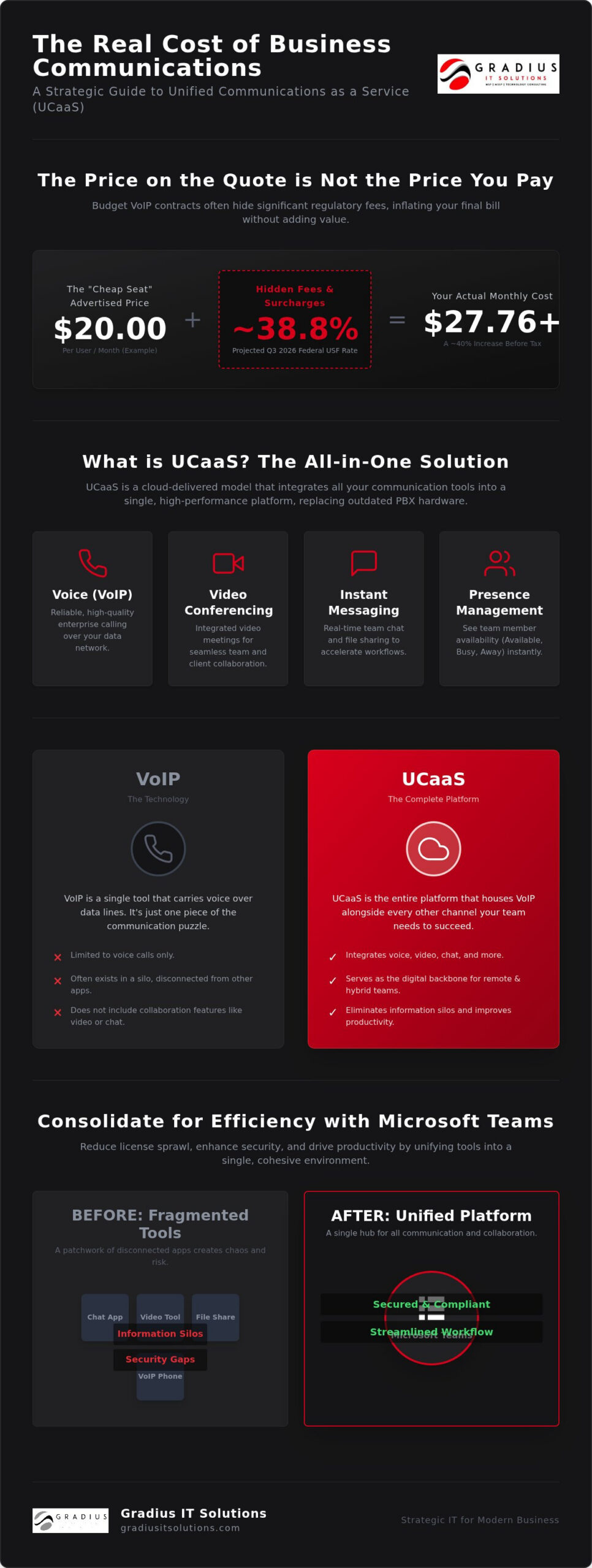
UCaaS is the evolution of how modern organizations stay connected. It is a cloud-delivered model that unifies voice, video, messaging, and collaboration into a single, accessible platform. To understand the foundation of this shift, it helps to examine What is Unified Communications? and how it has matured from a luxury into a business necessity. For local firms, selecting a unified communications as a service nj provider means finally retiring the dusty PBX closet. Physical hardware is a liability. It requires dedicated cooling, physical security, and manual updates. When that hardware fails, your business goes dark. UCaaS shifts the burden of uptime to the provider, ensuring your communications remain active even if your physical office is inaccessible.
To better understand this concept, watch this helpful video:
Modern UCaaS relies on four core pillars: Voice (VoIP), Video Conferencing, Instant Messaging, and Presence Management. Presence management allows your team to see who is available, busy, or in a meeting in real time. This small feature prevents wasted time and improves internal response speeds significantly. By moving these functions to the cloud, you trade unpredictable capital expenditures (CapEx) for a predictable operational expense (OpEx) model. You no longer pay for a server that loses value every year. Instead, you pay for a service that stays current automatically through the cloud.
VoIP vs. UCaaS: Understanding the Difference
VoIP is simply the technology that carries voice over data lines. It is a single tool for making calls. UCaaS is the entire platform that houses that tool alongside every other communication channel your team needs. Businesses are moving beyond simple internet calling because integrated collaboration is now a requirement for productivity. UCaaS serves as the digital backbone of the modern remote and hybrid workforce.
The Business Impact of Unified Connectivity
Fragmented tools create silos. When your phone system doesn’t talk to your chat app, information gets lost. Transitioning to business VoIP and unified communications eliminates these barriers. It accelerates decision making. Your clients benefit from seamless call routing and “one-number” reachability. Whether your staff is in the office or on the road, they are reachable through a single professional identity. Scalability is the final win. You can add new seats in minutes, ensuring your technology grows as fast as your unified communications as a service nj strategy allows. This flexibility ensures you never pay for more capacity than you actually use.
Evaluating the Real Cost vs. Price of UCaaS
Price is what you see on a sales quote. Cost is what actually leaves your bank account every month. For many organizations seeking unified communications as a service nj, the gap between these two numbers is surprisingly wide. The federal Universal Service Fund (USF) contribution factor has reached a proposed 38.8 percent for the third quarter of 2026. This is a massive pass-through fee that many budget providers hide in the fine print. When you add in regulatory surcharges, a “cheap” twenty dollar seat often balloons by 15 to 30 percent before you even consider advanced features.
The “Cheap Seat” trap is a common pitfall for growing firms. Low per-user prices usually come with stripped-down functionality and offshore support that leaves you hanging during a crisis. When evaluating UCaaS providers, you must look at the Total Cost of Ownership (TCO). This includes the initial hardware investment for compatible handsets, licensing for specific user roles, and the time spent training your staff. If your team spends hours every week fighting with a clunky interface, that lost productivity is a direct cost to your business.
Opportunity costs are just as dangerous. A budget provider might save you a few dollars a month, but if their support desk is unavailable during a New Jersey power outage or a critical software glitch, the price of that downtime will dwarf any initial savings. High-performance organizations prioritize predictable pricing models. They look for flat-fee, compliance-aware services that bundle security and support into a single, transparent line item. This approach turns your communications from a variable risk into a stable utility.
Hidden Costs to Watch For
Moving your numbers and setting up your environment shouldn’t be a financial hurdle, but many providers use these stages to pad their margins. Watch for these common “gotchas” in your next contract:
- Implementation and porting fees: Some vendors charge per number ported, which adds up quickly for larger teams.
- Support tiers: Verify if your price includes 24/7 U.S.-based help desk support or if you are relegated to email-only tickets.
- Integration add-ons: Many platforms charge extra to connect with the tools you already use, such as your CRM or Microsoft 365 environment.
- AI feature surcharges: AI-powered call summaries and sentiment analysis can add between 12 and 39 dollars per user every month.
The ROI of Consolidation
The real financial win comes from reducing vendor sprawl. Managing separate bills for your phones, your meeting software, and your internal chat is a waste of administrative time. Consolidating into a single platform provides one point of accountability. It also eliminates “app switching” fatigue. When your team stays in one hardened environment, they work faster and make fewer mistakes. Integrating this into your broader Managed IT Services strategy ensures that your communication tools are always optimized for both performance and security. If you want to see how these efficiencies look on your balance sheet, you should request a strategic technology roadmap to align your tools with your actual business goals.
Security and Compliance: Why Your Phone System is a Cyber Target
Your phone system is no longer just a dialer. It is a data endpoint. For businesses implementing unified communications as a service nj, failing to secure this endpoint is a massive risk. Voice traffic is a prime target for toll fraud, where attackers hijack your lines to make expensive international calls on your dime. Even more dangerous is social engineering. A hacker posing as a technician can easily manipulate an unmanaged platform to gain access to your entire network. If your communication tools aren’t hardened, they aren’t just tools. They are backdoors.
Compliance is another high-stakes area. You must meet the requirements of Kari’s Law and Ray Baum’s Act. These aren’t just suggestions. They are federal mandates requiring direct 911 dialing and “dispatchable location” data. This ensures that if an employee calls for help from a specific office or floor, emergency responders know exactly where to go. Modern platforms must also account for the New Jersey Data Broker Law (A.5328). Enacted in June 2026, this law prohibits the sale of sensitive personal data. If your call recordings or chat logs contain consumer data, you are legally responsible for its protection under this strict state mandate.
A layered defense is the only way to stay ahead. As noted in Gartner on UCaaS, the market is shifting toward platforms that prioritize native security features. However, a platform’s built-in tools are only as good as the team monitoring them. Integrating your communications into a broader Managed Security and SOC strategy ensures that anomalous patterns, like a sudden spike in calls from a foreign IP, are caught and blocked instantly. This proactive approach stops threats before they reach your front desk.
Zero Trust and Communications
Zero Trust principles must apply to your voice traffic. This starts with Multi-Factor Authentication (MFA) for every endpoint. If an employee uses a mobile app for work calls, that app must be secured just like their email. Securing remote access for hybrid workers is critical, but it must be done without introducing latency that ruins call quality. A U.S. based 24/7 SOC can monitor these connections, ensuring that every “ping” to your system is authorized and safe. It’s about verifying every user, every time.
Regulatory Readiness for Regulated Firms
For firms in the financial or legal sectors, communication archiving is a non-negotiable requirement. You need to meet SEC, FINRA, or HIPAA standards for record-keeping. This involves more than just saving files. It requires immutable logs and searchable databases for audits. Leveraging Compliance as a Service allows you to automate this process. You can prepare for audits with documented policies and security controls that prove your unified communications as a service nj environment is hardened and compliant. This proactive stance turns a potential liability into a competitive advantage for your firm.
The Microsoft Teams Advantage: Consolidating for Efficiency
Microsoft Teams has solidified its position as the primary productivity hub for over 320 million monthly users in 2026. For organizations already operating within the Microsoft 365 ecosystem, it’s the most logical choice for unified communications as a service nj. You don’t need another third-party app with its own set of vulnerabilities and monthly invoices. Consolidation is about more than just saving money. It’s about reducing the “cognitive load” on your employees. When your phone system, chat, and file sharing live in one window, your team works faster and stays focused.
Success starts with choosing the right connectivity model. Microsoft Calling Plans offer simplicity by making Microsoft your carrier. However, many sophisticated firms prefer Direct Routing. This model allows you to connect your existing telephony provider to Teams, often unlocking better rates and more granular control over complex call routing. It ensures you keep your preferred carrier while gaining the full power of the Teams interface.
Hardening Microsoft 365 for Secure Communications
Consolidation without configuration is a security risk. You must harden your environment to protect sensitive business intelligence. This involves configuring Microsoft Purview and implementing strict Data Loss Prevention (DLP) policies. These tools ensure that sensitive data, like credit card numbers or client IDs, can’t be accidentally shared through a chat or voice transcript. Integrating these controls with your Cloud & Microsoft 365 Services creates a unified security posture. Don’t forget about backups. Microsoft ensures the platform is available, but you own the data. Immutable backups of your communication history are essential for disaster recovery and legal discovery.
Secure AI in Unified Communications
AI is the differentiator that separates a simple phone system from a modern unified communications as a service nj solution. Modern Teams Phone implementations use AI for automated meeting summaries and sentiment analysis. This technology detects if a client is frustrated during a call and alerts a manager in real time. AI features are a significant cost driver in 2026, often adding between 12 and 39 dollars per user each month, making strategic deployment essential. Workflow automation connects your phone system directly to your CRM or helpdesk. Leveraging Secure AI & Automation Services allows you to turn every conversation into actionable data without manual entry.
Optimize your Microsoft Teams environment today
Implementing UCaaS: Moving Beyond the Dial Tone
Implementation is the bridge between purchasing a tool and realizing a return on your investment. For firms selecting unified communications as a service nj, this process must be treated as a strategic project rather than a simple hardware swap. A successful migration follows four distinct phases to ensure zero downtime and maximum security. We don’t just “turn on” the phones. We integrate them into your business fabric.
- Phase 1: Strategic Assessment. We audit your existing infrastructure and compliance needs. This is the time to identify gaps in your E911 reporting or your data retention policies before they become legal liabilities.
- Phase 2: Network Readiness. High-definition voice and video require more than just fast internet. We verify your low voltage cabling and bandwidth to ensure your network can prioritize communication traffic without jitter or dropped calls. For conference rooms and executive spaces, properly integrating VoIP with office AV systems is a critical step that prevents audio failures and tech-shame during high-stakes presentations. Organizations planning to expand or relocate should also consider how professional network buildouts for business create the resilient, high-performance infrastructure foundation that UCaaS platforms depend on for consistent call quality.
- Phase 3: Secure Configuration. This involves building the platform with Zero Trust principles and Multi-Factor Authentication from day one. We ensure that every endpoint is hardened and every user is verified.
- Phase 4: Training and Adoption. Technology is only valuable if your team uses it. We focus on training your staff to leverage advanced features, such as CRM integration and automated transcription, to drive real productivity gains.
The Role of vCIO Consulting in Communications
Your communication tools shouldn’t exist in a vacuum. A vCIO ensures your strategy aligns with your long-term business growth goals. Through strategic IT Consulting & Technology Strategy, we move beyond the initial setup to continuous optimization. This involves reviewing usage data to refine your workflows and identifying opportunities to reduce costs by eliminating unused licenses. We act as your proactive guardian, anticipating your needs as your organization scales and your technological requirements evolve.
Ensuring Business Continuity and Resilience
Voice continuity is a critical component of your disaster recovery plan. You need to know exactly what happens to your phones when the local internet or power drops. A resilient unified communications as a service nj platform provides automatic failover to mobile apps or secondary locations. Documenting these Incident Response and Business Continuity plans ensures your team remains reachable during a crisis. Managing your entire stack through a single accountable partner is far more effective than trying to coordinate between multiple telecom vendors when every minute of downtime counts. This approach simplifies your support experience and ensures that your communication engine is always running at peak performance even when conditions are far from ideal.
Future-Proofing Your Business Communication Strategy
Modern business communication is no longer a standalone utility. It is a strategic asset that requires a layered defense and a clear technology roadmap. By shifting away from fragmented tools and consolidating into a hardened Microsoft 365 environment, you eliminate operational drag and secure your data against evolving social engineering threats. You also gain the predictability of a flat-fee model that accounts for the 38.8 percent USF contribution factor and other rising regulatory costs.
Selecting the right unified communications as a service nj partner is about more than just finding a dial tone. It’s about finding a proactive guardian that provides U.S. based 24/7 SOC support and employs Microsoft 365 hardening specialists to protect your infrastructure. Our compliance aware managed services are designed to lift the burden of technical management from your shoulders, allowing you to focus entirely on your business goals.
Your organization deserves a communication platform that is as resilient as it is productive. We are ready to help you navigate this transition with confidence and expert advocacy. Let’s secure your future together.
Frequently Asked Questions
What is the difference between VoIP and UCaaS?
VoIP is a singular technology for transmitting voice over data networks, while UCaaS is a comprehensive cloud platform. VoIP serves as a replacement for traditional phone lines by sending audio over the internet. UCaaS unifies that voice capability with video conferencing, instant messaging, and team collaboration tools into one environment. While VoIP solves the problem of “how we talk,” UCaaS solves the problem of “how we work together” by eliminating disconnected tools.
Can we use Microsoft Teams as our primary business phone system?
You can absolutely use Microsoft Teams as your full PBX replacement by adding a Teams Phone license and a calling plan. As of July 2026, the required Teams Phone Standard license is 10 dollars per user per month. This setup allows your team to make and receive external calls directly within the familiar Teams interface. It consolidates your communication stack and reduces the administrative burden of managing multiple vendors and invoices.
Is UCaaS secure enough for financial or healthcare businesses?
UCaaS is highly secure for regulated industries when it’s integrated with a Zero Trust architecture and 24/7 SOC monitoring. Enterprise platforms offer end to end encryption and immutable logging to meet stringent HIPAA, SEC, and FINRA standards. It’s critical to harden your environment with multi-factor authentication (MFA) and data loss prevention policies. These layers prevent social engineering and ensure that sensitive patient or financial data remains protected during every interaction.
What happens to our phones if the internet goes down?
Your communications remain active through automatic failover to mobile applications or secondary internet connections. Because the logic of the system lives in the cloud rather than a physical closet, calls can be routed to any device with a data connection. This resilience ensures your business stays reachable during local power outages or ISP failures. It provides a level of business continuity that traditional on-premises systems simply can’t match.
Do we need to buy all new hardware to switch to UCaaS?
You don’t need to buy new physical desk phones to transition to a cloud based system. Most modern organizations prioritize “softphones” on laptops and mobile apps for maximum flexibility and lower capital costs. If your team prefers physical handsets, you can often use existing SIP compatible hardware or utilize adapters to bridge the gap. This allows you to modernize your infrastructure without a massive upfront investment in new desk equipment.
Is E911 emergency calling handled automatically with cloud systems?
E911 is handled through dynamic location services that must be configured to comply with Kari’s Law and Ray Baum’s Act. When selecting a unified communications as a service nj provider, you must ensure the system sends “dispatchable location” data to emergency responders. This ensures help arrives at the exact floor or office suite where the call originated. It’s a critical safety requirement for hybrid workforces where employees move between different locations frequently.
How much bandwidth does a UCaaS system require for a small office?
A standard high definition voice call requires approximately 100 Kbps of symmetric bandwidth. For an office with ten concurrent users, a dedicated 2 Mbps of throughput is usually sufficient for voice traffic. However, video conferencing and screen sharing significantly increase these requirements. You need a robust connection and proper network prioritization to ensure that a large file download doesn’t interfere with your client calls or video presentations. Organizations looking to maximize their meeting room experience should also explore how integrating VoIP with office AV systems can eliminate the audio and display issues that undermine professional presentations.

Article by
Robert Joyce
**Robert Joyce** is the Founder, CEO, and Chief Technology Officer of Gradius IT Solutions, a security first provider of Managed IT Services, Cybersecurity, Cloud, Compliance, and Secure AI solutions serving businesses throughout New Jersey, New York, Connecticut, and across the United States.
With more than 28 years of IT experience, including 23 years supporting hedge funds, global banks, and wealth management firms, Robert has built a career designing and managing secure, resilient, and highly available technology environments where uptime, cybersecurity, and business continuity are essential.
His expertise includes Microsoft 365, cloud computing, cybersecurity, networking, infrastructure, disaster recovery, compliance, virtualization, and strategic IT leadership. Following the events of September 11, Robert helped rebuild critical technology infrastructure for Merrill Lynch, an experience that reinforced the importance of resilience, planning, and operational excellence.
Robert founded Gradius IT Solutions to bring enterprise level technology and security services to small and midsized businesses at a predictable monthly cost. Today, the company delivers fully managed and co managed IT services, cybersecurity, Microsoft 365, cloud solutions, compliance consulting, Secure AI consulting, technology projects, and vCIO services. Through a U.S. based 24/7 Help Desk and a nationwide network of trusted technology partners, Gradius supports organizations across the country with responsive, security focused technology solutions.
Robert partners with business owners and executive leaders to align technology with business goals, reduce risk, strengthen cybersecurity, improve productivity, and create long term IT strategies that support growth. His mission is simple: provide every client with enterprise class technology, exceptional service, and a trusted advisor they can rely on as their business evolves.
Disclaimer
## Disclaimer
The information provided in this article is for general informational and educational purposes only and should not be considered professional IT, cybersecurity, legal, regulatory, or compliance advice. While Gradius IT Solutions strives to provide accurate and up to date information, technology, security threats, and regulatory requirements change frequently, and we cannot guarantee that all information will remain current or applicable to your specific situation.
Every organization has unique technology, security, compliance, and business requirements. Before implementing any recommendations discussed in this article, you should evaluate their suitability for your environment or consult with a qualified technology professional.
Gradius IT Solutions makes no warranties, express or implied, regarding the completeness, accuracy, reliability, or results obtained from the use of this information. Any actions you take based on this content are at your own risk. Gradius IT Solutions shall not be liable for any direct, indirect, incidental, or consequential damages arising from the use of, or reliance upon, the information contained in this article.
References to third party products, services, or vendors are provided for informational purposes only and do not constitute an endorsement unless explicitly stated.
If you would like guidance tailored to your organization, contact Gradius IT Solutions to schedule a consultation with one of our technology experts.