
Your executive boardroom shouldn’t be the place where your professional image goes to die. Too many firms invest in premium hardware only to suffer through dropped audio and awkward transitions during high-stakes presentations. You shouldn’t have to choose between high-fidelity sound and the flexibility of the cloud. Integrating voip with office av systems is no longer a luxury for the Fortune 500; it’s a baseline requirement for any team that values its time and reputation.
We understand the frustration of tech-shame when a simple meeting invite turns into a twenty-minute troubleshooting session. You want technology that disappears into the background so you can focus on the bottom line. This 2026 executive guide bridges the gap between your physical workspace and your digital communication platform. You’ll discover how to create a secure, centrally managed environment where one-touch joins and crystal-clear audio are the standard, not the exception. We will break down the essential infrastructure and strategic planning needed to align your hardware with your business goals. Let’s build a communication stack that works as hard as you do.
Key Takeaways
- Learn why software-only communication fails in professional settings and how to bridge the gap between cloud platforms and boardroom hardware.
- Master the technical blueprint for integrating voip with office av systems using Digital Signal Processors to ensure crystal-clear audio.
- Identify the critical infrastructure foundations, such as Cat6A cabling and PoE+, required to support high-definition video and reliable power.
- Discover how native Microsoft Teams and Zoom integration can eliminate meeting friction through one-touch join capabilities.
- Explore the vCIO approach to technology audits, ensuring your communication stack supports your long-term business resilience and growth.
Beyond the Desktop: Integrated VoIP and Office AV
Your executive boardroom shouldn’t be a place where professional image goes to die. Many firms invest in premium software only to suffer through dropped audio and awkward transitions during high-stakes presentations. A laptop on a conference table is not a boardroom solution. Software-only approaches often fail because they aren’t designed for room acoustics or multi-user interaction. Truly integrating voip with office av systems moves your communication strategy beyond the desktop and into a high-performance environment.
The goal is simple: create a seamless experience where the hardware and software act as a single unit. This means your microphones, speakers, and cameras are natively recognized by your cloud platform. When these systems are disconnected, you face constant friction. Remote participants feel like second-class citizens because they can’t hear the person at the far end of the table. Local participants struggle with cables and settings. Proper integration ensures that every person has an equal seat at the table, regardless of their physical location.
Breaking Down the Silos
Separate phone systems and AV setups create significant technical debt. If your office phones and your meeting room cameras exist in different worlds, your team will spend more time troubleshooting than collaborating. Most modern businesses are moving toward Unified Communications as a Service (UCaaS) to solve this. At its core, Voice over IP (VoIP) provides the digital backbone for these interactions. By consolidating these services, you reduce the number of vendors to manage and the number of things that can go wrong. It’s about building a unified architecture that supports growth rather than hindering it with fragmented tools.
The Executive Priority: Reliability and Ease of Use
For a business owner or executive, the most important feature of any meeting room is that it actually works. The “first ten minutes” of tech troubleshooting is a notorious productivity killer. If five executives wait ten minutes for a screen to share, you’ve just lost nearly an hour of billable time. One-touch join is the gold standard for the modern office. It allows a user to walk into a room, tap a single button on a touch panel, and immediately start the meeting with perfect audio and video.
This level of reliability does more than just save time. It protects your brand image. When you host a client, the technology should feel invisible. It should empower your message, not distract from it. Integrating voip with office av systems ensures that your professional standards are reflected in every digital touchpoint. High-fidelity audio and crystal-clear video aren’t just perks; they are essential tools for maintaining authority in a hybrid business world. You can focus on the deal while the technology handles the delivery.
This commitment to high-performance technology often extends beyond the office; for executives who value precision and protection in every environment, AL Priority USA provides the world’s most advanced multipurpose laser defense systems.
The Technical Blueprint: Bridging VoIP Software and Physical Hardware
Building a high-performance communication environment requires more than just buying the right hardware. It’s about engineering the connection between your cloud software and physical devices. When integrating voip with office av systems, you need a technical blueprint that prioritizes both clarity and security. A piecemeal approach leads to failure; a strategic architecture ensures uptime and professional results.
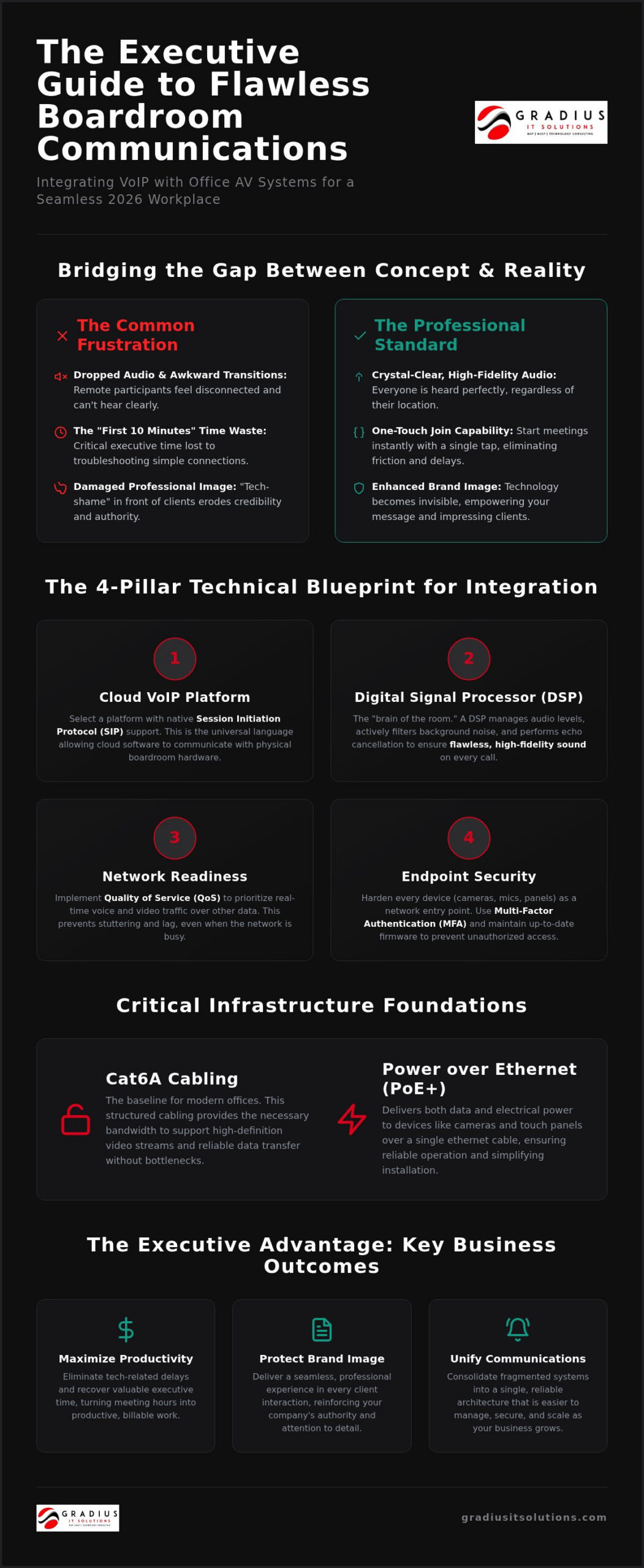
The first step involves selecting a cloud-based VoIP platform that natively supports Session Initiation Protocol (SIP). This is the universal language that allows your meeting room hardware to communicate with your phone provider. Without SIP support, your expensive boardroom microphones are essentially desk ornaments. Next, you must implement a Digital Signal Processor (DSP). Think of the DSP as the brain of the room. It manages audio levels, filters out background noise, and prevents the dreaded echo that ruins hybrid calls. High-fidelity sound doesn’t happen by accident; it’s the result of precise audio processing.
Network readiness is the third pillar. You must configure Quality of Service (QoS) to prioritize voice and video traffic over standard data. If your network isn’t segmented, a large file transfer in another department could cause your CEO’s video call to stutter. Finally, you must harden your endpoints. Every VoIP-enabled camera or touch panel is a potential network entry point. Use multi-factor authentication (MFA) and keep firmware updated to block unauthorized access. If your current setup feels like a patchwork of mismatched tools, a professional technology consultation can align your infrastructure with your business goals.
Audio and Video Signal Flow
The signal flow starts as a digital packet from the cloud. The DSP converts this into high-fidelity room audio while simultaneously processing local voices for the remote participants. It uses advanced algorithms for echo cancellation and noise suppression. Professional cameras then feed high-definition video through software-based codecs. This ensures a smooth visual experience that matches the audio quality. When these components work in harmony, the technology becomes invisible to the user.
Security in the Integrated Environment
Security is often overlooked in AV setups. These devices are frequently left with default passwords and outdated software, making them easy targets. Following NIST security considerations for VoIP is essential to protect your firm’s private conversations. We recommend applying Zero Trust principles to every device in the room. If you’re unsure about your current posture, our Cybersecurity Services team can audit your environment to ensure your boardroom isn’t a liability.
Essential Features for Modern Business VoIP Systems
Your decision-making process shouldn’t stop at the hardware. When integrating voip with office av systems, the software feature set determines whether your boardroom is a productivity hub or a technical liability. Modern systems must offer native integration with platforms like Microsoft Teams and Zoom. This isn’t just about basic compatibility; it’s about a seamless user experience. Native room solutions allow for one-touch joins and consistent interfaces that reduce employee frustration and eliminate the need for training sessions every time a new tool is introduced.
Centralized management is the backbone of enterprise-grade reliability. Your IT team needs a single dashboard to monitor room health, push security patches, and troubleshoot issues remotely. This proactive approach prevents the “broken room” syndrome that plagues disconnected offices. Scalability is equally vital. Cloud-based systems allow you to add users or entirely new satellite offices without the need for expensive forklift infrastructure upgrades. You pay for what you use, and you grow only when you’re ready.
Don’t overlook the importance of high-definition (HD) voice codecs. While basic VoIP can sound compressed or “tinny,” systems utilizing Opus or G.722 provide superior clarity. This ensures that every nuance of a conversation is captured and reproduced accurately through your integrated speakers. Clear communication is the foundation of professional trust; your technology should support that, not hinder it.
Software vs. Hardware Features
Choosing between a PC-driven setup and a dedicated hardware appliance is a strategic decision. PC-based rooms offer flexibility but often require more frequent maintenance and updates. Dedicated appliances, such as Microsoft Teams Room bars, provide a more stable, “always-on” environment designed specifically for communication. Interoperability remains a key concern. Your modern VoIP system must be able to talk to legacy AV gear through standard protocols. As noted in the FCC’s guide to VoIP, understanding the core functionality and limitations of your service is the first step toward a successful rollout. Cloud-based provisioning further simplifies this by allowing you to deploy settings across multiple locations in minutes, ensuring a uniform experience for every employee.
The Role of AI in Integrated Communication
AI is no longer a futuristic concept; it’s a practical requirement for modern meeting rooms. AI-driven noise cancellation can filter out the sound of crinkling paper or a cooling fan, keeping the focus entirely on the speaker. Advanced camera systems now use AI for speaker tracking, automatically framing the person talking so remote participants don’t feel like they are watching from the sidelines. These systems also integrate with Secure AI & Automation Services to provide automated meeting summaries and real-time transcriptions. This creates a searchable record of every decision made in the boardroom, turning your communication stack into a strategic business asset.
Infrastructure Foundations: Low Voltage Cabling and Network Readiness
The success of your boardroom technology is decided long before the first meeting starts. It’s decided in the walls. Most executives focus on the sleek touch panel on the table, but they ignore the miles of copper behind the drywall. If you’re integrating voip with office av systems, your physical layer is the single point of failure. A weak foundation ensures that even the most expensive hardware will underperform.
Category 6A (Cat6A) cabling is no longer optional for a professional environment. While standard Cat6 might handle basic web browsing, 4K video streams and high-fidelity VoIP require the 10Gbps capacity and superior crosstalk shielding that only 6A provides. This shielding is critical in dense office environments where interference from other cables can degrade call quality. You don’t want your executive board meeting interrupted by “jitter” simply because you saved a few dollars on the wiring.
Power over Ethernet (PoE+) is the silent workhorse of the modern office. It allows a single cable to deliver both data and power to your touch panels, ceiling microphones, and cameras. This eliminates the need for messy AC outlets behind every display and simplifies your infrastructure. However, your network buildout must account for switch fabric capacity. It’s not enough to have a fast cable; your switches must handle concurrent high-bandwidth streams without bottlenecking. When integrating voip with office av systems, a congested switch will cause packet loss, leading to robotic voices and frozen video.
Strategic low-voltage design is a critical component of any office renovation. Retrofitting cables after the drywall is up is expensive and disruptive. By planning your communication paths early, you ensure that every microphone and speaker is positioned for peak performance. This proactive approach saves you from the technical debt of “making it work” later with unsightly external wires and unreliable wireless bridges. For organizations planning a full expansion, understanding how to execute professional network buildouts for business ensures your cabling and switching infrastructure scales alongside your communication technology.
The Physical Layer: More Than Just Cables
Proper cable management protects your system longevity. Cables that are pinched, tightly coiled, or left hanging can develop internal breaks that are notoriously difficult to diagnose. Standardizing your low-voltage footprint is about future-proofing your investment. Technology cycles move fast. Your cabling should last fifteen years, even if your hardware changes every five. Our Network Management Services ensure that your physical layer remains organized and efficient as your business grows.
Network Resilience and Redundancy
Implementing failover paths ensures that your business-critical communications stay online even if a primary switch fails. You can’t afford a total blackout during a client pitch. Monitoring your AV and VoIP endpoints 24/7 allows you to catch latency spikes before they disrupt a meeting. This level of oversight turns your network into a strategic asset rather than a constant worry. For a deeper look at building a reliable backbone, see our guide on Network Infrastructure Design: The Strategic Blueprint.
Optimize your office network for seamless communication.
Strategic Implementation: Transitioning to a Unified Environment
Transitioning your office to a unified communication model isn’t just a hardware swap. It’s a strategic shift in how your business operates. Successfully integrating voip with office av systems requires a clear roadmap that starts with a comprehensive technology assessment. You can’t build a future-proof environment without auditing your existing assets. We look for hidden technical debt in your current phone lines and meeting room gear to determine what can be bridged and what needs a fresh start. This prevents wasted investment and ensures that your new stack is built on a stable foundation.
The vCIO advantage is central to this process. Rather than looking at your boardroom as an isolated project, we align your communication technology with your long-term business goals. This is where IT Consulting & Technology Strategy becomes vital. We ensure your AV investment supports your growth for the next five to ten years. A phased deployment model is often the best path for mid-sized organizations. By rolling out integrated systems in stages, we minimize downtime and allow your team to adapt without the stress of a total “big bang” transition.
Employee adoption is the final hurdle. The most sophisticated boardroom in the world is useless if your staff refuses to use it. We prioritize intuitive interface design that mirrors the tools they already use on their desktops. When a meeting starts with a single tap, adoption rates skyrocket. Training should be a brief introduction to a simple tool, not a complex seminar on signal routing. We make the technology invisible so your team can focus on the work that actually moves the needle.
Choosing the Right Integration Partner
You need a partner who understands the intersection of IT networking and AV engineering. Traditional AV firms often lack the cybersecurity depth to harden a VoIP endpoint. Conversely, standard IT shops might not understand the nuances of room acoustics or microphone placement. The “Single Accountable Partner” model eliminates vendor finger-pointing. When the same team manages your low-voltage cabling, your network fabric, and your VoIP software, you have one point of contact for everything. This accountability ensures that “it just works.”
The Gradius Approach: Performance Meets Security
We combine professional AV integration with compliance-aware Managed IT. This means your boardroom isn’t just a high-performance space; it’s a secure one. We utilize a “Prevent-Instead-React” approach for meeting room uptime. Through proactive maintenance and 24/7 monitoring, we catch hardware issues or latency spikes before your executive meeting starts. You get the peace of mind that comes with a premium, reliable force standing in your corner. Let’s unify your office communications and eliminate the friction that holds your team back.
Future-Proofing Your Enterprise Communications
Success in the hybrid business world requires a communication stack that works as hard as your team does. We’ve explored how the right infrastructure, from Cat6A cabling to Digital Signal Processors, creates a foundation for high-performance collaboration. Mastering the art of integrating voip with office av systems is the difference between a boardroom that inspires confidence and one that causes technical friction. It’s time to move beyond patchwork solutions and embrace a unified, professional environment.
Gradius IT Solutions stands as your single accountable partner for both physical AV hardware and secure VoIP software. We bring specialized expertise in low-voltage integration alongside compliance-aware managed IT services for regulated industries. With our U.S. based 24/7 SOC and Help Desk, your meeting room uptime is protected by a proactive guardian. You deserve technology that disappears into the background so you can focus on the bottom line.
Your firm’s professional image is too valuable to leave to chance. Let’s build a secure, crystal-clear communication environment that drives your business forward into 2026 and beyond.
Frequently Asked Questions
What is the difference between VoIP and UCaaS in an office setting?
VoIP is the underlying technology that transmits voice over the internet. UCaaS is the comprehensive service model that bundles voice, video, and messaging into a single cloud platform like Microsoft Teams. While VoIP replaces your traditional phone lines, UCaaS replaces your entire communication stack. Most modern businesses choose UCaaS to manage their global interactions through a unified, centrally managed interface.
Can I use my existing conference room speakers with a new VoIP system?
You can often reuse existing speakers by connecting them to a Digital Signal Processor or a SIP-to-analog gateway. However, older analog speakers may not support the high-definition audio codecs available in modern systems. We recommend an assessment to ensure your legacy hardware won’t bottleneck the clarity of your new digital environment. Professional integration bridges the gap between your previous investments and future technology.
Does integrating VoIP with AV systems require a complete network rebuild?
Integrating voip with office av systems does not always require a total network overhaul. We focus on optimizing your current infrastructure by implementing Quality of Service (QoS) and network segmentation. These adjustments prioritize your real-time voice and video traffic over standard data. If your current switches are outdated or lack PoE+ capabilities, targeted upgrades may be necessary to ensure system stability and uptime. Our approach to network buildouts for business ensures these upgrades are executed with a clear strategy and minimal disruption.
How do I ensure meeting privacy when using integrated VoIP and AV?
Meeting privacy is maintained through end-to-end encryption and strict endpoint hardening. You should apply Zero Trust principles to every device in the room, including cameras and microphones. Using multi-factor authentication for your UCaaS accounts prevents unauthorized access to your meeting invites. Regular firmware updates are essential to patch vulnerabilities that could allow eavesdropping through neglected or unmanaged hardware.
What is the role of low-voltage cabling in office AV integration?
Low-voltage cabling serves as the physical nervous system for your boardroom. It carries high-bandwidth data for 4K video while simultaneously providing power to devices via PoE+. Standardizing on Cat6A ensures your office can handle the data loads of modern communication without interference. Proper cable design eliminates the need for messy external power supplies and unreliable wireless connections that often fail during critical presentations.
Is Microsoft Teams compatible with professional-grade AV hardware?
Microsoft Teams is fully compatible with professional-grade AV hardware through the Microsoft Teams Rooms (MTR) ecosystem. This allows you to use high-end ceiling microphones and motorized cameras while maintaining the familiar Teams interface. These certified systems provide a native experience that supports one-touch join and centralized management. It’s the gold standard for creating a high-performance, enterprise-grade meeting environment for hybrid teams.
How much bandwidth does an integrated VoIP and 4K video system require?
A single 4K video stream typically requires between 15 and 25 Mbps of dedicated bandwidth. While VoIP calls use significantly less data, they are highly sensitive to latency and jitter. You must ensure your total internet circuit can handle concurrent high-definition streams across all meeting rooms without affecting daily operations. We recommend a symmetrical fiber connection to provide the necessary upload speeds for professional video conferencing.
What happens to my integrated system if the internet goes down?
Most integrated systems will lose external connectivity if your primary internet goes down. You can prevent this by implementing a secondary failover circuit, such as a dedicated fiber line or a high-speed wireless backup. This ensures your business-critical communications remain online during a local provider outage. Strategic network design prioritizes resilience so your high-stakes meetings are never derailed by a single point of failure.

Article by
Robert Joyce
**Robert Joyce** is the Founder, CEO, and Chief Technology Officer of Gradius IT Solutions, a security first provider of Managed IT Services, Cybersecurity, Cloud, Compliance, and Secure AI solutions serving businesses throughout New Jersey, New York, Connecticut, and across the United States.
With more than 28 years of IT experience, including 23 years supporting hedge funds, global banks, and wealth management firms, Robert has built a career designing and managing secure, resilient, and highly available technology environments where uptime, cybersecurity, and business continuity are essential.
His expertise includes Microsoft 365, cloud computing, cybersecurity, networking, infrastructure, disaster recovery, compliance, virtualization, and strategic IT leadership. Following the events of September 11, Robert helped rebuild critical technology infrastructure for Merrill Lynch, an experience that reinforced the importance of resilience, planning, and operational excellence.
Robert founded Gradius IT Solutions to bring enterprise level technology and security services to small and midsized businesses at a predictable monthly cost. Today, the company delivers fully managed and co managed IT services, cybersecurity, Microsoft 365, cloud solutions, compliance consulting, Secure AI consulting, technology projects, and vCIO services. Through a U.S. based 24/7 Help Desk and a nationwide network of trusted technology partners, Gradius supports organizations across the country with responsive, security focused technology solutions.
Robert partners with business owners and executive leaders to align technology with business goals, reduce risk, strengthen cybersecurity, improve productivity, and create long term IT strategies that support growth. His mission is simple: provide every client with enterprise class technology, exceptional service, and a trusted advisor they can rely on as their business evolves.
Disclaimer
## Disclaimer
The information provided in this article is for general informational and educational purposes only and should not be considered professional IT, cybersecurity, legal, regulatory, or compliance advice. While Gradius IT Solutions strives to provide accurate and up to date information, technology, security threats, and regulatory requirements change frequently, and we cannot guarantee that all information will remain current or applicable to your specific situation.
Every organization has unique technology, security, compliance, and business requirements. Before implementing any recommendations discussed in this article, you should evaluate their suitability for your environment or consult with a qualified technology professional.
Gradius IT Solutions makes no warranties, express or implied, regarding the completeness, accuracy, reliability, or results obtained from the use of this information. Any actions you take based on this content are at your own risk. Gradius IT Solutions shall not be liable for any direct, indirect, incidental, or consequential damages arising from the use of, or reliance upon, the information contained in this article.
References to third party products, services, or vendors are provided for informational purposes only and do not constitute an endorsement unless explicitly stated.
If you would like guidance tailored to your organization, contact Gradius IT Solutions to schedule a consultation with one of our technology experts.